PATH 3810 Tissue Repair and Healing
 Call Kai
 Learn
Learn Practice Test
 Spaced Repetition
 Match
Match Flashcards
 Knowt Play
1/38

There's no tags or description
Looks like no tags are added yet.
Name | Mastery | Learn | Test | Matching | Spaced | Call with Kai | Chat |
|---|
No analytics yet
Send a link to your students to track their progress
39 Terms
tissue repair
restoration of tissue architecture and functon after an injury
repair occurs by…
…regeneration or healing by scar formation, involving cell proliferation and cell-to-matrix interactions
fibrosis
extensive deposition of collagen in organs as a consequence of chronic inflammation
continuously dividing tissues
continuously being lost and replaced by maturation from stem cells and proliferation of mature cells
stable tissues
minimally replicative activity in normal state
permanent tissues
terminally differentiated and nonproliferative in postnatal life
polypeptide growth factors promote cell survival and proliferation by…
…binding to specific receptors and altering gene expression

autocrine signaling
the substance acts primarily on the cell that secretes it
paracrine signaling
substance acts on cells in the immediate vicinity of the cell that released the agent
endocrine signaling
regulatory substance is released into the blood stream and acts on target cells at a distance
fibroblast
spindle-shaped or stellate, most common connective tissue cell

fibroblast functions
synthesizes tropocollagen and extracellular matrix components
maintains and repairs connective tissue
extracellular matrix
dynamic, macromolecular complex that is synthesized locally
regulates proliferation, movement, and differentiation of cells inhabiting it
synthesis and degradation accompany healing and fibrosis
proteoglycans in the ECM act as…
…reservoirs for growth factors, such as FGF
repair by connective tissue
begins within 24 hours by the emigration of fibroblasts and proliferation of these and endothelial cells
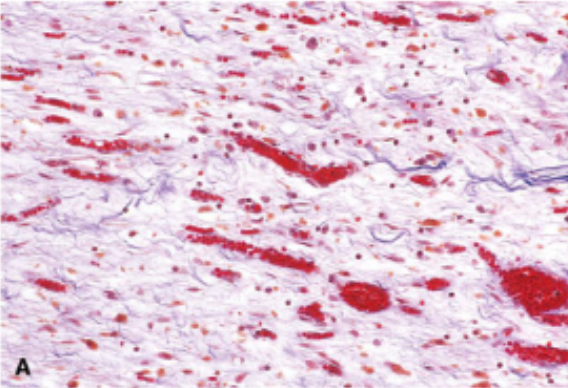
granulation tissue showing numerous blood vessels, edema, and loose ECM

trichrome of a mature scar
granulation tissue
formed within 3-5 days, characterized by pink, soft, granular gross appearance and proliferation of fibroblasts and newly formed capillaries
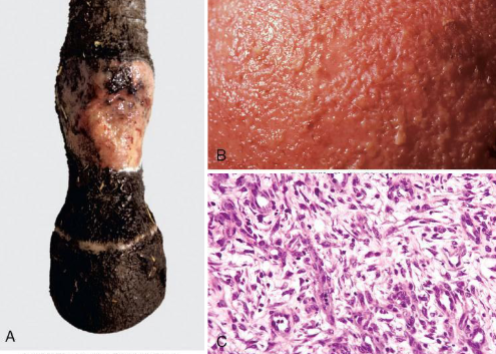
granulation tissue at three scales
process of repair by connective tissue
angiogenesis
migration and proliferation of fibroblasts
deposition of ECM
remodeling: maturation and reorganization of connective tissue
angiogenesis
process by which preexisting vessels send out capillary sprouts to produce new vessels
steps in angiogenesis
vasodilation
migration of endothelial cells toward site of injury
proliferation of endothelial cells
inhibition of proliferation and remodeling into capillary tubes
recruitment of peri-endothelial cells
growth factors crucial to angiogenesis
vascular endothelial growth factor (VEGF)
basic fibroblast growth factor (FGF-2)
scar formation
occurs on granulation tissue framework
migration and proliferation of fibroblasts
deposition of ECM
cutaneous wound healing phases
inflammation
granulation
scar formation
first intention healing
healing of a clean, uninfected surgical incision
first intention healing process
incision fills with fibrin-clotted blood, then invaded by granulation tissue and covered by new epithelium
at 24 hours, neutrophils present and basal cells show increased mitotic activity
at 24-48 hours, epithelial cells proliferate
at day 3, neutrophils are replaced by macrophages
at day 5, angiogenesis occurs and collagen is more abundant
second intention healing
healing of excessive tissue loss, abscess formation, and ulceration
second intention healing process
larger clot or scab rich in fibrin forms at surface of wound
inflammation more intense due to greater necrotic debris, exudate, and fibrin
much larger amounts of granulation tissue to fill gaps, which may result in greater mass of scar tissue
wound contraction mediated by myofibroblasts

epithelial ulcer
keloid
raised scars that form from excessive amounts of collagen
exuberant granulation on proud flesh
excessive granulation tissue that protrudes above the level of skin and hinders re-epithelialization
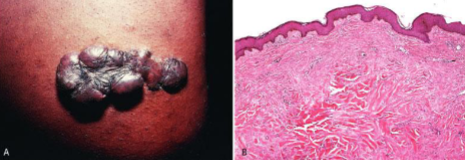
keloid

exuberant granulation tissue
A tissue contains cells that are normally quiescent in the G0 phase but can re-enter the cell cycle following injury. Which type of tissue is this?
Stable tissue
Which of the following are required for healing by regeneration?
both a and b

A horse develops a large mass of proliferating tissue that extends above the surface of a chronic skin ulcer and interferes with re-epithelialization. What is this lesion called?
Exuberant granulation tissue (proud flesh)
Which is NOT a feature of healing by first intention?
extensive tissue loss
Which cell is primarily responsible for synthesizing tropocollagen and other extracellular matrix components during tissue repair?
Fibroblast