Math quiz on functions
 Call Kai
 Learn
Learn Practice Test
 Spaced Repetition
 Match
Match Flashcards
 Knowt Play
1/53

There's no tags or description
Looks like no tags are added yet.
Name | Mastery | Learn | Test | Matching | Spaced | Call with Kai | Chat |
|---|
No analytics yet
Send a link to your students to track their progress
54 Terms
Input
x-value
Output
y-value
Function Notation
A notation that describes a function
For the function F, when x is the input, f(x) is the output
Domain and Range
Domain = All possible inputs (x-values)
Range = All possible outputs (y-values)
Interval Notation
Uses brackets and an interval to show the set of all numbers between two values
(__,__) or (__,__] or [__,__]
Set Notation
Specifies a set of elements that satisfy a set of conditions
{xIx<__}
In set notation, what does the variable and then a line mean (xI or yI)
It means its for domain or range
Hard bracket vs. Soft bracket
Hard bracket [ = A set point
Soft bracket ( = Everything up to the number but not the number or numbers that aren’t real (like infinity)
x-intercept
Also called zeroes, roots, and solutions
Value of domain where f(x) = 0
Where the line intercepts the x-axis
Any number of x-intercepts in a function
y-intercept
Value of range when f(0) = y
When the line intercepts the y-axis
At most one y-intercept in a function
Asymptote
A line that a curve approaches as one or both of the variables in the equation of the curve approach infinity
Curve never touches the line
End Behavior
Trend of a function or graph at its left and right ends; specifically, each y-value that each end, obtains or approaches
Ex. As x —> ∞, f(x) —> -∞
What does the arrow in the end behavior statement mean
It means “approaches”
What does it mean if the end of a function is a line or arrow going off the page?
It means it goes on forever
Absolute maximum and Absolute minimum
Absolute maximum = Highest y-value across the domain of a function
Absolute minimum = Lowest y-value across the domain of a function
A function can have at most one absolute, maximum or minimum, but that value might occur at multiple different x-coordinates
Relative maximum and Relative minimum
A point that is higher than all the neighboring points immediately around it (top of a “hill”)
A point that is lower than all the neighboring points immediately around it (bottom of a “valley”)

What do the symbols in this set notation equation mean?
x in the beginning represents “set of all x’s”
E like symbol means “that are members of
R like symbol means “real numbers”
Function Families…
…have a parent function and all transformations of the parent function
In this example: ∛, what is the index?
The 3
What are all of the function families?
Square root function
Cube root function
Rational function (both linear and quadratic denominators
Exponential
Logarithmic function
Absolute value function
Square root function
Radical function with an index of 2
Parent function → f(x) = √x, where x ≥ 0
Domain = [ 0, ∞ )
Range = [ 0, ∞ )
Absolute minimum at origin / No absolute maximum
Increasing over its domain
What does “increasing over its domain” mean?
As you move from left to right, or as the x-value gets bigger, the y-value gets bigger too.
Cube root function
Radical function with an index of 3
Parent function → f(x) = ∛x
Domain = ( -∞, ∞ )
Range = ( -∞, ∞ )
No relative or absolute maximum or minimum
x and y intercept at origin
Increasing over its domain
Rational function
Quotient of a polynomial with a denominator of at least 1
Two rational parent functions: One with a linear denominator, and one with a quadratic denominator
Rational parent function with linear denominator
Parent function → f(x) = 1/x
Domain = ( -∞, 0) U ( 0, ∞ )
Range = ( -∞, 0) U ( 0, ∞ )
No absolute or relative maximum or minimum
No x or y intercepts
Asymptotes at the lines x=0 and y=0
Decreasing over its domain
Which is horizontal and which is vertical: x=0 and y=0
x=0 is vertical
y=0 is horizontal
What do the domain and range of the rational parent function with linear denominator include?
They include all real numbers except for 0
What doed the domain of the rational parent function with quadratic denominator include?
It includes all real numbers except for 0
Rational parent function with quadratic denominator
Parent function → f(x) = 1/x2
Domain = ( -∞, 0) U ( 0, ∞ )
Range = ( 0, ∞ )
No absolute or relative maximum or minimum
No x or y intercepts
Asymptotes at the lines x=0 and y=0
Increasing over ( -∞, 0 ) ← interval
Decreasing over ( 0, ∞ ) ← interval
What does “decreasing over its domain mean”?
As x-values go left or right, or get bigger, the y-values consistently go down
Exponential function
Independent variable (x) is in the exponent
Parent function → f(x) = abx where a ≠ 0 and b > 0
Domain = ( -∞, ∞ )
Range = ( 0, ∞ )
Horizontal asymptote at y=0
Increasing when b > 1
Decreasing when 0 < b < 1
No absolute or relative maximum or minimum
No x-intercept, y-intercept at origin
Logarithmic function
Represents the exponent to which b must be raised to get x
Parent function → f(x) = logbx where x > 0, b > 0, and b ≠ 1
Domain = ( 0, ∞ )
Range = ( -∞, ∞ )
Increasing when b > 1
Decreasing when 0 < b < 1 (fraction)
No absolute or relative maximum or minimum
x-intercept at (1,0), no y-intercept
Asymptote at the vertical x=0
What is “b”?
b = base
Controls the rate of growth and decay
Absolute value function
Contains a variable expression inside absolute value bars
Parent function → f(x) = a Ix-hI + k
Domain = ( -∞, ∞ )
Range = [ 0, ∞ )
Absolute minimum at origin
x and y intercepts at origin
Vertical line of symmetry seperating the increasing and decreasing intervals
Full template for transformations
g(x) = a · f [ b (x-h) ] + k
In the template for transformations, what does a represent?
Vertical dilations
In the template for transformations, what does (x-h) represent?
Horizontal shift
In the template for transformations, what does + k represent?
Vertical shift
What are the two types of translations?
Horizontal and vertical shifts (translations)
Vertical Shift
Represented by k
At the end of the equation, just simple plus or minus for up and down
Horizontal Shift
Represented by (x-h)
A negative number means shift to the right and vice versa
What are the two types of dilations?
Horizontal and vertical dilations
Vertical dilations
Represented by I a I
g(x) = I a I · f(x)
Compression = 0 < IaI < 1 (fractions)
Stretch = IaI > 1
Horizontal dilations
Represented by I b I
g(x) = f ( IbI · x )
Compression = I b I > 1
Stretch = 0 < I b I < 1 (fractions)
What are the subcategories of horizontal and vertical dilations and what do they mean?
Horizontal
Compression = towards x-axis
Stretch = away from x-axis
Vertical
Compression = towards y-axis
Stretch = away from y-axis
Reflections
Across x-axis → g(x) = -f(x)
Across y-axis → g(x) = f(-x)

What function is this?
Square root function
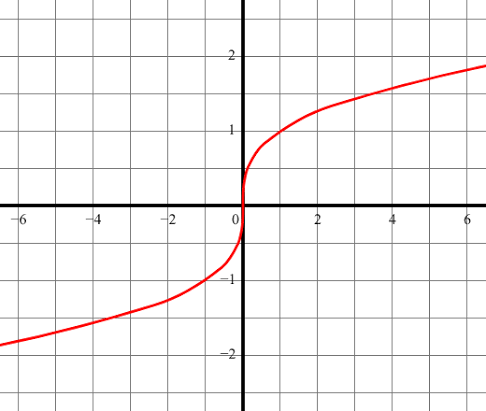
What function is this?
Cube root function

What function is this?
Rational function with linear denominator

What function is this?
Rational function with quadratic denominator
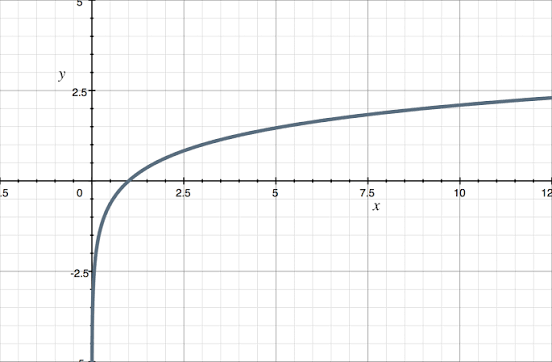
What function is this?
Logarithmic function
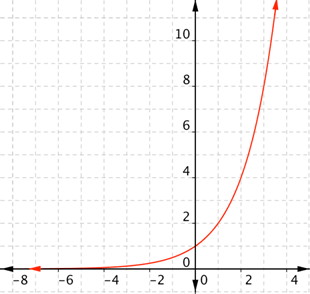
What function is this?
Exponential

What function is this?
Absolute value function
What is the vertex in a formula?
( h, k )