Kinesiology
 Call Kai
 Learn
Learn Practice Test
 Spaced Repetition
 Match
Match Flashcards
 Knowt Play
1/67

There's no tags or description
Looks like no tags are added yet.
Name | Mastery | Learn | Test | Matching | Spaced | Call with Kai |
|---|
No analytics yet
Send a link to your students to track their progress
68 Terms
some actors that influence physical activity are:
school, work and family demands
Obesity is defined as a BMI of:
30+
Superior can be defined as:
Towards the head
Frontal plane can be defined as:
divides the body from front to back
Insertion can be defined as:
the attachment site that DOES MOVE
Cardiac muscle can be defined as:
Involuntary
The anaerobic system can be defined as:
not requiring oxygen with a complete breakdown of glucose
stroke volume can be defined as:
the volume of blood pumped per beat
speed is defined as:
a measure of how fast an object is travelling at a particular instant in time
also called the Axis, this part of the lever is the pivot point?
Fulcrum
social development is:
the development of ones relationship with the ‘outside world’
the associative stage is:
when the learner is past the basics and can recognize errors
motivation is defined as:
the direction and intensity of effort
Hypothermia set in if your core is between:
33 and 35 degrees
the anatomical position can be described as
standing erect, facing observer, arms at side, palms facing forward
stiff covering bones, which connects to tendons and ligaments?
Periosteum
Artificial development of muscle tissue is promoted by the use of this:
steroids
This is a measure that we can use to help us understand how foods will affect our blood sugar levels:
Glycemic index
This is the energy needed to raise the temperature of 1 Kilogram of water by 1 degree celsius
calorie
individuals who move with confidence and competence and wide range of physical activities are:
physically literate
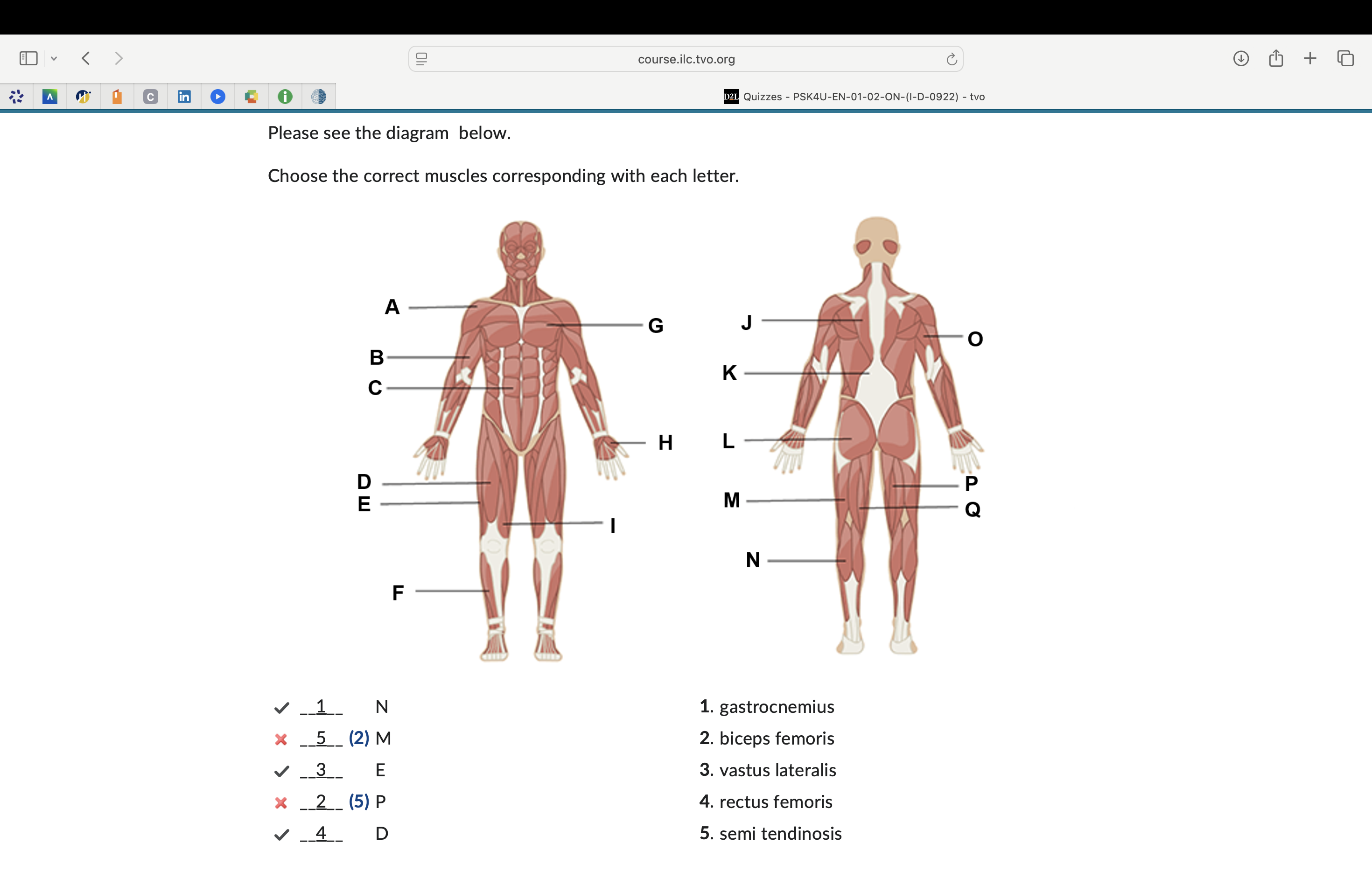
correct muscles:
Front-
A- Deltoid
B- Bicep
C- Rectus Abdominis
D- Rectus Femoris
E- Vastus Lateralis
F- Tibialis Anterior
G- Pectoralis Major
H- Forearm Flexors
I- Vastus Medialis
Back-
J- Trapezius
K- Latissimus Dorsi
L- Gluteus Maximus
M- Bicep Femoris
N- Gastrocnemius
O- Tricep Bracii
P- Semi tendinosus
Q- Semi Membranosus
The 'colour barrier' was broken in professional sports by Jackie Robinson in 1947.
True
Cardiac muscle is not striated.
False
Skeletal age can be determined with an X-ray.
True
There are 13 minerals we need from our diet.
False
Altitude can affect performance.
True
Limb moving its anterior surface medially is external rotation.
False
Pointing your foot to your head is an example of dorsiflexion.
True
The last 5 ribs are false ribs.
True
smooth muscle is voluntary
False
The central nervous system is broken into two parts; the brain and the spinal cord.
True
Different athletes require different nutrition requirements to perform at their best.
True
External respiration is the process that occur within the lungs involving the exchange of oxygen and carbon dioxide.
True
The respiratory system delivers oxygen and nutrients to the body.
False
Canada sent their first female athletes to the Olympics in 1928.
True
Adults of unhealthy weight are at greater risk for cancer.
true
Doing algebra is an example of social development.
False
There is not a significant difference between how the two genders develop.
False
The thyroid secretes necessary hormones for metabolic function.
True
A hockey player deciding to pass or shoot is an example of controlled motor activity.
True
Sport psychology is the study of how people think, feel, behave, and are motivated to complete.
True
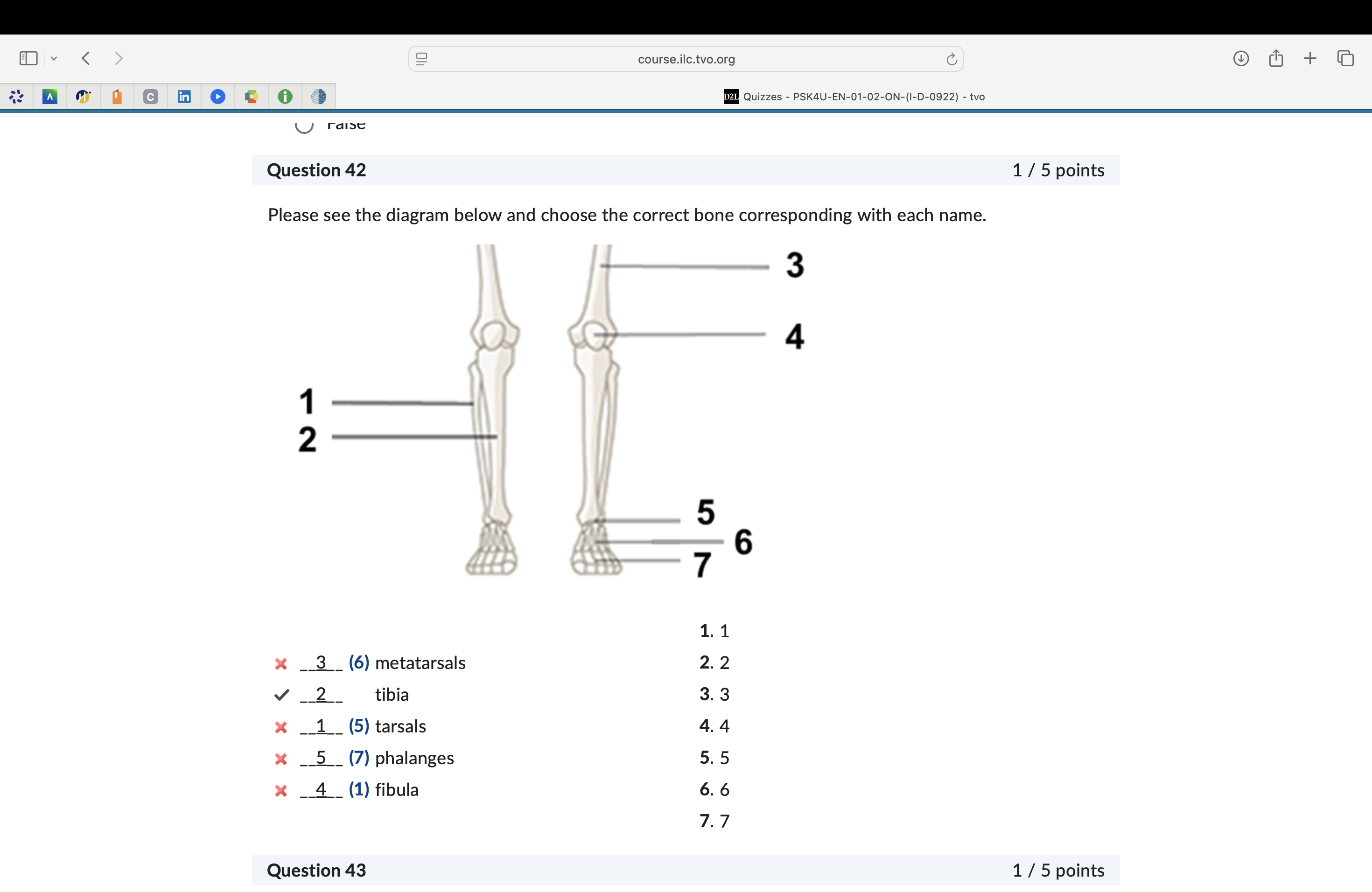
choose the correct bone corresponding with each name
1- Fibula
2- Tibia
3- Femur
4- Patella
5- Tarsals
6- Metatarsals
7- Phalanges
Choose one(1) of the Canadians you learned about in this course. What were their contributions to the world of sport? Terry Fox, Mario Lemieux, Nancy Greene, Donovan Bailey, Wayne Gretzky etc. Inventors, innovators, fundraisers, record-breakers,
A very known Canadian that I learned more about in this course is Terry Fox. Growing up everyone learns about Terry Fox, but I gained new information. Terry fox was diagnosed with cancer, he had a prosthetic leg because of that. He didn't want the cancer to stop him from being an influence on many other people who struggle with cancer. He competed in a marathon and walked/ran no matter how painful/tired he was, he showed other not to give me, everyone looked up to him. To this day around September there is the "Terry Fox run day" at least where I live. In school we would go on a walk around the city to raise awareness for Terry Fox. He also showed runners and anyone in sports not to give up no matter what life throws at you.
What are the five (5) functions of bones?
Structural support, protection, Blood cell and platelet formation, reservoir of minerals, and movement.
five functions of bones are Support, protection, movement, mineral storage, and blood cell production. here is an explanation of each, support is providing the body's framework and helping is maintain our shape and posture. Protection is shielding organs like our brain, heart, and lungs from injuries. Movement is working with muscles and joints to allow the body to move. Mineral storage is storing minerals like calcium and phosphorus for the body to use when needed. Blood cell production is making red blood cells, white blood cells, and platelets in the bone marrow.
What are the five (5) types of bones and give one example.
The Five bone types are: Long bones, short bones, flat bones, irregular bones, sesamoid bones
long bones are longer than they are wide and help with movement- Femur
short bones are cube shaped and provide support- carpal bone
flat bones are thin and curved , helping to protect organs- sternum
irregular bones are complex shapes that do not fit into the other categories- Vertebra
sesamoid bones are small bones embedded within tendons- patella
What is the role of blood in exercise?
Blood volume: As you exercise, the blood vessels in your muscles dilate. This allows blood flow to increase in the same way that more water can flow through a wide fire hose than through a thin garden hose. The increased blood flow delivers more oxygenated blood and glucose to the working muscles and removes waste faster. Oxygen delivery, energy delivery; blood flow is critical for replacing the consumed ATP.
Explain the four stages of growth.
Infancy & toddlerhood: In this stage of physical development, body size is tripled and hardening of the bones occurs.
Childhood: In this stage of development, the body's growth rate stabilizes so that bones and tissues grow and develop at a more uniform rate.
Adolescence: This stage of development is marked by a series of short, pronounced "growth spurts," marking the most significant periods of growth since infancy Adulthood; At this stage of development, your brain mass slowly declines.
Describe and explain each of the six steps in the Sliding Filament Theory. (6 marks for identification of each step, 4 marks for quality of explanation.
The sliding Filament Theory explains how muscles contract and produce movement. it describes the interaction between actin and myosin filaments within muscle fibres. there are six main steps for this process.
The first step is stimulation, where a nerve impulse reaches the muscle and causes the release of calcium ions. in the second step the calcium binds to troponin, that causes tropomyosin to move away and expose binding sites on the actin filament. The third step is cross bridge formation, the myosin heads attach to the exposed binding sites on actin. The court step is the power stroke, the myosin heads pivot and pull the actin filaments toward the center of the sarcomere, causing the muscles to shorten. The fifth step is cross bridge detachment, where ATP binds to the myosin heads, causing them to release from actin filament. The sixth step is reactivation, where ATP is broken down into ADP and phosphate, recocking the myosin heads so they are ready to attach to actin again and repeat the cycle as long as calcium and ATP are available. to conclude, the theory explains muscles contraction as a repeating cycle of stimulation, exposure of binding sites, cross bridge formation, power stroke, detachment, and reactivation. These steps allow muscles to shorten and generate force for movement.
How physically active are you? What types of activities do you do and why? How do you think you compare to the average Canadian? Do you think the levels at which you participate are enough to maintain your health? What factors affect your participation is physical activity? Given all of this information and your answers, assess yourself; where can you improve, and how will you continue to promote and live a healthy life for years to come?
My physical activity is below average of an average Canadian as of right now. I try to go on walks as much as I can but a busy scedual can come in the way along with money, I want to get a gym membership to start being more active. My doctors even tell me to start being more active because my health is not that great, I get back pain very often and straightening my back would help with that. its definitely money and a busy scedual that effects my physical activity. I can improve by being more active, setting a schedule for myself, working out when im not busy, or just making time for working out, health should come first, along with eating healthy to maintain a healthy gut.
Some actors that influence physical activity are:
Obesity is defined as a BMI of:
Superior can be defined as:
Frontal plane can be defined as:
Insertion can be defined as:
Cardiac muscle can be defined as:
The anaerobic system can be defined as:
Stroke volume can be defined as:
Speed is defined as:
Also called the axis, this part of the lever is the pivot point?
The associative stage is:
Motivation is defined as:
Hypothermia set in if your core is between
The anatomical position can be described as:
Stuff covering bones, which connects to tendons and ligaments?
Artificial development of muscle tissue is promoted by the use of this:
This is a measure that we can use to help us understand how foods will affect our blood sugar levels:
This is the energy needed to raise the temperature of 1 kilogram of water by 1 degree Celsius:
Individuals who move with confidence and competence and a wide rang of physical activities are: