Physiology Unit #2 (chapter 5)
 Call Kai
 Learn
Learn Practice Test
 Spaced Repetition
 Match
Match Flashcards
 Knowt Play
1/94

There's no tags or description
Looks like no tags are added yet.
Name | Mastery | Learn | Test | Matching | Spaced | Call with Kai | Chat |
|---|
No analytics yet
Send a link to your students to track their progress
95 Terms
What is the state of equilibrium maintained across plasma membranes due to free movement of water called?
Osmotic equilibrium
What is the proportion of total body water contained within the intracellular fluid (ICF)?
2/3
What is the proportion of total body water contained within the extracellular fluid (ECF)?
1/3
What is the fluid compartment called that lies directly between the circulatory system and cells?
Interstitial fluid
What is the liquid matrix of blood called, that forms part of the extracellular fluid?
Blood plasma
What are the two major sub-compartments that make up extracellular fluid (ECF)?
Interstitial fluid and blood plasma.
What is the status of specific ion concentrations across the plasma membrane under normal conditions?
Chemical disequilibrium (unequal distribution maintained or restored by the cell)
Besides osmotic equilibrium, what two states of disequilibrium exist across body fluid compartments?
Chemical disequilibrium and electrical disequilibrium
What structures maintain and manipulate concentration gradients across the plasma membrane?
Membrane transporters
In what way can membrane transporters utilize concentration gradients for cellular transport?
As a power source
What is a concentration gradient?
The difference in the concentration of a substance or ion between two areas, such as across a cell membrane.
What charge does the intracellular compartment have relative to the extracellular compartment?
A more negative charge
What is the separation of charge or polarity across the plasma membrane called?
Membrane potential
What electrical signals can cells like neurons and muscle cells generate using the membrane potential?
Action potentials
Can non-polar molecules move freely through the plasma membrane?
Yes, the plasma membrane is fully permeable to non-polar molecules.
Can a small, polar molecule like water move freely through the plasma membrane?
Yes, for thee most part (some body cells are actually water-tight). Usually water moves freely through the plasma membrane or through specialized water channels called aquaporins.
What are aquaporins?
Are specialized membrane proteins that facilitate the transport of water across the plasma membrane, allowing for increased water permeability.
Is osmotic equilibrium always maintained?
Yes.
Can polar molecules or ions move freely through the plasma membrane?
No, although electrical or chemical disequilibrium can be maintained, cells must work (expend energy in the form of ATP) to maintain the normal, unequal distribution of molecules and ions across the membrane.
What do solutes (dissolved biomolecules or ions) need in order to freely move through the phospholipid bilayer of the plasma membrane to enter and exit?
Membrane transporter proteins.
When will membrane transporters be present?
If there is an action potential.
Alternate source of power for cellular work.
How many types of membrane transport are there? And how do they differ?
There are two types of membrane transport that differ in their energy requirements.
What is Passive Transport?
Osmosis, simple diffusion, and facilitated diffusion.
Does not require energy from ATP or any other source.
Substances move down or with their concentration or pressure gradient (higher to lower).
Ions can also sometimes move against a concentration gradient, but down or with an electrical charge.
What is Active Transport?
Primary, secondary, vesicular.
Requires energy from ATP or an ion concentration gradient.
Moves substances against or up a concentration gradient (from lower to higher) or moves substances in-bulk (using vesicles).
The rate or speed at which this movement happens is directly related to how abundant or strong the power source is at any given moment.
What does Fick’s Law of diffusion say?
Passive transport through the membrane will be faster if:
the membrane surface is larger.
the membrane is thinner or phospholipids are less densely packed.
the concentration/ pressure gradient is larger (bigger difference).
the substance is more non polar (lipid solubility).
the substance is smaller.
If the temperature increases.
What are the two types of membrane transporters that can preform facilitated diffusion?
Channel proteins (or simply “channel”)
Carrier proteins
What are some characteristics of channel proteins?
They are like a “tunnel” through the membrane. They can be open or closed both allow free movement into or out of the cell.
*Think of an unlocked classroom door.
What are some characteristics of carrier proteins?
They never open to the inside and outside at the same time. Very specific as to what they allow in. Never will the ICF and ECF mix.
*Think of a spinning door.
What are channel proteins or “channels”?
Fluid filled, tunnel like passageways.
When opened, substances move passively through a channel via facilitated diffusion, down either their concentration and/or electrochemical gradient.
Can only transport ions (more common) or water.
What are open channels?
Are open most of the time; occasionally closed.
Also called “leak channels” or “pores".
They are also specialized open channels for water only called aquaporins.
What are gated channels?
Need a triggering stimulus to change shape and open or close.
Help to regulate or control movement of ions into or out of a cell based on a cells needs at any given moment.
What are the three types of gated channels?
Voltage-gated, chemically gated, and mechanically gated.
What is a voltage gated channel?
Change permeability in response to a change in the cell’s electrical state or membrane potential.
What is a chemically gated channel?
Change permeability in repose to a chemical stimulus.
What is a mechanically gated channel?
Change permeability in repose to pressure or temperature changes.
What is a monovalent cation channel?
A channel that allows Na+ to enter and K+ to leave cells through the same channel.
What is the sequence of events for how carrier proteins work?
The carrier protein is open on one side of the membrane.
The substrate binds.
The carrier protein changes shape once the substrate binds.
The substrate dissociates.
The carrier protein reverts ti starting conformation and repeats these steps if more substrate is available.
When are carrier proteins needed?
They are needed to move charged, polar, or large molecules across the membrane.
What is an example of a molecule that needs the help of a carrier protein in order to facilitate into the cell?
Glucose transporters. Very high concentration outside of the cell due to blood delivery of glucose; low inside the cells due to constant cellular respiration. Glucose cannot pass through bilayer on its own.
How many types of Carrier Proteins are there? What are their names?
3 types of carrier proteins, they are determined by the number and direction of solutes moving through them.
uniport
symport
antiport
What is a uniport carrier?
Transports only one kind of substrate.
What are symport carriers?
Move two or more substrates in the same direction across the membrane.
What are antiport carriers?
Move substrates in opposite directions.

What type of membrane transporter is labeled #1?
Channel.

What type of transporter is labeled #2?
Carrier
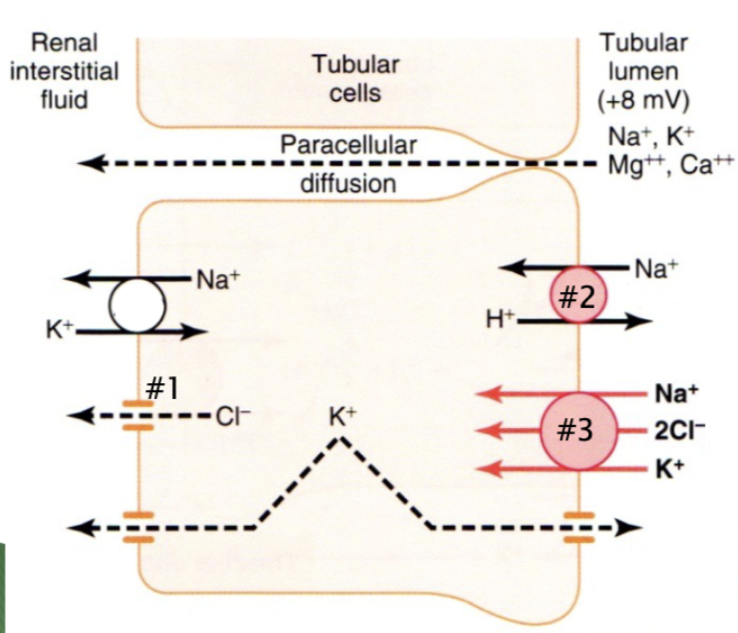
What term best describes the number and direction of solutes moving through #2?
Antiport.

What type of transporter is #3?
Carrier
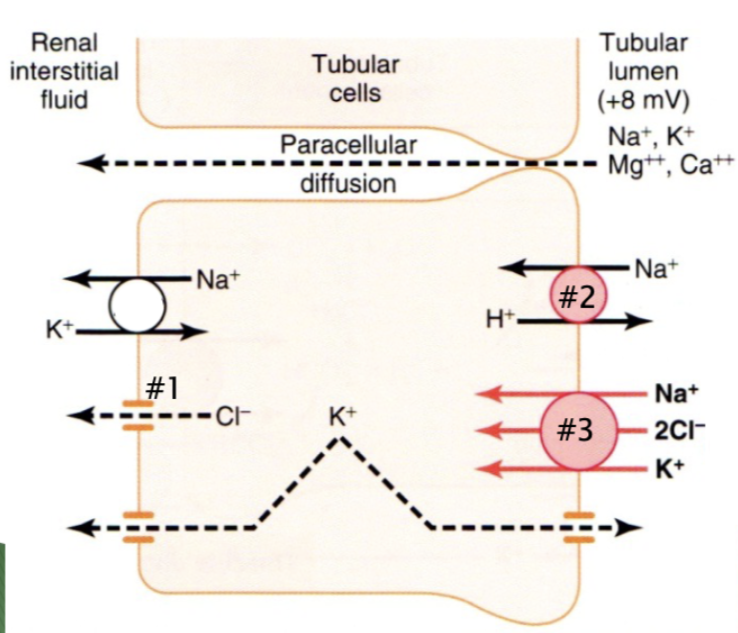
What term describes #3 in terms of the number and direction of solutes moving through it?
Symport

If channels only do passive transport, what is causing Cl- to diffuse out of the cell, against its natural concentration gradient, at transporter #1?
Electrochemical gradients can sometimes override electroconcentrational gradients.
In what instances must solutes must be moved against their concentration gradient?
During active transport and when there is disequilibrium.
What happens to solutes when carrier proteins use active transport?
They “push” solutes against their concentration gradients.
What is the power source of primary active transport carrier proteins?
They use ATP as their power source.
What is the power source of secondary active transport carrier proteins?
They use an ion concentration gradient as their power source.
How does primary active transport work?
They have an enzymatic domain on their surface with a binding site that can hydrolyze ATP (they are an ATPase).
The more ATP available, the faster and longer they will preform their action (direct relationship).
What are the steps of the Na+/K+ -ATPase pump?
3 Na+ from ICF bind to high affinity sites.
ATP hydrolysis takes place.
ATPase is phosphorylated with P1 from ATP.
Protein changes structure.
Na- binding sites lose their affinity for Na+ and release 3 Na+ into ECF.
Which causes two high affinity binding sites for K+ to appear.
Then two K+ bind to high affinity sites.
Protein changes confirmation and simultaneously a phosphate (P1 is released).
K- binding sights lose their affinity for K+ and release two K+ into ICF.
Then the high-affinity binding sites for Na+ appear.
Why is it called “primary”?
-Because energy from ATP is used at the site of the transport or exchange of ions.
-And because it creates and maintains ion concentration gradients used by secondary active transport carrier proteins.
What is the difference between facilitated diffusion and primary active transport?
Facilitated diffusion: goes down the concentration gradient. Primary active transport goes against (up) concentration gradient.
What defines secondary active transport?
-It is always some form of contransport (these proteins are never uniport).
-At least one solute moves down its gradient.
-And at least one solute is pumped against (up) its gradient.
How is maintenanceHow maintained for transport of other solutes to continue?
Maintenance of that ion gradient requires primary active transport somewhere else in the plasma membrane.
How does the Sodium-Glucose Transporter (SGLT) do active transport?
Sodium binds first then glucose binds.
The carrier protein changes shape and opens to other side, releasing both Na+ and glucose.
Na+ moves down its gradient, from higher to lower, but glucose is pumped against its gradient, from lower to higher.
A Na+ pump elsewhere moves Na+ out of the cell as it enters through the SGLT carrier protein.
Keeps [Na+] low inside and high outside.
The stronger the Na+ gradient, the faster this carrier protein will work (another direct relationship).
What is NCX?
Na+/Ca2+ exchanger
What is SGLT?
Sodium Glucose Transporter

What term best describes the energy requirements for membrane transporter #1:
Primary active transport

What term best describes the energy requirements for membrane transporter #2?
Secondary active transport
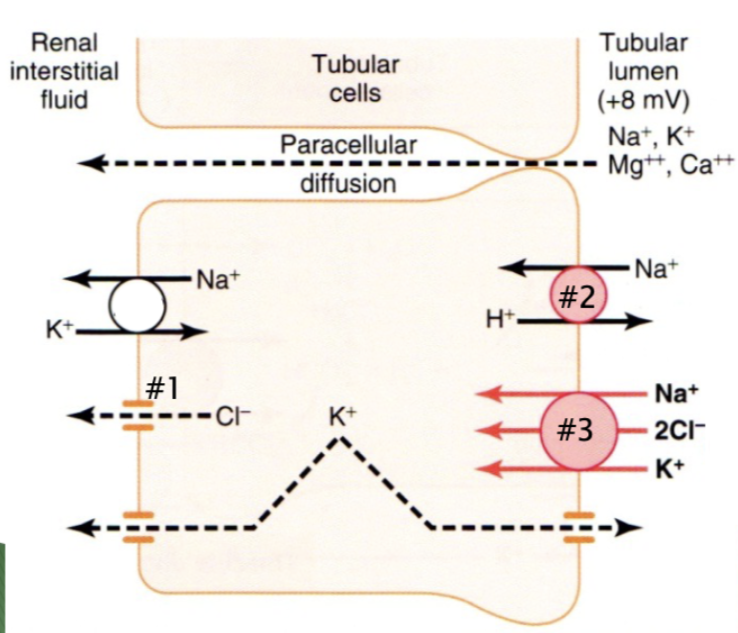
What term best describes the energy requirements for membrane transporter #3?
Secondary active transport
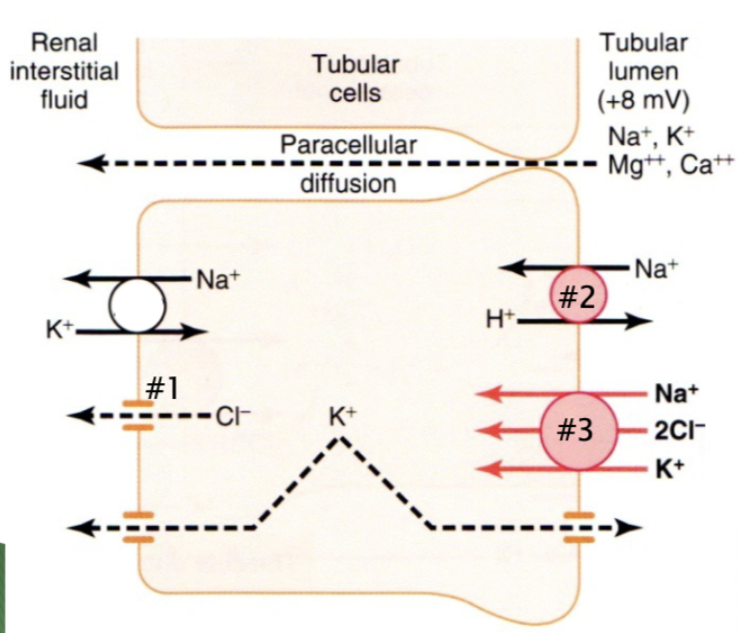
What term best describes the energy requirements for membrane transporter #4?
Facilitated diffusion

What term best describes the energy requirements for membrane transporter #5?
Facilitated diffusion
How is vesicular transport another form of active transport?
Because it moves solutes across the membrane in bulk, against their concentration gradient, and requires ATP as a power source.
What is endocytosis?
-Protein workers at the plasma membrane use ATP as a power source to indent a section of the membrane, pinch it off, and form a fluid-filled vesicle inside the cell
What is Receptor-mediated endocytosis?
uses specific receptor proteins and clathrin-coated pits to bring a specific solute into the cell
What is Phagocytosis?
describes the process by which some immune system cells use a vesicle to internalize a living organism (such as a bacterium) and destroy it
What is exocytosis?
protein workers in the plasma membrane use ATP as a power source to …
Merge a secretory vesicle with the membrane and release its contents (e.g., signal
molecules or wastes) to the extracellular fluid
Or, merge a transport vesicle to the membrane to embed membrane transporters
or receptors that vesicle carries into the plasma membrane so they can begin their
work
How does receptor-mediated endocytosis work?
Ligand binds to membrane receptor.
Receptor ligand migrates to clathrin-coated pit.
Endocytosis occurs
Vesicle loses clathrin coat
Receptors and ligands seperate
Ligands go to lysosomes or Golgi for processing
Transport vesicle with receptors moves to the cell membrane
Transport vesicle and cell membrane fuse (membrane recycling)
What does “phago” mean?
“eating” or “devouring”
What is phagocytosis?
The process by which some immune cells (ex macrophages, neutrophils, and eosinophils) fight infections.
they eat or devour pathogens (disease causing microorganisms).
cells that have this function are called phagocytes
What are the steps pf phagocytosis in immune cells?
The phagocytic white blood cells encounters a bacterium that binds to the cells membrane.
The phagocyte uses its cytoskeleton to push its cell membrane around the bacterium, creating a large vesicle, the phagosome.
The phagosome containing the bacterium separates from the cell membrane and moves into the cytoplasm.
The phagosome fuses with lysosomes containing digestive enzymes.
The bacterium is killed and digested within the vesicle.
What is pseudopods?
Phagocytes that stretch out plasma membrane and encircles the target pathogen.
What is a phagosome?
A specialized vesicle that pulls the pathogen into its cytoplasm.
What two things merge together to strop an engulfed pathogen?
Phagosome and Lysosome
What is the barrier between blood plasma and interstitial fluid?
Capillary endothelium
Transcytosis is another for of: ———-
Vesicular transport
What is transcytosis?
Uses a combination of endocytosis on one side of the cell and exocytosis on the other side to transport large solutes through that cell in bulk.
What are the steps of transcytosis?
Plasma proteins are concentrated in caveolae, which then undergo endocytosis and for vesicles.
Vesicles cross the cell with the help of the cytoskeleton.
Vesicle contents are released into interstitial fluid by exocytosis.
What is the resting membrane potential?
Represents the electrical gradient or difference in charge between the extracellular fluid and the intracellular fluid when a cell is at rest (not preforming any special action).
What works to maintain the resting membrane potential at all times?
ATPase carrier protein pumps.
How can the resting membrane potential be recorded?
from cells inside a living organism
or in cells separated from a living organism and placed in a dish.
The side of a resting cell is more —— charged, relative to outside.
negatively
Is the plasma membrane polarized or non-polarized?
Polarized; positive region outside vs negative region inside.
What is depolarization?
When the cell becomes more positively charged inside, compared to the resting membrane potential.
the difference between the inside and outside is reduced
less polarized = depolarized
to activate a cell, it must become depolarized
What is a repolarization?
The membrane potential returns to its resting value AFTER a depolarization.
Polarize again= re-polar
returns cell to its electrical set point
What is hyperpolarization?
The cell becomes MORE negatively charged inside, compared with the resting membrane potential.
more polarized = hyper- polarized
hyper polarization will inhibit cell function or prevent it from being easily activated.