PHARM 310 - MIDTERM
 Call Kai
 Learn
Learn Practice Test
 Spaced Repetition
 Match
Match Flashcards
 Knowt Play
1/135

There's no tags or description
Looks like no tags are added yet.
Name | Mastery | Learn | Test | Matching | Spaced | Call with Kai | Chat |
|---|
No analytics yet
Send a link to your students to track their progress
136 Terms
The immune system include cells and ——- factors dedicated to defend the body against infection.
humoral
The ——- immunity is passive, while the ——- immunity is acquired.
innate, adaptive
What components make up the innate immunity?
physical barriers, cells, soluble factors
What components make up the adaptive immunity?
cell-mediated immunity, humoral immunity
A ——- is any organism with the potential to cause disease.
More specifically an ——— pathogen takes advantage of an individual’s weakened body’s defenses and cause illness.
pathogen, opportunistic
What are the 4 main categories of pathogens?
bacteria, viruses, fungi, parasites
Organize the following into either innate or adaptive immunity:
neutrophils, cytokines, lymphocytes, antibodies, macrophages
innate = neutrophils, macrophages, cytokines
adaptive = lymphocytes, antibodies
What are examples of physical barriers in our body (innate immunity)?
skin - layers of keratinized cells
mucus - thick fluid (acidic glycoprotein) containing enzymes (lysozyme)
ciliated epithelial cells (lungs)
For each of the following soluble factors, explain their role in innate immunity: bactericidal factors, complement proteins, interferon cytokines
bactericidal factors - HCl (acidic pH), phagocyte lysosomes (creates free radicals)
complement proteins - amplifies the immune response
interferon cytokines - notify neighbouring cells to amplify their immune defense
What are the 5 cardinal signs of an inflammatory response?
Rubor (redness)
Calor (heat)
Donor (pain)
Tumor (swelling)
Functio-laesia (loss of function)
What are the main differences between innate vs. adaptive immunity in terms of:
1) rate of response
2) variability
3) specificity
innate immunity:
rapid response (hours)
fixed
limited number of specificities
adaptive immunity:
slow response (days to weeks)
variable
numerous highly selective specificities

A —— cell is the fully differentiated form of a B cell that secretes antibodies.
plasma

——- ——- (NK) cells kill cells infected with certain viruses.
natural killer
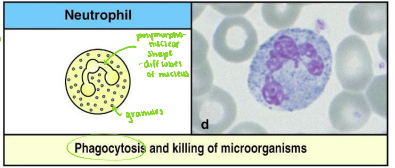
——- undergo phagocytosis and kills microorganisms.
neutrophils

—— kill antibody-coated parasites through the release of their granule contents.
eosinophils

—— cells activate T cells and initiate the adaptive immune response.
dendritic
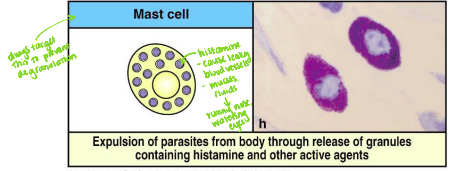
——- cells release granule contents containing histamine and other active agents to expel parasites.
mast

——— are circulating precursors to macrophages.
monocytes

——- undergo phagocytosis and killing of microorganisms. They also activate T cells (by presenting antigens) and initiate immune responses.
macrophages

——- break off to form platelets, aiding in wound repair.
megakaryocytes
Which leukocytes has a polymorpho-nucleus? (i.e. their nucleus as diff. lobes)
neutrophil, eosinophil, basophil
Rank the following leukocytes by their proportion in the blood from highest to least:
neutrophil, eosinophil, basophil, monocyte, lymphocyte
neutrophil, lymphocyte, monocyte, eosinophil, basophil
What is the difference between primary vs. secondary lymphoid tissues?
primary = where lymphocytes develop and mature
secondary = where mature lymphocytes are stimulated and respond to antigens

What are primary lymphoid organs?
bone marrow, thymus
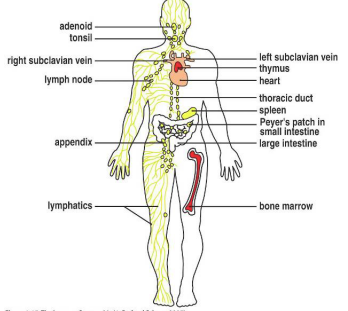
What are secondary lymphoid tissues?
spleen, adenoids, tonsils, appendix, lymph nodes, Peyer’s patches
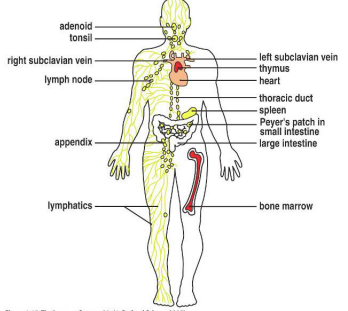
What are GALTs?
Gut-Associated Lymphoid Tissues = tonsils, adenoids, appendix, Peyer’s patches
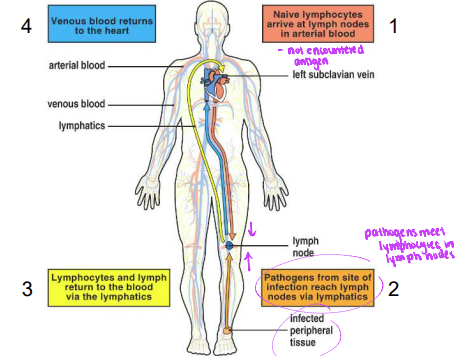
Lymphatics originate in ——- tissues and collect fluid from ——- space that leaks from blood vessels. They then return the fluid to venous circulation via the —— duct to the ——- vein in the neck.
connective, extracellular, thoracic, subclavian

Where do pathogens meet lymphocytes?
lymph nodes

What is different abt the spleen vs other lymphatic tissues/organs?
spleen has no lymphatic connections - it filters circulating blood, removes old RBCs, bacteria, and site of antibody production
What cells produce immunoglobulins (aka antibodies)?
B-lymphocytes (aka plasma cells)

What are the 2 forms of immunoglobulins?
cell-surface tethered form, secreted form
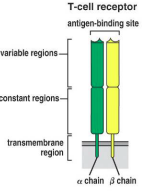
——— (TCRs) are cell surface molecules that recognize antigens and are only found on T-cells.
T-cell receptors
An ——- is any substance capable of inducing a specific immune response.
i.e. any molecule recognized and bound by an ——- or ——-
antigen, immunoglobulin, T-cell receptor

An ——- ——- or ——- is the specific part of the antigen surface that is bound by TCRs or Igs.
antigenic determinant, epitope
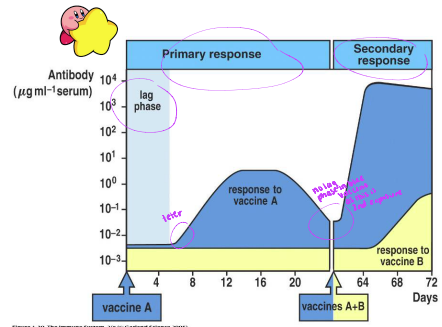
What are the 4 key attributes of adaptive immunity?
Specificity - reacts to each antigen
Memory - remembers encounter with Ag (antigen), next response is quicker and greater
Amplification - clonal expansion
Modulation - switching of Aby isotypes

KNOW THIS GRAPH
KNOW THIS GRAPH
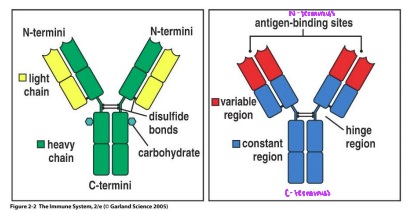
Antibodies (Aby) are Y-shaped glycoproteins assembled from 2 identical “heavy” H chains + 2 identical “light” L chains. Each polypeptide chain is composed of a —— region that binds to the antigen, and ——- regions that bind to the cell.
variable, constant
Each B-cell expresses just one specificity of Ig on its surface. T/F
T

What happens when a B-cell binds to an antigen?
the B-cell differentiates to a Aby-secreting plasma cell
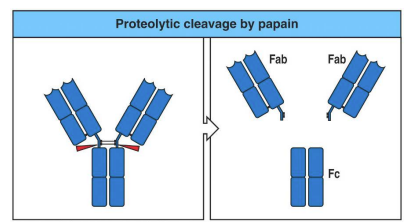
What is the Fc region on an antibody important for?
opsonization (tagging of pathogen)
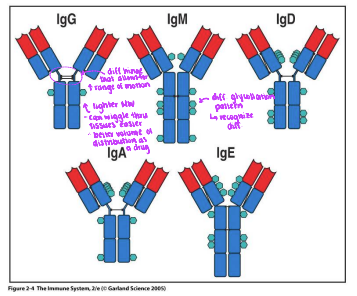
The different antibody isotypes differ in the —- regions of the heavy and light chains.
constant

What are the 5 isotypes of antibodies?
hint: GAMED
IgG, IgA, IgM, IgE, IgD
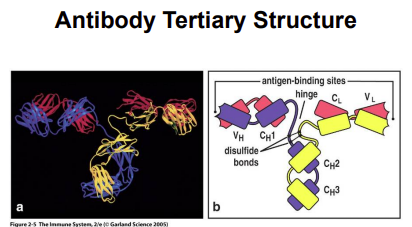
In the antibody tertiary structure, the ——-regions are the variable domains consisting of the VH of the heavy chain + VL of the light chain → these 2 variable regions side-by-side is what binds to the antigen.
The ——-regions have little or no amino acid sequence diversity.
V, C

Light chain V (variable) regions are made of ——- regions (FR) and ——region (HV) loops (aka —— ——- Region (CDR)). FR form the a-helices and b-pleated sheets, while CDRs provide a binding surface complementary to the antigens.
Framework, Hypervariable, Complementarity Determining

Which Hypervariable Region (HV) has the highest variability? (i.e. will generate the most antibody diversity)
HV 3
The antigen-binding site on the antibody is known as the ——- → which will bind to the ——- of the antigen.
paratope, epitope
What are epitopes (on the antigen) usually made of?
carbohydrates, proteins, or both

Most antigens are multivalent (many potential epitopes). T/F
T

Antibody binds antigen due to molecular ——- and ——- binding.
complementarity, non-covalent
——- is important in antigen-antibody interactions as it creates extra lumps and bumps on the antigenic determinant.
glycosylation

What enzymes are responsible for enzymatic rearrangement of the germline DNA of Ig genes → allows for Ig diversity?
Recombination Activating Gene (RAG) enzymes

Where does the RAG enzymes bind to splice the germline DNA?
RAG enzymes recognize the RSS (Recombination Signal Sequences) = Heptamer (CACAGTG) and Nonamer (ACAAAAACC) that are separated by 12 and 23 pair “spacers” (12/23 rule) → RAG enzyme then cuts the DNA at the heptamer sequences

Each B-cell can only produce Ig of only one specificity, this is known as —— ——-. aka once a B-cell commits to making a type of Ig, it can’t go back and make another type, bc that part of the RNA has been spliced off.
allelic exclusion
Each individual B cell expresses membrane-bound immunoglobulins (forming its B-cell receptor or BCR) with a single, unique antigen specificity due to genetic processes like allelic exclusion and V(D)J recombination.
What process is this describing:
Cleavage: Special proteins called RAG1 and RAG2 cut the DNA at specific spots next to the gene segments.
Joining: The cell's repair machinery joins one V, one D, and one J segment together at random. (Some light chains only use V and J segments).
Randomness: Extra random nucleotides are often added or deleted during the joining step, which increases diversity even more.
Result: This creates a unique coding sequence for that specific cell's receptor, ensuring each immune cell targets a different threat
VDJ recombination
Because humans inherit two copies of every gene, one from your mother and one from your father, a cell could theoretically express receptors from both alleles. ——- ——- shuts down the second allele once the first one successfully rearranges, ensuring each B cell or T cell has a single specificity.
allelic exclusion

What is the MC region?
MC region = Membrane Coding region → will insert into the bilipid layer
if the MC region is kept → Ig bound to be transmembrane form
if MC region excised = Ig bound to be secreted form
What is a B-cell receptor (BCR)?
a membrane-bound immunoglobulin on a B-cell (aka an antibody attached to a B-cell)
What is the function of Igα and Igβ?
when the B-cell receptor binds to an antigen → causes shape of the constant domains where it bends to expose the attractive residues Igα and Igβ → trigger 2nd messengers inside the cell
Overtime, Aby becomes more specific for their triggering antigen, this is known as —— ——- or —— ——.
somatic hypermutation, affinity maturation

Is it possible to switch from one Ig isotype to another?
i.e. switch from IgM to IgA
yes

Rank each of the following type from highest to lowest molecule weight:
IgM, IgG, IgE
IgM, IgE, IgG (MEG)

Rank the following from highest to lowest concentration in the blood serum:
IgM, IgG, IgA, IgE
IgG, IgA, IgM, IgE (GAME)

Rank the following from the longest to shortest half-life:
IgM, IgG, IgA, IgE
IgG, IgM, IgA, IgE (GMAE)
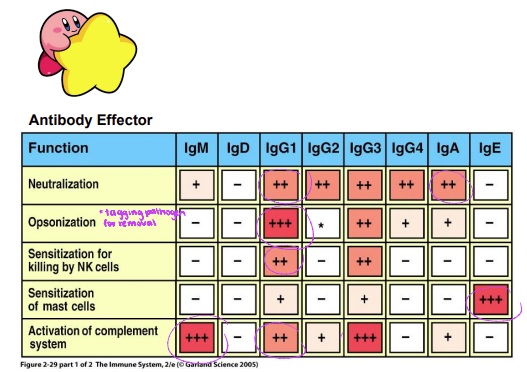
What is the main function of IgMs?
a) neutralization
b) opsonization
c) sensitization for killing by NK cells
d) sensitization of mast cells
e) activation of complement system
e → the first antibody your immune system makes when it encounters a pathogen
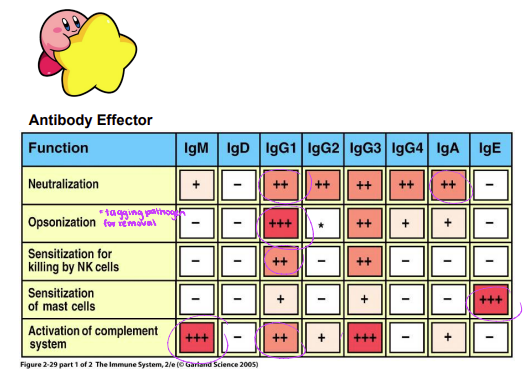
What is the main function of IgG?
a) neutralization
b) opsonization
c) sensitization for killing by NK cells
d) sensitization of mast cells
e) activation of complement system
a, b, c, e

What is the main function of IgAs?
a) neutralization
b) opsonization
c) sensitization for killing by NK cells
d) sensitization of mast cells
e) activation of complement system
a
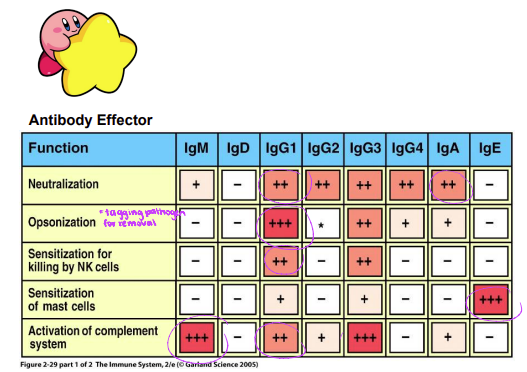
What is the main function of IgEs?
a) neutralization
b) opsonization
c) sensitization for killing by NK cells
d) sensitization of mast cells
e) activation of complement system
d
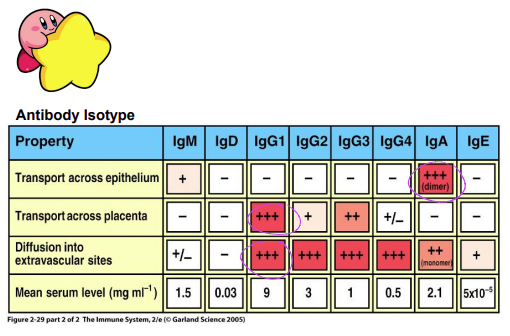
Which antibody isotype can cross the epithelium the best?
a) IgM
b) IgG
c) IgA
d) IgE
IgA

Which antibody isotype can best cross the placenta?
a) IgM
b) IgG
c) IgA
d) IgE
IgG
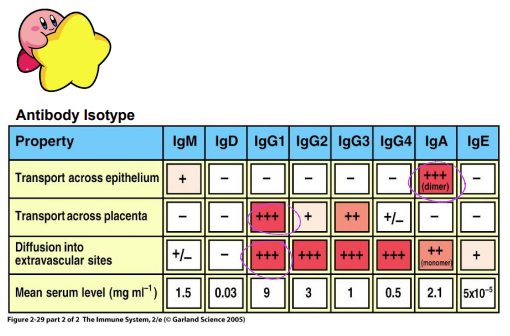
Which antibody isotype can best diffuse into extravacular sites?
a) IgM
b) IgG
c) IgA
d) IgE
IgG

Which of the following process is reversible?
a) V-region assembly from gene fragments
b) generation of junctional diversity
c) assembly of transcriptional controlling elements
d) transcription activated with co-expression of surface IgM and IgD
e) synthesis changes from membrane Ig to secreted antibody
f) somatic hypermutation
g) isotype switch
d, e
An immunoassay is a sensitive analytical test that utilizes highly specific antibody-antigen (Aby-Ag) complexes to produce a signal that can be measured and related to —— of a compound in solution.
concentration
Immunoassays differ from biochemical techniques as they measure ——— ——-, not just a ——- ——-.
Aby-Ag interaction, chemical reaction
Immunoassays are considered (multi-select):
a) qualitative
b) semi-qualitative
c) quantitative
d) semi-quantitative
a, d
Immunoassays are considered qualitative or semi-quantitative (at best). What does this mean?
can indicate the presence or absence of the analyte, but can’t precisely tell how much of it there is
——- is the degree of attraction between the epitope (on Ag) and the paratope (Aby binding site). This close fit is stabilized by weak, non-covalent forces (i.e. ionic bonds, H-bonds, Van der Waals attraction, hydrophobic effect).
affinity
——- is the combined strength (or binding intensity) of multiple binding sites for an Ag.
Example: IgM in pentameric form has 10 Ag-binding sites. Even if attraction for the antigen is weak (i.e. low affinity for Ag), pentameric IgM will still have strong avidity (10 binding sites vs. 2).
avidity
——- is the unique recognition of an antigenic determinant over that of another. Also defined as the property of Aby which enables them to react with some antigenic determinants, but not with others.
specificity
——- is the ability of an Aby to bind, with low affinity, to closely related epitopes.
cross-reactivity
——- is the detection limit of an Aby for an Ag.
Example: the RIA is capable of sensitivity as low as the femto-mole (10-15).
sensitivity

Describe each part of this graph.
Note: this is an Ag with multiple epitopes (can bind more than one Ab at once)
A: antigen excess - not enough Ab to cross-link Ag
B: equivalence - forms a lattice and precipitates out → seen as precipitin line
C: antibody excess - more Ab that available Ag present to bind

Describe the following diagram of the immunodiffusion detection method.
1 and 4 = control serum with 2 precipitin line, 2 antibodies with diff MW (IgM + IgG)
3 = this patient’s serum contain antibody that’s reacting to the antigen to form a precipitin line
What is this method of immunoassay called?
ouchterlony
What is the most common type of antibody isotype shift?
IgM to IgG

What antibody is often used in agglutination for detection techniques?
IgM as it is highly effective at cross-linking and agglutination due to its bulky size (pentameric)

What are the different types of assay formats?
competitive vs. non-competitive, homogeneous vs. heterogeneous

Describe the mechanism of competitive assays.
(refer image)
Un-labelled analyte (Ag of interest) in the test sample is measured based on its ability to compete with labeled Ag in the immunoassay.
Unlabeled Ag blocks the ability of labeled Ag to bind to Aby.
In a competitive immunoassay, the greater the amount of Ag in the test sample, the —— the signal generated. There is a(n) ——- correlation of signal intensity to the amount of analyte Ag present in sample.
lesser, inverse
Describe the mechanism of non-competitive assays.
the antigen is “sandwiched” between antibodies specific to two different epitopes
In a non-competitive immunoassay, the greater the amount of Ag in the test sample, the —— the signal generated. There is a(n) ——- correlation of signal intensity to the amount to analyte Ag present in sample.
greater, direct
What is the difference between heterogeneous vs. homogenous assays?
homogeneous - does not require separation of bound vs. unbound components to measure the result (more ideal for point-of-care testing) e.g. dip-strips, pregnancy tests
heterogeneous - requires requires a separation/washing step before measurement
What are the 2 main types of detection labels and assay designs?
radiolabel (RIA), enzyme (EIA)
note: IA = ImmunoAssay
What type of assay design is ELISA?
enzyme
ELISA = Enzyme Linked ImmunoSorbent Assay
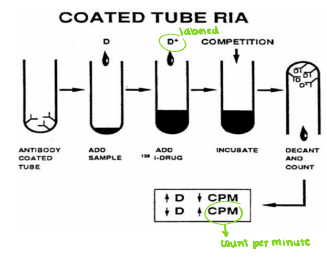
Describe the steps of radioimmunoassay (RIA) in this image.
mix pt Ag + radiolabeled Ag to test tube with the specific Ab
Ag will compete with the radiolabeled Ag for Ab binding
wash the sample to separate bound vs. unbound Ag
measure radioactivity to give count
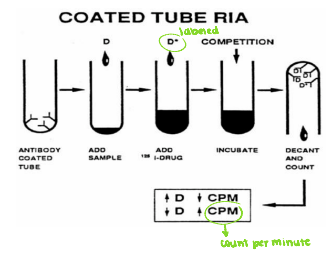
What type of immunoassay is RIA in this image?
a) competitive, homogeneous
b) competitive, heterogeneous
c) non-competitive, homogeneous
d) non-competitive, heterogeneous
b

In the RIA technique shown in this image, the assay signal intensity ——- with greater analyte (target antigen) in the sample. There is a(n) ——- correlation of signal intensity to the amount of analyte Ag present in sample.
decreases, inverse

What type of immunoassay is RIA in this image?
a) competitive, homogeneous
b) competitive, heterogeneous
c) non-competitive, homogeneous
d) non-competitive, heterogeneous
d
In the RIA technique shown in this image, the assay signal intensity ——- with greater analyte (target antigen) in the sample. There is a(n) ——- correlation of signal intensity to the amount to analyte Ag present in sample.
increases, direct

Describe the mechanism of enzyme immunoassays (ELISA).
a capture antibody is immobilized on the surface of a matrix (e.g. polystyrene/polyacrylamide)
once antigen is bound to the capture protein, a detection antibody that’s conjugated to an enzyme will come along and also attach to the Ag
the conjugated enzyme will then convert substrate to yield some product that can be measured (requires washing to remove unbound signaling Aby first)

What is the difference between direct vs. indirect ELISA?
direct - a primary enzyme-labelled (or fluorescent-tagged) antibody will directly bind to the substrate and allow for reading
indirect - primary antibody binds to the antigen, then a secondary enzyme-labelled (or fluorescent-tagged) antibody specific for the primary antibody is used to get a reading