Medicinal Microbiology: Bacteria
 Studied by 2 people
 Call Kai
 Learn
Learn Practice Test
 Spaced Repetition
 Match
Match Flashcards
 Knowt Play
1/41

There's no tags or description
Looks like no tags are added yet.
Name | Mastery | Learn | Test | Matching | Spaced |
|---|
No study sessions yet.
42 Terms
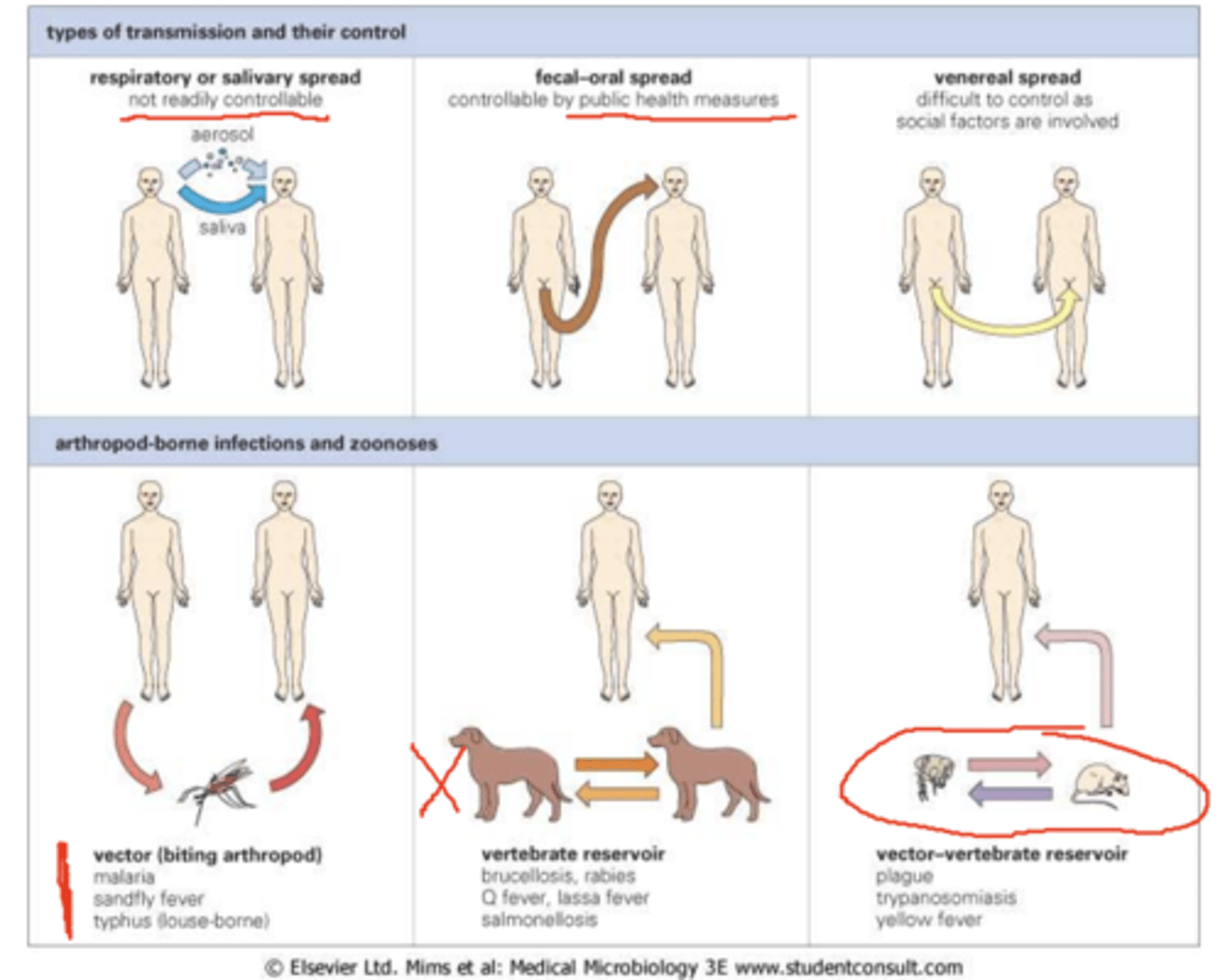
What are the types of transmission?
- Respiratory or salivary spread.
- Fecal-oral spread
- Venereal spread
- Vector
- Vertebrate reservoir
- Vector-vertebrate reservoir.
What are pseudomonades?
A term for bacteria which morphologically and physiologically resemble members of the genus pseudomonas.
Where are psudomonas usually found?
In sever burns as a secondary invader
What bacteria causes whooping cough?
Bordetella pertussis
What bacteria causes legionnaires pneumonia?
Legionella pnemophila
What bacteria causes gonorrhoea?
Neisseria gonorrhoeae
What bacteria causes meningitis?
Neisseria meningitidis
What bacteria causes meningitis however its occurrence has declined since the vaccine?
Haemophilus Influenzae
What bacteria causes the bubonic plague?
Yersinia pestis
What is the mortality rate of the bubonic plague?
1-15% in treated cases
40-60% in untreated cases
What is the mortality rate of the septicemic plague?
40% in intreated cases
100% in untreated cases
What is the mortality rate of the Pneumonic plague?
100% if not treated in first 24 hours of infection.
What is borrelia burgdorferi?
- Causes Lyme disease.
- Spread by ticks
- Causes three main stages of disease.
What are the three stages of disease caused by borrelia burgdorferi?
1. Distinctive rash at the site of the bite
2. Dissemination stage with headache and fever.
3. Persistent infection which can be treated by antibiotics.
Describe pneumonia.
- Caused by streptococcus pneumonia.
- Can be transmitted virally and bacterially.
- Most common cause of infection-related death in the US and Europe.
What are the main causes of pneumonia in children?
Mainly virally however can be caused by bacterial due to a viral respiratory infection e.g., measles.
What are examples of endospore-forming bacteria?
Gram positive: Bacillus (aerobic), Clostridium (anaerobic),
What bacteria causes anthrax?
Bacillus anthracis
What bacteria causes food poisoning?
Bacillius cereus
Describe anthrax.
- Enters human body through intestines, lungs or skin.
- Symptoms presented depend on how the bacteria entered.
- It is non-contagious so unlikely spread from person to person.
What are the symptoms of anthrax when entered through the lungs?
- Most deadly.
- Initially presents with cold or flu-like symptoms.
- Sever respiratory problems develop which can be fatal.
- If not treated before symptoms appear patient will likely die.
What are the symptoms of anthrax when entered through the intestines?
Present with serious GI difficulty, vomiting of blood and severe diarrhoea.
What are the symptoms of anthrax when entered through the skin?
- Cutaneous (skin) anthrax presents with large, painless necrotic ulcer which is dark in colour and itchy.
- Lasts about 1-2 weeks after exposure.
What is pyogenic cocci?
Spherical gram positive bacteria which cause various pus-producing infection in animals.
What is Staphylococcus aureus?
- Bacteria which lives on the skin and nasal membranes.
- Different strains differ in severity and can cause boils and pimples.
- Resistant to penicillin and other antibiotics.
What is MRSA?
- Found in hospitals.
- Can be treated with Vancomycin.
How does cholera bacteria cause disease?
- Cholera bacteria releases the cholera toxin which has two subunits, A and B.
- The toxin binds to a receptor on the GI cells.
- This causes the A subunit to be taken into the cell where it binds to the Gαs subunit activating it.
- The Gαs subunit can now activate adenylyl cyclase which produces cAMP.
- Activated cAMP then activates CFTR which causes Cl- to be removed from the cell.
- This decreases osmolarity outside of the cell forcing Na+ and water out of the cell.
- This causes the watery diarrhoea symptom to be produced.
What are the staphylococcal toxins?
- Alpha toxin
- Beta-toxin
- Delta toxin
- Gamma Toxin
- Exfoliate toxin
- Enterotoxins
- Toxic shock syndrom toxin.
Describe Corynebacterium diphtheria.
- Caused by toxin producing C.diptheria strains.
- Toxins released destroy epithelia cells.
- Forms an ulcer with is covered in necrotic exucate.
- Managed by immediate treatment with antitoxins and antibiotic tory obstruction
How does Salmonella cause disease?
- Upon entering the body, Salmonella infiltrates neutrophils in the small intestine's lymphoid follicles, causing swelling and gastrointestinal discomfort.
- Salmonella in neutrophils triggers inflammation, leading to prostaglandin release.
- Prostaglandins boost acetylcholine, increasing cAMP concentration, promoting Cl- ion efflux ou,t reducing intestinal osmolarity.
- This osmotic shift causes water and Na+ influx, resulting in diarrhoea symptoms.
What is the equation for generation time (G) of bacteria?
G = generation time
t = Time elapsed
b = Final number of bacteria
B = Initial number of bacteria

How can you rearrange the generation time equation to calculate Final number of bacteria (b)?
b = Final number of bacteria
B = Initial number of bacteria
t = Time elapsed
G = generation time

How can you rearrange the generation time equation to calculate initial number of bacteria (b)?
N0 = Initial number
Nt = Final number
t = Time elapsed
G = Generation time

Describe hepatitis
- 6 types, A B C D E G
- Target the liver.
- Type A and B are classical viruses whilst the rest are non-A non-B viruses.
Describe hepatitis A:
- Spread by faecal-oral route.
- HAV is a picornavirus, small and naked capsid structure.
- Target cells are parenchymal cells in liver.
What are the symptoms of hepatitis A?
Initial: Fever, fatigue, nausea and abdominal pain.
Secondary: Jaundice, Fulminant hepatitis.
How is hepatitis A treated?
- Prophylaxis with immune serum globulin.
- Killed HAV vaccine.
Describe hepatitis B.
- Small, envoloped DNA.
- Source of infection is transfer of bodily fluids.
- Can take up to 45 days to experience symptoms.
How is hepatitis B treated?
- No treatment for acute infection.
- Hep B immune globulin may be administered within a week of exposure.
- Vaccination is recommended for children.
Describe hepatitis C.
- Predominant cause of NANBH.
- Transmitted by bodily fluids.
- Often leads to cirrhosis and carcinoma.
Describe the influenza virus.
- 3 types A,B and C.
- Only A and B cause significant human disease.
- Enveloped virus and has about 500 HA spikes.
- Spread via airborne droplets.
- virus can survive for days outside the body.
-
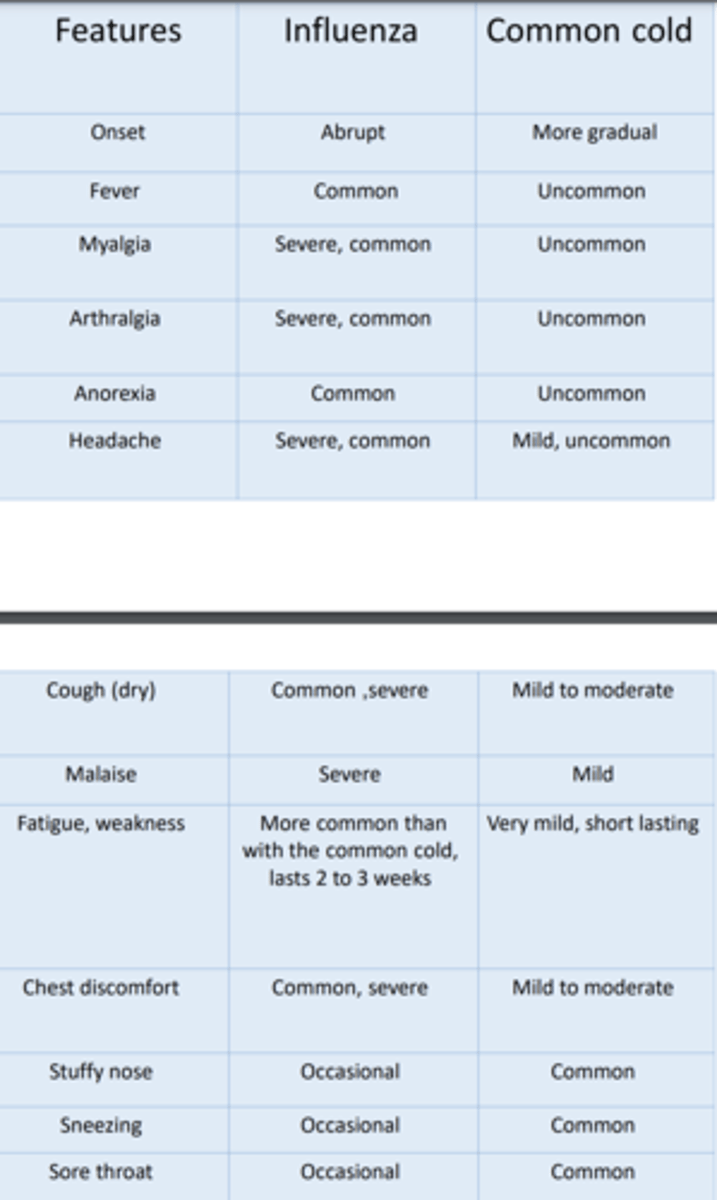
Differences between influenza and common cold.