A Thousand Splendid Suns - Context
 Call Kai
 Learn
Learn Practice Test
 Spaced Repetition
 Match
Match Flashcards
 Knowt Play
1/23

Earn XP
Description and Tags
Prose - Women and Society - Edexcel - A-level English Literature
Name | Mastery | Learn | Test | Matching | Spaced | Call with Kai | Chat |
|---|
No analytics yet
Send a link to your students to track their progress
24 Terms
The Soviet Invasion of Afghanistan
1979: USSR invaded Afghanistan to expand influence and protect the communist PDPA government (in power since 1978 coup).
Aimed to secure Afghanistan against Iranian influence and Western (especially U.S.) intervention.
Afghanistan acted as a buffer state between the USSR and U.S.-aligned Pakistan.
Soviets feared PDPA collapse would lead to:
Afghanistan aligning with the West
U.S. influence reaching the Soviet border
After PDPA leader Hafizullah Amin was assassinated, the Soviets installed Babrak Karmal as a puppet leader.
Mujahideen Resistance
Soviet invasion (1979) met with fierce resistance from the mujahideen.
Fighters saw Christian/atheist Soviet control as a threat to Islam and Afghan tradition.
Declared jihad (holy war) against the Soviets, supported widely across the Islamic world.
Mujahideen weapons came from captured Soviet supplies or were provided by the U.S.
Soviet bombing campaigns destroyed villages, crops, and infrastructure, causing mass suffering.
Millions were left dead, homeless, or starving.
Refugee camps in Pakistan became overcrowded and unsanitary due to huge influxes of Afghans
The End of Invasion
The invasion was condemned by the UN and they repeatedly called for the Soviets to withdraw their troops. While the Arab world provided relief and money to the mujahideen.
In 1989, the Soviets withdrew their troops.
The Rise of the Taliban
Soviet invasion sparked a nationwide Afghan uprising.
The mujahideen (“those engaged in jihad”) were not one unified group but many factions divided by ethnicity, tribe, region, and ideology.
Became one of the most heavily funded insurgencies of the Cold War.
Received major support from:
U.S. (CIA) – weapons, training, funding
Saudi Arabia – money and ideological backing
Pakistan (ISI) – training camps, logistics, intelligence
Additional aid came from China, Iran, and Arab volunteer fighters
Why did the Taliban rise?
The Soviet invasion created the conditions for the Taliban’s emergence.
Millions of Afghans displaced
Huge numbers of armed fighters
A generation raised in refugee camps or madrassas
Deepened ethnic, tribal, and factional divisions
A steady flow of foreign Islamist influence into Afghanistan and Pakistan
The Infiltration of the Taliban
After the Soviet withdrawal, Afghanistan fragmented into territories controlled by rival warlords.
The Taliban (“religious students”) emerged from madrassas; loosely organised until 1994, when they united as a force.
They defeated rival mujahideen factions and captured Kandahar, then Kabul.
Many Afghans initially welcomed the Taliban for restoring order after years of chaos.
Led by Mullah Muhammad Omar.
Their rule imposed a strict, hard‑line interpretation of Islamic law, restricting daily life, especially for women.
Sharia Law
Afghan soccer stadiums began hosting public executions and punishments
Television, music and the Internet were banned
Men were required to wear beards or face public beatings
Frivolous activities like kite-flying were banned
Most significant were the Taliban’s rules for women
Women were banned from going to school
Women were banned from working outside the home or leaving home without being accompanied by a male relative.
Those who did not obey the laws risked being beaten.
Women caught wearing nail polish risked having their fingers chopped off.
Sharia Law - Legal system
Sharia = Islam’s legal and moral system.
Derived from the Qur’an, Sunnah, and Hadith (teachings and actions of Prophet Muhammad).
When answers aren’t explicit in these texts, religious scholars issue rulings (fatwas) for guidance.
Sharia can guide all aspects of daily life for Muslims.
Examples: decisions about social behaviour, family matters, finance, and business ethics.
A Muslim might consult Sharia guidance for everyday dilemmas (e.g., whether to join colleagues at a pub).
Daily Life for Women under the Taliban
Women are almost entirely removed from public life
Education
Girls were banned from schooling beyond early primary grades (1996–2001: no formal education at all; 2021–present: banned beyond grade 6, and de facto banned from most schooling).
Universities were closed to women.
Female teachers were dismissed unless teaching very young girls in limited settings.
Women under Taliban
Dress Code
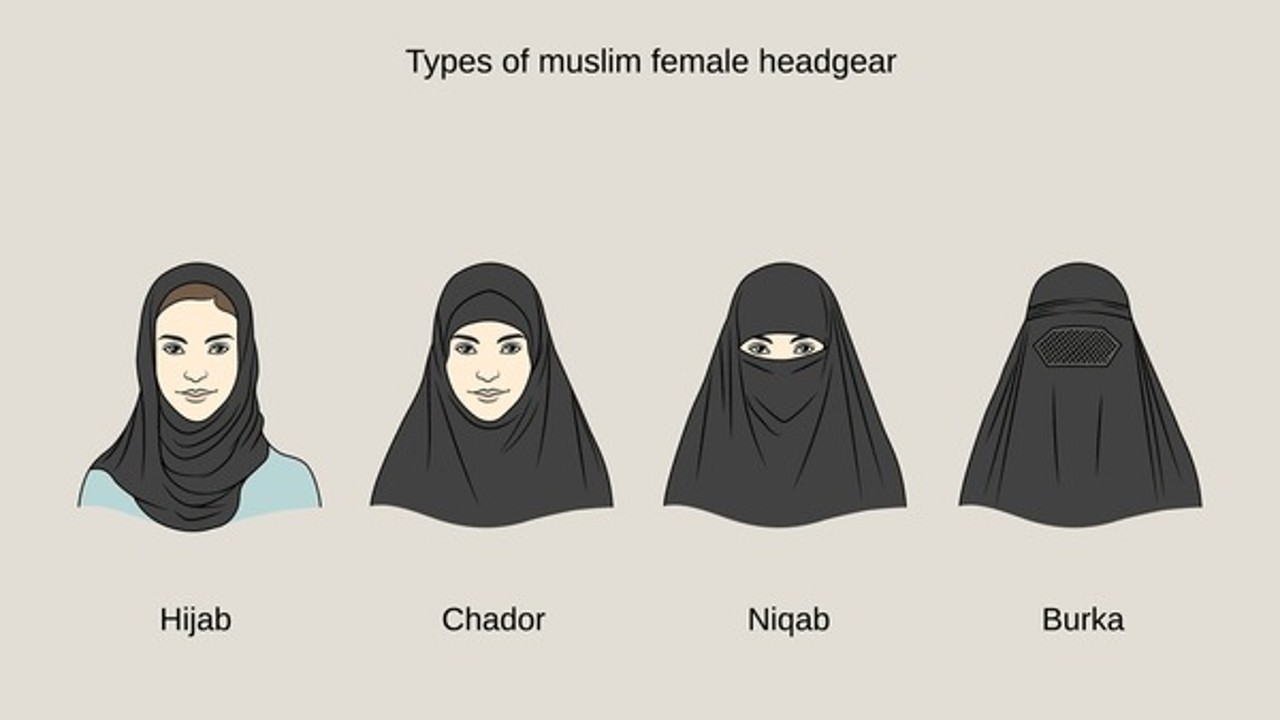
Women were required to wear the burqa (full-body covering with mesh over the eyes).
Any deviation could lead to punishment.
Freedom of Movement
Women could not leave home without a mahram (a close male relative).
Violations led to beatings, fines, or imprisonment.
The Qur’an
1. The Qur’an does not require a burqa
The Qur’an instructs both men and women to dress modestly. The two verses commonly cited are:
24:31 — instructs believing women to dress modestly and cover their bosom
33:59 — tells women to draw their jilbab (outer cloak) over themselves
First word of the Qur’an is ‘Read’
Taliban implementations through the Qur’an
These verses do not specify:
covering the face
covering the eyes
wearing a full-body garment
a particular style of clothing (burqa, niqab, hijab, chador, etc.)
The burqa is not mentioned or required in scripture.
Taliban and Mandatory Burqa
•Under both Taliban regimes (1996–2001 and post-2021), the burqa became mandatory.
Their reasons are ideological and political, not purely religious.
Taliban interpretation of modesty
The Taliban interpret Qur’anic modesty as requiring full-body coverage, including the face.
Pashtunwali (tribal code)
The Taliban incorporate Pashtun tribal norms, where women’s visibility is linked to family honour.
Control and social order with Burqa
The burqa becomes a symbol of:
women’s obedience
gender segregation
The Taliban’s moral authority
Erasing women from public space - Burqa
Face covering aligns with the Taliban’s goal of limiting women’s public presence.
Taliban members who enforced the Burqa
The Taliban’s Ministry for the Promotion of Virtue and Prevention of Vice
(the religious police), which patrols and punishes non-compliance.
Types of Muslim female headgear
Healthcare for women
Access to healthcare was limited because:
Women were only allowed to be treated by female doctors.
Female doctors were few, restricted, and often lacked equipment.
Many women died from preventable conditions.
Taliban Ministries that controlled Women’s lives
The Taliban established (or revived) powerful ministries to enforce their version of Sharia and control daily life. The most significant for women were:
A religious police force
This ministry essentially dictated every aspect of women’s visibility and behavior in society
Religious police force - power
Powers included:
•Enforcing dress codes
•Ensuring women were accompanied by male guardians
•Banning music, photography, entertainment
•Regulating prayer attendance
•Punishing “moral” offenses
How it affected women:
This ministry’s officers patrolled streets and made immediate arrests or beatings for violations such as:
•Showing any part of the body
•Wearing bright clothing
•Traveling unaccompanied
•Talking to unrelated men
•Having uncovered feet, hands, or ankles
•Not wearing a fully compliant burqa
•Being at work in prohibited fields
•Attempted schooling
•Punishments included public beatings, imprisonment, and humiliation.
Bamiyan Buddha
Seen in Chapter: 21, 25, 42
Babi had wanted Laila and Tariq to understand their country’s living heritage - apart from the violence and turmoil of the national wars.
The Buddhas (ancient community of monks that lived in caves within the cliffs) symbolize the cultural richness of this national heritage. The Taliban’s destruction of these statues serves as only another testament to their disregard for the true Afghanistan. The Buddhas also come to stand for a sense of contentment and security for Laila, one that she will yearn for in the tumultuous years to come.