Oral Anatomy
 Note
Note Call Kai
 Learn
Learn Practice Test
 Spaced Repetition
 Match
Match Flashcards
 Knowt Play
1/103

There's no tags or description
Looks like no tags are added yet.
104 Terms
What does the term "facial" refer to?
The surface of a tooth in the mouth resting against or next to the cheeks or lips.
Which teeth are considered "labial"?
Anterior teeth that touch the lips. the Incisors and Canine teeth
Which teeth are considered "buccal"?
Posterior teeth that touch the cheeks. the Premolar and Molar teeth
What does the term "palatal" refer to?
The surface of a maxillary tooth nearest the palate and tongue.
What does the term "lingual" refer to?
The surface of a mandibular tooth nearest the palate and tongue. The surface of a tooth that can be used on both maxillary and mandibular teeth.
What is the "mesial" surface of a tooth?
The surface closer to the midline.
What is a quadrant?
It contains one-fourth of all the teeth in a dentition.
What is dentition?
Refers to all of the teeth in the oral cavity/mouth together.
What is the maxillary arch?
Refers to the teeth in the upper jawbones
What is the Mandibular arch?
Refers to the teeth in the lower jawbone
What is/are the Hard tissues of a tooth?
Enamel, Dentin, Cementum
What is/ are the soft tissues of a tooth?
Pulp
Enamel
White, protective external surface layer of the anatomic crown
Dentin
hard yellowish tissue underlying the enamel and cementum
Cementum
Dull yellow external layer of the tooth rooth
Pulp
Soft tissue in the cavity or space in the center of the crown and root
DentinoEnamel Junction (DEJ)
Inner surface of the enamel cap where enamel joins dentin
CementoDentinal Junction (CDJ)
Inner surface of cementum where cementum joins dentin
Cervical Line Curvature (CEJ)
Curvature of the cervical line of a tooth towards the incisal or occlusal surface
Apex
Anatomic area at the tip/ end of the rooth
Apical foramen
Opening where nerves and blood vessels enter into the tooth pulp
Periodontium
Supporting tissues of the teeth, including alveolar bone, gingival, periodontal ligament, and cementum
Alveolar bone
Portion of the upper or lower jawbone that surrounds the root of the teeth
Gingiva
Soft tissue in the mouth that covers the alveolar bone of the jaws
Free Gingiva
Collar of thin gingiva surrounding each tooth
Attached gingiva
Portion of the gingiva firmly bound to the underlying alveolar bone
Interdental papilla
Part of the collar of free gingiva that extends between the teeth
What quadrant does this bracket refers to “⏌”
Quadrant 1
What quadrant does this bracket refers to “⎿ ”
Quadrant 2
What quadrant does this bracket refers to “⏋”
Quadrant 4
What quadrant does this bracket refers to “⎾”
Quadrant 3
Permanent Maxillary Right Third molar
Universal Numbering: 1
Zsigmondy Notation: 8⏌
FDI: 18
Permanent Maxillary Right Second molar
Universal Numbering: 2
Zsigmondy Notation: 7⏌
FDI: 17
Permanent Maxillary Right First molar
Universal Numbering: 3
Zsigmondy Notation: 6⏌
FDI: 16
Permanent Maxillary Right Second premolar
Universal Numbering: 4
Zsigmondy Notation: 5⏌
FDI: 15
Permanent Maxillary Right First premolar
Universal Numbering: 5
Zsigmondy Notation: 4⏌
FDI: 14
Permanent Maxillary Right Canine
Universal Numbering: 6
Zsigmondy Notation: 3⏌
FDI: 13
Permanent Maxillary Right Lateral Incisor
Universal Numbering: 7
Zsigmondy Notation: 2⏌
FDI:12
Permanent Maxillary Right Central Incisor
Universal Numbering: 8
Zsigmondy Notation: 1⏌
FDI: 11
Permanent Maxillary Left Central Incisor
Universal Numbering: 9
Zsigmondy Notation:⎿ 1
FDI: 21
Permanent Maxillary Left Lateral Incisor
Universal Numbering: 10
Zsigmondy Notation: ⎿2
FDI: 22
Permanent Maxillary Left Canine
Universal Numbering: 11
Zsigmondy Notation: ⎿ 3
FDI: 23
Permanent Maxillary Left First premolar
Universal Numbering: 12
Zsigmondy Notation: ⎿ 4
FDI: 24
Permanent Maxillary Left Second Premolar
Universal Numbering: 13
Zsigmondy Notation:⎿5
FDI: 25
Permanent Maxillary Left First Molar
Universal Numbering: 14
Zsigmondy Notation: ⎿ 6
FDI: 26
Permanent Maxillary Left Second Molar
Universal Numbering: 15
Zsigmondy Notation: ⎿7
FDI: 27
Permanent Maxillary Left Third Molar
Universal Numbering: 16
Zsigmondy Notation: ⎿8
FDI: 28
Permanent Mandibular Left Third Molar
Universal Numbering: 17
Zsigmondy Notation: ⎾8
FDI: 38
Permanent Mandibular Left Second Molar
Universal Numbering: 18
Zsigmondy Notation: ⎾7
FDI: 37
Permanent Mandibular Left First Molar
Universal Numbering: 19
Zsigmondy Notation: ⎾6
FDI: 36
Permanent Mandibular Left Second Premolar
Universal Numbering: 20
Zsigmondy Notation: ⎾5
FDI: 35
Permanent Mandibular Left First Premolar
Universal Numbering: 21
Zsigmondy Notation: ⎾4
FDI: 34
Permanent Mandibular Left Canine
Universal Numbering: 22
Zsigmondy Notation: ⎾3
FDI: 33
Permanent Mandibular Left Lateral Incisor
Universal Numbering: 23
Zsigmondy Notation: ⎾2
FDI: 32
Permanent Mandibular Left Central Incisor
Universal Numbering: 24
Zsigmondy Notation:⎾1
FDI:31
Permanent Mandibular Right Central Incisor
Universal Numbering: 25
Zsigmondy Notation: 1⏋
FDI: 41
Permanent Mandibular Right Lateral Incisor
Universal Numbering: 26
Zsigmondy Notation: 2⏋
FDI: 42
Permanent Mandibular Right Canine
Universal Numbering: 27
Zsigmondy Notation: 3⏋
FDI: 43
Permanent Mandibular Right First Premolar
Universal Numbering: 28
Zsigmondy Notation: 4⏋
FDI: 44
Permanent Mandibular Right Second Premolar
Universal Numbering: 29
Zsigmondy Notation: 5⏋
FDI: 45
Permanent Mandibular Right First Molar
Universal Numbering: 30
Zsigmondy Notation: 6⏋
FDI: 46
Permanent Mandibular Right Second Molar
Universal Numbering: 31
Zsigmondy Notation: 7⏋
FDI: 47
Permanent Mandibular Right Third Molar
Universal Numbering: 32
Zsigmondy Notation: 8⏋
FDI:48
Deciduous Maxillary Right Second molar
Universal Numbering: a
Zsigmondy Notation: e⏌
FDI: 55
Deciduous Maxillary Right First Molar
Universal Numbering: b
Zsigmondy Notation: d⏌
FDI: 54
Deciduous Maxillary Right Canine
Universal Numbering: c
Zsigmondy Notation: c⏌
FDI: 53
Deciduous Maxillary Right Lateral Incisor
Universal Numbering: d
Zsigmondy Notation: b⏌
FDI: 52
Deciduous Maxillary Right Central Incisor
Universal Numbering: e
Zsigmondy Notation: a⏌
FDI: 51
Deciduous Maxillary Left Central Incisor
Universal Numbering: f
Zsigmondy Notation: ⎿a
FDI: 61
Deciduous Maxillary Left Lateral Incisor
Universal Numbering: g
Zsigmondy Notation:⎿b
FDI: 62
Deciduous Maxillary Left Canine
Universal Numbering: h
Zsigmondy Notation:⎿c
FDI: 63
Deciduous Maxillary Left First Molar
Universal Numbering: i
Zsigmondy Notation:⎿d
FDI: 64
Deciduous Maxillary Left Second Molar
Universal Numbering: j
Zsigmondy Notation: ⎿e
FDI: 65
Deciduous Mandibular Left Second Molar
Universal Numbering: k
Zsigmondy Notation: ⎾e
FDI: 75
Deciduous Mandibular Left First Molar
Universal Numbering: l
Zsigmondy Notation: ⎾d
FDI: 74
Deciduous Mandibular Left Canine
Universal Numbering: m
Zsigmondy Notation:⎾c
FDI: 73
Deciduous Mandibular Left Lateral Incisor
Universal Numbering: n
Zsigmondy Notation: ⎾b
FDI: 72
Deciduous Mandibular Left Central Incisor
Universal Numbering: o
Zsigmondy Notation:⎾a
FDI: 71
Deciduous Mandibular Right Central Incisor
Universal Numbering: p
Zsigmondy Notation: a⏋
FDI: 81
Deciduous Mandibular Right Lateral Incisor
Universal Numbering: q
Zsigmondy Notation: b⏋
FDI: 82
Deciduous Mandibular Right Canine
Universal Numbering: r
Zsigmondy Notation: c⏋
FDI: 83
Deciduous Mandibular Right First Molar
Universal Numbering: s
Zsigmondy Notation: d⏋
FDI: 84
Deciduous Mandibular Right Second Molar
Universal Numbering: t
Zsigmondy Notation: e⏋
FDI:85
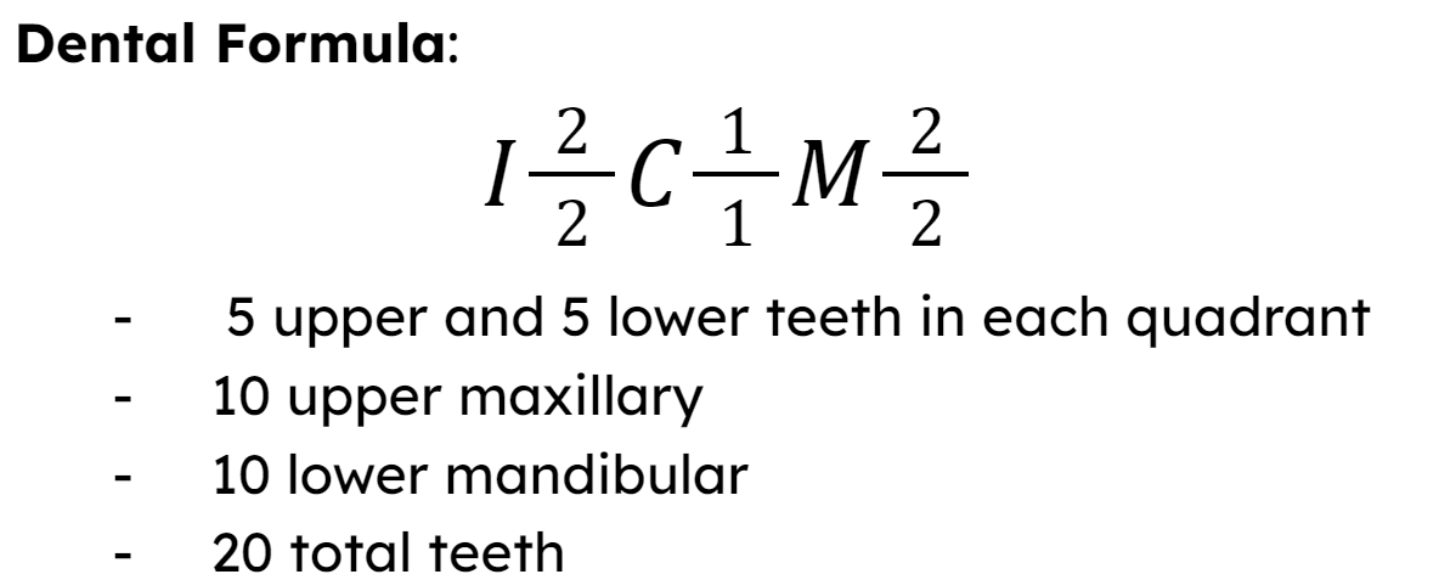
Primary Dentition formula
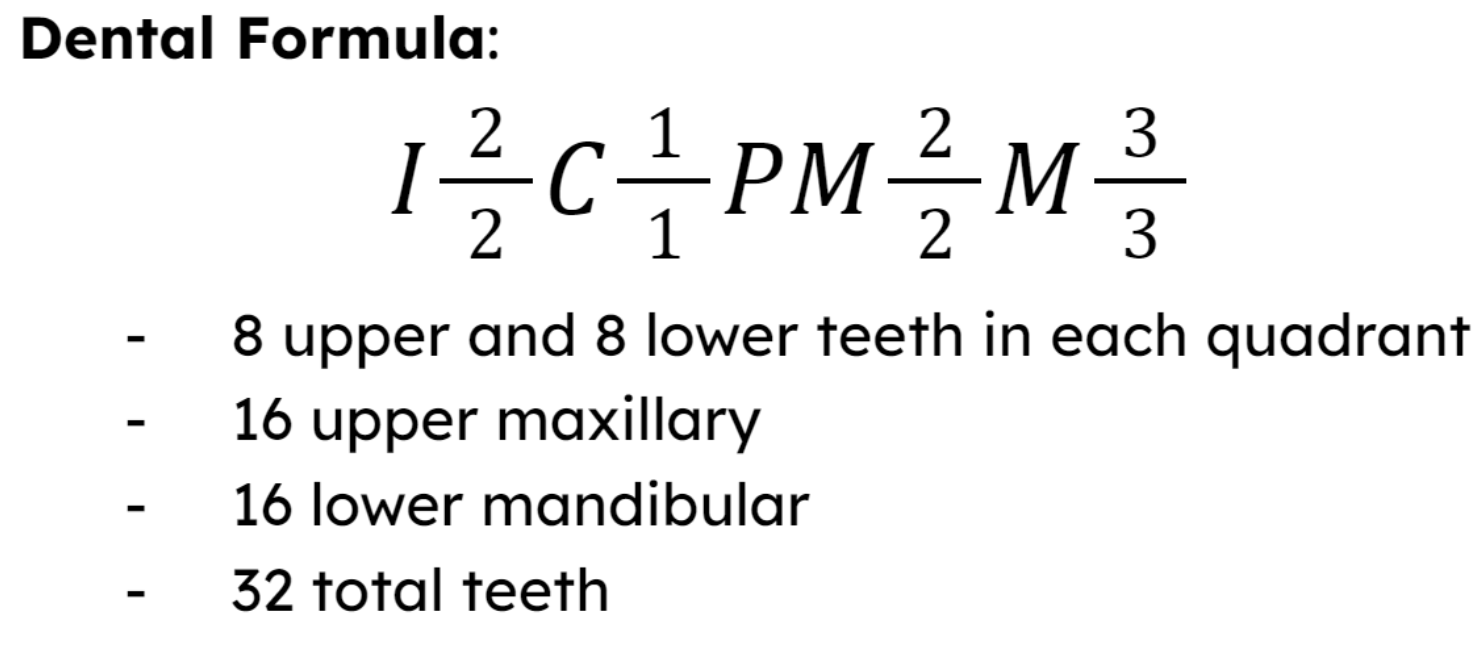
Permanent Dentition formula
Succedaneous
Permanent teeth that replace the deciduous teeth in the dental arch
Central Incisors, Lateral Incisors, Canines, Premolars
Non-succedaneous
They do not have predecessors, and they do not succeed or replace deciduous teeth
Permanent molars
Maxillary and Mandibular 1st, 2nd, and 3rd
Mixed dentition Stage
Dentition with mixed permanent teeth and primary teeth
Usually happens at the age 6 -12
By 12 yrs old there is no primary teeth
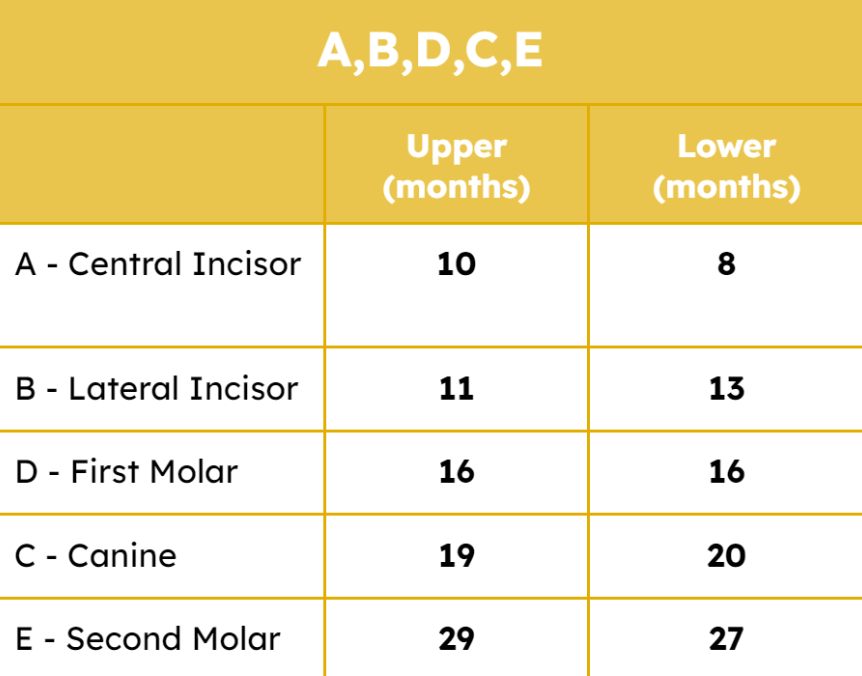
Sequence of emergence in Primary Teeth
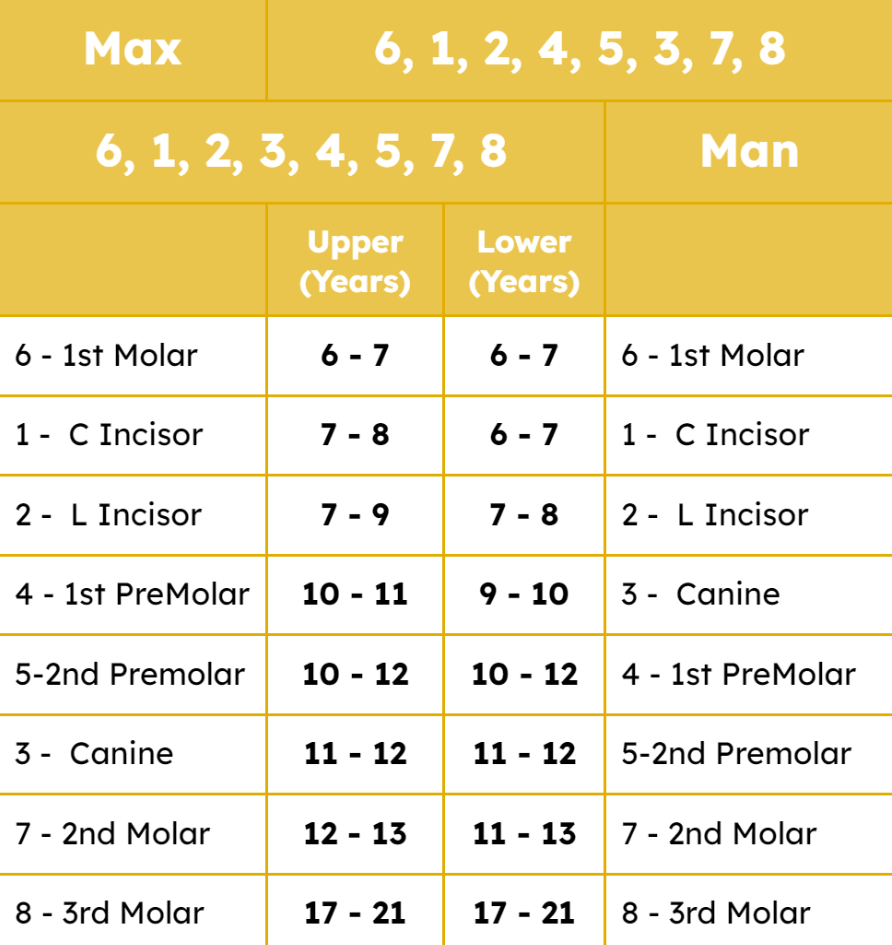
Sequence of emergence in Permanent teeth
Edentulous
No teeth (6 months old)
Primary Dentition Only
6 months to 2 years old: all primary teeth are erupting into the child’s mouth
2 to 6 years old: All 20 primary teeth are present; no permanent teeth are yet visible
Mixed dentition
6 years old: permanent teeth start to appear emergence = first molars. loss = primary mandibular central incisors
6 to 9 years old: All eight permanent incisors replace primary incisors that are exfoliated (shed).
9 to 12 years old: All four permanent canines and eight premolars replace primary canines and molars.
12 years old: Second molars (also called 12-year molars) emerge distal to the permanent first molars