ICF: International Classification of Function, Disability, and Health
 Call Kai
 Learn
Learn Practice Test
 Spaced Repetition
 Match
Match Flashcards
 Knowt Play
1/46

There's no tags or description
Looks like no tags are added yet.
Name | Mastery | Learn | Test | Matching | Spaced | Call with Kai | Chat |
|---|
No analytics yet
Send a link to your students to track their progress
47 Terms
ICF measures what
functional domains of health (NOT disabiltiy)
ICF focuses on __________ complementing ICD-__
function; 10
world health organization adopted a system of classifying health conditions to develop what
a common language in describing health conditions where the information can then be stored, analyzed, and interpreted/compared
in 2001 the WHO adopted the ICF as the “basis for the ___________ of data on _______ and ________ worldwide”
standardization; health; disability
the WHO adopting the ICF establishes a common international language to describe what 3 things
function, health, disability
the ICF is a coding system that looks at health, diagnosis, function, and the environment in which one functions. this allows for collegetion of data in terms of how one functions with a health condition. this was developed in more than ___ countries and was developed by health professionals, persons with disability, ___________, and _________________
40; statisticians; gov’t officials
5 applications of the ICF
statistical tool, research tool, clinical tool, social policy, educational tool
in _____ (what year) the APTA endorsed the ICF model for describing ___________ and now PTs are encouraged to use this model now on the daily and it has even been incorporated into the latest version of ____________
2008; function; the guide
why ICF matters in PT:
moves beyond ________ and gets to ________ care
integrated 3 factors: list them
guides clinical reasoning and goal setting
diagnosis; whole-person
physical, psychological, social
ICD-10 vs ICF:
they are both _________ systems developed by ____ to describe a persons health at a __________
they are meant to be _______________
classification; WHO; particular point in time
complimentary
ICD-10 provides….
a diagnosis of diseases, disorder, and other health conditions
the ICF enriches the ICD-10 information by providing what
additional information on function
PT Guide to Practice was developed on the ______ model for describing disability
NAGI
NAGI model vs ICF
NAGI looks at active pathology leading to impairments, functional limitations, and disability whereas the ICF model addresses the environment looking into both health structure/body function, activities/participation, and the environment
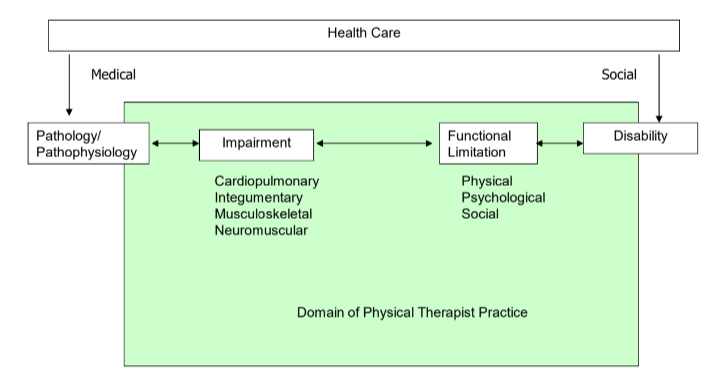
this diagram shows what model
NAGI’s model
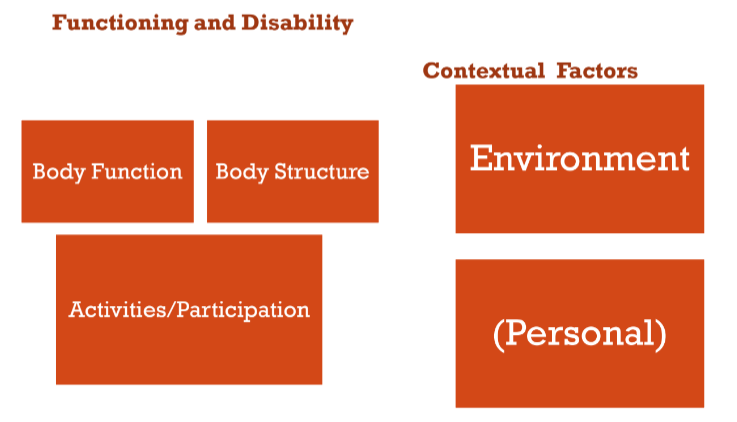
this diagram shows what model
ICF
ICF codes include what 4 things
body structure, body function, activities/participation, environment
(s) code is for what
body structure
(b) code is for what
body function
(d) code is for what
activities/participation
(e) code is for what
environment
body structure (s) and body function (b) work in _______
parallel
body structure (s) refers to what
anatomical parts
body function (b) refers to what
physiological function
includes psychological/mental aspects
assessed via examination and tests/measures
examples of (s) and (b) working together
s: eye and related structures correlates to what b
b: hypertension correlates to what s
seeing functions
CV system
__________ is the execution of a task or action by an individual
activity
____________ is the involvement of a life situation
participation
__________________ are difficulties an individual may have in executing activities
activity limitations
___________________ are problems an individual may experience in involvement in life situations
participation restriction
examples of activity and what is the focus for PT
ex: walking, transferring, ADLs
focus: functional limitations
examples of participation and what is the focus for PT
ex: work, school, social roles
focus: reflects patient-centered outcomes
activities/participation includes what 3 things
learning/applying knowledge
mobility
self-care/domestic life
specific coding for ICF has numerical values assigned to body functions, structures, activities/participation, and environment
ex: is 4 means mobility, 50 means walking, and 2 means walking on different surfaces, then the code d4502 means what
remember (d) is environment soooo
walking on sloping, uneven or moving surfaces such as grass, gravel, or ice snow, or moving aboard a ship or train
qualifiers
describe magnitude, severity, and level of function
T/F: without qualifiers the codes have no meaning
true
qualifier numbers and meanings
0: no problem
1: mild problem
2: moderate problem
3: severe problem
4: complete problem
8: not specified
9: not applicable
qualifiers determine ___________ as it relates to body structure (s) and body function (b)
magnitude
qualifiers determine ___________ as it relates to the environment
barrier/facilitator
qualifiers determine ___________ as it relates to activities/participation
capacity and performance
contextual factors such as the environment and personal factors influence what
outcomes and interventions
how to apply ICF in PT practice
use for evaluation, goal setting, and __________
link _________ to functional outcome
enhance _____________
documentation; impairments; interdisciplinary communication
define s, b, e, and d as it relates to gait
s: structures related to lower extremities
b: actual deviation and gait impairment
e: public transportation services
d: distances ambulated, moving around using equipment, ability to walk on various surfaces
define s, b, e, and d as it relates to an ACL tear
s: actual ACL tear
b: decreased strength
e: context- athlete? how is patient doing during practice?
d: activity-difficulty running and participation-cannot play sports
T/F: ICF classifies people
false, ICF does not classify people it classifies function/activities
is ICF an assessment or measurement tool
neither
T/F: ICF is only for people with disabilities
false, it is for all people