Unit 0.5-0.6 Vocab
 Call Kai
 Learn
Learn Practice Test
 Spaced Repetition
 Match
Match Flashcards
 Knowt Play
1/24

Earn XP
Description and Tags
Everyone needs to blow up already.
Name | Mastery | Learn | Test | Matching | Spaced | Call with Kai | Chat |
|---|
No analytics yet
Send a link to your students to track their progress
25 Terms
Quantitative Research
A research method that relies on numerical data.
Example: SAT scores.
Qualitative Research
A research method that replies on in-depth descriptive data, and is not numerical.
Example: Case study
Informed Consent
Giving enough information about the experiment in order for the participants to actually determine if they wish to proceed with the experiment.
Example: A surgeon provides a form detailing surgical risks, anesthesia options, and recovery expectations before a patient signs.
Debriefing
Post experimental explanation of a study, including its purpose and any deceptions, to its participants.
Example: Talking to someone after an experiment, telling them the results and how each test went.
Institutional Review Board
A committee at an institution that applies research ethics by reviewing the methods proposed for research involving human subjects, to ensure that the projects are ethical.
Example: A researcher must send in his procedures to the IRB in order to start recruiting people for his experiment.
APA Ethical Guidelines for Human Research
The American Psychological Association (APA) ethical guidelines for human research are official rules and core principles designed to protect the safety, rights, and dignity of people who take part in psychological studies.
Informed assent
A process through which minors agree to participate in any activity, through their Guardian.
Example: Getting signed permission slip from legal guardian to participate in a fieldtrip.
Protection from Harm
It is a commitment to prevent any negative physical, mental, or emotional distress caused by a study or treatment.
Example: A researcher notices a participant crying during a stressful emotional recall task. The researcher stops the experiment immediately to prevent further distress.
Confidentiality
Participants information must be kept private.
Example: A therapist refusing to tell a client's spouse, employer, or police about personal struggles shared in a session.
Research Confederates
an actor or researcher assistant who secretly works for the experimenter while pretending to be a normal, regular participant.
Example: In an experiment to see if people would do something because majority of the people in the room are doing it also, the confederates would be the people starting the strange actions.
Descriptive Statistics
numerical data used to measure and describe characteristics of groups; include measures of central tendency and measures of variation.
Example: A teacher wants to summarize the math test scores for a class of 5 students: 70, 80, 80, 85, and 95.
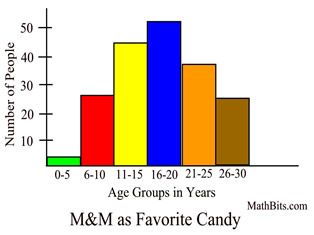
Histogram
a bar graph depicting a frequency distribution.
Example in the image.
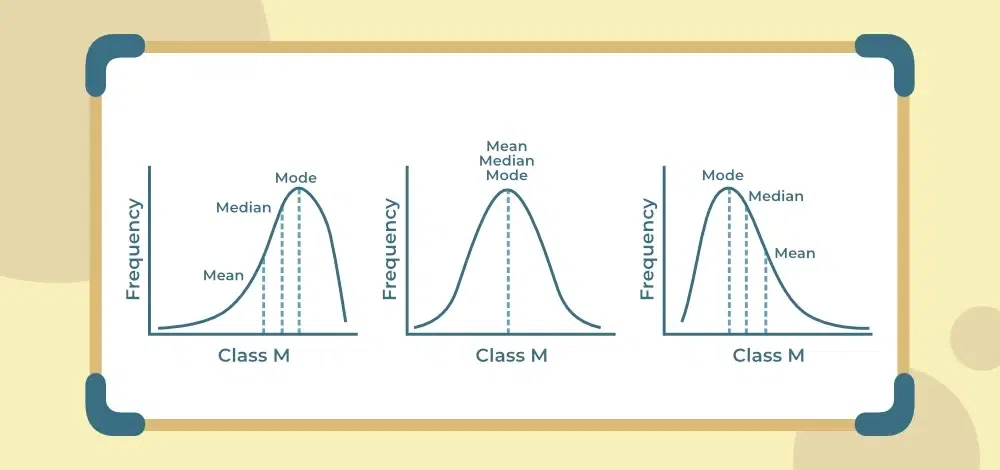
Measures of Central Tendency
Something that represents the middle, center, or typical value of a data set
Example in the image
Mode
Measures the most frequently occurring number in a data set.
Example: In a set of 12, 12,14, 15, 10, 13; the Mode would be 12 since it appears twice.
Mean
The numerical average of a set of data (add up all the digits and then divide by the number of numbers in the data).
Example: in a set of 10, 10, 15, 10, 15; the mean would be 12 after doing the calculations.
Median
The middle number in a data set after arranging then all in numerical order (if it’s an even set of numbers you would get the two numbers in the middle add the up and divide by two to find the median).
Example: in a data set of 3, 5, and 7; the median would be 5.
Percentile Rank
The percentage of scores that are lower than the given score.
Example in the image.

Skewed Distribution
Data that is not spread evenly and instead cluster toward one side.
Example in the image.

Range
The difference between the maximum value from minimum value.
Example: If test scores in a psychology class range from a low of 43 to a high of 98, the range is 98 - 43 = 55.
Standard Deviation
A statistical measure that shows how spread-out individual scores or data points are from the group average.
Example: Scores cluster closely around the mean, meaning participants responded or performed very similarly, Scores spread out widely from the mean, meaning participants varied greatly in their responses or behaviors.
Normal Curve
a symmetrical, bell-shaped curve that describes the distribution of many types of data; most scores fall near the mean (about 68 percent fall within one standard deviation of it) and fewer and fewer scores lie near the extremes.
Example in the image

Inferential Statistics
numerical data that allow one to generalize; to infer from sample data the probability of something being true of a population.
Example: If a researcher asks 30 students out of a school population, of 3,000 students about stress, and all the kids say they experience horrible cases of stress. The researcher could assume everyone in there has similar experiences.
Meta-analysis
a statistical procedure for analyzing the results of multiple studies to reach an overall conclusion.
Statistical Significance
a statistical statement of how likely it is that a result (such as a difference between samples) occurred by chance, assuming there is no difference between the populations being studied.
Effect Size
the strength of the relationship between two variables. The larger the effect size, the more one variable can be explained by the other.