Biology Chapter 3 - Macromolecules
 Call Kai
 Learn
Learn Practice Test
 Spaced Repetition
 Match
Match Flashcards
 Knowt Play
1/99

There's no tags or description
Looks like no tags are added yet.
Name | Mastery | Learn | Test | Matching | Spaced | Call with Kai | Chat |
|---|
No analytics yet
Send a link to your students to track their progress
100 Terms
The Big Six - the most common elements in biological molecules are
Carbon, Hydrogen, Oxygen, Nitrogen, Phosphorus, and Sulfur
Bonds and Molecules
Molecule - a chemical substance that results from the combination of two or more atoms
Compounds - molecules that are combinations of
two or more different elements
3 Types of Chemical Bonds
Covalent Bonds - strongest; two atoms share one or more pairs of valence electrons to become stable Non - polar is equal sharing Polar is unequal sharing of electrons
Ionic Bonds - electrons are transferred to one atom, forming positively charged atoms cations and negatively charged anions
Hydrogen Bonds - Electrostatic attraction between H, N or O
Hydrogen Bonds
weak bonds between H and other atoms; strength is additive
Solutions
Solution - A mixture of one or more substances called solutes, dispersed in a dissolving medium called a solvent
Aqueous Solutions
Hydrophilic Molecules - dissolve in water
Hydrophobic molecules - repeal water
Amphipathic molecules - have both hydrophilic and hydrophobic properties

Why Water is so special
Liquid at most earth temperatures, resists temperature changes ( it takes a lot of energy to heat water)
superb solvent (carry nutrients to cells and wastes away)
Sticks Together ( high cohesion water molecules sticks to water molecules - adhesion - water sticking to other things, and tension due to hydrogen bonds)
water is a buffer (resists changes in pH)
Ice floats so whole lakes won’t freeze and kill everything in the winter
cells use water as part of their cytoplasm
Acidity, Alkalinity, and the pH Scale
Self - Ionization of H2O releases H ions and hydroxyl ions, pH scale ranges from 0 to 14, expresses the concentration of H ions, is important to the cell because if its too acidic then the cell will be destroyed
Organic Compounds
compounds containing C bonded to H’s, inorganic compounds lack C and H like CO2, carbon in the fundamental element of life
Organic Compounds matter because…..
plants and trees combine water and carbon dioxide into sugars and other carbon based compounds through photosynthesis, which they all depend on. Carbon compounds form structures living organisms, take part in all biological reactions, and serve as energy sources living organisms and industry
Organic Molecule - Four major classes of organic molecules are found in living organisms:
Carbohydrates, Lipids, proteins, and nucleic acids. In organic molecules, carbon atoms bond covalently to each other and to other atoms in molecules that range in size from a few atoms to thousands or millions of atoms.
Hydrocarbons
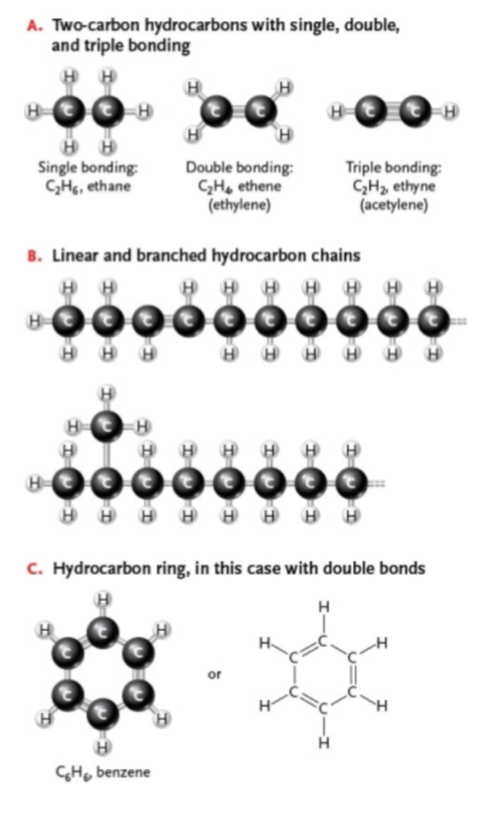
Molecules consisting of carbon linked only to hydrogen atoms are called hydrocarbons
Carbon has four unpaired outer electrons, Simplest Hydrocarbon is
CH4 methane
Complex Hydrocarbons involve…
two or more carbon atoms arranged in a linear unbranched chain, a linear branched chain, or a structure with one or more rings. Single and double bonds are found in linear and ring hydrocarbons; triple bonds only in two-carbon hydrocarbon
Chemical Evolutions
this resulted in first forms of life on Earth after formations of organic molecules, resulted from reactions involving inorganic molecules on primordial earth and conditions on the planet at that time
Functional Groups
Small reactive groups of atoms which give larger molecules specific chemical properties. Most frequent in biological reactions are hydroxyl, carbonyl, carboxyl, amino, phosphate and sulfhydryl.
Functional groups are linked by…..
covalent bonds to other atoms in biological molecules, usually carbon atoms represented in the collective symbol R
Hydroxyl
(-OH)
Major class - Alcohols
Ex. Ethyl Alcohol
Polar, Hydrogen bonds with water; dissolves organic molecules. Alcohol can form linkages with other organic molecules through dehydration synthesis
Carbonyl
C=O
Major Classes - Aldehydes, Ketones
Ex. Acetone
Major building blocks of carbohydrates and participate in reactions supplying energy for cellular activities
Carboxyl
(-COOH)
Major classes - Carboxylic Acids
Ex. Acetic Acid
Gives organic molecules acidic properties because -OH releases the hydrogen as a proton (H+) in aqueous solutions, turning it from a non-Ionized to an ionized form
Amino
(-NH2)
Major Class - Amines
Ex. Alanine
Acts as an organic base by accepting a proton in aqueous solutions, turning it from a non-Ionized to an ionized form
Phosphate
(-OPO2-3)
Major Classes - Organic Phosphates
Ex. Glyceraldehyde 3-phosphate
React as weak acids because one or both OOH groups release their hydrogens as H+ in aqueous solutions, turning it from a non-Ionized to an ionized form
Can bridge two organic building blocks to form a larger structure. Added or removed from biological molecules as part of reactions that conserve or release energy ro to alter protein activity
Sulfhydryl
(-SH)
Major Class - Thiols
Ex. Mercaptoethanol
easily converted into a covalent linkage, in which it loses its hydrogen atoms as it binds
Isomers
Carbons that are linked to four different atoms or functional groups are asymmetric, Can take either of two fixed positions with respect to other carbons in a chain, The two forms (isomers) have the same chemical formula, but have different molecular structures
Stereoisomers
Isomers that are mirror images of each other, Typically only one of the two forms (L-form or D-form) can enter into a reaction
Structural Isomers
two molecules with the same chemical formula but atoms are arranged in different ways
Adding and Removing Water
In many reactions involving functional groups, the components of a water molecule (—H and —OH) are removed from or added to the groups as they interact
Water removed
reaction is called dehydration synthesis, or a condensation reaction
Dehydration - removes the components of a water molecule as new covalent bonds join subunits into a larger molecule

Adding Water
Hydrolysis - add the components of a water molecule as covalent bonds are broken, splitting a molecule into smaller subunits

Macromolecules
large compounds assembled from smaller subunits
monomer: a repeating subunit
polymer: a chain of monomers
Main: Carbohydrates, lipids, proteins, nucleic acids
Polymers
carbohydrates, lipids, proteins and nucleic acids are larger polymers assembled from subunit molecules (monomers) into a chain by covalent bonds
Polymers are assembled from
monomers (polymerization) by dehydration synthesis reactions, the breakdown of polymers into monomers occurs by hydrolysis
Macromolecules - each type of polymeric biological molecule contains….
one type of monomer, individual monomers may be identical or may have chemical variations depending on the molecule
A single polymer with a mass of ——— or more is called a ———
1,000 Daltons, macromolecule
Includes many carbs, proteins, and nucleic acids, lipids are not large enough to be classed as macromolecules
Carbohydrates Functions
Energy Providing: Plants - they are starch Animals - glucose
Structural: cellulose, a primary components in plants cell wall
Cell structure, adhesion, and metabolism
Carbohydrates contain
Only carbon, hydrogen, and oxygen atoms in a ratio of about 1C:2H:1O
Monosaccharides contain three to seven carbons, two monosaccharides polymerize to form a disaccharide. Carbohydrate polymers with more than 5-10 or more lined monosaccharide monomers are polysaccharides
Saccharide, Monosaccharide, Disaccharide, Polysaccharide
simple carbohydrate, 3-7 carbons, two monosaccharide, five or more monosaccharides
Monosaccharides
Carbohydrates occur either as monosaccharides or as polymers of monosaccharide units
Monosaccharides (such as glucose, C6H12O6) are soluble in water and sweet-tasting
The most common monosaccharides contain three carbons (trioses), five carbons (pentoses), or six carbons (hexoses)
All monosaccharides can occur in linear form
Sugar and Polysaccharides general formula
(CH2O)n
Ring Forms
Monosaccharides with five or more carbons (such as glucose) can fold back on themselves through a reaction between two functional groups to assume a ring form
Glucose exists as two different enantiomers
α-glucose, with an —OH group pointing below the plane of the ring
β-glucose, with an —OH group pointing above the plane
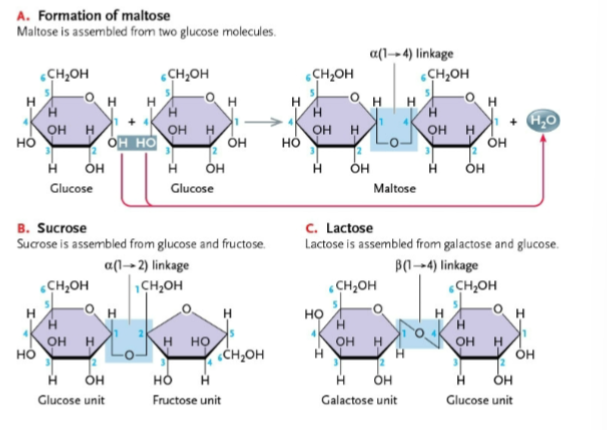
Disaccharides
Disaccharides are assembled from two monosaccharides covalently joined by a dehydration synthesis reaction
Common disaccharides: sucrose (glucose + fructose) galactose (glucose + galactose)
Polysaccharides
The most common polysaccharides (plant starches, glycogen, and cellulose) are polymers of hundreds or thousands of glucose units
Chitin is assembled from glucose units modified by the addition of nitrogen-containing groups
Polysaccharides may be linear, unbranched molecules, or they may contain one or more branches in which side chains of sugar units are attached to a main chain
Carbohydrate subunits are linked by
glycosidic bonds
Dehydration synthesis: loss of water in a polymerization reaction
Hydrolysis: Cleavage of the glycosidic bond by the addition of water
Lipids
water-insoluble, primarily nonpolar biological molecules composed mostly of hydrocarbons
Three common types of lipid molecules:
• Neutral lipids are stored and used as an energy source
• Phospholipids form cell membranes
• Steroids serve as hormones that regulate cellular activities
Neutral Lipids
energy storage molecules have no charged groups (nonpolar)
Two types: Oils ( liquid at a biological temperature) Fats (are semisolid)
A fatty acid contains a single hydrocarbon chain with a carboxyl group at one end
Glycerol and Triglyceride Formation
Triglycerides form by dehydration synthesis between three carbon glycerol (an alcohol) and three fatty acid side chains
A covalent bond (ester linkage) forms between the -COOH group of the fatty acid and the -OH group of the glycerol
The polar groups of glycerol are eliminated, forming a nonpolar triglyceride
The most common fatty acids have
chains of 14 to 22 carbons - As chain length increases, fatty acids become less water-soluble and more oily
A saturated fatty acid binds
the maximum number of hydrogen atoms
only a single bond exist between carbon atoms
Fatty acids with one double bond are monounsaturated those with more than one double bond are polyunsaturated
Saturated fatty acids are found in solid animal fats such as
butter
Unsaturated fatty acids
(such as vegetable oil) bend at a double bond and are more fluid at biological temperatures
Unsaturated fats are considered healthier than saturated fats in the human diet
Plant oils are converted commercially to saturated fats by hydrogenation
Functions of Triglycerides ( triglycerides are the most common lipid found in the bloodstream)
Energy reserves in animals
Store more than twice the calories per gram as carbohydrates
A layer of fatty tissue just under the skin acts as insulation in mammals and birds
Triglycerides also help make bird feathers waterproof
Can be saturated or unsaturated
Waxes
Fatty acids combine with long-chain alcohols or hydrocarbon structures to form waxes, which are harder and less greasy than fats
Waxy coatings help animals keep skin, hair, or feathers protected, lubricated, and pliable
Plants secrete waxes that form a protective exterior layer, which reduces water loss and resists infective agents
Phospholipids
Phosphate-containing phospholipids are the primary lipids of cell membranes
The most common phospholipid has a glycerol backbone linked to two fatty acid chains and a polar phosphate group, which is linked to another polar group
The end of the molecule containing the fatty acids is nonpolar and hydrophobic, and the end with the phosphate group is polar and hydrophilic
Phospholipid Bilayer
a film of phospholipids two molecules thick – is the structural basis of membranes
In a bilayer, the polar groups face the surrounding water molecules at the surfaces of the bilayer – the hydrocarbon chains form a nonpolar, hydrophobic region in the interior
Steroid
Steroids are lipids with structures based on a framework of four carbon rings
Sterols, the most common steroids, have a single polar OH group linked to one end of the ring framework and a complex, nonpolar hydrocarbon chain at the other end
Cholesterol is an important component of animal cell membranes
Similar sterols (phytosterols) occur in plant cell membranes

Steroid Hormones
Steroid hormones control development, behavior, and many internal biochemical processes
Examples: The sex hormones that control differentiation of the sexes and sexual behavior
Estradiol (female sex hormone) has an —OH in the position where testosterone (male sex hormone) has an =O, and testosterone has a methyl group (—CH3) that is absent from estradiol

Other Lipids
Several other lipid types have structures unrelated to triglycerides, phospholipids, or steroids
Chlorophylls and carotenoids are pigments that absorb light and help convert it to chemical energy in plants
Lipid groups combine with carbohydrates to form glycolipids, and with proteins to form lipoproteins, which have important structural and functional roles in cell membranes
Proteins
Predominant molecules in cells
Essential to cell structure and function: structural support; enzymes; movement; transport; recognition and receptor molecules; regulation of proteins and DNA; hormones; antibodies; toxins and venoms
Cell type varies based on the type of proteins they can produce
Monomer – amino acids – 20 encoded by codons
Polymer – peptide, polypeptide, protein
Amino Acids
All organisms use 20 different amino acids to build proteins
Most have the same structural plan: a central carbon atom is attached to an amino group, a carboxyl group, a hydrogen atom, and a variable R group
R group can be polar ( hydrophillic), non-polar (hydrophobic; cystine has sulfur and Methionine has sulfur), or electrically charged
The monomers that make up a protein polymer

Proline Amino Acid
differs slightly in that it has a ring structure that includes the central carbon atom – the central carbon bonds to a —COOH group on one side and to an =NH (imino) group at the other side
All amino acids can act as
acids or bases
The amino acid group can produce a basic reaction by accepting H+, or the carboxyl group can produce an acidic reaction by releasing H+
Some chemical groups are
polar and some are nonpolar
Among the polar chemical groups, some carry a positive or negative charge and some act as acids or bases
Many chemical groups contain reactive functional groups such as
—NH2, —OH, —COOH, or —SH, which interact with other atoms in the same protein or outside the protein
Sulfhydryl groups (in cysteines) can produce disulfide linkages (—S—S—) that help hold proteins in their 3-D shape
Peptide Bonds
Covalent peptide bonds link amino acids into polypeptide chains - the subunits of proteins
A peptide bond is formed by a dehydration synthesis reaction between the -NH2 group of one amino acid and the -COOH group of another amino acid
The growing polypeptide chain has an N-terminal end and a C-terminal end
New amino acids are linked only to the C-terminal end
Amino Acids are attached through
peptide bonds to form proteins
Four Levels of Protein Structure
Primary structure is the unique sequence of amino acids forming a polypeptide
Secondary structure is produced by the twists and turns of the amino acid chain
Tertiary structure is the folding of the amino acid chain, with its secondary structures, into the overall 3-D shape of a protein, where a lot of proteins stop
Quaternary structure, when present, is formed from more than one polypeptide chain, multiple proteins to make something
Structure =
Function
Primary Structure of a protein is the
precise sequence in which amino acids are linked
Changing even a single amino acid alters secondary, tertiary, and quaternary structures, which can alter or destroy the biological function of a protein
Secondary Structure
The amino acid chain (primary structure) is folded into arrangements that form the protein’s secondary structure
The alpha (α) helix is twisted into a regular right-hand spiral
The beta (β) strand zigzags in a flat plane, forming a sheet
Most proteins have segments of both arrangements
An α Helix
Amino acid chemical groups extend outward from the twisted backbone
Stabilized by regularly spaced hydrogen bonds
Forms rigid, rod-like structures

A β Sheet
The amino acid chain zigzags in a flat plane
β strands are aligned side by side in the same or opposite directions
Hydrogen bonds stabilize the sheet

The Random Coil
A random coil has an irregularly folded arrangement
Segments of random coil provide flexible sites that allow α helical or β-strand segments to bend or fold back on themselves
Segments of random coil act as “hinges” that allow major parts of proteins to move with respect to one another
Tertiary Structure
Tertiary structure gives a protein its overall three-dimensional shape, or conformation
The positions of secondary structures, disulfide linkages, and hydrogen bonds play major roles in folding each protein into its tertiary structure
Attractions between positively and negatively charged chemical groups and polar or nonpolar associations also contribute to tertiary structure
Tertiary Structure determines
a proteins function
The distribution and 3-D arrangement of chemical groups, in combination with their chemical properties, determine the overall chemical activity of the protein
Tertiary structure also determines the solubility of a protein, depending on the arrangement of polar (hydrophilic) and nonpolar (hydrophobic) segments
Tertiary structure of most proteins is flexible, allowing them to
undergo limited conformational charges
Conformational charges are important to the function of enzymes, and to proteins involved in cellular movements or transport of substances across cell membranes
Denaturation
Unfolding a protein from its active conformation so that it loses its structure and function (caused by chemicals, changes in pH, or high temperatures) is called denaturation
For some proteins, denaturation is permanent – for others, denaturation is reversible (renaturation)
Anfinsen’s Experiment
showed that breaking the disulfide linkages holding the protein ribonuclease in its functional state caused it to unfolded and lose enzyme activity
Chaperonins
present in the Golgi apparatus
Proteins fold gradually as they are assembled – as successive amino acids are linked into the primary structure, the chain folds into increasingly complex structures
For many proteins, “guide” proteins called chaperone proteins or chaperonins bind temporarily with newly synthesized proteins, directing their conformation toward the correct tertiary structure and inhibiting incorrect arrangements

Quaternary Structure
Some complex proteins, such as hemoglobin and antibody
molecules, have quaternary structure – the presence and
arrangement of two or more polypeptide chains
• Hydrogen bonds, polar and nonpolar attractions, and disulfide linkages hold the multiple polypeptide chains together
• Chaperonins promote correct association of the individual amino acid chains and inhibit incorrect formations
Functional Domains
In many proteins, folding of the amino acid chain (or chains) produces large subdivisions called domains
In proteins with multiple functions, individual functions are often located in different domains
Domains with similar functions are found in different proteins
3-D arrangement of amino acid chains within and between domains produces highly specialized regions called motifs
Protein Combinations
Proteins link with lipids to form lipoproteins, which form parts of cell membranes
Proteins link with carbohydrates to form glycoproteins, which function as enzymes, antibodies, recognition and receptor molecules, and parts of extracellular supports
Proteins link with nucleic acids to form nucleoproteins, which form structures such as chromosomes
Nucleic Acids
monomer - Nucleotide
All living cells have both DNA and RNA
DNA
deoxyribonucleic acid
A,T,G,C – nitrogen bases
Double helix
Function – hereditary material in all eukaryotes and prokaryotes and in a large group of viruses
Double stranded
RNA
ribonucleic acid
A,U,G,C – nitrogen bases
Usually single stranded
Function –is the hereditary molecule of another large group of viruses – three major types of RNA are involved in protein synthesis
Single stranded
Nucleotides
A nucleotide, the monomer of nucleic acids, consists of three parts linked together by covalent bonds:
A nitrogenous base formed from rings of carbon and nitrogen atoms
A five-carbon, ring-shaped sugar
One to three phosphate groups

Pyrimidines
Nitrogenous bases with one carbon-nitrogen ring
Uracil (U), thymine (T), and cytosine (C)
Purines
Nitrogenous bases with two carbon–nitrogen rings
Adenine (A) and guanine (G)
DNA Nucleotides
Deoxyribose (sugar)
A, T, G, C
nitrogenous base
phosphate
RNA Nucleotides
Ribose (sugar)
A, U, G, C
nitrogenous base
phosphate
Ring Shaped Sugars
Nitrogenous bases link covalently to a five-carbon sugar:
Deoxyribose in DNA deoxyribonucleotides
Ribose in RNA ribonucleotides
The two sugars differ only in the chemical group bound to the 2′ carbon (—H in deoxyribose, —OH in ribose)
In unlinked nucleotides: 1, 2, or 3 phosphate groups bond to the ribose or deoxyribose sugar at the 5′ carbon
Nucleosides and Nucleotide Phosphates
A structure containing only a nitrogenous base and a five-
carbon sugar is a nucleoside
A nucleotide is a nucleoside phosphate
Examples: Adenosine monophosphate (AMP) Adenosine diphosphate (ADP) Adenosine triphosphate (ATP)
DNA Base Pairs
The two polynucleotide chains of a DNA double helix are held together by hydrogen bonds between the base pairs
A base pair consists of one purine and one pyrimidine
Adenine pairs only with thymine (A–T), forming two stabilizing hydrogen bonds
Guanine pairs only with cytosine (G–C), forming three hydrogen bonds
DNA and RNA consist of
Polynucleotide chains, with one nucleotide linked to the next by a phosphodiester bond
One nucleotide is linked to the next by a bridging phosphate group between the 5′ carbon of one sugar and the 3′ carbon of the next sugar
Alternating sugar and phosphate groups form the backbone of a nucleic acid chain

DNA Molecule
The DNA molecule is a double helix (double-stranded) consisting of two polynucleotide chains wrapped around each other in a spiral that resembles a twisted ladder
The sides of the ladder are the sugar-phosphate backbones of the two chains
The rungs of the ladder are nitrogenous bases which extend inward from the sugars toward the center of the helix
DNA is formed by two very long polynucleotide strands linked along their length by hydrogen bonds
Complementary Base Pairing
Formation of A–T and G–C pairs allows the sequence of one polynucleotide chain to determine the sequence of its partner in the double helix
The nucleotide sequence of one chain is said to be complementary to the nucleotide sequence of the other chain
In DNA replication, one polynucleotide chain is used as a template for the assembly of a complementary chain according to the A–T and G–C base-pairing rules
Chargraff’s Rule
number of purines = number of pyrimidines
DNA Passing on the Genetic Message
Each strand is copied
Semi-conservative replication
Replication is guided by base pairing
A=T and G=C
RNA Molecules
RNA molecules exist mainly as single polynucleotide chains (single-stranded) – however, RNA molecules can fold back on themselves to form double-helical regions
In RNA, the uracil (U) base takes the place of thymine (T), forming A–U base pairs
“Hybrid” double helices (an RNA chain paired with a DNA chain) are formed temporarily when RNA copies DNA
ATP
The energy molecule of cells
Adenosine Triphosphate
Nucleotide - adenine, ribose, and three phosphates
Function - transfer and storage of energy
ATP is made by
dehydration synthesis
Is broken by hydrolysis to liberate useful energy for the cell
