External Morphology of Insects
 Call Kai
 Learn
Learn Practice Test
 Spaced Repetition
 Match
Match Flashcards
 Knowt Play
1/135

There's no tags or description
Looks like no tags are added yet.
Name | Mastery | Learn | Test | Matching | Spaced | Call with Kai | Chat |
|---|
No analytics yet
Send a link to your students to track their progress
136 Terms
Tagmosis
The formation of specialized body segments in arthrpods.
Head
Anterior-most tagma of an insect, crucial for food ingestion and sensing the environment.
Thorax
Middle tagma of an insect, between the head and abdomen, primary purpose is for locomotion
Abdomen
Posterior-most tagma of an insect, houses digestive canal, doral blood vessel, & reproductive organs, made of 11 segments
Integument
The tough, outer body layer of an insect. The largest organ of insects, very diverse in structure, and critical to their success.
Cuticle
The outermost layer of an insect’s integument, the exoskeleton.
Epidermis
A deep, single layer of cells, innermost layer of an insect’s integument.
Sclerites
Rigid, discrete plates making up an insect’s cuticle.
Setae
Hair-like projections on an insect’s integument.
Spines
Rigid outgrowths of an insect’s integument.
Spurs
Movable outgrowths of an insect’s integument
Sutures
Grooves on the surface of an insect’s integument that separate sclerites
Hypognathous
Directional position of the head where mouthparts are directed downward, below the eyes
Prognathous
Directional position of the head where mouthparts are directed forward, anterior to the eyes
Opisthognathus
Directional position of the head where mouthparts are directed posteriorly, beneath the thorax
Cervix
A membranous neck region of the head
Cervical sclerites
Lateral plates of cervix that help move the head
Compound eyes
Large pairs of sensory organs composed of many ommatidia
Ommatidia
Individual light-processing units that comprise insect’s compound eyes
Vertex
Dorsal section of head, between eyes
Gena
The area ventral to the vertex and compound eyes, may not be visually distinct
Antennae
Paired, segmented sensory structures on an insects head, main function is sensory. May be more elaborate in males and have additional sensory capacity
Frons
Ventral to the vertex, between eyes and antennae
Clypeus
Area of an insect’s head ventral to the frons
Ocelli
Simple eyes located between compound eyes
Tentorium
A special modification of the head, serves as a site for muscle attachments and also stabilized the head.
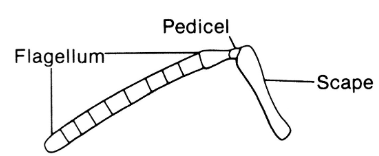
Scape
Basal-most section of an insect’s antennae
Pedicel
Middle section of an insect’s antennae
Flagellum
Distal-most segment of an insect’s antennae, often multi-segmented into flagellomeres
Sensilla
Sensory receptors on the antennae, pegs, cones, pits, or hairs. Sense heat, chemicals, moisture, and movement
Filiform
Antennal type that is thread-like with segments nearly uniform in size, often cylindrical
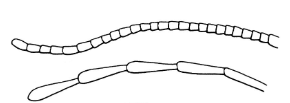
Setaceous
Antennae type that are bristle-like, segments becoming more slender distally

Moniliform
Antennae type with bead-like spherical segments similar in size

Clavate
Antennae type where segments increase gradually in size distally
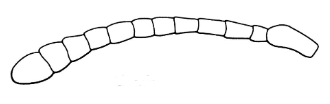
Capitate
Antennae types where segments increase suddenly in size distally

Serrate
Antennae type that are saw-like, with triangular segments, especially in distal 2/3

Stylate
Antennae type with distal-most segment having an elongate finger-like process

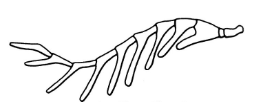
Pectinate
Antennae type that are comb-like and have long lateral processes
Geniculate
Antennae type that are elbowed, with the scape long, and the pedicel small and at an angle to the scape
Lamellate
Antennae type with the terminal segments expanded laterally to form rounded or oval plate-like lobes

Plumose
Antennae type that are feathery, most segments have whorls of long hair

Aristate
Antennae type with the last segment enlarged, with a dorsal bristle

Mouthparts
modified, paired appendages used to capture, manipulate, gather, chew food
Labrum
Anterior-most segment of mouthparts, “upper lip”
Mandibles
Paired, heavily-sclerotized jaws, used to cut & crush food and used for defense
Molar area
Section of mandibles modified for biting and often hardened with metal deposits
Maxillae
Smaller pair of jaws that assist mandibles in processing
Cardo
Basal sclerite of maxilla
Stipes
Distal sclerite of maxilla
Lacinia
Distal pointed lobe of maxilla
Galea
Distal rounded lobe of maxilla
Labium
Posterior-most section of mouthparts, “lower lip”, similar to maxillae but not paired
Postmentum
Basal section of labium
Prementum
Distal section of labium, with glossae, paraglossae, and palps
Glossae
Small pair of distal, inner lobes on prementum of labium
Paraglossae
Large pair of distal, outer lobes on prementum of labium
Palps
Antennae-like segmented appendages on the maxillae and labium, help manipulate food into mouth and sense food
Hypopharynx
A tongue-like structure in chewing insects, variously modified and often secreting saliva
Entognathous
Of arthropods whose mandibles and maxillae are withdrawn into the head capsule when not in use, 6-legged arthropods like Collembola, Diplura, Protura
Ectognathous
Of arthropods whose mouthparts are visible and not withdrawn into the head capsule, typical of “true” insects
Chewing mouthparts
Most adult and immature insects have these, least specialized & basic type, for solid food
Cutting-sponging mouthparts
Extremely specialized mouthparts seen in a few species of adult flies, parasitic blood-feeders of vertebrates. Mandibles and maxillae are long and pointed to pierce skin and labium sponges up blood
Sponging mouthparts
Specialized group of flies (house flies), proboscis formed of mostly labium, maxillae and mandibles largely lost (maxillary palps remain), sponging labellum at tip of proboscis sponges up liquid food, hypopharynx secretes saliva to liquefy solids
Siphoning mouthparts
Seen in butterflies & moths, long proboscis formed from galea take up water and nectar and is coiled under head when not in use, mandibles are reduced or lost, between galea is a food canal that siphons up food using sucking pump in head
Piercing-sucking mouthparts
Second-most common mouthparts, have independently evolved in distantly related groups, used to suck blood or plant nectar, elongate beak composed of long needle-like stylets
Stylets
Specialized maxillae and mandibles to be long and needle-like in piercing-sucking mouthparts, enter animal or plant tissue, may have two channels for food and saliva
Sheath
Specialized labium in piercing-sucking mouthparts, does not enter animal/plant tissue but guides and cradles stylets
Chewing-lapping mouthparts
Used in adult bees to take up nectar and honey, proboscis formed by glossae of labium and galea of maxillae, nectar is drawn in by a sucking pump in head and movement of proboscis. Mandibles are used for nest-building, feeding queen, grooming, fighting
Prothorax
Anterior-most segment of thorax, attachment point for first pair of legs
Mesothorax
Middle segment of thorax, attachment point for second pair of legs and forewings
Metathorax
Posterior-most segment of thorax, attachment point for third pair of legs and hindwings
Pronotum
Dorsal portion of prothorax, often enlarged in treehoppers & cockroaches
Mesonotum
Dorsal portion of mesothorax
Metanotum
Dorsal portion of metathorax
Propleuron
Lateral wall of prothorax
Mesopleuron
Lateral wall of mesothorax
Metapleuron
Lateral wall of metathorax
Prosternum
Ventral plate of prothorax
Mesosternum
Ventral plate of mesothorax
Metasternum
Ventral plate of metathorax
Pleural suture
Suture that divides pleuron into two areas, extending from wing to leg
Episternum
Pleural area anterior to the pleural suture
Epimeron
Pleural area posterior to the pleural suture
Scutellum
Posterior dorsal sclerite, often present on meso- and metathorax
Legs
Paired appendages of the thoracic segments, modified for various functions in different insect groups
Coxa
Basal-most segment of the leg
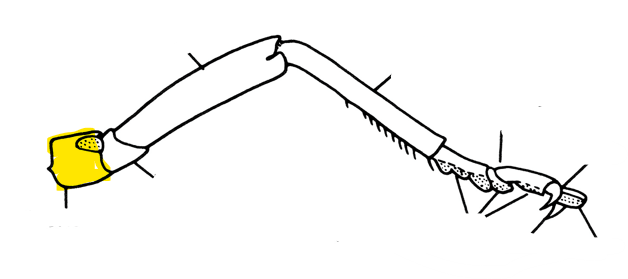
Trochanter
Second-most basal segment of the leg
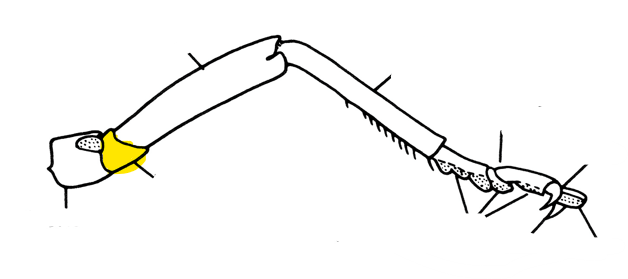
Femur
Middle segment of the leg, may have long spines or spurs
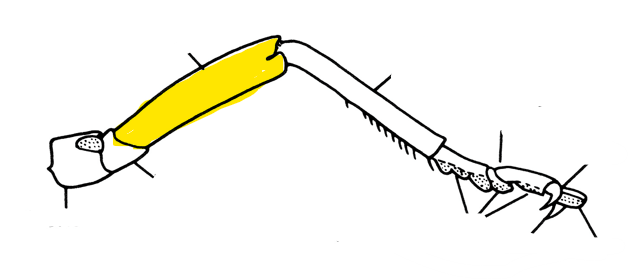
Tibia
Second-most distal segment of the leg, may have long spines or spurs

Tarsus
Distal-most segment of the leg

Tarsomeres
Up to five sub-segments of the tarsus
Tarsal formula
Number of tarsomeres in each insect leg, useful for identifying beetles
Cursorial
Leg modification for running & walking
Raptorial
Leg modification for catching prey
Saltatorial
Leg modification for jumping
Natatorial
Leg modification for swimming
Fossorial
Leg modification for digging
Prehensile
Leg modification for grasping & holding onto
Corbiculum
Modification on hind tibia of worker honeybees, “pollen basket”, depression fringed by long stiff setae
Wings
Flap-like cuticular projections supported by tubular veins, found on meso- and metathorax, contain tracheae (air vessels), blood vessels, and nerves