Complete Denture (Midterm Exam): Week 2
 Call Kai
 Learn
Learn Practice Test
 Spaced Repetition
 Match
Match Flashcards
 Knowt Play
1/59

There's no tags or description
Looks like no tags are added yet.
Name | Mastery | Learn | Test | Matching | Spaced | Call with Kai | Chat |
|---|
No analytics yet
Send a link to your students to track their progress
60 Terms
- Pour and trim the preliminary casts
- Fabricate custom trays
What should be completed in the lab between visit 1 (preliminary impressions) and 2 (border molder and final impression)?
border molding and final impression
What should be completed at the 2nd visit?
1- Intra-oral adjustment of the edentulous custom tray.
2- Border molding.
3- The final impression itself.
There are three equally important steps in the making of the final edentulous impression. What are they?
- Support
- Retention
- Stability
What are the 3 objectives of impressions?
Overextended, sharp
The trays are placed intra-orally and assessed for support, stability, and retention. Borders of the trays are verified to make sure they are not _________ and _________
Border molding
Define the following:
The shaping of the peripheral areas of an impression tray by the functional or manual manipulation of the tissues adjacent to the edges of the tray. We do all of this extra work in order to duplicate the contours, the varying heights and the widths of the patient's peripheral rolls.
Principle of border molding
What is the following principle?
- Extend the impression to cover the maximum area possible to maximize support within the limits of the health and function of the tissues of the basal seat.
OR
- The denture should cover all the available basal seat tissues without causing soreness at the denture borders and without interfering with the action of any of the structures they contact or that surround the denture.
- The anatomy to be considered is the anatomy in function rather than descriptive anatomy.
Vinylpolysiloxanes (VPS aka PVS) (can also be made with polyether)
What is used at TUSDM for the final impression material?
6 minutes
What is the setting time for PVS/VPS?
Before the material sets, all the border molding movements should be performed by the patient to "shape" the impression material.
You have just placed the first application of Vinylpolysiloxanes (VPS) on the edges of the custom tray. Before the material sets, what do you need to do?
2mm
When trying in custom trays, they should be ___ mm short from the vestibule
- To provide retention for the denture
- To provide stability for the denture
- To provide support for the denture
- Provide esthetics for the lips
- Maintain the health of the oral tissues
What are the five objectives of an impression?
support
Define the following:
The resistance to vertical components of mastication and occlusal forces applied in the direction of the basal seat/path of insertion
retention
Define the following:
Resistance to removal in a direction opposite that of its insertion
stability
Define the following:
- The quality of a denture to be firm, steady, and constant in position when forces are applied to it
- Refers especially to resistance against horizontal forces.
horizontal segment of the hard palate
What is the area of primary support for the maxilla?
crest of remaining alveolar ridge
What is the area of secondary support for the maxilla?
- Buccal shelf
- Posterior ridges
What is the area of primary support for the mandible?
crest of remaining alveolar ridge
What is the area of secondary support for the mandible?
border molding
What is the only way to efficiently achieve peripheral seal?
Retention
All of the following are things to consider under what objective of an impression?
- Adhesion (physical attraction of unlike particles --> ex like the denture with mucosa)
- Cohesion (physical attraction of like particles: Interfacial surface tension/mechanical locking into undercuts)
- Peripheral and atmospheric pressure (border molding!!)
Adhesion
Define the following:
- Physical attraction of unlike particles
- Ex: Denture with mucosa
Cohesion
Define the following:
- Physical attraction of like particles
- Ex: Interfacial surface tension/mechanical locking into undercuts
Good retention
What is the only factor that is related to the impression making phase?
True
T/F: Good retention is the only factor that is related to the impression making phase. All other factors of stability are either ineffective or minimal if retention is lacking.
Stability
All of the following are things to consider under what objective of an impression?
1. Good retention
2. Non-interfering occlusion (If the occlusion is off stability will be off- Bilateral Balanced Occlusion).
3. Proper tooth arrangement. (Best if the teeth are placed on the ridge.)
4. Proper form an contour of the polished surfaces.
5. Proper orientation of the occlusal plane.
6. Good control and coordination of the patient's musculature.
False - more extended = MORE stable (but do not over-extend to get in the way of muscles when they contract)
T/F: The more extended the base of the future denture is in border molding, the less stable it will be
The denture would get in the way of the muscles when they contract and it would dislodge the denture
If the denture base is over-extended, what is the consequence?
- In the clinic, compound sticks are used for border molding.
- In the laboratory project, a V.P.S. material will be used
What materials are used for border molding in clinic? What about in pre-clin?
- Bunsen burner
- Hanau torch
- Water bath
In order to use the compound material three sources of heat are necessary:
1- Labial vestibule
2- Buccal vestibule (each side)
3- Posterior Palatal seal
When doing border molding of the maxilla, what areas need to be captured?
1- The sublingual crescent area
2- The mylohyoid area (each side)
3- Retromylohyoid area (each side)
4- Buccal vestibule (each side)
5- Labial vestibule
When doing border molding of the mandible, what areas need to be captured?
- Manual manipulation and movement for border molding: Lip is elevated and extended outwards, downwards, inwards for orbicularis oris
Functional border molding: ask the patient to overtly move the lips by saying Ouh!, Ah!, E!
When border molding, how do you capture the labial vestibule?
- Patient cannot understand instructions: mental impairment or language barrier.
- Muscular disability: Parkinson's disease or tardive dyskinesia (uncontrolled movements of the face and body induced by long-term use of some psychiatric drugs)
With functional border molding, the base is more extended as the muscles are not as stretched so potentially provides more support. However, in extreme movements of the patients like sneezing, the denture may be dislodged.
Manual manipulation of the muscles: opposite advantages but additionally, it is the only possible method with what two conditions?
Buccinator manual manipulation and movements for border molding:
Cheek is:
- Elevated
- Pulled downward
- Pulled outward
- Pulled inward
- Pulled forward for the action of the orbicularis oris
- Pulled backward for the action of the buccinator
Buccinator functional border molding:
- Ask the patient to do the fish face!
- Ask patient to move the mandible side to side for border molding of coronoid process
When border molding, how do you capture the buccal vestibule?
Ask the patient to open as wide as possible
When border molding, how do you capture the pterygomaxillary notch or hamular notch?
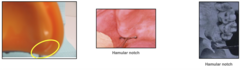
- Compensate for acrylic shrinkage during processing
- Avoid food being trapped under the denture
- Make the interface between the acrylic plate and the patient soft tissue less noticeable which helps decrease gagging reflex
What are the goals of the posterior palatal seal?
- Ask the patient to say a long ah
- Valsava maneuver
What are the options for border molding the vibrating line in the posterior palatal seal area?
labial vestibule
When border molding, the following actions will allow you to capture what structure:
- Pull the lip up and down
- Have patient say "Ouh!, Ah!, E!"
buccal vestibule
When border molding, the following actions will allow you to capture what structure:
Cheek is:
- Elevated
- Pulled downward
- Pulled outward
- Pulled inward
- Pulled forward for the action of the orbicularis oris
- Pulled backward for the action of the buccinator
- Ask the patient to do the fish face!
- Ask patient to move the mandible side to side for border molding of coronoid process
posterior palatal seal/vibrating line
When border molding, the following actions will allow you to capture what structure:
- Ask the patient to say a long ah
- Valsava maneuver
Holding down the mandibular custom tray and instructing the patient to close
How can you capture the border molding movement for the action of the masseter?
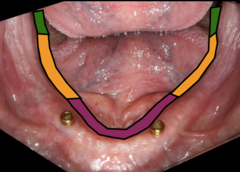
- Sublinugal crescent area (purple)
- Mylohyoid area (orange)
- Retromylohyoid area (green)
The alveololingual sulcus can be divided into what three areas, as shown in the image?
sublingual crescent area
When border molding, the following actions will allow you to capture what structure:
- Anterior Lingual Flange length: ask patient to protrude the tongue out as it activates the genioglossus muscle, which raises sublingual fold.
- Anterior lingual flange thickness: push the tongue against the front part of the palate.
mylohyoid area
When border molding, the following actions will allow you to capture what structure:
- Inferior edge of both posterior lingual flanges: get the tongue to touch the opposite cheek.
- Posterior edge of posterior lingual flanges: push the tongue against the front part of palate. It activates mylohyoid muscle.
retromylohyoid fossa
When border molding, the following actions will allow you to capture what structure:
- Open wide for pterygomandibular raphe to be brought forward
- Thrust tongue out so that the superior constrictor of the pharynx pushes the mylohyoid muscle
- Ask patient to close the mouth: the downward pressure on the mandible activates the medial pterygoids push that against the retromylohyoid curtains distal end of the lingual flange.
1 - Tongue out
2 - Tongue to the front part of the palate
3 - Tongue to the left and right cheeks
4 - Open wide
5 - Close
What is the five step summary to remember border molding in clinic?
40%
What percentage of natural resins (thermoplastic properties) are present in impression compound?
7%
What percentage of waxes (thermoplastic properties) are present in impression compound?
3%
What percentage of stearic acid (lubricant and plasticizer) are present in impression compound?
50%
What percentage of fillers and pigments are present in impression compound?
122°-124°F (50-51°C)
What is the working temperature range for Soft Green Kerr impression compound?
128°-130°F (53-54°C)
What is the working temperature range for Gray Kerr impression compound?
130°-132°F (55-56°C)
What is the working temperature range for Red Kerr impression compound?
Stearic acid leaches out
What happens if impression compound is immersed in water for a prolonged period?
140°
What should the water bath temperature be to temper the wax during border molding?
heavy body V.P.S. (Vinylpolysiloxane)
In this project ,________ materials will be used for both the border molding and the final impression.
Squeeze a little material into any bubbles as you are adding material for the next section to be border molded (you can add-on to the V.P.S. material!)
If you encounter a bubble during border molding, how can you fix it?
Border molding
What defines the entire peripheral edges of the final impression trays and gives us the varying heights, contours and thicknesses that we want our dentures to have?
light body VPS
What VPS did we use for the final impressions?