unit 1: biochemistry
 Call Kai
 Learn
Learn Practice Test
 Spaced Repetition
 Match
Match Flashcards
 Knowt Play
1/121

Earn XP
Description and Tags
i will not fail ap bio.
Name | Mastery | Learn | Test | Matching | Spaced | Call with Kai | Chat |
|---|
No analytics yet
Send a link to your students to track their progress
122 Terms
how are biological systems organized?
hierarchically; each level builds on the previous.
what is an emergent property?
a new characteristic that appears when individual parts of a system interact and work together, which none of those separate parts possess on their own (e.g. consciousness emerges through the interactions of indivuaul cells in the brain).
what is a polar bond?
a covalent bond in which electrons are not shared equally, causing a positive and negative charge on different regions of the molecule (e.g. in water, oxygen would be negative, as it “hogs” the electrons more than hydrogen, making hydrogen positive).
what is a nonpolar bond?
a covalent bond in which electrons are shared equally, there are no charged regions.
are polar molecules hydrophobic or hydrophilic?
polar molecules are hydrophilic (water-loving).
are nonpolar molecules hydrophobic or hydrophilic?
nonpolar molecules are hydrophobic (water-fearing).
what does the phrase “like dissolves like” mean in terms of polar and nonpolar molecules?
polar dissolves polar, nonpolar dissolves nonpolar.
what would happen if oil (nonpolar) and water (polar) meet? why?
they will not mix, and instead they separate into two distinct layers (oil at the top, water at the bottom, due to density). this is because the polarity of water causes it to stick closely together, not even allowing oil to get in the way.
what types of elements tend to cause polar molecules?
nonmetals with high electronegativity: oxygen, nitrogen, phosphorus and sulfur.
are carbon to hydrogen bonds (C-H) polar on nonpolar?
they are strictly nonpolar.
what is a hydrogen bond?
a weak interaction between hydrogen in water and other oppositely charged molecules.
what are the seven key properties of water?
cohesion, adhesion, capillary action, high heat capacity, high heat of vaporization, density anomaly, and universal solvent.
what is cohesion?
water bonding to itself (water).hatw
what is adhesion?
water binding to other polar surfaces.
what is capillary action?
cohesion + adhesion in plants, moving water from the roots to the leaves (transpiration).
what does it mean that water has a high heat capacity?
water can absorb and retain heat easily (this can stabilize climate in places near large bodies of water, causing less fluctuations in temperature).
what does it mean that water has a high heat of vaporization?
water evaporates to cool (which causes sweating) but also it requires a large amount of energy to transition from liquid to gas.
example of cohesion:
H2O - H2O
example of adhesion:
H2O - plant
how is water able to dissolve ionic and other polar molecules?
water can dissolve polar and ionic substances by separating the molecules. the negatively charged oxygens pull at the positively charged ions (e.g. Na+ in NaCl) and the positively charged hydrogens pull at the negatively charged ions (e.g. Cl- in NaCl).
why can hydrogen bonds be compared to sticks?
one hydrogen bond is weak, like a singular stick. multiple hydrogen bonds can be strong, like a bundle of sticks. it’s significantly easier to break one stick rather than a whole bunch of them at once.
a single hydrogen bond is ____, but multiple hydrogen bonds are ____.
weak, strong.
what are the elements of life?
CHONS + P (carbon, hydrogen, oxygen, nitrogen, sulfur, and phosphorus).
why is carbon the backbone of biological compounds?
carbon is versatile! it has four valence electrons, allowing it to form four covalent bonds. it can bond with itself to form many different types of structures. carbon also bonds with hydrogen to form hydrocarbon.
what makes hydrocarbon important?
they store large quantities of energy and serve as the foundation for larger biological molecules.
what are functional groups?
small, specific atom groups on carbon skeletons with predictable behaviors.
what are the significant properties of hydroxyl (OH)?
polar, hydrophilic, neutral, presents in sugars and some amino acids.
what are the significant properties of methyl (CH3)?
nonpolar, hydrophobic, neutral, generally very stable (nonreactive).
what are the significant properties of carboxyl (OH-C=O)?
polar, hydrophilic, acidic (releases H+ ions), presents in amino acids.
what are the significant properties of amino (NH2)?
polar, hydrophilic, basic (picks up H+ ions), presents in amino acids.
what are the significant properties of sulfhydryl (SH)
polar, hydrophilic, neutral, will form disulfide bonds, presents in amino acids.
what are the significant properties of phosphate (O2P(OH)2)?
polar, hydrophilic, acidic (releases H+ ions), present in nucleotides and phospholipids.
what are R-groups?
any group (usually carbon) the functional group is attached to.
what makes water a density anomaly?
it’s solid form (ice) is less dense than it’s liquid form.
which is stronger in water: cohesion or adhesion?
water’s cohesion properties are much stronger than it’s adhesion properties.
what is dissociation?
when ionic compounds are broken apart or dissolved (e.g. salt in water).
what is the formula for density?
density = mass/volume
why is water hard to separate in liquid form?
it’s hard to separate due to its hydrogen bonds.
what happens to H+ ions in acids?
they are released.
what happens to H+ ions in bases?
they are gained.
what are trace elements?
similar to the elements of life but are small in use compared to CHONS + P, but still essential for life (Ca, Mg, Na, K, Fe, etc).
why is hydrocarbon gas at room temperature even though H2O is liquid and C is solid at room temperature?
H2O is only liquid at room temperature due to hydrogen bonds, making it hard to break. hydrocarbons are nonpolar and lack hydrogen bonds, making it easier to break.
what are the four main forms of simple hydrocarbons (alkanes)?
methane (CH4), ethane (C2H6), propane (C3H8), butane (C4H10).
what does DNA stand for and why is this important?
deoxyribonucleic acid. deoxyribo refers to the specific sugar found in DNA, deoxyribose. nucleic refers to the nucleus. acid refers to its chemical makeup being acidic.
how is the structure and function of a polymer determined?
by the monomers used and their orientation.
what is polymerization?
the process of monomers joining together to form a polymer.
what is dehydration synthesis?
a chemical reaction where small molecules join together to form a larger molecule by releasing water.
what is hydrolysis?
a chemical reaction that uses water to break the bonds of large molecules into smaller ones.
what type of bond is formed as a result of dehydration synthesis?
a peptide bond is formed, which is a bond between the carboxyl group of one amino acid and the amine group of another. a peptide bond is between the carbon in the carboxyl group and the nitrogen in the amine group, and results in the loss of hydroxyl (OH) from the carboxyl group and hydrogen (H) from the amine group.
what is another name for dehydration synthesis?
condensation
example of dehydration synthesis:
A + B → AB + H2O
example of a hydrolysis reaction:
AB + H2O → A + B
different shape = different ____
function
how do you identify an organic compound?
look for molecules that contain carbon atoms bonded to hydrogen atoms (C-H bonds), often from living things.
how do you identify an inorganic compound?
lack of C-H bonds (salts, water, CO2, O2, minerals, etc.).
what are the four classes of biological polymers?
carbohydrates, proteins, lipids, and nucleic acids.
how does structure cause function in terms of the classes of biological polymers?
how these polymers function and interact is dependent on their functional groups.
what are the defining characteristics of carbohydrates?
its monomer is monosaccharides (which means “1 sugar”), is made up of C:H:O in a 1:2:1 ratio (C6H12O6), has functional and structural purposes.
what is the functional use of carbohydrates?
primary source of short-term energy storage in living things.
what is the structural use of carbohydrates?
plants use it as cellulose and arthropods use it as chitin.
what are some examples of monosaccharides (1 sugar molecule)?
glucose, fructose, galactose, ribose, and deoxyribose (found in nucleic acids).
what are some examples of disaccharides (2 sugar molecules)?
maltose and lactose.
what are some examples of polysaccharides (many sugar molecules)?
starch, cellulose, and glycogen.
what is the convenient way that plants store sugar?
they store their sugar, glucose, in the form of starch, which makes it easy to “pluck” individual sugars away from the chains in amylose and amylopectin (which is a form of hydrolysis).
what do different structures lead to?
different physical and functional properties.
how do the structural differences between starch and cellulose change their function?
the only difference between starch and cellulose’s makeup is its orientation. in starch, all the monomers face the same way, but in cellulose they are alternating upside down. cellulose’s differing orientation allows for strong hydrogen bonds to form between parallel chains, making it incredibly strong, durable, and completely insoluble compared to starch.
what are the defining characteristics of lipids?
made up mostly of C, H, O, and P in the cell membrane, tend to be insoluble in water (meaning they’re nonpolar), have no true monomer or polymer, and has many functions.
what are the main functions of lipids?
long-term energy storage (fats and oils), make up the cell membrane, hormones/steroids, protection.
what does saturation mean in terms of lipid structure?
it refers to whether a fatty acid tail is packed with the maximum number of hydrogen atoms.
what does it mean if a fatty acid is saturated?
there are no double bonds; the carbon chain is completely “full” of hydrogens.
what does it mean if a fatty acid is unsaturated?
contains one or more double carbon bonds (C=C), meaning some hydrogens are missing.
what are fats and oils used for?
they are used for energy and protection (fat/insulation).
how do the structural differences between saturated and unsaturated fatty acids affect their physical properties?
saturated fatty acids have straight “tails” which allows them to pack tightly together, causing them to be solid at room temperature (e.g. butter). unsaturated fatty acids have a kink/bend in the tail due to double bonds which prevents tight packing, making them liquid at room temperature (e.g. oils).
saturated is ____ at room temp?
solid
unsaturated is ____ at room temp?
liquid
what are fats and oils made up of?
triglycerides (1 glycerol backbone + 3 fatty acids tails).
what from lipids makes up the cell membrane?
phospholipids; fatty acids attached to a phosphate group (phosphate group is polar and will orient towards water).
what are the defining characteristics of nucleic acids?
made up of C, H, O, N, P,
what is the monomer for nucleic acids and what is it made up of?
nucleotides are the monomers. they are made up of a 5-carbon pentose sugar (ribose and deoxyribose), a phosphate group, and a nitrogen base (adenine, thymine (DNA only), uracil (RNA only), cytosine, and guanine).
what are some examples of nucleic acids?
DNA, RNA, and ATP.
why is the structure of DNA and RNA important?
the sequence and direction the nucleotides “read” determine information. this is important, as DNA and RNA encode information in our bodies.
what is the best known nucleotide?
ATP (adenine triphosphate), which is used as an energy source for chemical reactions in cells.
what are the defining characteristics of proteins?
made up of C, H, O, N, and S, used for structure, function, and regulation (enzymes), and monomers are amino acids.
what are amino acids made up of?
a central carbon bonded to the following: an amine group, carboxyl group, R group (20 different kinds), and a hydrogen atom.
what are the four levels of protein structures?
primary, secondary, tertiary, and quaternary.
what is the primary structure of proteins?
the sequence of amino acids in a polypeptide chain, held together by peptide bonds.
what determines a proteins primary structure?
the amino acid sequence, which is determined by the genetic information (DNA).
what is the secondary structure of proteins?
parts of a polypeptide chain fold into α-helixes and β-pleated sheets, held together by hydrogen bonds.
what are the two main types of secondary structure?
α-helix and β-pleated sheet.
what is an α-helix?
a coiled, spiral-shaped secondary structure stabilized by hydrogen bonds between backbone groups.
what is a β-pleated sheet?
an extended, folded sheet formed when sections of a polypeptide chain line up and are stabilized by hydrogen bonds.
what is the tertiary structure of proteins?
the entire polypeptide chain folds into its overall 3d shape because of interactions between its R-groups.
what is the quaternary structure of proteins?
multiple folded polypeptide chains come together to make one functional protein.
what bonds hold together primary protein structure?
peptide bonds between amino acids.
what bonds hold together secondary protein structure?
hydrogen bonds between the backbone C=O and N–H groups.
what interactions hold together tertiary protein structure?
hydrogen bonds, ionic bonds, hydrophobic interactions, and disulfide bridges between R-groups.
what interactions hold together quaternary protein structure?
hydrogen bonds, ionic bonds, hydrophobic interactions, and sometimes disulfide bridges between different polypeptide chains.
what is a simple way to explain how proteins go from primary to quaternary structure?
a chain of amino acids (primary structure) folds into either alpha helixes or beta pleated sheets (secondary structure), which fold into a 3d shape (tertiary structure), and multiple 3d-shaped chains come together to form a functional protein (quaternary structure).

which protein structure is this?
primary structure
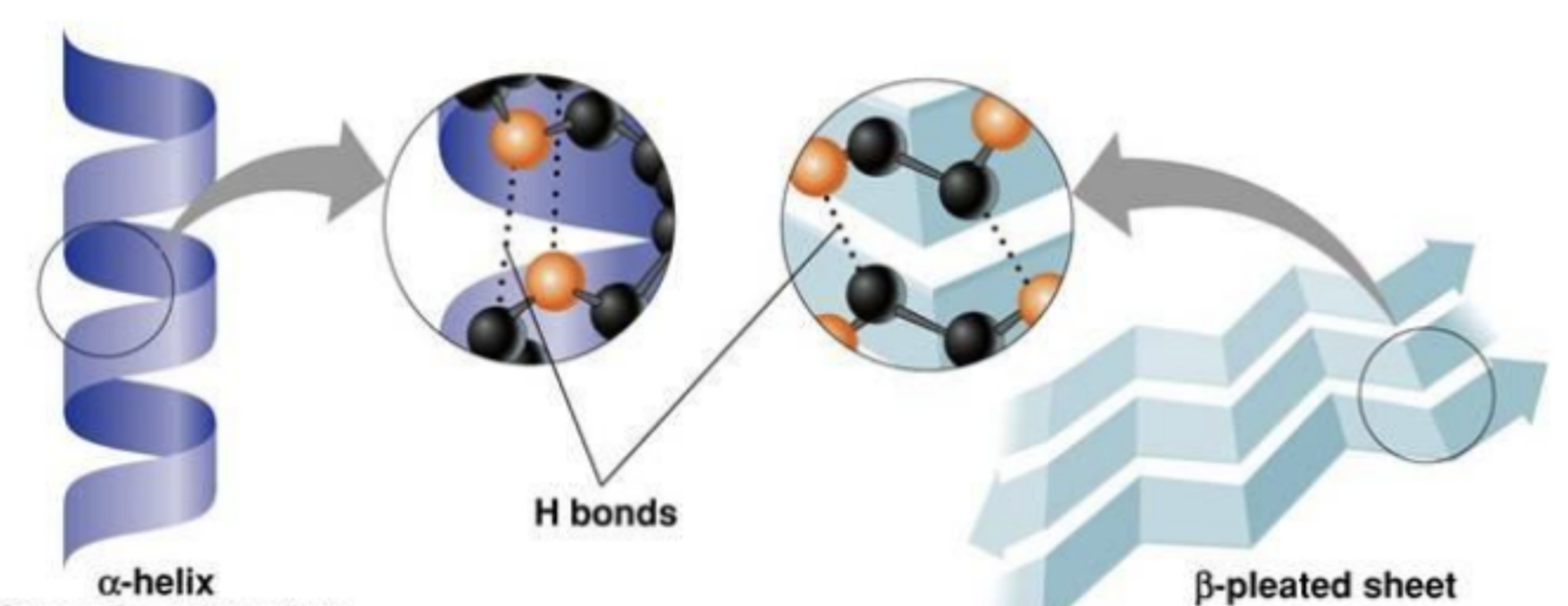
which protein structure is this?
secondary structure