CFA Mock Notes I (b session 2)
 Call Kai
 Learn
Learn Practice Test
 Spaced Repetition
 Match
Match Flashcards
 Knowt Play
1/16

There's no tags or description
Looks like no tags are added yet.
Name | Mastery | Learn | Test | Matching | Spaced | Call with Kai | Chat |
|---|
No analytics yet
Send a link to your students to track their progress
17 Terms
Norway Model
Reliance on public equities and fixed income (passive)
B-L
The Black–Litterman model starts with excess returns produced from reverse optimization and then provides a technique to reflect an investor’s own distinctive views. It enables investors to combine their unique forecasts of expected returns with reverse-optimized returns in an elegant manner. The resulting expected returns often lead to well-diversified asset allocations grounded in economic reality.
Roy Safety First
probability of exceeding min return given normal distribution
(return - acceptable return) / std dev
Risk Parity
w*cov = 1/n(var)
varswap value

Equity Futures Rebalance
USE BETA
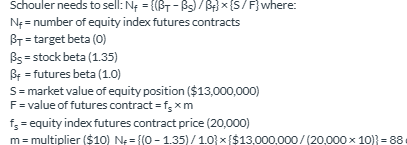
Rebalance Bonds
BPVHR = ((BPVT-BPVP)/BPVCTD)*CF
BPVT Formula
BPVT = MDURT*.01%*MV
Modified Dietz
(V1-V0-CF)/(V0+(CF*w))
Well Constructed Portfolio (risk exposure)
in a well-constructed portfolio, we would be looking for risk exposures that are aligned with investor expectations and constraints and low idiosyncratic (unexplained) risk relative to total risk. If two products have comparable factor exposures, the product with a lower absolute volatility and lower active risk will likely be preferred (assuming similar costs). If two products have similar active and absolute risks, the portfolios have similar costs, and the alpha skills of the managers are similar, the product having a higher active share is preferable, because it leverages the alpha skills of the manager and will have higher expected returns.
leveraged return
Leveraged return = Portfolio return / Portfolio equity = [rI × (VE + VB) – (VB × rB)] / VE
lower duration
less sensitive to an unfavorable change in the level of benchmark interest rates
higher convexity
bond price will increase (decrease) more than the duration estimate would suggest if interest rates decrease (increase)
bull flattening
long term ytm fall by more than short term
long swaption
option to enter interest rate swap to PAY FIXED
risk reversal
long call and short put
ARCH
The key idea in the ARCH methodology is to model variance as a linear time-series process in which the current volatility depends on its own recent history or recent shocks. The shocks to volatility arise from unexpectedly large or small returns.