KA Biology
 Call Kai
 Learn
Learn Practice Test
 Spaced Repetition
 Match
Match Flashcards
 Knowt Play
1/66

There's no tags or description
Looks like no tags are added yet.
Name | Mastery | Learn | Test | Matching | Spaced | Call with Kai | Chat |
|---|
No analytics yet
Send a link to your students to track their progress
67 Terms
Reproduction occurs when parent organisms pass on __________ to their offspring.
genes
Characteristics passed from parents to offspring are known as __________ traits.
inherited
Fission, budding, fragmentation, and __________ are different types of asexual reproduction.
parthenogenesis
During sexual reproduction, gametes from two parents join during __________.
fertilization
Organisms such as potato plants and __________ can reproduce both sexually and asexually.
corals
An animal's reproductive success is related to the number of __________ it has during its life.
offspring
Animals that help flowering plants reproduce through pollination are called __________.
pollinators
When pollinators feed on flowers, they transfer pollen from male to __________ flower parts.
female
The movement of seeds away from a parent plant is called seed __________.
dispersal
Any influence of genes on an organism's traits is called a __________ factor.
genetic
Any influence of the environment on an organism's growth is called an __________ factor.
environmental
What is the function of the cell membrane?
It separates the inside and the outside of the cell and controls what goes in and comes out.
What is the cytoplasm?
A jelly-like substance that surrounds a cell's parts.
What are organelles?
Parts of a cell that each carry out a specific function, working alone and together to keep the whole cell functioning.
What is the role of mitochondria in a cell?
They break down sugars to release energy that the cell can use.
What is the function of the nucleus?
It is an organelle that contains a cell’s genes.
What process do chloroplasts carry out, and what is produced?
They carry out photosynthesis, which makes food for plant cells in the form of sugars.
Which two structures are present in plant cells but absent in animal cells?
Chloroplasts and a cell wall.
Where is the plant cell wall located in relation to the cell membrane?
The plant cell wall is located outside the cell membrane.
What is the primary function of the plant cell wall?
It provides structure for the cell.
What is the basic unit of all living organisms?
The cell
According to cell theory, what are all living things made of?
One or more cells
Why is the cell considered the basic unit of life?
Because it is the smallest structure capable of carrying out all life functions.
Major Cell Functions
The four essential tasks every cell must perform to stay alive: obtain nutrients and water, remove waste, obtain and use energy, and respond to the environment.
Unicellular Organisms
Organisms consisting of a single cell that performs all the functions necessary for life.
Multicellular Organisms
Organisms consisting of many cells where labor is divided among specialized cells to perform specific functions more efficiently.
Cell Specialization
The process in multicellular organisms where different cells perform specific tasks, such as muscle cells contracting or nerve cells transmitting signals.
Cell Division
The process where one cell grows, copies its contents, and divides into two new cells, allowing for growth, tissue repair, and reproduction.
Microscopic
A term used to describe objects, such as most cells, that are too small to be seen with the naked eye.
Microscope
The instrument used by scientists to observe cells and other microscopic structures.
Preexisting Cells
The existing cells from which all new cells are produced, contradicting the idea that cells can arise from nonliving matter.

What is ‘1’ and ‘4’ pointing to?
The nucleus

What is ‘2’ and ‘5’ pointing to?
The mitochondria
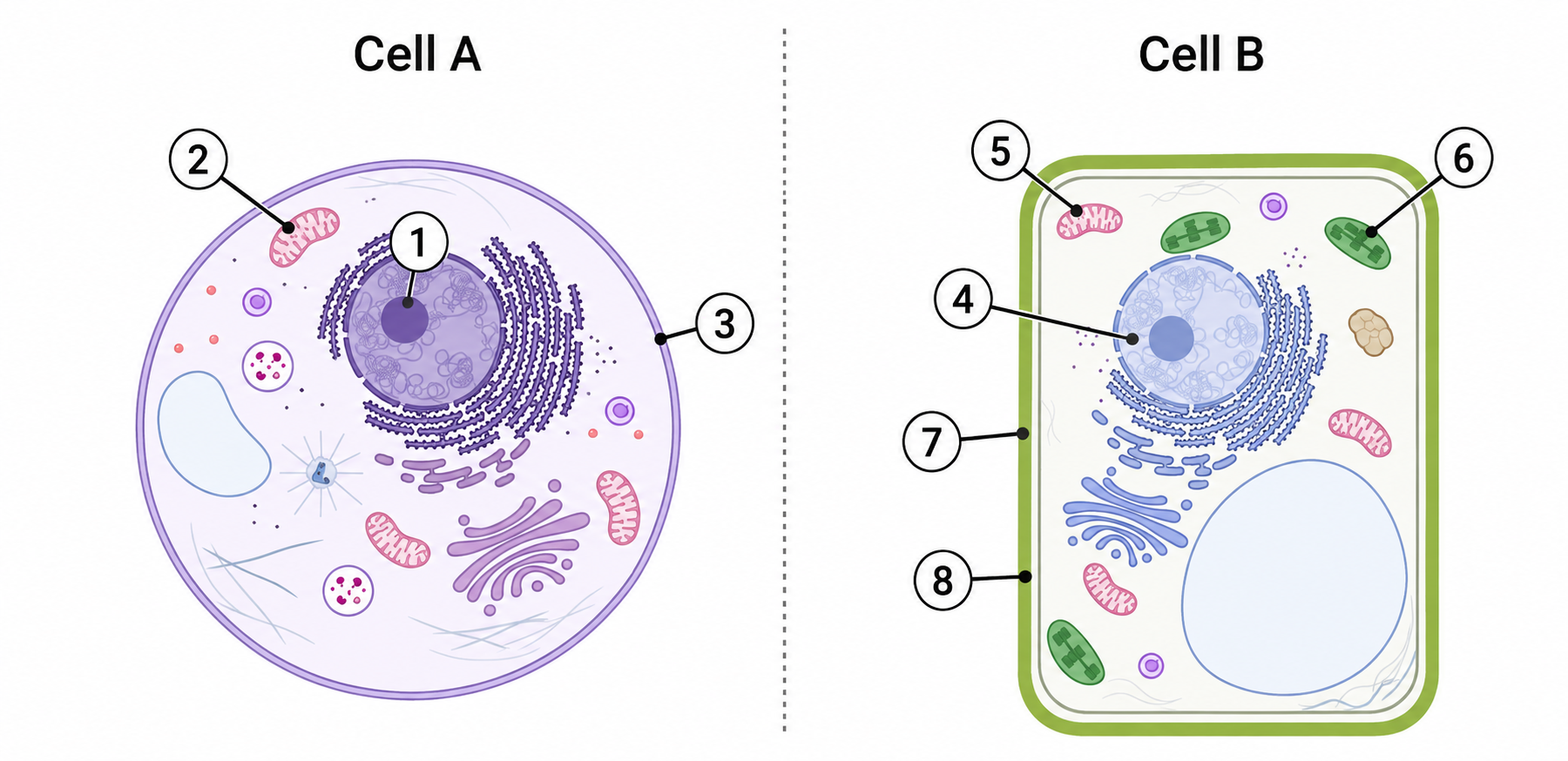
What is ‘3’ and ‘8’ pointing to?
The cell membrane
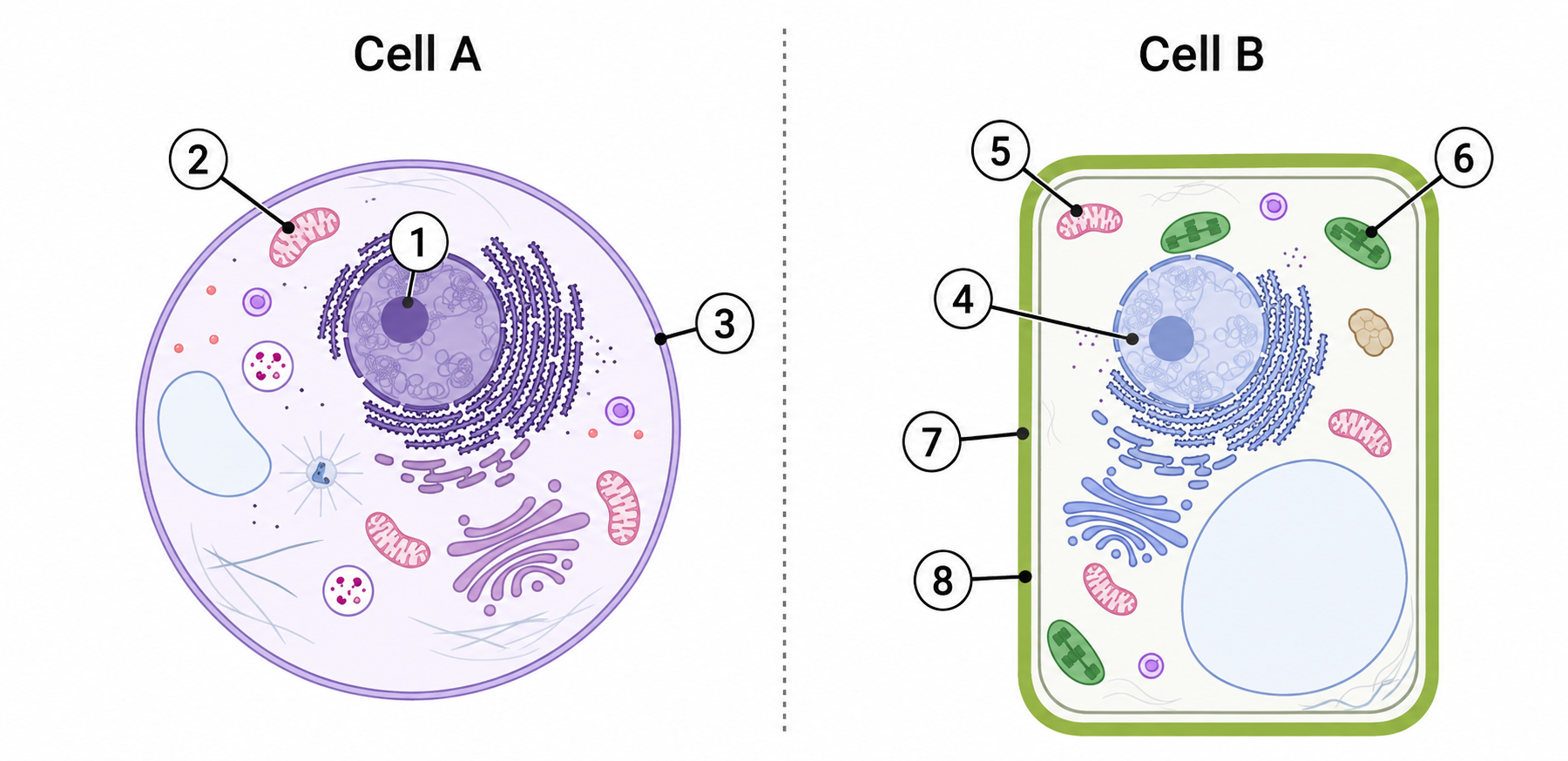
What is 7 pointing to?
The cell wall

What is ‘6’ pointing to?
The chloroplast

Which cell shows a plant cell and which shows an animal cell?
Cell A is the animal cell
Cell B is the plant cell
What levels of organization make up the human body's complex system?
Organ systems, organs, tissue, and cells.
What does it mean for cells in the human body to be specialized?
It means they have unique structures and functions.
How is a tissue defined in the context of the human body?
A group of similar, specialized cells that work together so that the tissue can do its job.
What constitutes an organ?
Multiple types of tissues that make up its structure and work together.
What is an organ system?
A group of organs that work together to carry out complex tasks in the body.
What is the primary function of the respiratory system?
To use the lungs to bring oxygen into the body through inhalation and remove carbon dioxide through exhalation.
What is the role of alveoli in the respiratory system?
They are tiny air sacs that allow oxygen to move from the air into the blood in nearby capillaries, while carbon dioxide moves from the blood into the alveoli.
What is the function of the circulatory system?
To transport oxygen, nutrients, and waste materials in the blood.
What is the main organ of the circulatory system and its function?
The heart, which pumps blood through blood vessels throughout the body.
How do the respiratory and circulatory systems respond to increased physical activity?
Breathing and heart rates increase because cells need more oxygen and nutrients and produce more carbon dioxide.
What are the primary functions of the skeletal system?
It gives the body structure, protects organs, helps the body move, and produces new blood cells in bone marrow.
What materials make up the skeletal system?
Bones and connective tissues, including cartilage and ligaments.
How does the muscular system function?
Muscle tissues contract and relax to move the body and move materials through the body.
What are skeletal muscles and how are they attached to bones?
Muscles that allow voluntary movement; they are attached to bones by tendons.
What is the difference between smooth muscles and cardiac muscles?
Smooth muscles allow involuntary movement of materials through organs and blood vessels, while cardiac muscle makes up the heart and contracts involuntarily to pump blood.
What components are included in the integumentary system and what is its role?
The skin, hair, and nails; it protects the body from injury, infection, and water loss.
What are the three layers of the skin?
The epidermis, the dermis, and the hypodermis.
What is the function of the nervous system?
It detects stimuli and sends rapid electrical signals to communicate with different parts of the body, allowing for quick responses to environmental changes.
What are the two main parts of the nervous system?
The central nervous system (brain and spinal cord) and the peripheral nervous system (the body's nerves).
How does the endocrine system regulate body processes?
Through glands that produce chemical signals called hormones, which create longer lasting changes like growth, development, metabolism, and reproduction.
Which glands are specifically involved in the endocrine system's regulation of reproduction?
The pituitary gland, ovaries, and testes.
What is the difference between mechanical and chemical digestion?
Mechanical digestion is the physical breakdown of food into smaller pieces, while chemical digestion is the breakdown of biomolecules using enzymes and other substances.
What are the major organs of the digestive system?
The mouth, esophagus, stomach, small intestine, liver, gallbladder, pancreas, and large intestine (including the colon, rectum, and anus).
Where are most nutrients absorbed in the digestive system?
In the small intestine, from which they are carried to cells via the bloodstream.
What is the function of the excretory system?
To filter waste and excess water from the blood and remove them from the body as urine.
What are the main structures of the excretory system?
The kidneys, ureters, urinary bladder, and urethra.
How does the immune system protect the body?
It detects pathogens and responds to prevent and fight infections using white blood cells and processes like inflammation and fever.
What is inflammation and which systems coordinate to produce it?
A response that increases blood flow to an affected area to help with healing; it is a coordination between the immune and circulatory systems.
What is a fever and which systems coordinate to produce it?
A temporary increase in body temperature to help fight infection; it is a coordination between the immune and nervous systems.
What are the components and functions of the lymphatic system?
A network of lymph vessels, lymph nodes, and lymph (fluid) that helps immune cells travel and removes pathogens, damaged cells, and waste.