Lecture 5
 Call Kai
 Learn
Learn Practice Test
 Spaced Repetition
 Match
Match Flashcards
 Knowt Play
1/17

There's no tags or description
Looks like no tags are added yet.
Name | Mastery | Learn | Test | Matching | Spaced | Call with Kai | Chat |
|---|
No analytics yet
Send a link to your students to track their progress
18 Terms
Host Organisms & Bacterial Genotypes
• E. coli K12 Derivatives: Primary bacterial host for cloning and propagation.
• Biological Containment: Carries mutations that prevent survival outside laboratory conditions.
• Essential Modifications: Altered restriction systems and lac operon machinery allow plasmid stability and regulated expression.
• Eukaryotic Hosts: Yeast (S. cerevisiae, Pichia) for basic eukaryotic protein folding; insect and mammalian cells for complex post-translational modifications (e.g., glycosylation).
Bacterial Genotype Nomenclature Rules
• Mutated Genes Only: Strains list only mutated alleles; normal/wild-type genes are omitted.
• 3-Letter Designation: Indicates the specific pathway or phenotype (e.g., rec = recombination, end = endonuclease).
• Delta (Δ): Indicates a complete gene deletion.
• F' Episome [in brackets]: Lists genes carried on the F fertility plasmid; these represent functional wild-type alleles unless noted.
• Identification Markers: Nutritional mutations (e.g., requiring thiamine) allow strain verification using selective minimal media like M9.
Restriction & Modification (R-M) Systems in Bacteria
Natural Role:
- Serves as a bacterial immune defence against bacteriophage infection.
- Host DNA is protected by methylation (-CH3 groups added to specific bases).
- Unmethylated foreign phage DNA is cleaved and destroyed by host restriction endonucleases.
Application in Molecular Biology Hosts:
- Restriction mutants (r-): Allow uptake and survival of foreign/unmodified DNA.
- Modification mutants (m-): Prevent the host from methylating DNA, ensuring downstream restriction enzymes can cut target sites.
Methylation in PCR & Cloning (DPNI Digest)
1. Methylation Status Differences:
- Parental plasmid DNA isolated from E. coli = Methylated.
- Newly synthesized PCR product generated in vitro = Unmethylated.
This happens because in PCR, no enzyme methylates the newly synthesized DNA, compared to within a bacterium; thus, we can get rid of the methylation.
Also, Taq polymerase can synthesize methylated regions, which is how PCR can still be performed on methylated DNA.
2. DpnI Selection Strategy:
- DpnI is an endonuclease that ONLY cuts methylated GATC sites.
- Adding DpnI digests and eliminates the background parental template DNA.
- The desired, unmethylated PCR amplicon is left untouched for downstream transformation.
Overview of the lac Operon
Biological Purpose: An inducible bacterial operon in E. coli that coordinates lactose transport and breakdown.
• Structural Genes (Transcribed together):
lacZ: Encodes beta-galactosidase (cleaves lactose into glucose and galactose).
lacY: Encodes lactose permease (membrane transporter for lactose entry).
lacA: Encodes beta-galactoside transacetylase (transfers acetyl groups for detoxification).
• Regulatory Elements:
lacI: Regulatory gene that continuously produces the Lac repressor protein.
Promoter (P): Binding site for RNA polymerase.
Operator (O): DNA regulatory sequence between promoter and structural genes where the repressor binds.
CAP site (c): Binding region for CAP-cAMP activation under low-glucose conditions.
Mechanisms of Regulation (Lac operon)
Repressed State (Inducer Absent):
Lac repressor binds to the Operator site.
RNA polymerase is sterically blocked from moving forward.
Transcription of lacZYA structural genes is shut off.
Induced State (Inducer Present: Allolactose / IPTG):
Inducer molecule binds to the allosteric site of the Lac repressor.
Repressor changes shape and detaches from the Operator.
RNA polymerase transcribes the structural genes (lacZYA) into a polycistronic mRNA.
Molecular Biology Application (IPTG):
IPTG functions as a non-metabolizable ("gratuitous") inducer. It’s often used in labs instead of allolactose.
Because it is not degraded by beta-galactosidase, IPTG maintains steady, long-lasting transcriptional induction in recombinant protein expression systems. Meaning this system will always remain turned on.
Lac Operon Mutation & Alpha Complementation
1. Engineered Host Mutations:
- lacI^q: Overexpresses Lac repressor (~10x); ensures tight transcriptional shutdown of multi-copy plasmid promoters until IPTG induction.
- lacZ ΔM15: Deletes amino acids 11-41 from beta-galactosidase; produces an inactive C-terminal beta-galactosidase (omega fragment).
2. Principles of Alpha-Complementation:
- Host Cell: Supplies the inactive omega fragment (from F' episome).
- Cloning Vector: Supplies the functional N-terminal alpha peptide (lacZ 5' region).
- Reconstitution: The alpha and omega pieces associate non-covalently into an active enzyme complex (beta-galactosidase).
3. X-Gal Selection Breakdown:
- Non-recombinant / Empty Vector: Alpha peptide produced -> Active beta-galactosidase -> Cleaves X-Gal -> BLUE COLONIES.
- Recombinant / Inserted Gene: Insert disrupts alpha peptide coding frame -> Inactive enzyme -> Cannot cleave X-Gal -> WHITE COLONIES.
- White colonies are the ones that took up the plasmid WITH the insert in it, thus its the colonies we are concerned with.
Common features of vectors
They are able to replicate in a host cell.
They can accept foreign DNA.
They are able to be transformed into host cells.
Plasmid Replication & Copy Number Control
• Host Enzyme Utilization: Plasmids rely on stable host cellular machinery (e.g., host DNA polymerases) to initiate and execute DNA replication.
• Replication Control Modes:
Stringent Replication: Tightly coupled to the host chromosome cycle; results in low copy numbers (1–5 copies/cell).
Relaxed Replication: Decoupled from host chromosomal division, can replicate whenever; produces medium-to-high copy numbers (e.g., ColE1, pMB1 give 15–20+ copies/cell).
• Independence from Protein Synthesis: Relaxed replicons utilize long-lived host enzymes and regulatory RNAs, allowing replication to proceed even when bacterial protein synthesis is inhibited.
• Biosafety Disarming (tra Deletion): Molecular biology vectors lack tra (transfer) genes to eliminate conjugative transfer and prevent horizontal gene spread outside the lab.
Replicons & Plasmid Incompatibility
• Replicon Definition: The functional genetic unit containing the origin of replication (ORF) and its control elements (e.g., pMB1, ColE1, pBR322, pUC series).
• Plasmid Incompatibility: The failure of two different plasmids to stably coexist within the same host cell in the absence of continuous selection pressure.
• Molecular Basis of Incompatibility:
Plasmids sharing identical or closely related replication control systems cross-regulate each other.
Competition for shared regulatory factors and unequal partitioning during division leads to the rapid loss of one plasmid type.
• Co-Transformation Requirement: To stably propagate two distinct plasmids simultaneously, each plasmid must possess an origin from a distinct, mutually compatible incompatibility group (e.g., ColE1 paired with p15A).
Plasmid Development
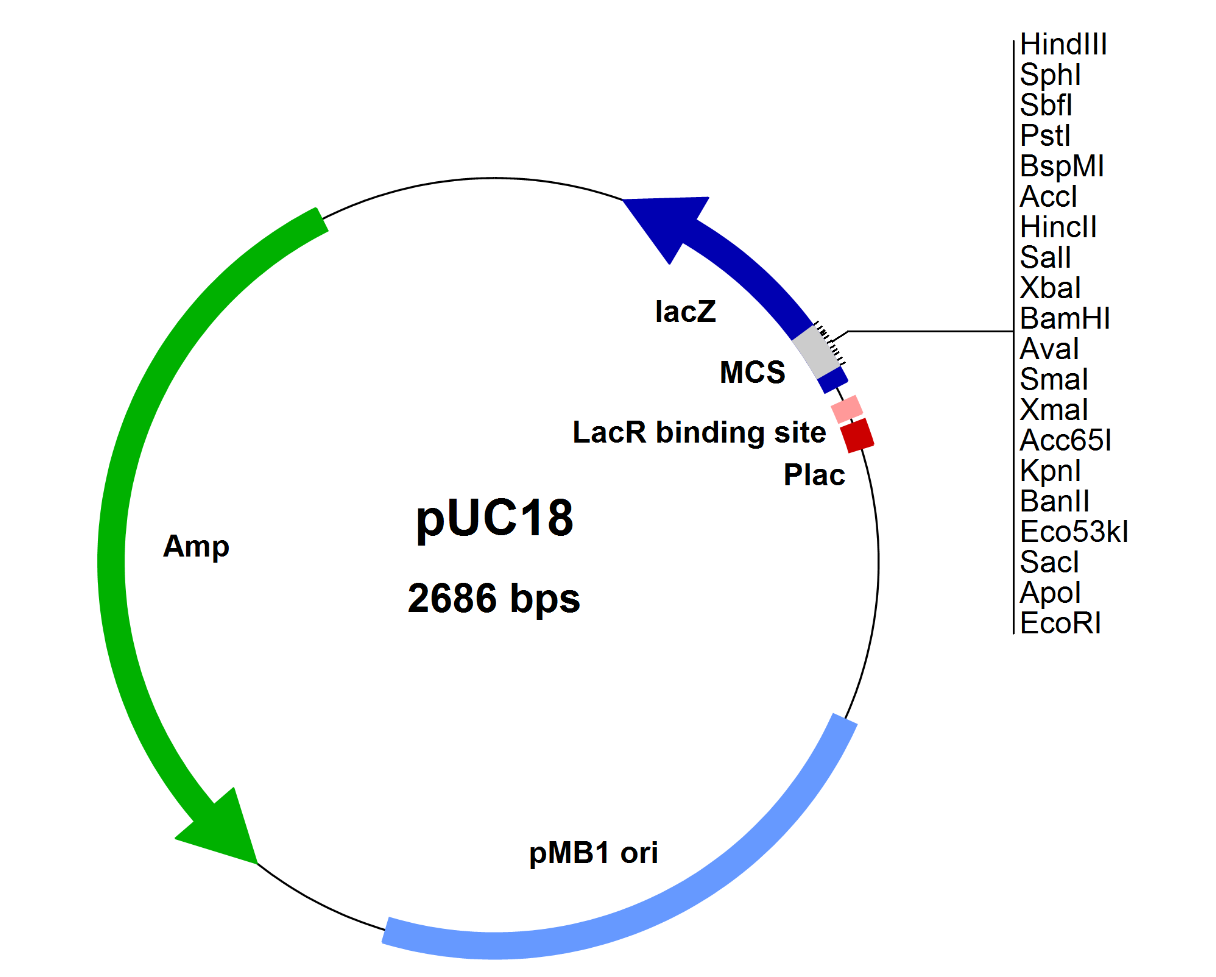
1. Key Improvements in Modern Vectors:
Compact size: Accommodates larger inserts, increases transformation yield, simplifies gel mapping.
Multi-Cloning Sites (MCS) / Polylinker: Cluster of unique restriction enzyme sites for flexible cloning.
Efficient markers: Antibiotic resistance (selection) + lacZ alpha-peptide (blue/white screening).
2. pUC18 (Plasmid) Vector Features:
Size: 2686 bp.
Replicon: High-copy pMB1 origin.
Screening: lacZ alpha-peptide gene interrupted by the MCS.
3. pBluescript (Phagemid) Specialized Functions:
ColE1 Origin: Drives normal high-copy double-stranded plasmid replication.
f1 Phage Origin: Produces single-stranded DNA (ssDNA) upon helper phage infection.
T3 & T7 Promoters: Flank the MCS to allow in vitro synthesis of sense and antisense RNA transcripts.
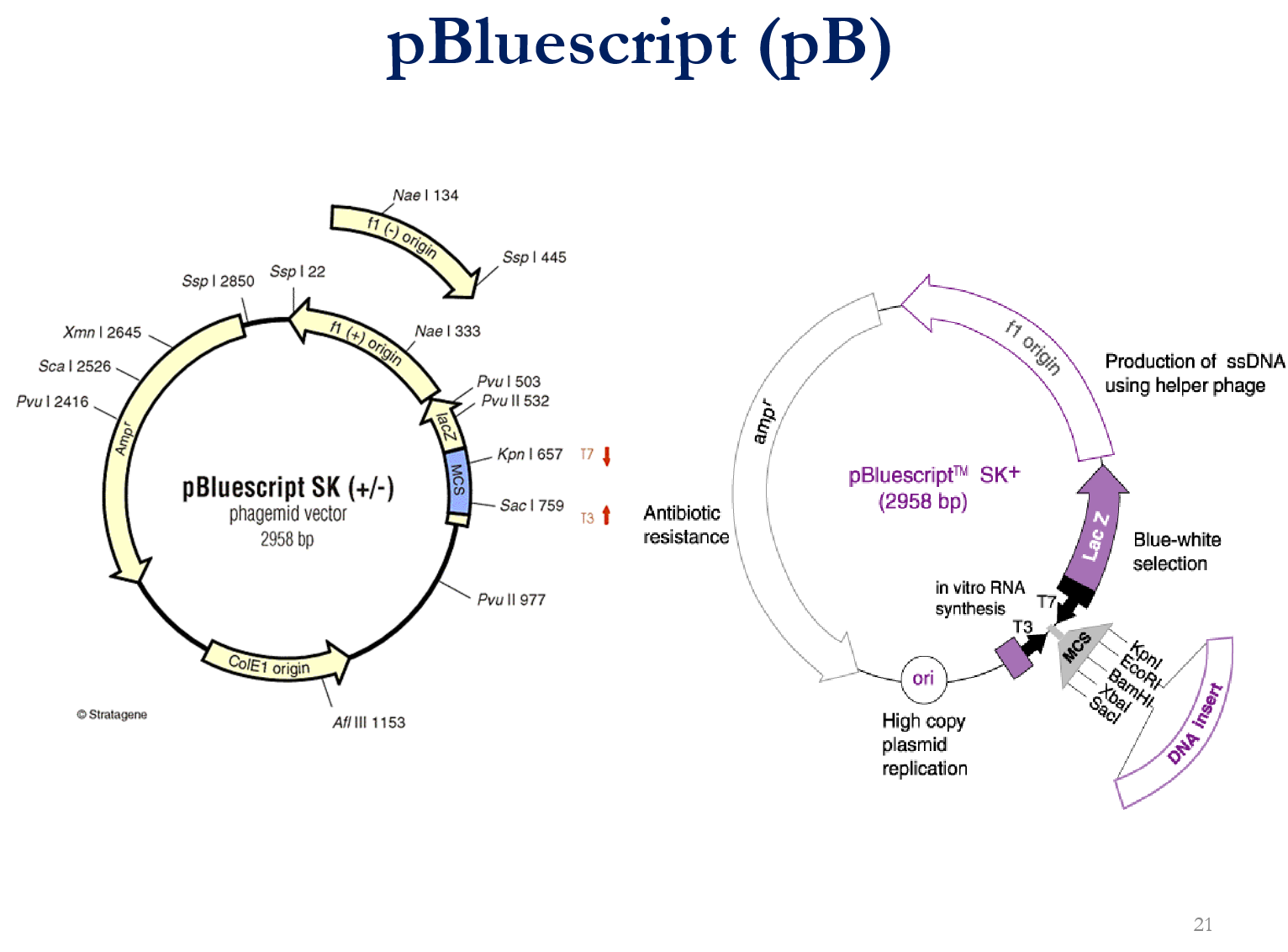
pUC18 Vector
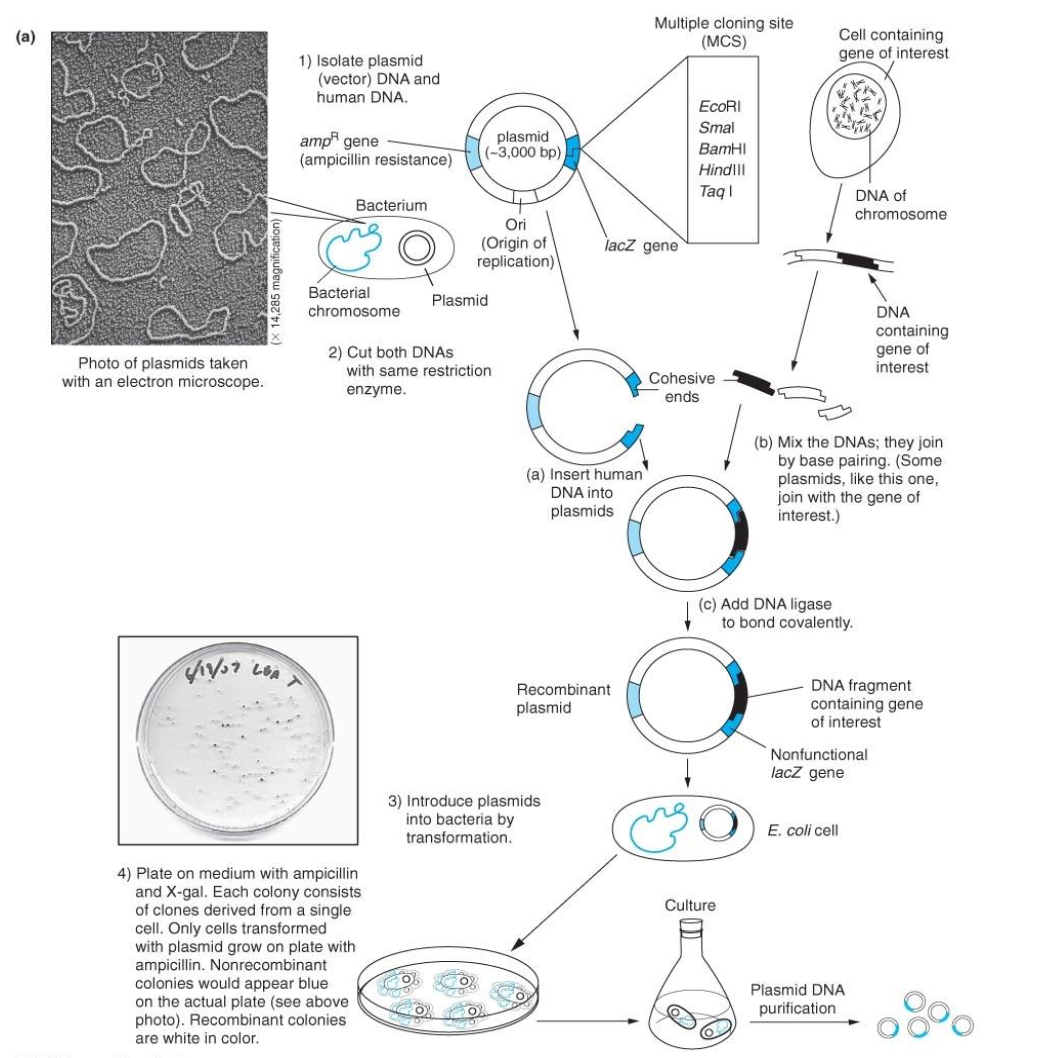
Gene Cloning Workflow & Blue-White Screening
1. Standard Cloning Protocol:
- Digestion: Vector and DNA insert are cut with the same restriction enzyme(s) to create matching sticky ends.
- Ligation: DNA ligase covalently seals the vector and insert into circular recombinant plasmids.
- Transformation: Plasmids are introduced into competent host bacteria.
- Plating: Grown on LB agar containing Ampicillin + X-Gal + IPTG.
2. Colony Phenotype Interpretation:
- Antibiotic Selection: Only cells containing a plasmid (AmpR) can grow into colonies.
- Blue Colonies = Non-recombinant (Empty Vector): Intact lacZ alpha-peptide -> Active beta-galactosidase -> Cleaves X-Gal -> Blue color.
- White Colonies = Recombinant Clones (Target Insert Present): Insert disrupts lacZ gene (insertional inactivation) -> No beta-galactosidase activity -> Cannot cleave X-Gal -> White colour. - Action: White colonies are selected and cultured for plasmid DNA extraction and verification.
Bacteriophage Lambda Vector
1. Biological Basis:
- Linear dsDNA genome (~48.5 kb).
- Middle 1/3 of the genome is dispensable for lytic growth (contains non-essential lysogeny genes).
- Essential lytic/structural genes reside on the left and right terminal arms.
2. Major Advantages:
- High Efficiency: in vitro packaging into viral capsids allows near 100% infection efficiency (1:1 plaque formation), compared to <1/1000 for standard plasmid transformation.
- High Capacity: Can clone fragments up to 20-25 kb.
3. Packaging Rules:
- Capsid size limit: Only DNA lengths between 38 kb and 52 kb (~78% - 105% of WT) can be successfully packaged into infectious phages. Anyting larger or smaller will lead to no replication.Anything
4. Types of Lambda Vectors:
- Insertion Vectors: Single cloning site; accommodates small inserts (0 - 10 kb); commonly used for cDNA libraries.
- Replacement Vectors: Contains a removable "stuffer fragment" between arms. Arms alone (~30-36 kb) are too small to package. Foreign insert (10 - 20 kb) restores total length into the 38-52 kb packaging range. * Serves as automatic positive selection for recombinants (genomic libraries).
Insert Capacity:
Insertion Vectors: Carry small inserts (0–10 kb).
Replacement Vectors: Accommodate large fragments (10–20 kb).
Cloning Mechanism:
Insertion Vectors: Single-restriction-site cleavage; target DNA is inserted directly into the vector backbone.
Replacement Vectors: Dual-restriction-site cleavage; a disposable stuffer fragment is excised and replaced with the target DNA.
Selection Strategy:
Insertion Vectors: Requires screening methods (e.g., plaque phenotype or insertional inactivation of cI / lacZ) to distinguish recombinants from empty vectors.
Replacement Vectors: Relies on physical size constraints for automatic selection; vector arms alone (38 kb) are too small to package, ensuring only recombinants form viable phage particles.
Primary Use Cases:
Insertion: cDNA library construction.
Replacement: Genomic DNA library construction.
Gateway Cloning System
• Recombination-Based: Replaces traditional restriction endonuclease and DNA ligase reactions with site-specific recombination machinery derived from bacteriophage λ.
• Recombination Sites (att): Target genes flanked by specific att sequences are transferred directionally and in-frame.
• Universal Entry Clone: Once a gene is captured inside an Entry Vector, it can be recombined simultaneously into various specialized Destination Vectors (e.g., His-tag, GST-tag, mammalian CMV, or Baculovirus).
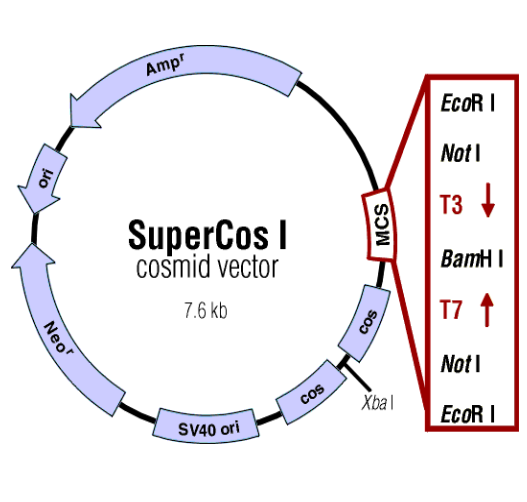
Cosmid Vectors
• Hybrid Architecture: Standard plasmid backbone (plasmid ORF + antibiotic marker) engineered with phage lambda cos sites.
• High Cloning Capacity: Accommodates large inserts up to ~42 kb.
• Delivery and Maintenance:
Packaged in vitro into phage lambda capsids for high-efficiency infection into E. coli.
Circularizes inside the host via
cosoverhangs and replicates as a large extra-chromosomal plasmid (does not cause lytic plaque formation).
Large-Scale Vectors: BACs vs. YACs
Bacterial Artificial Chromosomes (BACs):
Insert Capacity: ~300 kb; based on the E. coli F-factor plasmid.
Replication Control:
repEControls low-copy plasmid replication complex formation.Partitioning Stability:
sopA,sopB, andsopCensure accurate segregation to daughter cells.Markers:
Cm^R(chloramphenicol selection) andlacZ(blue/white screening).
Yeast Artificial Chromosomes (YACs):
Insert Capacity: ~1,000 kb (1 Mb); maintained as linear eukaryotic chromosomes in S. cerevisiae.
Essential Functional Units:
ARS: Autonomously Replicating Sequence (yeast origin of replication).CEN: Centromere sequence for spindle attachment and equal division.TEL: Telomeric repeats protecting terminal ends from exonucleases.TRP1/URA3: Auxotrophic selection markers ensuring retention of both arms.