BIOL 108- Theme 1 (topic 1, 2 ,3 ,4)
 Call Kai
 Learn
Learn Practice Test
 Spaced Repetition
 Match
Match Flashcards
 Knowt Play
1/81

There's no tags or description
Looks like no tags are added yet.
Name | Mastery | Learn | Test | Matching | Spaced | Call with Kai | Chat |
|---|
No analytics yet
Send a link to your students to track their progress
82 Terms
biological diversity
variety of life on earth
i.e
The animals, plants, fungi, and microorganisms like bacteria.

3 components of biodiversity
genetic diversity, species diversity, ecosystem diversity
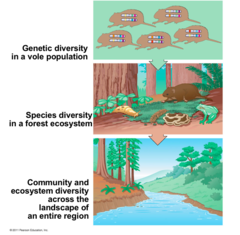
genetic diversity
the genetic variation within a population and between populations of a single species.

Population
a group of individuals of the same species that live in the same area and interbreed, producing fertile offspring.
Note:
A species with limited distribution may consist of a single ______.
A widely dispersed species may form numerous _______.
Variation in ____________ (genetic diversity) of a species is necessary for evolution.

Species diversity
The number and relative abundance of species in a biological community. All the variety of species of animals, plants, fungi, and micro-organisms that occur in an area
Note:
- the most well known and easily recognized unit of biodiversity.
- Most biodiversity studies or monitoring programs (e.g. ABMI) measure the number of species at a site or in a particular habitat.

What is the biggest threat to species diversity?
High rates of species extinction are the result of ecosystem degradation by humans.

Ecosystems
Where species live, connect, and interact

ecosystem diversity
the variety of different habitats in a region, and their patterns and linkages across the landscape.
i.e: Examples of Alberta ecosystems are the boreal forest, grasslands, foothills, wetlands, and rivers.
note: Human activity is reducing ecosystem diversity.

benefits of biodiversity
Maintains healthy ecosystems and thereby sustaining ecosystem services to human populations

Ecosystem services
Provisioning services, Regulating services, Supporting services, Cultural services
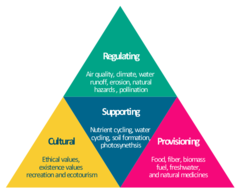
Provisioning services
Products that we obtain from nature including our food, raw materials, medicines, energy, water, and genetic resources.
i.e:
- anti-cancer drug Taxol extracted from Canada yew (Taxus canadensis).
- Cross-breeding modern crop cultivars with wild relatives adds genetic diversity, improving crop resistance to drought, disease, and pests.

Regulating services
The benefits humans receive beyond raw materials (provisioning services), such as climate regulation, purification of water and air, pollination, and pest control.

Supporting services
critical to biosphere viability. Examples include the production of oxygen, absorption of CO2, cycling of biomass, nutrients & water, and providing habitats.

cultural services
intangible, non-material benefits people obtain from nature and ecosystems.
Two types of species loss
extinction and extirpation
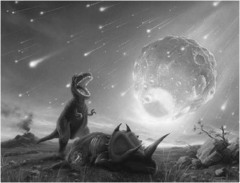
Extinction
A species is considered extinct when it exists nowhere on the globe

Extirpation
A species no longer exists in a defined geographic region but it can be found elsewhere, i.e. local extinction.

Extant
species that are still in existence

Endangered
species are facing imminent extinction, and threatened species are likely to become endangered if no action is taken.
Example: IUCN* estimates that 12% of birds and 26% of mammals are threatened with extinction.

Threats to ecosystem diversity
Human activity
examples: − IUCN* has identified ecosystems at risk of losing species and/or ecological functions and services:
− Caribbean coral reef ecosystems are endangered.
Due to the loss of important herbivores, overfishing, pollution, and climate change.
− The Aral Sea ecosystem in Asia has been assessed as being collapsed (analogous to extinct).
Caused by extraction of water to irrigate agricultural land

four major threats to biodiversity
1. Habitat loss
2. Invasive species
3. Overexploitation
4. Climate change
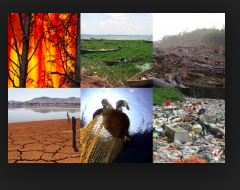
habitat loss
Human alteration of habitats is the greatest threat to biodiversity. In almost all cases, habitat loss and fragmentation lead to loss of biodiversity.
Habitat loss contributes to the endangerment of over 80% of all species
Examples of habitat loss:
~98% of the tropical dry forests of Central America and Mexico have been cut down.
Southeast Asian tropical rainforests are being destroyed at a rate of about 1% per year.
Amazon forest fires

invasive species
species that humans have accidentally or deliberately introduced into areas beyond their native range and negatively impact the environment, economy, or society.
- Without their native predators, parasites, and pathogens, introduced species may spread rapidly

Overexploitation
human harvesting of wild plants or animals at rates exceeding the ability of populations of those species to recover.
− Large animals with low reproductive rates are especially vulnerable to overexploitation.

climate change
a change in global or regional climate patterns.
- The climate is changing more rapidly than ecosystems and species can adjust.
− By the end of this century, the average temperature of Alberta will likely increase by at least 2°C which will change the timing and amount of rain and snow, and increase the frequency of extreme weather events, i.e. adversely affecting the supply of ecosystem services
Species may take advantage of a warming climate by expanding their ranges But habitat loss and fragmentation may limit expansion.
• A warming climate also expands the range of pests and diseases.
Species that are less mobile will need to adapt in place or face extirpation, and possibly even extinction.
• Many organisms with limited genetic diversity may not be able to adapt as quickly as the environment changes.
Climate change is creating warmer, drier conditions.
• Increased frequency of droughts and longer fire seasons are creating intense and more frequent wildfires.
• UN 2022 report: "global wildfire crisis"

Evolution
the process by which species of living organisms change over time through the gradual accumulation of small genetic variations.
- helps explain the origin of the vast variety of life forms on Earth and their interconnectedness (biodiversity).

Theories
explanations that unite our understanding of the natural world.

scientific theory
broad, natural explanation for a wide range of natural phenomena.
- strongly supported by many different lines of evidence and are widely accepted as valid because they have been repeatedly confirmed through observation and experimentation and have have withstood rigorous scientific testing, challenge, and debate.
- Fact-supported theories are NOT "guesses" but reliable accounts of the real world

Theory means ____________ not ____________
Body of knowledge, hypothesis
e.g. the "theory of gravity" does not mean we are currently uncertain of whether gravity exists.
- Examples of theories: gene theory, cell theory, and evolutionary theory.

How to conduct science
Scientists make observations
Form and test hypotheses
Make observations (collect data)
Data are recorded observations or items of information
Qualitative data - descriptions
Quantitative data - recorded measurements
Data that has been repeatedly confirmed by observation or experimentation are FACTS.

Mechanistic questions
"What pigments make the spider green?"
Focus: Understanding the specific mechanisms or processes that lead to the observed phenomenon, in this case, the green colour of the spider.

Evolutionary questions
"Why is the spider green?"
"How might it benefit the spider to be green?"
Focus: Exploring the evolutionary aspects and potential advantages or adaptations associated with the observed trait, in this case, the green coloration of the spider.

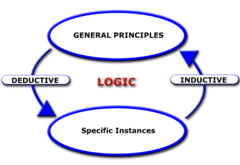
inductive reasoning
specific to general
Makes general conclusions by looking at specific observations. In biology, it's crucial when some things can't be tested through experiments (we cant experiment on dinosaurs)
EX:
Observation: "Many crab spiders in a particular habitat are observed to have green colouration"
Conclusion: "Based on the observed diverse colourations of crab spiders, it can be generalized that these spiders use coloration, potentially as a form of camouflage."

deductive reasoning
general to specific
EX: if organisms are made of cells (premise 1), and humans are organisms (premise 2), then humans are composed of cells.

Observation ("Discovery Science")
Process involves making detailed observations, using inductive reasoning to draw generalizations, and posing specific questions or hypotheses based on those observations
- example: "Is the mysterious coloration of crab spiders a form of camouflage?"
- Observations and inductive reasoning can lead us to:
− ask questions, and then propose hypothetical explanations called hypotheses.
scientific hypothesis
a tentative (not certain) or proposed explanation for a set of observations, grounded in available data and guided by inductive reasoning.
- knowledge-based
- It's a preliminary idea or suggestion based on the available evidence.
- leads to testable and FALSIFIABLE predictions
- Experiments can yield unexpected results, promoting the development of new hypotheses.
Note: scientific methods cannot test supernatural phenomena or religious beliefs as they are not testable or falsifiable.
How do we test these different hypotheses
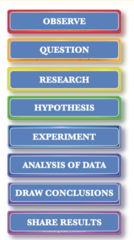
scientific method

Scientific Method
A series of steps followed to solve problems including collecting data, formulating a hypothesis, testing the hypothesis, and stating conclusions.
Rules:
1. We can never prove that a hypothesis is true. Failure to falsify a hypothesis does not prove the hypothesis is true.
Observations may be due to an alternative hypothesis that has not been considered.
2. repeated testing with varied experimental approaches can increase confidence in the hypothesis.

Hypothesis to specific prediction uses _______ reasoning
deductive
example:
Hypothesis: Crab spiders use color-matching for camouflage.
DEDUCTIVE PREDICTION: Mismatched spiders will suffer higher predation.
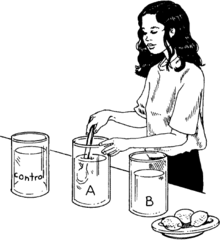
Design a controlled experiment, collect and analyze data, draw conclusions.
Importance of Experiments:
Allow researchers to move beyond correlations and establish causation, providing a foundation for evidence-based decision-making and interventions across various fields.
scientific method summary
Repetitive process involving observations -( inductive reasoning)-> questions -> hypotheses -(deductive reasoning) -> specific predictions, experimentation, and conclusion drawing.
If a hypothesis is not rejected, additional experimentation may be conducted to confirm; if rejected, a new/revised hypothesis is proposed.

Taxonomy
the scientific discipline concerned with naming and classifying organisms.
− taxo = arrange (Gk.), nomos = knowledge/science of (Gk.)
nomenclature
system of rules for naming things.
− nomen = name (Lt.)
Problems with common names
1. Different names for the same species.
− Common names differ among countries and languages.
2. Same name for different species.
3. The common name may imply relationships that do not exist. − e.g. consider these "fish": Jellyfish (cnidarian) = not a fish Crayfish (crustacean) = not a fish Silverfish (insect) = not a fish
Linnaean system of nomenclature, Swedish botanist Carl Linnaeus (1707-1778)
in his series Systema Naturae proposed a system of taxonomy based on resemblances: Uses Latin as the universal language of scientific nomenclature.
− Linnaeus classified >12,000 species.
e.g. humans, Homo sapiens
- Hierarchical classification of species into groups (ranks) based on the similarity of structures, functions, and other features.
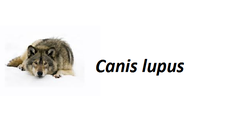
− Unique two-part scientific names for species (binomial nomenclature).
binomial nomenclature
Classification system in which each species is assigned a two-part scientific name.
-Every species has a unique binomial.
- genus name (e.g. Homo) followed by a specific name (or specific epithet) (e.g. sapiens)
- The first letter of the genus is capitalized, and the entire binomial name is italicized. − A genus name may be abbreviated, but not a specific epithet (e.g. Homo sapiens = H. sapiens).
- Specific epithets are unique for each species within a genus but are often reused between genera. While technically both parts together define the species name, it's a common practice to refer to the specific epithet alone as the 'species.'

Genus
A classification grouping that consists of a number of similar, closely related species

Epithets
describes a characteristic of the organism, the habitat it occupies, its geographical location.
- ex: Homo is the Latin word for 'human' or 'man' and sapiens is derived from a Latin word that means 'wise' or 'astute'.

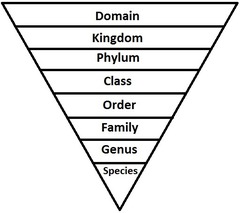
hierarchical classification system
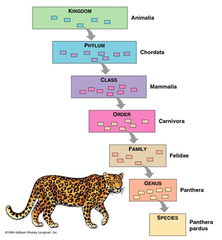
(from broad to narrow) Domain, Kingdom, Phylum, Class, Order, Family, Genus, Species
Linnaean classification groups species into increasingly broad categories, based on the degree to which they share characteristics
cat vs human
- example; domain: Eucarya
- class: mammals
- species: Homo sapiens (humans), Felis catus (domestic cats)

Domain
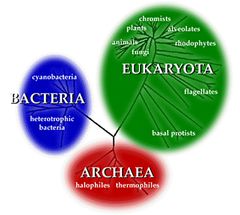
Using DNA sequence comparisons biologists have divided all organisms into three groups at the broadest level of classification:
− Domain Bacteria (prokaryotes)
− Domain Archaea (prokaryotes)
− Domain Eukarya (eukaryotes)
Eukaryotes includes various groups of protists (many single-celled) and the three kingdoms of multicellular organisms: Plantae, Fungi, and Animalia.
Taxon
a group of organisms classified at ANY LEVEL of a hierarchical system. The term is used to refer to a group of related organisms.
example:
- Order Rodentia: In the hierarchical classification system, "Order Rodentia" is a specific taxon. It includes various rodents like mice, rats, and squirrels

Limitations of hierarchical classification
the challenges lie in the varying applicability of traits across different groups and the fact that hierarchical classification, while useful for organizing and identifying species, does not inherently reveal the evolutionary relationships between them.
1. Different Groups Are Hard to Compare:
- It's tricky to directly compare higher-level groups (like orders or classes) between different sets of organisms.
- Traits used to classify, such as looks or genes, might not work the same way for all types of species. For example, what helps classify flowers might not be useful for categorizing invertebrates.
- This leads to variations in the amount of differences or similarities in how species look or their genetic makeup.
2. Classification Doesn't Show Evolutionary Connections Clearly:
- Even though we organize species based on traits, it doesn't tell us much about how different species are related in terms of evolution.
- Similarities and differences used for classification might not tell us the true evolutionary story of the organisms.
- This method relies on what we can see in terms of traits and doesn't directly show how species are connected through evolution.

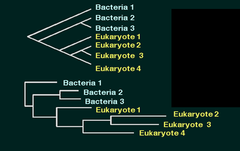
Cladogram
Diagram that shows the evolutionary relationships among a group of organisms
speciation event at the start of branch. Creating unique ancestors moving forward.
can infer ancestry and the timing
nodes inbetween are irrelevant
doesn't imply taxa as advanced or primitive

Phylograms
Diagram in which the length of a branch reflects number of changes in a DNA sequence.
speciation event
A point in evolutionary history at which a given population splits into independent evolutionary lineages.
-independent evolutionary paths (mutations, etc...)

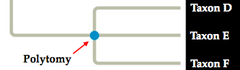
phylogenetic polytomies indicate
1. Lack of knowledge
2. Rapid speciation:multiple speciation events happen spontaneously
Taxonomy vs Systematics
Taxonomy: naming and classifying organisms
Systematics: provides scientific names, describes, preserves collections, provides classifications, keys for identification, data on distributions, investigates evolutionary histories and considers environmental adaptation of organisms.
-rapidly changing heirchal classifications

Building pholygenetic trees
• To construct a phylogenetic tree (hypothesis) for a group of organisms, systematists collect information about anatomical, physiological, or molecular traits that make up organisms.
The characteristics (traits) used to infer the phylogeny need to have arisen due to shared ancestry.
Traits shared among related organisms arise because the traits descended from the common ancestor of the group.
Organisms with shared traits (e.g.
DNA sequences or morphologies) are likely to be more closely related than organisms with different traits.
1. Trait was present in the common ancestors of the two groups and retained over time (shared ancestry). Traits are homologous
2. The trait r picked independently in the two groups as an adaption to similar environments (convergent enveloution)
Only homologous traits should be used to build phylogenetic trees.
Only homologous traits reflect evolutionary history.
Analogous traits appear the same but evolved independently (convergent evolution).
Homology
similarity resulting from common ancestry.
stricture are anatomical morphological resemblances representing variations on a structural theme present in a common ancestor
I.e mammals forelimbs

Analogy
A comparison of two different things that are similar in some way. Independent evolution of similar traits in DIFFERENT lineages.
- similar environmental conditions and natural selection profuse similar analogous adaptations in organisms from different evolutionary lineages

Homologous vs analogy
homologies in separate species result because they've evolved from a common species. Analogies in separate species result because they've evolved separately to simply adapt to their environment.
I.e wings are analogous in birds and bats since wings evolved independently in the two groups and are not present in their common ancestors

homoplasies
analogous structures or molecular sequences that evolved independently
-traits shared by a set of fax but the trait is not present in their common ancestors
-the more complex two similar structures are the more likely they are homologous
(ie eyes have evolved independently in different animals)

ingroup
the group of taxa whose evolutionary relationships are being determined
Outgroup
One or more tax that are related to the ingroup but that have diverged
Characters
comical physiological kr molecular features of organisms
-eyes

Character states
The observed condition of a character, such as presence or absence of lungs or arrangement of petals.
- orange eyes

Cladisticts
Method of inferring phylogeny from homologous characters
- organized by common descent.

monophyletic
ALL descendants came from one common ancestor. No unrelated taxa.
- monophyletic group = clade
paraphyletic group
O sits if an ancestral tack. JT not all of the defendants
polyphyletic grouping
Includes distantly related taxa but does not include the common ancestor of all group members

causes of polyphyletic Grouping
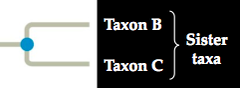
sister taxa
closest relatives
shared derived character
shared by two or more taxa and their most recent common ancestor (i.e. shared by taxa in a clade) but is not found in the ancestor that precedes the clade.
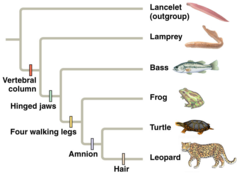
- The presence of an amniotic egg is shared among members of clade Amniotes, but it's different (derived) from the ancestral state (amnion absent) seen in the most recent common ancestor of the preceding clade (frog + turtle + leopard clade: tetrapods).

clade Amniotes
reptiles, birds, mammals
For clade Amniotes: − The presence of four walking legs (or hinged jaws, or a vertebral column) is a __________
shared ancestral character

shared ancestral character
a character that originated in an ancestor of the taxon/clade.
- The presence of four walking legs is shared among members of clade Amniotes, but it's the same as the ancestral state (four walking legs present) seen in the most recent common ancestor of the preceding clade (frog + turtle + leopard clade: tetrapods).
Synapomorphy
a derived character (apomorphy) shared by two or more groups which originated in their last common ancestor.

Symplesiomorphy
an ancestral character (plesiomorphy) shared by several groups, but inherited from ancestors older than the last common ancestor.

Plesiomorphy
an ancestral character.
- plesio = near

out-group
a member of the same phylum (Chordata) but it is not a vertebrate, i.e. it diverged before the ingroup

maximum parsimony
A principle that states that when considering multiple explanations for an observation, one should first investigate the simplest explanation that is consistent with the facts.
- The phylogeny (tree) that requires the fewest evolutionary events is the most likely. Choose the phylogeny that requires the fewest number of evolutionary events → because it is more probable.

evolutionary event
a change from the ancestral state, e.g. gaining a new trait or losing an old one.
