Bio Ch 15/17 & 19-21
 Call Kai
 Learn
Learn Practice Test
 Spaced Repetition
 Match
Match Flashcards
 Knowt Play
1/167

There's no tags or description
Looks like no tags are added yet.
Name | Mastery | Learn | Test | Matching | Spaced | Call with Kai | Chat |
|---|
No analytics yet
Send a link to your students to track their progress
168 Terms
Chromosome theory of inheritance
States Mendelian genes have specific loci (sites) along chromosome & it is the chromosome that undergoes segregation & independent assortment.
Supported by Mendel experiments
Mendel Experiment
Chose fruit flies (inexpensive, convenient)
4 pair of chromosomes, easily distinguishable w/ light microscope
Spotted male fly w/ white eyes
Mated that mutant white eye male with red eye female (all F1 = while type (red eye) )
F2 has 3:1 (only in males showcasing sex linked)
Separation of homologs during Anaphase 1
Accounts for segregation of the 2 alleles of a gene into separate gametes
Random arrangement of chromosomes pairs during metaphase 1
Accounts for independent assessment of alleles for two or more genes located on different homolog pairs
SRY gene activation is important
On Y chromosome allows for correct development of male anatomical features
X-linked trait is due to
Recessive allele, females must be homozygous to phenotypically show
Duchess muscular dystrophy
Affects male (weakening bone/coordination)
Lacking key protein on X chromosome
Hemophilia
X linked , lacking protein required for blood clotting
Female mammals including human inherit
2 X chromosome
Does not mean they encode double
Infact almost all of one X becomes inactive
Barr Body
Inactive X cell on female condenses into this compact object
Most genes on this are not expressed until they’re in the ovaries where chromosome are reactivated to give rise to egg (resulting in female egg having active X after meiosis)
Linked genes
Genes located near each other on the same chromosome tend to be inherited together in genetic crosses
Morgan’s experiment w/ flies body color & wing size gene
Resulting flies had higher combination of traits seen in P generation
Concluding that they’re linked
Meiosis & random fertilization
Generate specific variation among sexually reproducing organism due to
Independent assortment
Crossing over Meiosis 1
Probability of any sperm fertilizing any egg
Matching offspring are called
Parental types
Non parental phenotypes amongst offspring have new combinations
Recombinant types
50% frequency of recombination in test cross is observed
For any 2 genes that are located on different chromosomes & thus cannot be linked
More than 50% frequency indicates
Genes are linked
Crossing over accounts for recombination of linked genes
Breaking physical connection between specific alleles of genes on same chromosome
Occurs while replicated homologous chromosomes are paired during prophase of meiosis 1
Genetic map
Ordered list of genetic loci along a particular chromosome
Linkage map
Genetic map based on recombinant frequencies
(Genes located ver far apart on same chromosome will NOT show linkage)
Nondisjunction
Members of a pair of homologous chromosomes do not move apart properly during meiosis 1 or sis.chromatid fail to separate during meiosis 11
One gamete receives 2 of the same while the other receives nothing
Aneuploidy
One or more chromosomes are present in extra or deficient copies
Nondisjunction can occur in
Mitosis, and if aneuploidy occurs during earlier embryonic development, this can be passed on to large numbers of cells having substantial negative impact
Polyploidy
More than 2 full sets of chromosomes
Important in plant
Errors in meiosis or radiation (etc) can cause changes
Deletion
Duplication
Inversion
Translocation
Deletion
Chromosomal fragments is lost
Duplication
Reattachment of extra fragmented segment to sis/non sis chrom
Inversion
Fragment reattaches OG chromosome in reverse orientation
Translocation
Fragment joins a non homologous chromosomes
Deletion & duplication are likely to occur in
Meiosis
translocation & inversion
Can alter phenotype bc gene expression can be influenced by its location
Nondisjunction in meiosis results in
Aneuploidy in gametes & resulting zygote
(Although number is high in human, most are miscarried, the ones that survive ~syndrome~ )
Down syndrome
Trisomy on 21
Genomic imprinting
Expressions of an allele in offspring depends on whether the allele is inherited from male or female parent
Occurs during gamete formation, silences a particular allele of a certain gene or activates it
Costs of methyl —CH3 groups being added to Cytosine ( silencing allele mainly/ few activation )
Critical for embryonic development
Extra cellular gene
Not all locate on nuclear chromosomes, some outside organelle
(Some on mitochondria, chloroplast, plastid DNA. = do not display Mendelian inheritance)
Defects in protein of mitochondria
Result in reduction of ATP, b/c of effect on oxi phosphorylation
Causing disorder (detrimental) only from female parents
Gene expression
Process of DNA directing synthesis of proteins (some cases RNA)
Garold postulated that symptoms of an inherited disease reflects on the inability to make a particular enzyme
Later named One gene- One enzyme hypothesis
Beagle & Tatum
Neurospora (bread mold)
Used haploid mold species to demonstrate relationship between gene and enzyme
Require minimal medium
To experiment used complete medium to investigate Argentine synthesis, using Argentine requiring mutant
Result = each mutant unable to carry out one step in pathways for synthesizing Arg (presumably bc it lacked enzyme)
Supporting the one gene one enzyme hypothesis
Not all proteins are
Enzyme
Transcription
Synthesis of RNA using information in DNA
Occurs in nucleus
(Protein coding gene resulting in RNA = mRNA)
Translation
Synthesis of a polypeptide using info in the mRNA
Site = ribosome
Both transcription & translation occur in prok & euk
In bacteria since there’s no compartmentalization it occurs at same time
In euk transcription occur in nucleus but must be transported to cytoplasm for translation
Primary transcript
Initial RNA transcript from any gene including those specifying RNA is not translated into proteins
Flow of info going one way = Central Dogma
DNA — RNA — PROTEIN
Triplet of nucleotide bases = smallest unit of nucleotide length that can code for AA
4³ = 64 (possible code)
Flow of information from gene to protein is based on the triple codes
Template strand
DNA strand that is transcribed, provides pattern
Ex: 3’ ACC 5’
mRNA
Carrier of info from DNA to cells protein synthesizing machinery
Complementary 5’ UGG 3’
Non template strand of DNA
Coding strand 5’ TGG 3’
Number of nucleotides
Is 3x those of AA
61 OUT OF 64 CODE FOR AA
There is redundancy in genetic code
But not ambiguity
Enzyme RNA polymerase
Pries 2 strands of DNA apart & joins together RNA nucleotides complementary to DNA template thus elongating RNA polynucleotide
Assembly in 5’ — 3’ (adding on 3’)
Can start chain from scratch without the need of pre existing primer
Transcription stages
Initiation
Elongation
Termination
Promoter
DNA seq, where RNA polym attaches & initiates transcription
In bacteria signal ending transcription
Terminator
Bacteria vs Eukarya RNA polymerase
Bacteria = 1
Euk = 3 (RNA pol 11 used for pre mRNA synthesis, while others transcribe RNA molecules that are not translated to protein
Binding of RNA pol to promoter
Determines where transcription start & what direction it will travel
In eukarya transcription factors
Help guide binding of RNA pol & initiation of transcription
Transcription initiation complex
Whole complex of transcription factors & RNA pol 11 bound to the promoter
Has crucial promoter DNA seq called TATA box
Elongation of RNA
Enzyme adding nucleotide to 3’ end
Termination of transcription
In bacteria = terminator which causes polymerase to detach from DNA & releases transcript
In eukarya = RNA pol 11 transcribes seq on DNA , called polyadenylation , which specifies a signal in pre-mRNA
(note although in eukarya this cleavage marks end of mRNA , RNA pol 11 continues to transcribe until enzymes catch up & it dissociate from DNA
Alteration of mRNA end
5’ end (synthesized first) receives 5’ cap (modified form of G add onto 5’end after transcription of the first 20-40 nucleotide)
3’ end also modified before mRNA exit nucleus , enzyme add 50-250 more A nucleotide forming a poly A tail
Important function of 5’cap & poly A tail
Facilitate export of mature mRNA from nucleus
Help protect mRNA from degradation by hydrolytic enzymes
Help ribosome attach to 5’ end of mRNA once it reaches cytoplasm
UTRs
Untranslated regions of 5’ & e’ , help ribosome binding
RNA splicing
In eukarya nucleus
Large portions of RNA primary transcript molecule are removed & remaining portions are reconnected
Non coding region of Nucleic acid lies between
Intron
Eventually expressed
Exons
In RNA splicing introns are
Cut out from molecule while exons are joined together , forming an mRNA molecule w/ continuous coding seq
Removal of intron is possible
Via protein complex = spliceosome
(They also join together exons
Showing RNA can act as catalyst)
Ribozymes
RNA molecule that functions as enzyme
Intron RNA function as ribozyme & catalyzes its own removal
3 properties of RNA functioning as enzyme
Region in RNA molecule that may base pair, In An antiparallel arrangement w/ a complimentary region elsewhere in same molecule
Some of bases in RNA containing functional groups that can participate in catalysis
Ability of RNA to HB with other Nucleic acid molecules adding specifity to it’s catalytic activity
introns have allowed
Single gene to encode more than one kind of polypeptide
Alternative RNA splicing
Genes giving rise to 2 or more diff polypeptide base on what segment is treated as exon
Introns increase
Probability of crossing over between exon of allele by providing more terrain for cross over
Tranfer RNA
Tranfer an AA from cytoplasmic pool of AA to a growing polypeptide in a ribosome
Key of translating genetic message into a specific AA is the fact each tRNA molecule enables translation of given mRNA codon into certain AA
Has complimentary stretches of nucleotide bases that can HB to each other
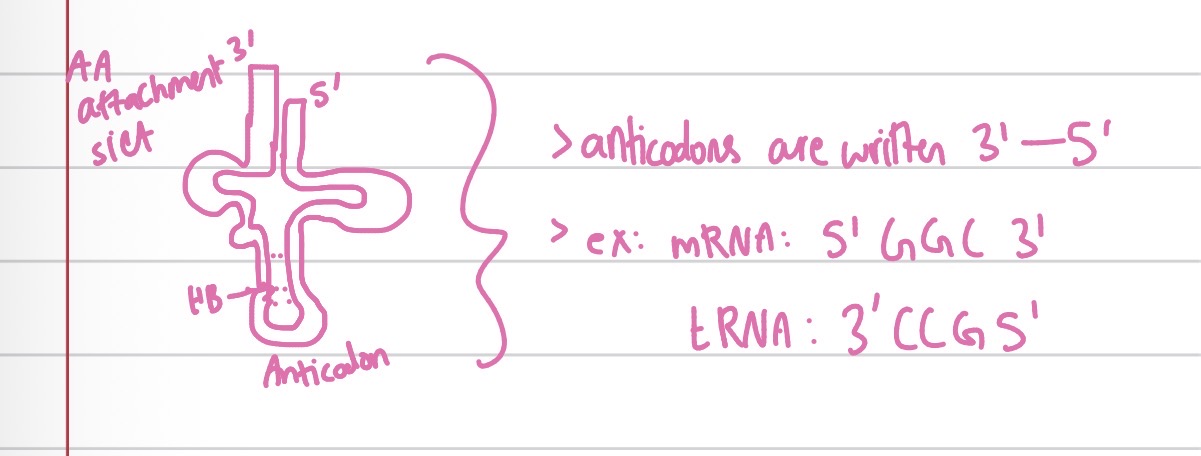
tRNA
Used repeatedly , & in eukaryotic it is made in nucleus & travels to cytoplasm
Aminoacyl- tRNA synthetases = allows for correct matching of tRNA & AA
(Uses ATP & releases charged tRNA)
Ribosome
Eukarya = larger can continue even after bacterial ribosome are inactivated
Facilitate coupling of tRNA anticodon w/ mRNA codons during protein synthesis
rRNA
Most abundant type of cellular RNA
Site in Ribosome
E= exit site (discharged tRNA leave ribosome)
P= peptidyl- tRNA binding site ( holds tRNA carrying growing polypeptide chain)
A= Aminoacyl tRNA binding site ( holds tRNA carrying the next aa to be added to chain)
Ribosome can be considered
One colossal ribozyme
Translation 3 stages
Initiation = bring mRNA , tRNA bearing first AA of polypeptide & 2 subunit of ribosome
(Binding to mRNA reaching AUG codon, binding to large subunit as well, completing initiation complex)
Proteins called initiation factors bring all components together (energy is expended)
tRNA sit in P & A is vacant for next
N terminus to C terminus (synthesis of polypeptide)
Elongation of translation
AA added one by one to previous AA at C terminus
Energy expenditure happens at 1 & 3 step
Step:
1st = codon recognition
2nd= peptide formation to carboxyl end
3rd= translocation from A to P & empty tRNA in P are released from E
Termination in translation
Stop codon reaching A site (UGA, UAA, UAG 5’ — 3’ )
Release factor protein shaped like Aminoacyl tRNA binds directly to stop codon in A site & release water (hydrolyzing peptide chain)
2 types of ribosome
Free = suspended in cytosol & mostly synthesize protein that stays in cytosol
Bound= attached to cytosolic side of ER or nuclear envelope, make proteins of Endomembrane system as well as the ones secrete into the cell
(These ribosome are identical and can alternate between free/bound)
Signal mechanism for targeting proteins to ER
Polypeptide synthesis begun in cytosol as free ribosome translate mRNA , there process continues to completion unless growing peptide itself cues ribosome to attach to ER
Polypeptide (marked by signal peptide which targets protein to ER)
Signal recognized by SRP , binds to receptors protein in ER , part of protein complex that forms a pore
SRP leaves , polypeptide synthesis resumes w/ simultaneous translocation across the membrane
Signal peptide is cleaved by enzyme in receptor complex
Rest of completed polypeptide leaves the ribosome & fold into final conformation
Mutations
Source of new gens/ changes to genetic info
Point mutation
Changes in a single nucleotide pair of gene
If in gamete , can be passed to future generations (ex:sickle cell)
Nucleotide pair substitution
Replacement of one nucleotide & its partner w/ another pair of nucleotide
Silent mutation
No observable affect on phenotype bc results in same AA
Missennse mutations
Substitution that changes one AA
To another
Nonsense mutations
Causes translation be terminated prematurely
Insertion & deletions
May alter reading frame, disastrous effect on resulting protein
Framehsift mutation
Wherever # of nucleotide inserted or deleted does not equal multiple of 3 (unless near every end, otherwise protein is non functional)
Mutations arise by
Error in DNA replication
Recombination
Mutagens interacting w/ DNA
Using CRISPR CAs 9
Gene editing
CAs 9 acts with guide RNA made from CRISPR region of bacteria genome
CAs 9 is Nuclease & cuts ds DNA molecules
Thus triggers repair system where there’s no undamaged DNA to use as template, repair enzymes introduce /remove random nucleotides
Technique is good in “knocking out” given gene to see what it does in an organism
Cas 9
Bacterial protein helping defend bacteria against virus that infect them (becateriopahges)
CRISPR CAS 9 has been modified
To repair gene w/ harmful mutations
By introducing functional segment along with the CRISPR system , so when it edits , the defective gene is corrected
Gene
Region of DNA that can be expressed to produce a final functional product , that’s either a polypeptide or RNA molecule
Virus
Infectious particle consisting of little more than genes packaged in a protein coat
CANNOT reproduce/carry out activities outside of host cell
Viral genomes
Can be diverse DNA/RNA , ds, ss