OCD explanation and evaluations
 Call Kai
 Learn
Learn Practice Test
 Spaced Repetition
 Match
Match Flashcards
 Knowt Play
1/10

There's no tags or description
Looks like no tags are added yet.
Name | Mastery | Learn | Test | Matching | Spaced | Call with Kai |
|---|
No analytics yet
Send a link to your students to track their progress
11 Terms
what does the approach believe
Approach assumes that all behaviour can be related to physical changes in the body
Focus is on nervous system - the brain particularly
Views psychological abnormality as an illness and as a disease (in the same way as physical illness or disease)
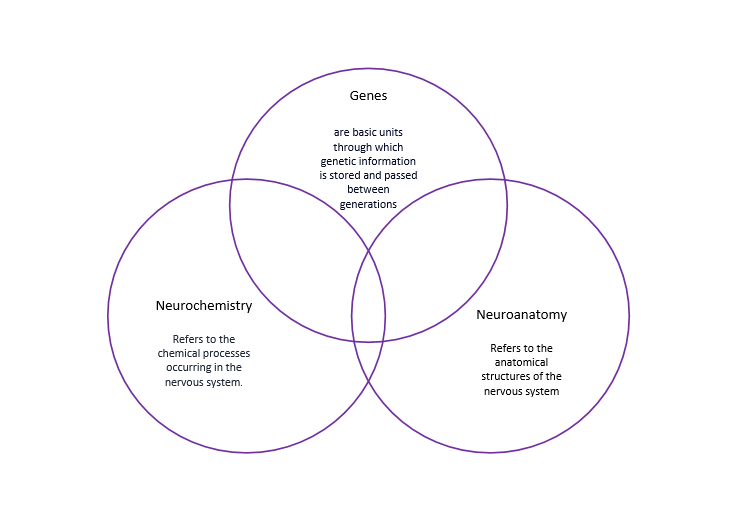
genetic explanation
Genetic explanation suggests that OCD is inherited in the genetic material which is passed down from parents
Genes are said to be involved in individual vulnerability to OCD
Lewis 1936 observed that of his OCD patients, 37% had parents with OCD and 21% had siblings with OCD - suggests that it runs in the family
What is passed on is vulnerability to OCD not certainty
Diathesis-stress model - certain genes leave some more likely to develop a mental disorder but it is not certain and environmental stress is necessary to develop OCD
what are the two types of gene
Everyone has the same genes but they just vary slightly which triggers different things
Candidate genes: researchers have identified genes which create vulnerability for OCD
COMT gene
SERT gene
Disorders including OCD may be influenced by a lot of genes - polygenic
Taylor 2013 analysed findings of previous studies and found evidence that up to 230 genes may be involved with OCD
Main genes studied have association with role of mood regulating neurotransmitters - serotonin and dopamine
COMT gene is involved in the production of the enzyme COMT - catechol-methyltransferase
Regulates the production of dopamine, a neurotransmitter, in the synapse
Dopamine - involved in reward, motivation and motor control
The form of the COMT gene that is more common in those with OCD is low level activity of the gene which results in higher levels of dopamine
SERT gene - shorter form of serotonin transporter gene = 5-HTT
Regulates the transport of serotonin in a synapse
Involved in feelings of well being and happiness
Form of SERT gene more common in OCD individuals is high level activity of the gene which results in lower levels of serotonin as reuptake mechanism works too hard
different types of OCD
One group of genes may cause OCD in one person but different group of genes will cause this in another
Aetiologically heterogenous - origins of OCD vary from one to another
Some evidence to suggest that different types of OCD may be the result of particular genetic variations - hoarding disorder and religious obsession
neural explanation what is the worry circuit
People with OCD tend to have relatively high levels of neural activity in the orbital frontal cortex (OFC)
OFC sends 'worry' signals to the thalamus, thalamus is alerted and confirms the 'worry' back to the OFC, creating a circuit
In a 'neurotypical' brain, the 'worry' signal would be suppressed/intercepted by the caudate nucleus however, in an 'atypical' brain the caudate nucleus is impaired allowing this neural activity (worry gets to thalamus and the thalamus will reconfirm the worry and send it back to the OFC)
Caudate nucleus' inability to filter small worries in people with OCD result in worry circuit being overactive
neurotransmitters and neuroanatomy
Serotonin plays a key role in operation of the OFC and the caudate nucleus - abnormally low levels of serotonin might cause this area to malfunction
Dopamine - main neurotransmitter of the basal ganglia (caudate nucleus, putamen and globus pallidus), high levels of dopamine leads to overactivity of this region - associated with OCD
what are some decision making systems
Some cases - associated with impaired decision making
Frontal and lateral lobes are abnormally functioning - frontal lobes are responsible for logical thinking and decisions
Evidence suggests that left parahippocampal gyrus which is associated with processing unpleasant emotions, functions abnormally in OCD
strengths of neural explanation
Piggot et al 1990 - serotonin agonists and several selective serotonin uptake inhibitors are effective at reducing the symptoms of OCD
Anxiety reducing drugs that do not affect serotonin are not effective for those with OCD
Supports the idea that lower levels of serotonin are involved in exhibition of OCD symptoms
Szechtman et al 1999 - gave rats a dopamine agonist (stimulates production) and they started to experience repetitive behaviours that were compulsive
They then gave rats anti-OCD drugs (antagonists) and the repetitive behaviour was reduced as this slows dopamine production
Supports idea that dopamine systems are involved in OCD as it resembles ritualistic behaviour in humans
Saxena and Rauch 2000 - reviewed studies of OCD that used PET, fMRI and MRI neuro-imaging techniques
Found consistent evidence of an association between the orbital frontal cortex and OCD symptoms
Suggests that specific neural mechanisms in the OFC are involved with the explanation of OCD
weaknesses of neural explanation
Many people who have OCD also have depression (co-morbidity), this is thought to involve disruption of the serotonin system
Leaves us with a logical problem when it comes to serotonin system as possible basis for OCD
Simply be that serotonin activity is disrupted in many people with OCD as they are depressed as well
Serotonin may not be relevant to symptoms
Not clear what neural mechanisms are involved in OCD
Studies show that neural systems involved in decision making are the ones that malfunction in OCD (Cavedini et al 2002)
Some research also identified various other brain systems that may be involved in OCD
Cannot claim to understand the neural mechanisms in OCD
strengths of genetic explanation
Nestadt et al 2010 reviewed twin studies of OCD and it was found that concordance for MZs was 68% compared to 31% for DZ
Concordance rate is the percentage of pairs of twins that both showed the disorder
Person with a family member diagnosed with OCD is around 4 times more likely to develop the disorder than someone without - Marini & Stebnicki 2012
maybe RWA for genetic counselling
weaknesses of genetic explanation
OCD is polygenic so the COMT and SERT genes are not the only ones that contribute to OCD
Our understanding of the human genome advances all the time and more genes being discovered which contribute to OCD
Many of the genes contribute small risk of OCD and many have other functions
Genetic vulnerability is not the only factor in determining whether someone will develop OCD as there are also environmental risk factors
Cromer et al 2007 - sample of 265 diagnosed with OCD given structured clinical interviews
54% reported experiencing one traumatic life event
Those with traumatic life events had more severe OCD symptoms - the correlation remained despite variables such as age, OCD age-of-onset, comorbidity and depressive symptoms