Soil Science Exam
 Call Kai
 Learn
Learn Practice Test
 Spaced Repetition
 Match
Match Flashcards
 Knowt Play
1/63

There's no tags or description
Looks like no tags are added yet.
Name | Mastery | Learn | Test | Matching | Spaced | Call with Kai | Chat |
|---|
No analytics yet
Send a link to your students to track their progress
64 Terms
What is soil?
Soil is an organic mineral mix in which four distinct spheres interface. Namely the:
Lithosphere
Biosphere
Hydrosphere
Atmosphere
the intersection of those spheres is pedosphere - in other words: soil
Describe 5 soil functions
Soil functions:
purification system for water
modifier of the atmosphere
system for water supply
engineering medium
serves as habitat for soil organisms
recycles nutrients and organic matter
medium for plant growth
Name Horizons> Name main properties for Horizons
O - not present in all soils. feature of mostly forest soils in which a dense layer of organic material builds up on the surface of the topsoil
A - organic matter and minerals are intimately mixed
E - not present in all soils - mostly in forest soils with a lot of downward movement of water. zone in which minerals are leached resulting in a distinctive “bleached layer” consisting mostly of quartz minerals
B - zone of accumulation. its lower in organic content then A horizon. contains more of the minerals leached from upper horizons. contains less pore space being usually dominated by micropores.
C - consists of unconsolidated parent material which has been partly weathered by plant roots, enzymes and so on
Bedrock ® - consolidated parent material
Soil-forming factors
Soil-forming factors: all interdependent!
a) Parent material
b) Climate
c) Biota
d) Topography
e) Time
The 4 Soil Forming Processes. AND EXAMPLES
- Additions -> dust, fertilizer, manure, OM from litter/roots
- Losses -> leaching, surface erosion
- Translocations -> earthworm mixing of OM, water transport of OM
- Transformations -> humification, chemical weathering, synthesis (clays formed from primary minerals)
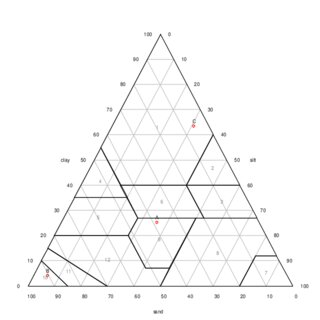
Know how to read the texture triangle
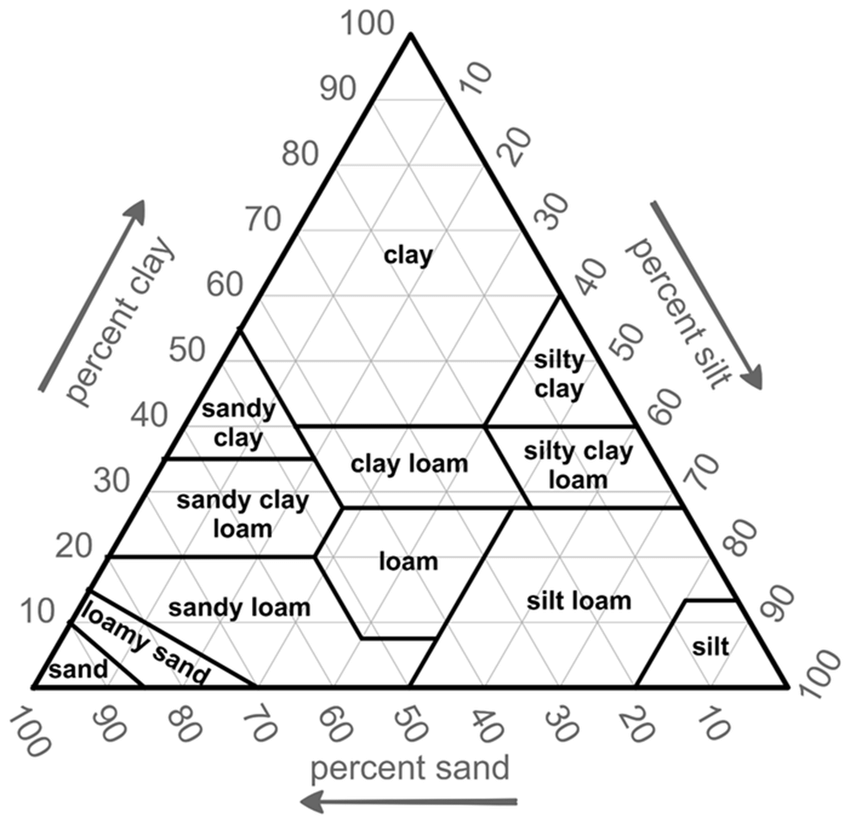
What are the sizes of clay, silt and sand particles?
Clay (smallest) - >0.002 millimeters in diameter
Silt - 0.002 mm to 0.05 mm in diameter
Sand - 2mm to 0.05 mm in diameter
SOM: why is it important?
- Nutrient release: vital to cycling of C, N, S, P
- Soil aggregate stabilisation
- Cation exchange capacity
- Water holding capacity
- Inactivation of pollutants
- Long-term C storage (climate change)
- Soil temperature adjustment
- Habitat and energy source for soil microbes
Why are soil colloids important?
- Negative and positive charges
- Attraction and repulsion of ions
- Attraction of water molecules
- Adsorption of cations (Al3+, Ca2+, Mg2+, K+, Na+, H+)
- Constant exchange & release of plant nutrients
- Equilibrium of soil solution and exchange sites
- Fixation of pollutants
Which are the important steps of cultivation on arable land?
1. Primary tillage and reconsolidation
2. Secondary tillage or seedbed preparation
3. Seeding/planting
4. Plant protection/weeding/fertilizer application/irrigation
5. Harvest
What are the aims of the different cultivation steps?
- create a good soil structure (granular, crumb)
- remove unwanted plants by burying, cutting, ripping out and squeezing
- leveling soil surface
- alter surface to enhance infiltration of water
- stimulate organic matter breakdown to release nutrients (mineralisation)
- place seeds and fertilizer
- increasing trafficability of soil
How do these steps influence soil properties?
- consolidation (reduction of soil volume due to loss of macropores < 30 µm)
- plough pans from subsoil compaction reducing air/water storage = hampered growth of deep-rooted crops e.g. corn
-coalescence = fine particles deposited between aggregates after tillage in dry conditions
- slaking = structural collapse when dry aggregates wetted rapidly
- sealing = fine particles enter macropores, reduce infiltration
- soil erosion by water and wind
- loss of soil organic matter by decomposition
Earthworms: name the main groups and their habitats/behavior. . Habitat and characteristics of earthworms (anecic, epigei, endogeic) and how they live.
epigeic - leaf litter compost, pigmented
endogeic - top soil, subsoil (unpigmented)
anecic - deep burrowing (unpigmented, part of the tail is colored)
Why is the size of the soil microbial biomass important?
-> Soil microbial biomass is an important pool of nutrients.
- “Early warning system”, e.g. change of organic matter content;
- Microbial biomass is closely related to the soil organic matter content
- Indicator of soil quality (size, metabolism)
- Biological buffer against environmental stress (resilience, self regulation, functional diversity, functional redundancy)
- Biocatalyst: degradation of xenobiotics (resilience)
- Suppressive soils
- Weathering of soil minerals
- Altering the redox properties of the soil
- Humification organic matter enrichment
- N2-fixation
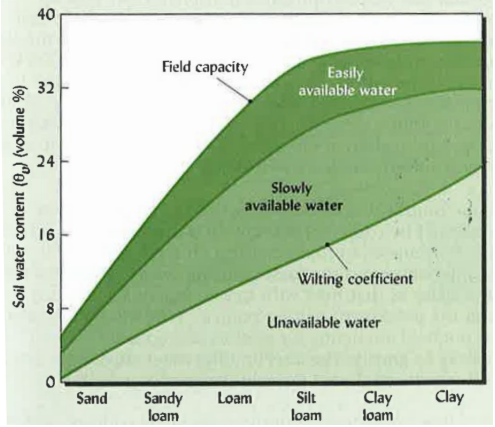
Know the diagram: Different soil water contents in soils of different textural classes
Define soil texture and soil structure
Soil texture - relative amount of soil particles of different sizes (salt, silt, clay) forming the soil mineral matter
Soil structure - describes how those particles are arranged, soil structure considers the pore space as well as organic matter.
Is there soil on the moon? Why?
No, there is no soil on the moon because the atmosphere, hydrosphere and biosphere is not present and they are all necessary constituents of the pedosphere.
What Does the C/N ratio mean?
a ratio of the mass of carbon to the mass of nitrogen in organic residues.
It can, amongst other things, be used in analyzing sediments and soil including soil organic matter
What processes influence C and OM pools?
Agricultural practices like tilling will quickly start to influence SOM reducing the amount of plant residues, active OM, slow OM and will slowly start to degrade passive OM pool.
Overall loss of total SOM with the SOM being eventually dominated by the passive OM and therefore a low C/N ratio.
SOM content can also be improved by eg. OM management practices like:
- reduced till
- no till
- cover cropping
- mulching
- putting the land back into native vegetation
Explain the steps of Leguminous N2>fixation with the rhizobia bacteria. Which factors influence that process?
Steps:
Rhizobia in soil contact legume roots
Infection of root hairs → nodule formation
Rhizobia fix N₂ → NH₃ inside nodules
Plant uses NH₃ for growth; supplies bacteria with sugars
Active nodules = pink (leghemoglobin); old = gray/green
Key Factors:
Rhizobia strain + legume type
Soil nutrients (P, K, micronutrients)
Water, temp, O₂ balance
Low soil N (high N suppresses fixation)
Plant health, photosynthesis
Name the Pathways of:organic nitrogen, ammonium and nitrate
xx
How can you measure the phosphatase activity and what does it indicate?
xx
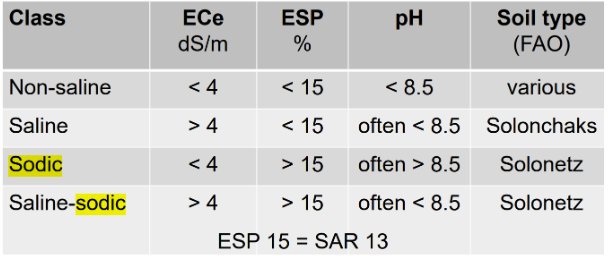
What types of classification and thresholds are there for soil salinity?
Saline, Sodic, …know ESP, EC, ph
EC = electrical conductivity (dS/m = decisiemens/meter), influenced by salt content (chlorides and sulfates of Ca, Mg, Na & K)
ESP = exchangeable sodium percentage (%)
SAR = sodium adsorption ratio
TDS = total dissolved solids; mass of dissolved salts per unit of volume soil water
CEC = cation exchange capacity (cmolc/kg soil)
How can these soil problems be tackled?
- Alkalinity
- Salinity
- Sodicity
Counteracting:
Salinity:
- Improve irrigation to leach excess salts below root zone (~80 % of salts can be removed by a volume of water passing through the same volume of soil)
- Improve drainage to lower water table -> reduce upward movement of water and salt
- Apply organic matter Utilize salt-tolerant crops
Sodicity:
Removing sodium from the exchange complex and soil profile as Na2SO4
- Application of gypsum, sulphur or sulphuric acid and excess water (leaching of salts)
2NaHCO3 + CaSO4 CaCO3 + Na2SO4 + CO2 + H2O Na2CO3 + CaSO4 CaCO3 + Na2SO4
Alkalinity
- Lowering the pH in the rhizosphere application of sulphur, sulphates (Fe, Ca) or sulphuric acid
Create a soil footprint 8P. How can we measure it? Which soil properties are relevant?
texture
pH
OM
xx
What is the difference between a resilient soil in comparison to a resistant soil? Give an example for a resilient soil( soil A) and a resistant soil (soil B)
Soil resistance = capacity of a soil to resist change when confronted with a disturbance e.g. compaction or nutrient depletion
e.g. plant uptake of K replenished more easily from fine textured than sandy soil = much better resistance
Soil resilience = the capacity of a soil to recover its structural and functional integrity after a disturbance
name functions of OM in soil
- Nutrient release, especially N
- Soil aggregate stabilization
- Cation exchange capacity
- Water holding capacity
- Inactivation of pollutants
- Long-term C storage
What produces the OM and C pool?
xx
name OM management tools
xx
Pesticides: How do they get into the soil? Environmental Effects? Alternatives to pesticides?
a) Soil has key role in a pesticide´s dispersal:
• many pesticides are soil-applied
• wider range enters soil due to rain-wash from leaves
• incorporation of pesticide-treated plant residues into soil
b) Alternatives to pesticide use:
- Integrated Pest Management:
• redesign agricultural system to favour pest predators, disadvantage pests e.g. crop rotation, ground cover and pest-resistant cultivars
- Natural pesticides:
• Nicotine kills sap-sucking insects
• Eugenol herbicide extracted from oil of cloves
- Biological strategies:
• aphid parasites attracted by clover and sunflower
• decoy plants e.g. mustard attracts cabbage butterflies
• use of hormones/pheromones to remove insects from crops e.g. fruit fly
c) Environmental effects:
residues may spread in environment and enter food chain
„broad spectrum“ chemicals may kill beneficial organisms (e.g. mycorrhizal fungi or N-fixation bacteria)
harm to pests´ natural predators
How can plants help to clean soils from toxins.2 different processes
xx
Fill out the flow diagram with the names of different parent material deposits
xx
Fill out the flow diagram with the names of different parent material deposits
water logging results in upward movement of salts <only info
Fate of org N,
Fate of NH4
Fate of nitrate
Fate of:
a) Organic nitrogen:
1. Immobilization by soil microorganisms
2. Removal by plant uptake (amino acids)
3. Loss to groundwater by leaching
4. Mineralisation by soil microorganisms
Loss by runoff and erosion
b) NH4 +
1. Immobilization by soil microorganisms
2. Removal by plant uptake
3. Fixation to clay minerals
4. Volatilisation as gaseous NH3
5. Oxidation to nitrite and nitrate (nitrification)
Loss by runoff and erosion
c) NO3 -
1. Immobilization by soil microorganisms
2. Removal by plant uptake
3. Loss to ground-water by leaching
4. Dissimilatory nitrate reduction (to NH4 +)
5. Volatilisation as NOx, N2O, N2 (denitrification)
Which is the FAO classification of soil types?
The Food and Agriculture Organization of the United Nations (FAO) -
diagnostic properties and diagnostic horizons based on soil formation
eg.
Ferralsols
Acrisols
Lixisols
Luvisols
Nitisols
Arenosols
Calcisols
Solonetz
Gleysols
Fluvisols
Which properties define dry regions?
xxx
xx
xx
xx
xx
Soil Types in tropical regions which is one? Vertisol, Ultisol, Oxisol, etc.
• Kaolinitic soil - Account for more than 70% of all tropical soils
- A-horizon often sand to sandy loam
- B-horizon clayey with kaolinite > 90% of clay minerals
- Highly weathered, low CEC. Oxidic soils - Second most widespread soils
- Strongly weathered red and yellowish, fine-textured soils
- Kaolinite and Fe-/Al-oxidesAllophanic soils
- Dark-coloured young soils derived from volcanic ash
- Low bulk density (<0.9 Mg/m³)
- High WHCSmectitic soils
- Loamy to clayey soils of alluvial origin (delta & river plains)
- Moderate to large amounts of smectites with shrink and swell ability
- Moderate to high CEC, high base saturation and WHC
xx
What are the consequences of tropical humid climates for soil properties?
• Physical weathering, erosion and sedimentation
• Intensive vegetation/biomass development
• Fast organic matter turnover
• Increased acidification
• Leaching of salts, carbonates, basic cations
• Strong chemical weathering of primary minerals
• Formation of secondary minerals (clay minerals)
• Weathering of secondary minerals
• Release of Si and Al from clay minerals
• Free Al and Fe and Al and Fe-oxide accumulation
• Phosphorus fixation
• Low nutrient content (also trace elements)
Why are moore high in acidity: Multiple choice. Low temp. slow OM turnover, parent material poor in cations, strong leaching of cations, addition of rainwater / spring water
How can you raise a soil's CEC ? Explain the mechanism.
How can you influence CEC of clay particle (multiple choice)
Fill out the diagram of different parent materials deposits. (only 4 gaps: Alluvial/fluvial, lacustrine, colluvial (gravity) and eolian (wind)
Name influencing factors in water erosion?
Predicted annual soil loss: A = R x K x LS x C x P
R = rainfall erosivity
K = soil erodibility
L = slope length
S = slope gradient or steepness
C = cover and management
P = erosion-control practices
How can soil erosion by water be reduced?
1. Reduce raindrop impact
-> cover crops/mulches for rainy season
2. Increase infiltration and reduce runoff
-> modify slope, mulches
3. Reduce runoff velocity
-> modify slope, contour cropping
4. Safe runoff removal
-> grassed waterways
5. Vegetative barriers
-> perpendicular to slope direction
-> dense stem system filters particles from runoff
e.g. vetiver grass
6. Minimize soil disturbance
-> conservation tillage
e.g. chisel plowing stirs soil but only partially incorporates residues -> improves macroporosity, aggregation, infiltration and WHC
What are the influencing factors of soil erosion by wind?
Predicted wind erosion: E = f(I x C x K x L x V)
I = soil erodibility factor
C = climate factor
K = soil-ridge roughness factor
L = width of field factor
V = vegetative cover factor
How can soil erosion by wind be reduced?
1) Stabilize aggregates with OM
2) Plant cover crops to shield and anchor soil
3) Cultivate at right angles to dominant wind direction
4) Standing stubble to absorb shear stress of wind
5) Wind barriers e.g trees and perennial grass trap wind-blown soil reduce fetch (distance of unhindered travel) and wind velocity effects felt at lengths 20 times the height of trees