1.5 - particle interactions
 Call Kai
 Learn
Learn Practice Test
 Spaced Repetition
 Match
Match Flashcards
 Knowt Play
1/80

There's no tags or description
Looks like no tags are added yet.
Name | Mastery | Learn | Test | Matching | Spaced | Call with Kai | Chat |
|---|
No analytics yet
Send a link to your students to track their progress
81 Terms
what changes the momentum of an object?
a single force acting on the object
what happens when a single force acts on an object?
it changes the momentum of the object
momentum equation
p = mv
p - momentum
m - mass
v - velocity
what is momentum?
the product of an object’s mass and velocity
what force do 2 interacting objects exert?
equal and opposite forces on each other
what happens to the momentum when 2 objects interact?
momentum is transferred between the objects by their equal and opposite forces, considering no other forces act on them
what is a virtual photon?
a photon that cannot be seen or destroyed. known as the ‘exchange particle’ or the ‘force carrier’
what is a virtual photon also known as?
exchange particle
force carrier
which direction do you move if you throw momentum forwards?
backwards
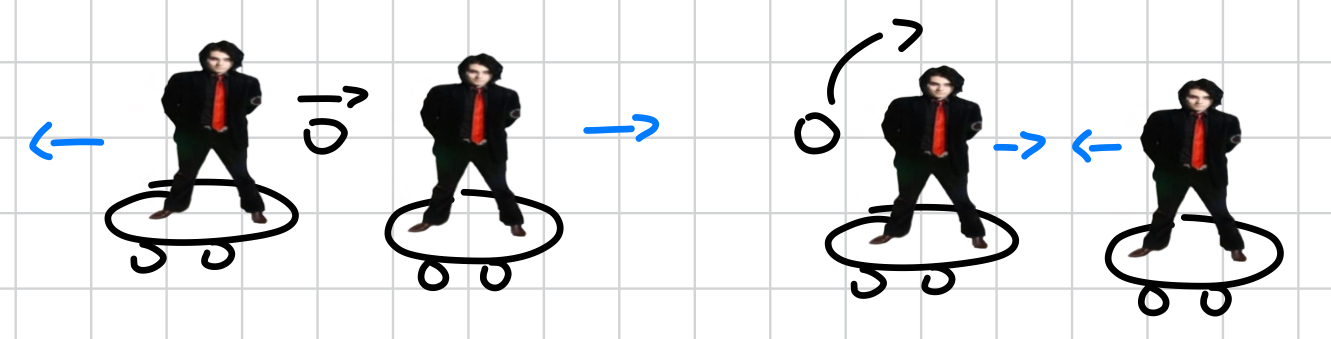
why do particles of the same charge repel?
they exchange virtual photons (known as electromagnetic force), transferring momentum, repelling them
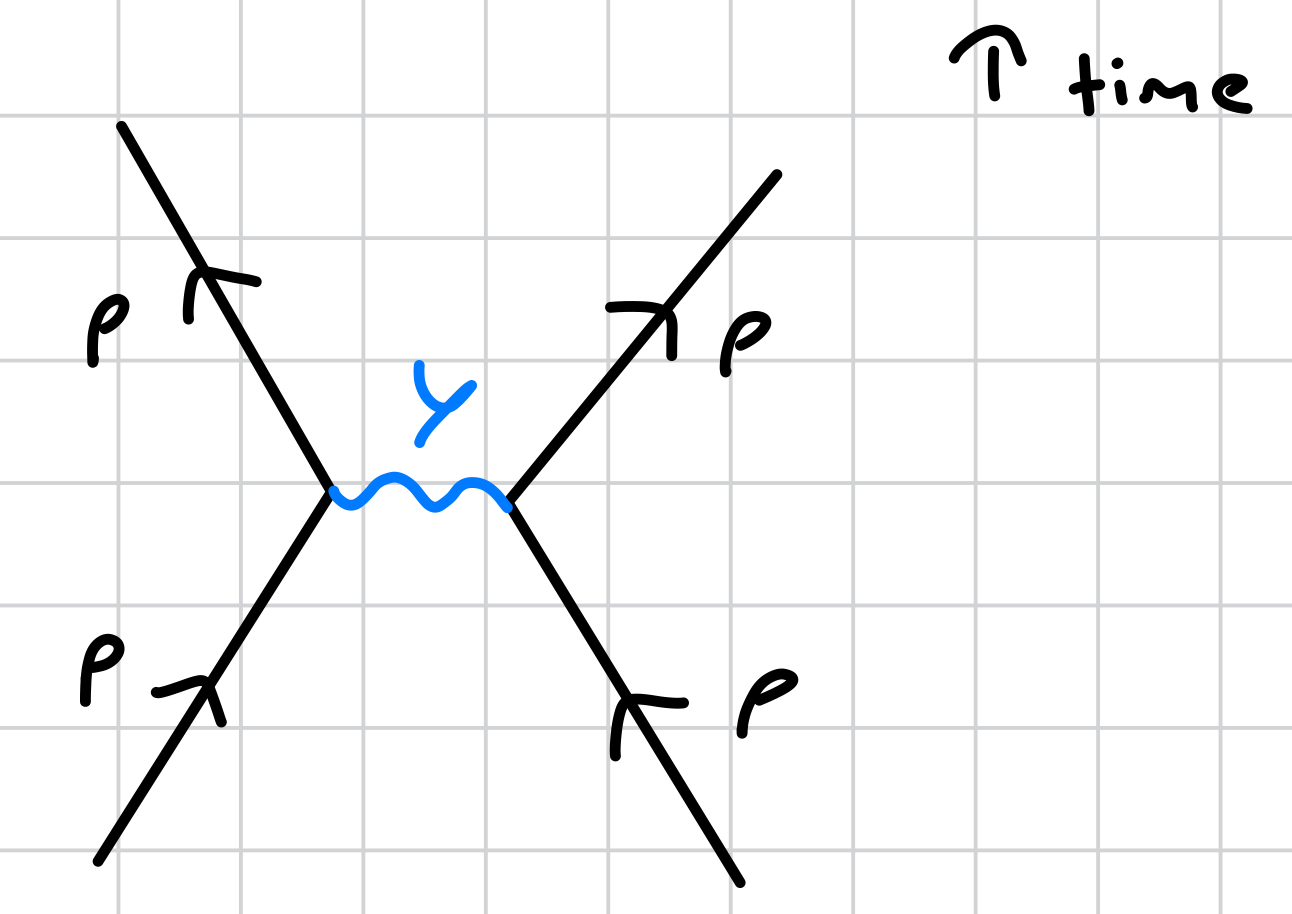
what are the electromagnetic forces due to?
the exchange of virtual photons
what interactions are virtual photons involved in?
electromagnetic forces acting on each other (attraction and repulsion), interactions between charged particles
what interactions are W bosons involved in?
weak nuclear
what do weak nuclear forces do?
turn protons to neutrons, and vice versa
what interactions are weak nuclear forces involved in?
β+ decay
β- decay
positron emission
neutron-neutrino interactions
proton-antineutrino interacts
why is weak nuclear force weak?
as it works within the nucleus (since it works with nucleons), it needs to be weaker than the strong nuclear force holding the nucleus together
β+ decay
weak nuclear force
p → n
W+ boson released to turn a proton to a neutron, and a neutrino to a β+ particle
which type of β decay has a proton turning to a neutron?
β+
what kind of photon is released in a β+ decay?
W+ boson
what kind of boson is released in β- decay?
W- boson
which type of β decay involves a neutrino?
β+ decay
which type of β decay involves an antineutrino?
β- decay
in which β decay does a proton turn to a neutron?
β+ decay
in which β decay does a neutron turn to a proton?
β- decay
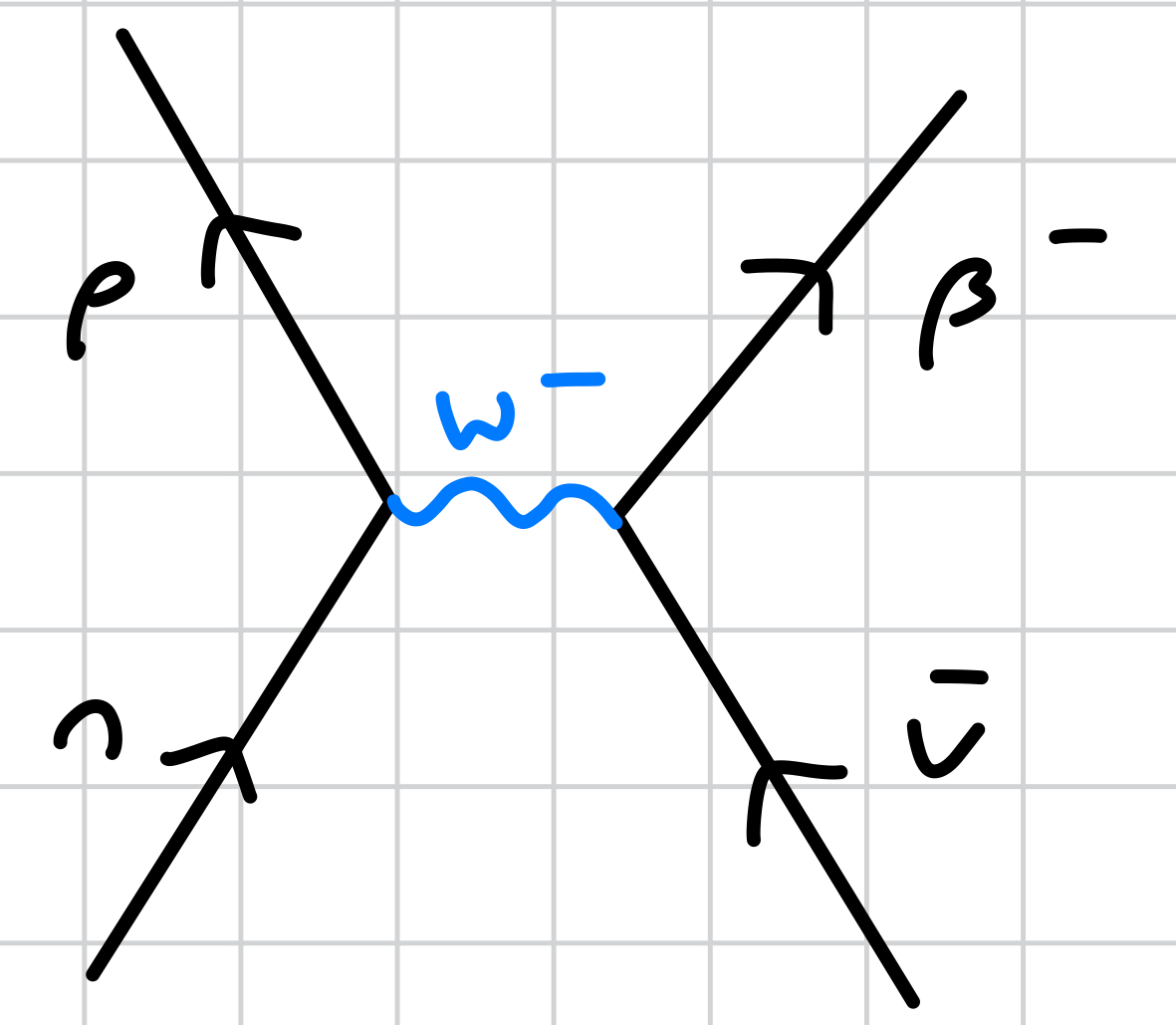
β- decay
weak nuclear force
n → p
W- boson released to turn a neutron to a proton, and an antineutrino to a to a β-
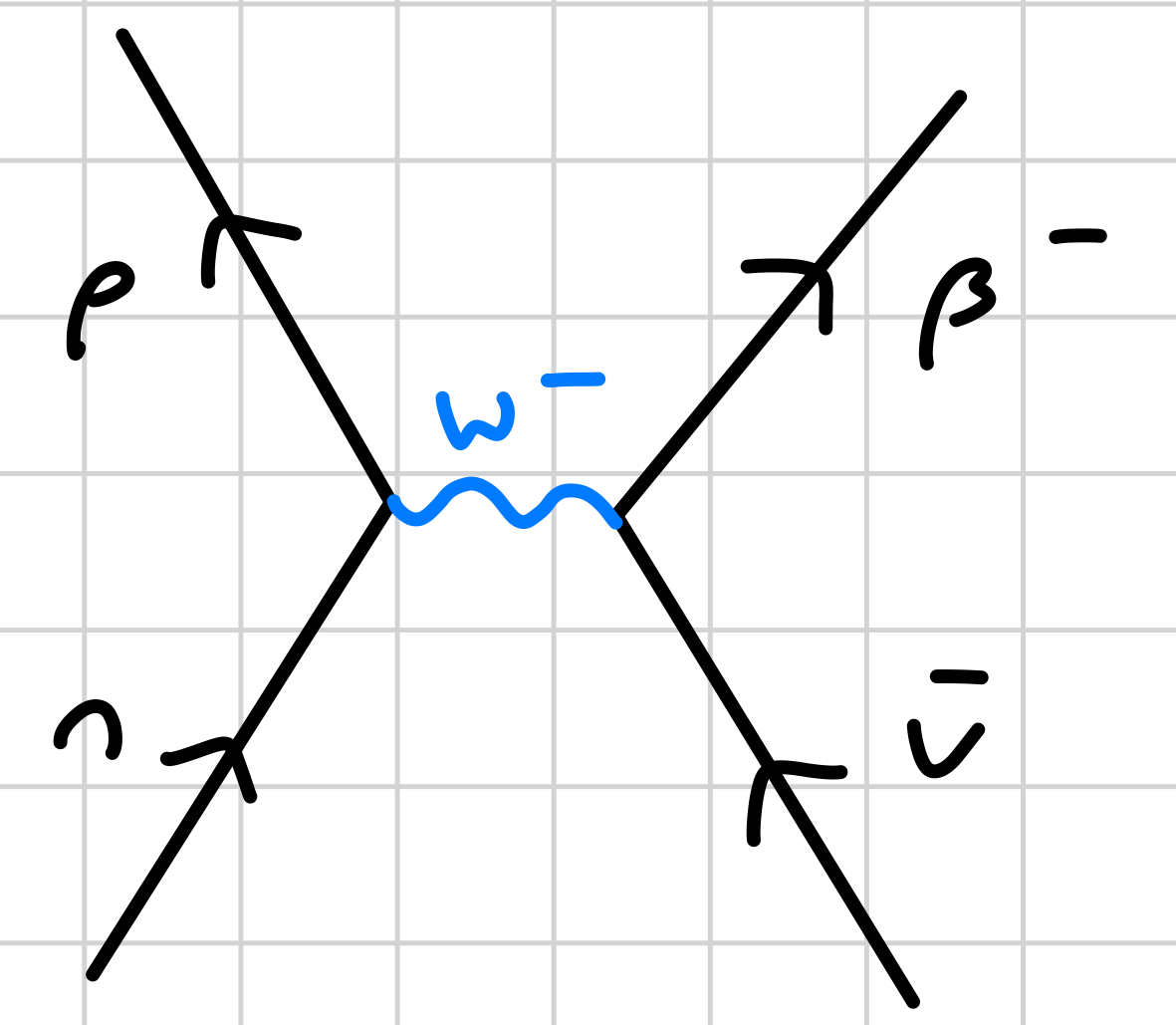
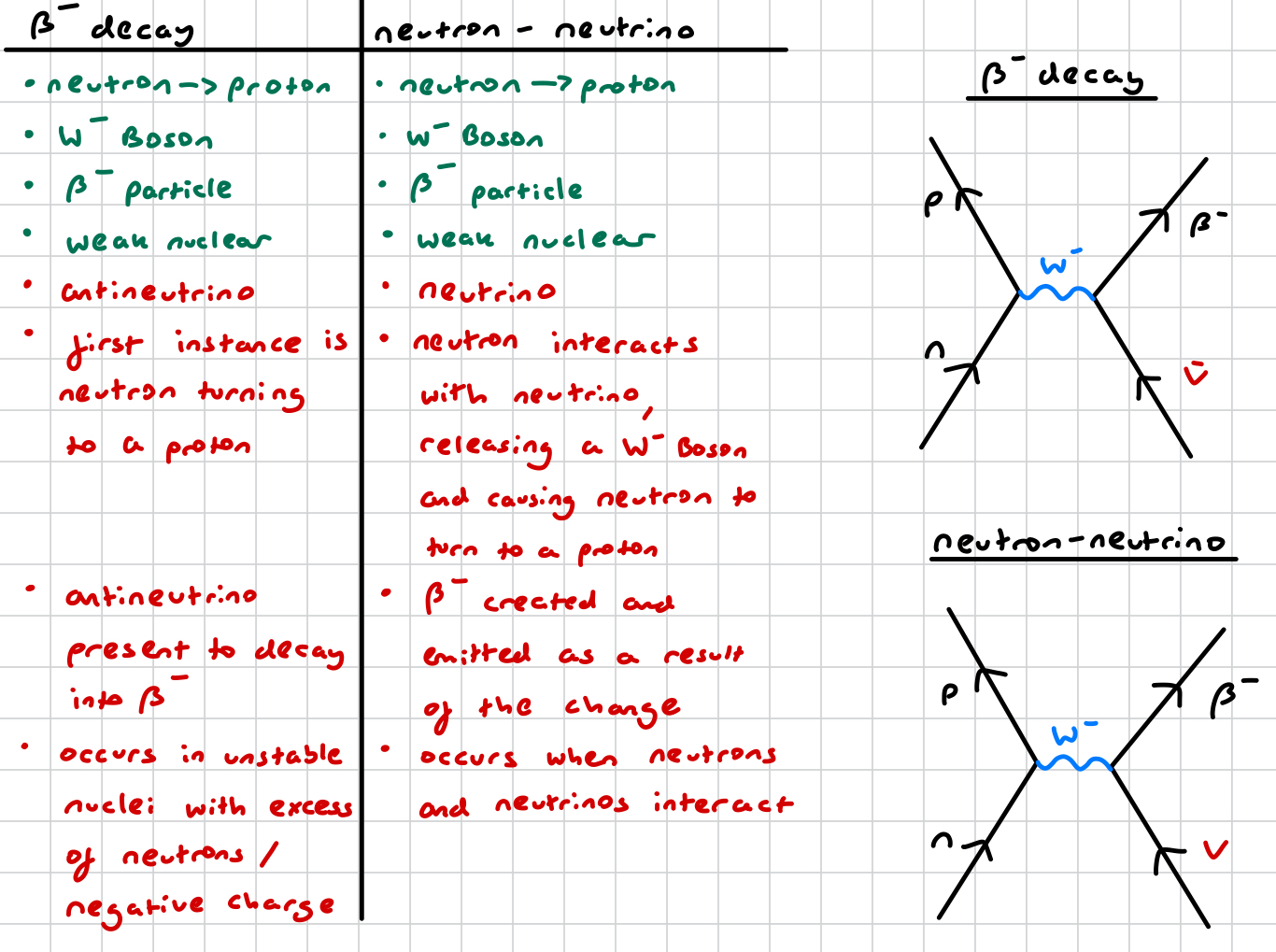
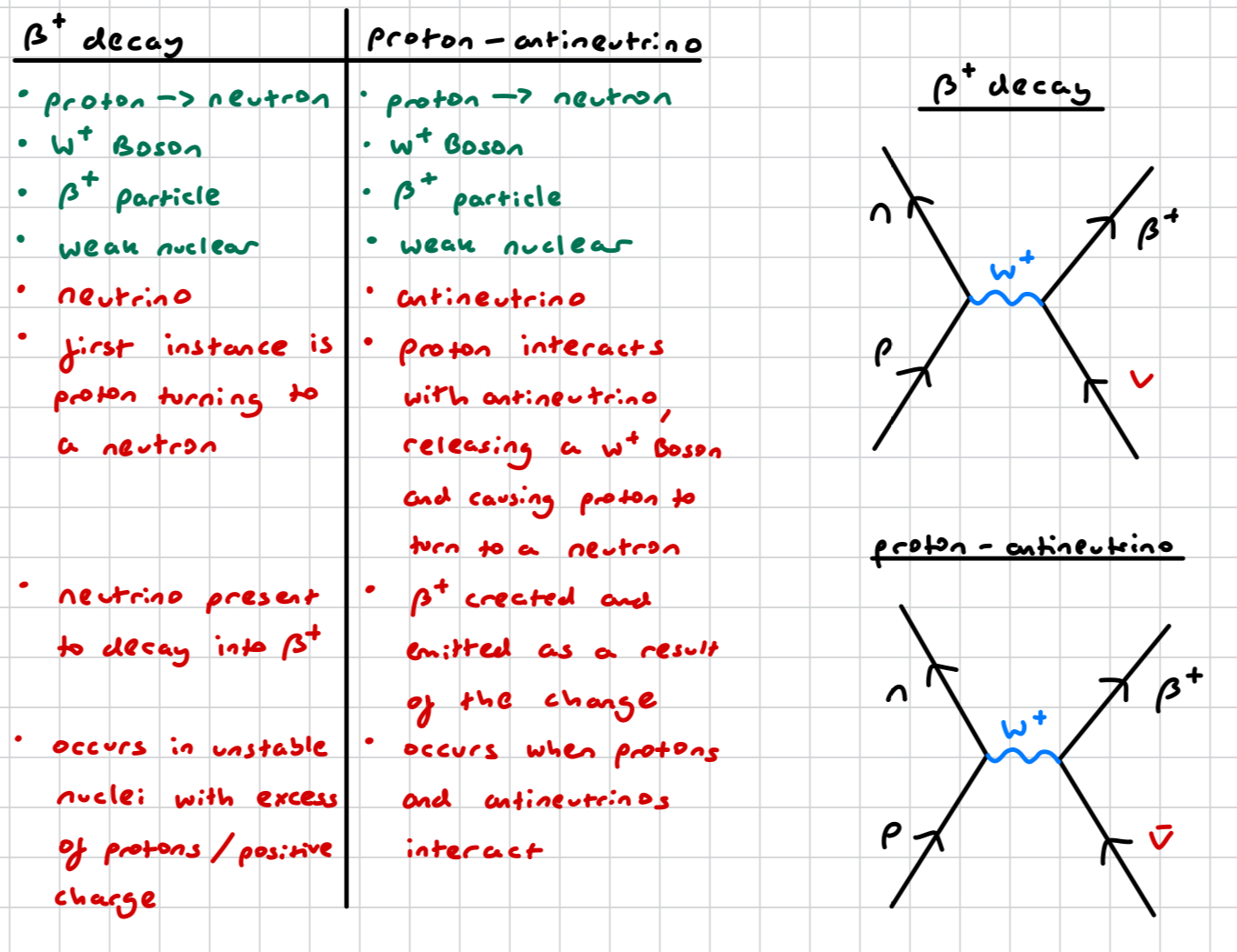
feynman diagram for β+ decay
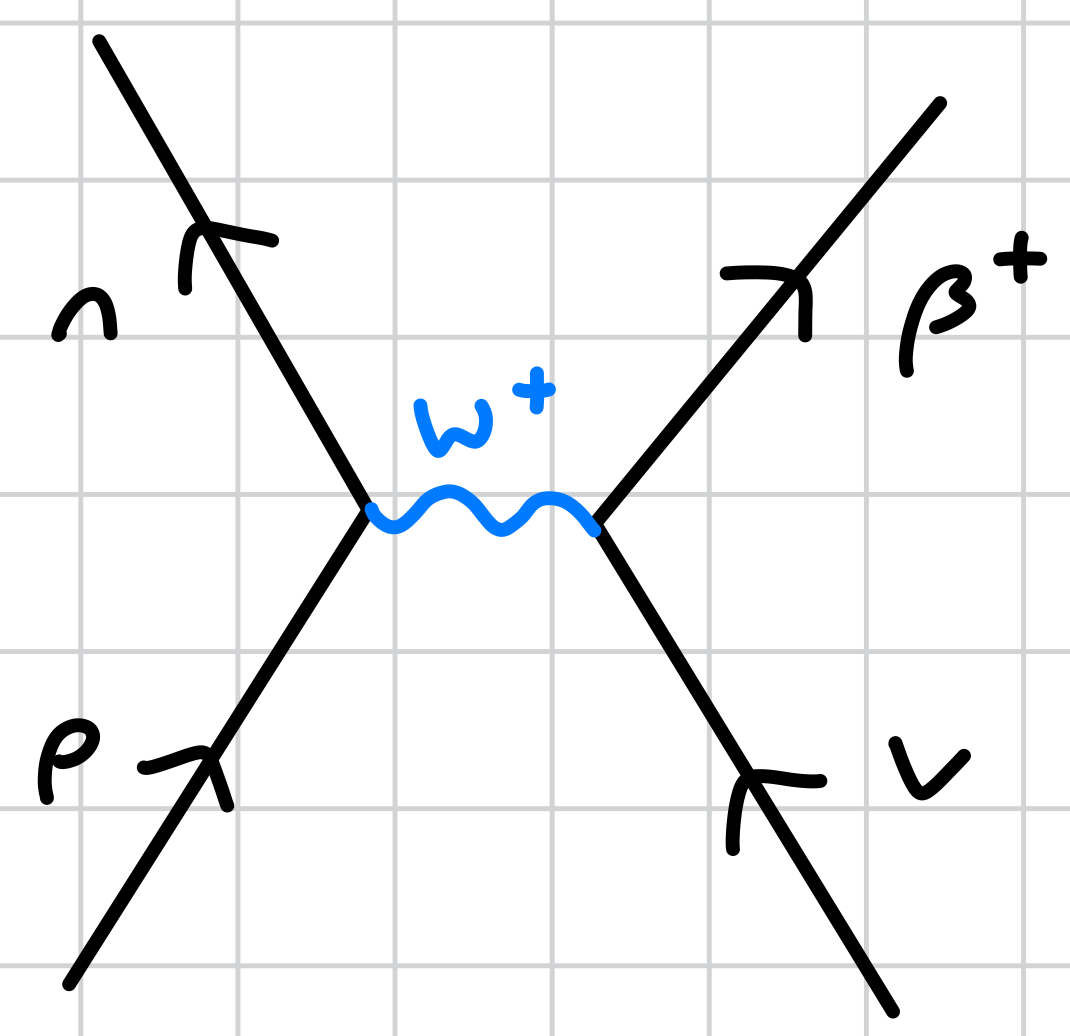
feynman diagram for β- decay
what happens if a neutrino / antineutrino is not present to turn into a β particle in either β decay?
then the W boson will decay into the products instead, although there will always be a neutrino / antineutrino in an unstable nucleus as a supplier of energy
what is always present in an unstable nucleus as a supplier of energy?
neutrino / antineutrino
what are the 4 fundamental interactions?
gravitational attraction
objects acting on each other based on mass
strong nuclear
holds nucleus together
electromagnetic force
between charged particles
attract and repulsion
weak nuclear
β decay
positron emission
neutron-neutrino interaction
proton-antineutrino interaction
what does the strong nuclear force do?
hold the nucleus together
what is gravitational attraction force?
objects acting on each other based on mass
how reactive are neutrinos and antineutrinos?
very unreactive - they hardly interact with other particles. however sometimes interactions do happen
what are some neutrino / antineutrino interactions?
neutron-neutrino
proton-antineutrino
what kind of interaction is a neutron-neutrino interaction?
weak nuclear
what kind of interaction is a proton-antineutrino interaction?
weak nuclear
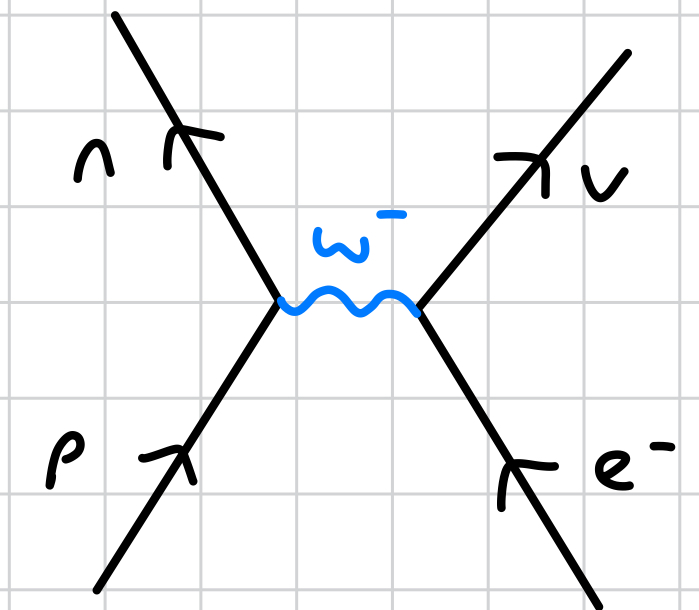
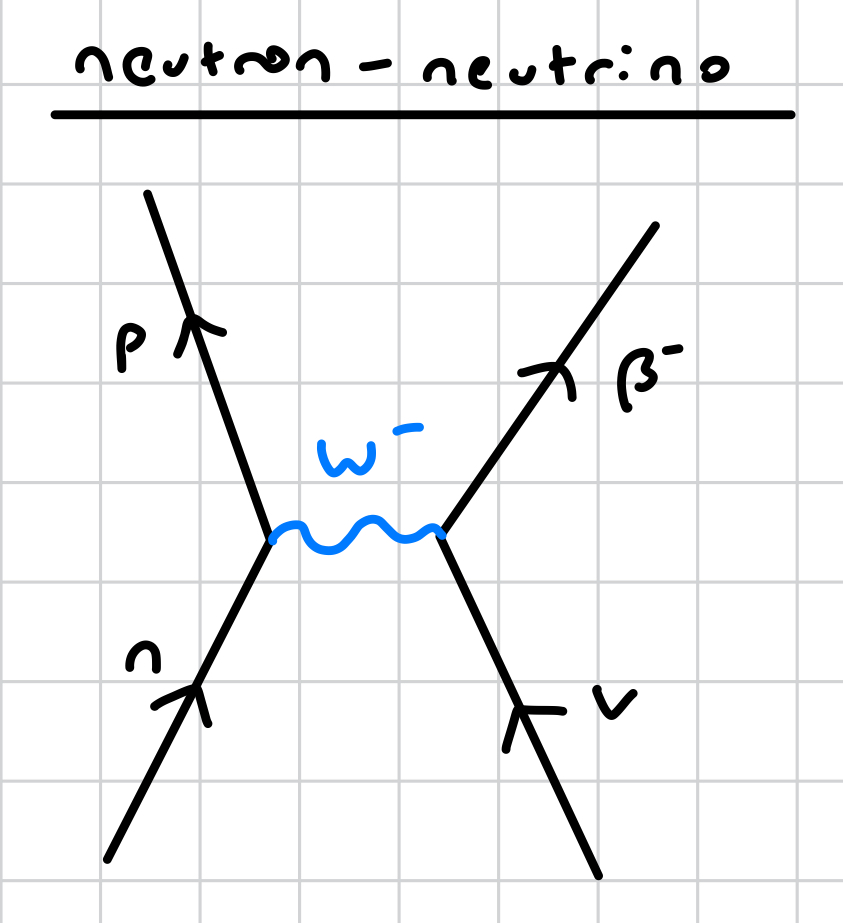
neutron-neutrino interaction
neutrino interacts with a neutron
W- boson released
interaction causes neutron to turn into a proton
a β- particle (electron) created and emitted as a result of the change
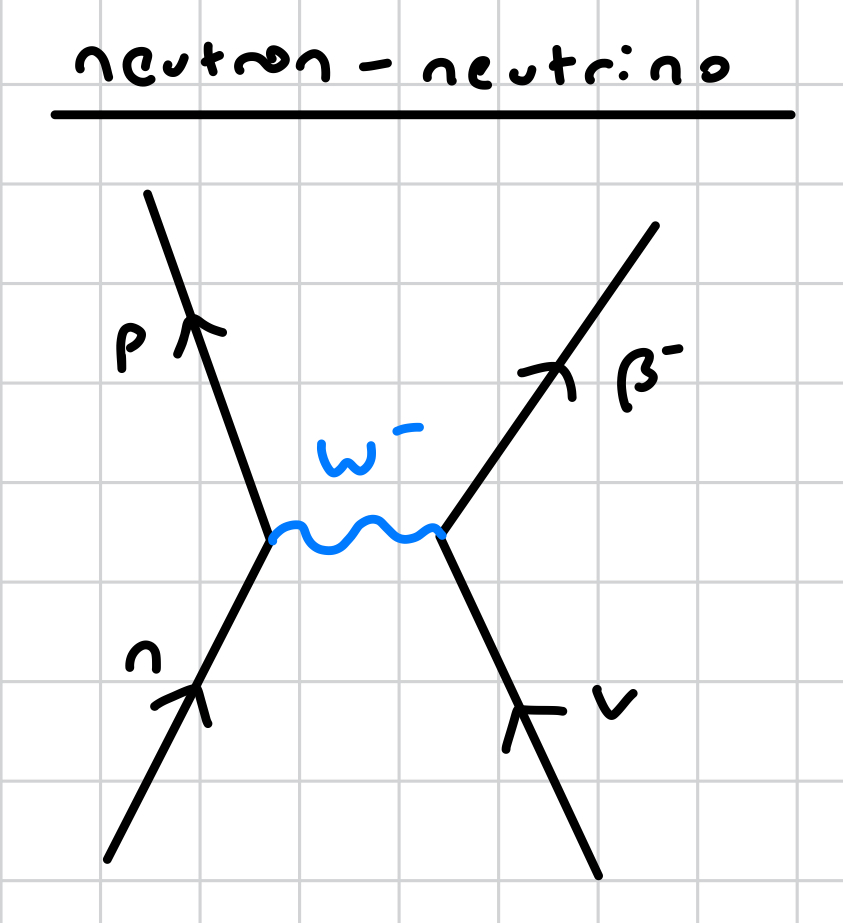
what interacts with what in a neutron-neutrino interaction?
neutron interacts with a neutrino
what kind of interaction is a neutron-neutrino interaction?
weak nuclear force, because it involves electrostatic particles turning into each other
which W boson is released in a neutron-neutrino interaction?
W- boson
what does the neutron turn into in a neutron-neutrino interaction?
a proton
what is created and emitted in a neutron-neutrino interaction? why?
a β- particle (electron), as a result of the neutron turning into a proton
feynman diagram of neutron-neutrino interaction
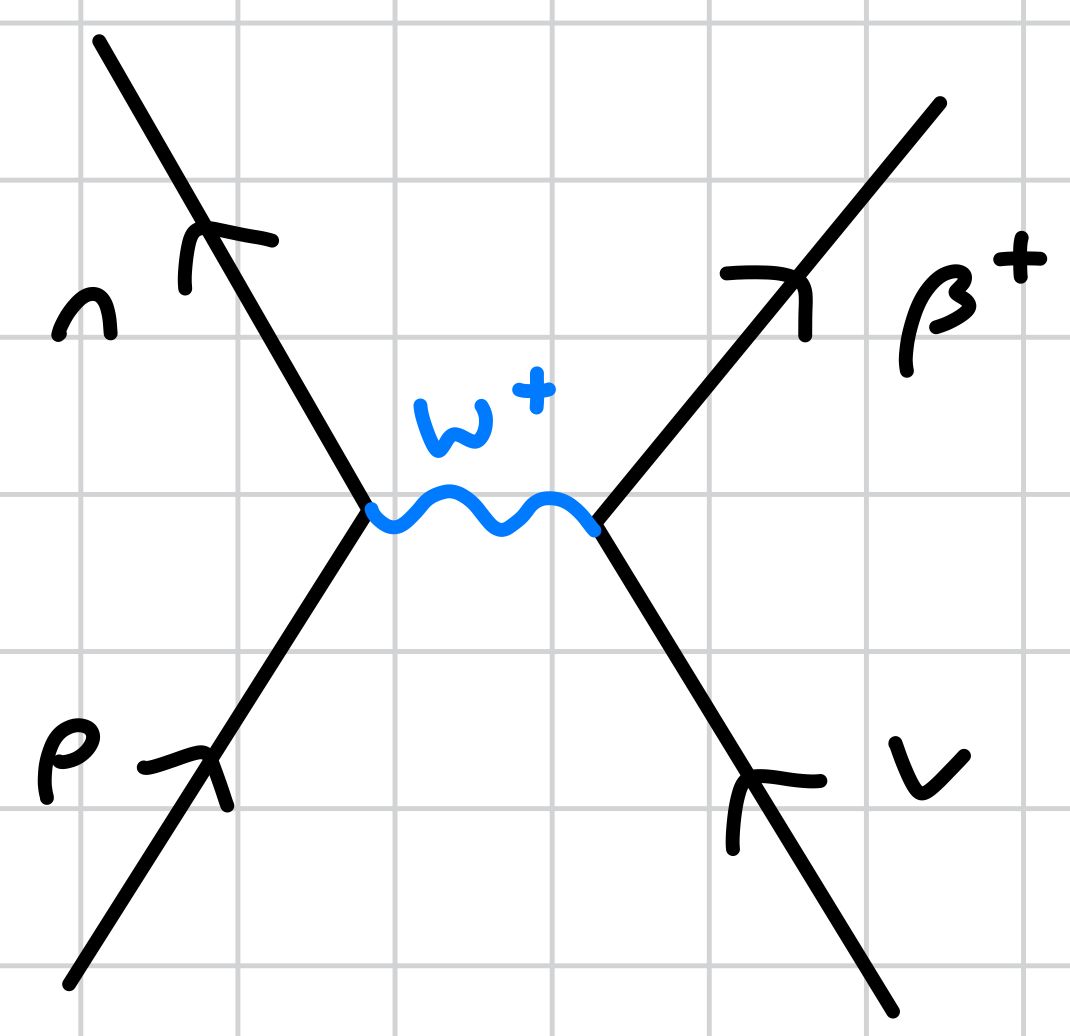
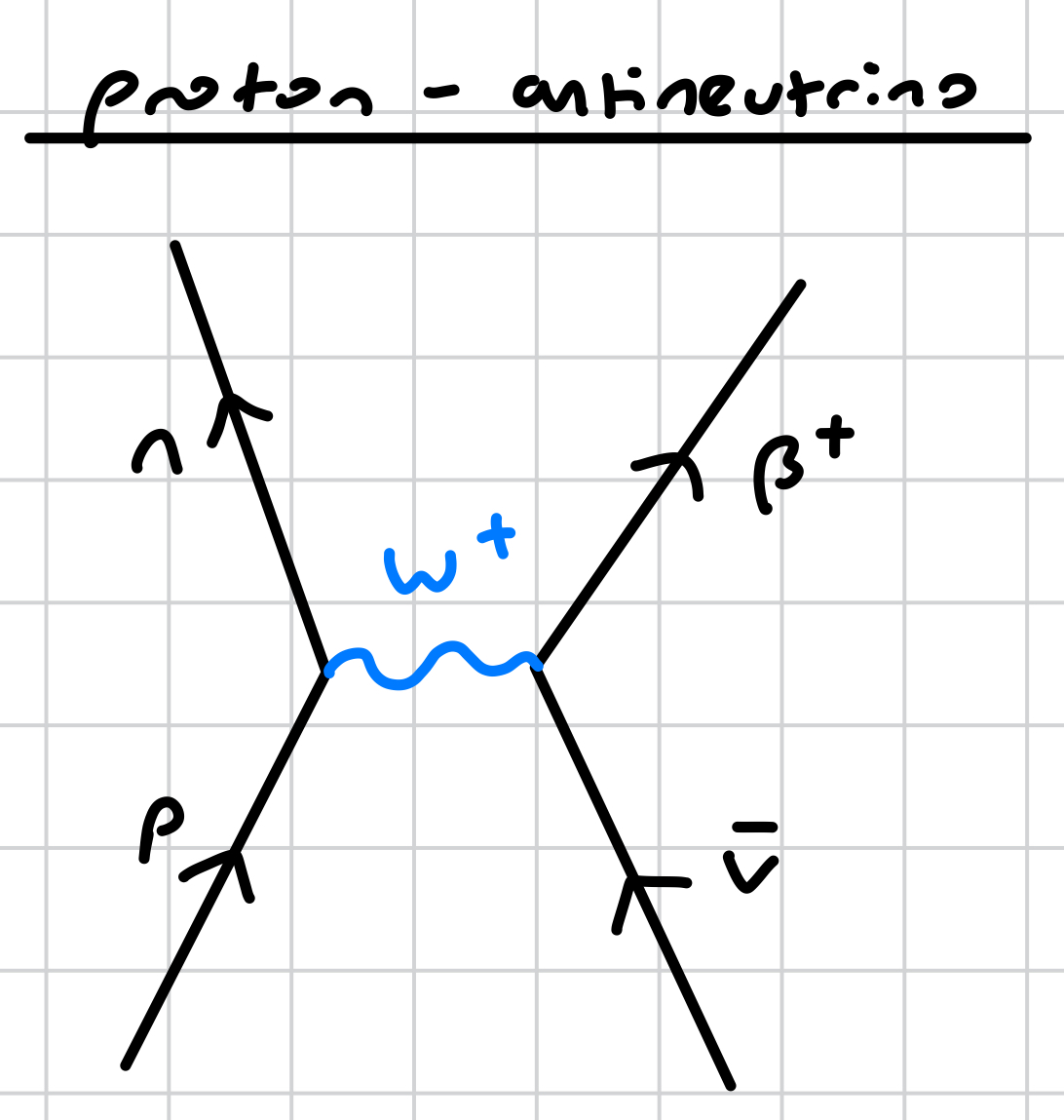
proton-antineutrino interaction
antineutrino interacts with a proton
W+ boson released
interaction causes proton to turn into a neutron
β+ particle (positron) created and released as a result of the change
what interacts with what in a proton-antineutrino interaction?
antineutrino interacts with a proton
which boson is released in a proton-antineutrino interaction?
W+ boson
what type of interaction is a proton-antineutrino interaction?
weak nuclear force, because it involves electrostatic particles turning into each other
what does the proton turn into in a proton-antineutrino interaction?
a neutron
what is created and emitted in a proton-antineutrino interaction? why?
a β+ particle (positron), as a result of the proton turning into a neutron
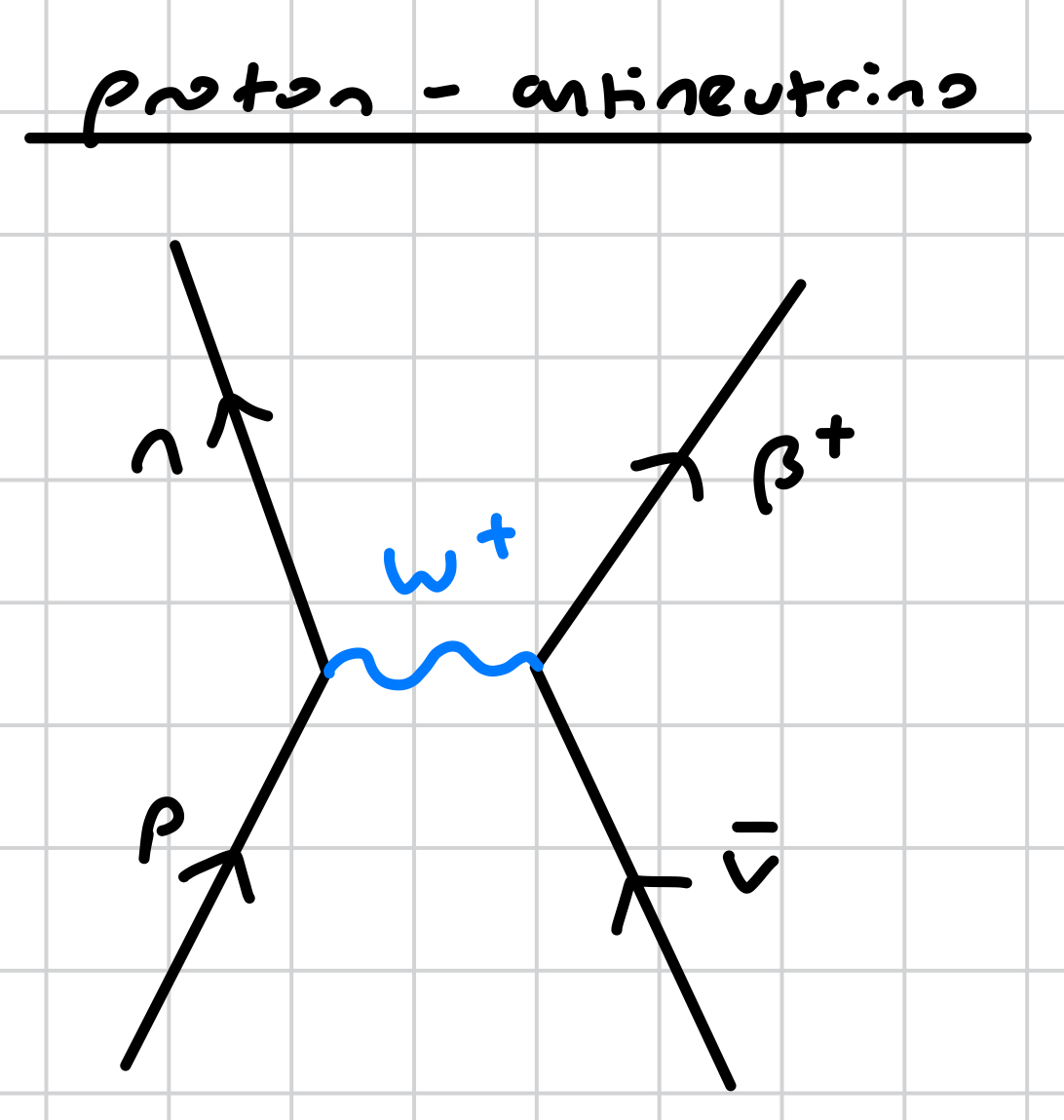
feynman diagram of a positron-antineutrino interaction
neutron-neutrino vs proton-antineutrino
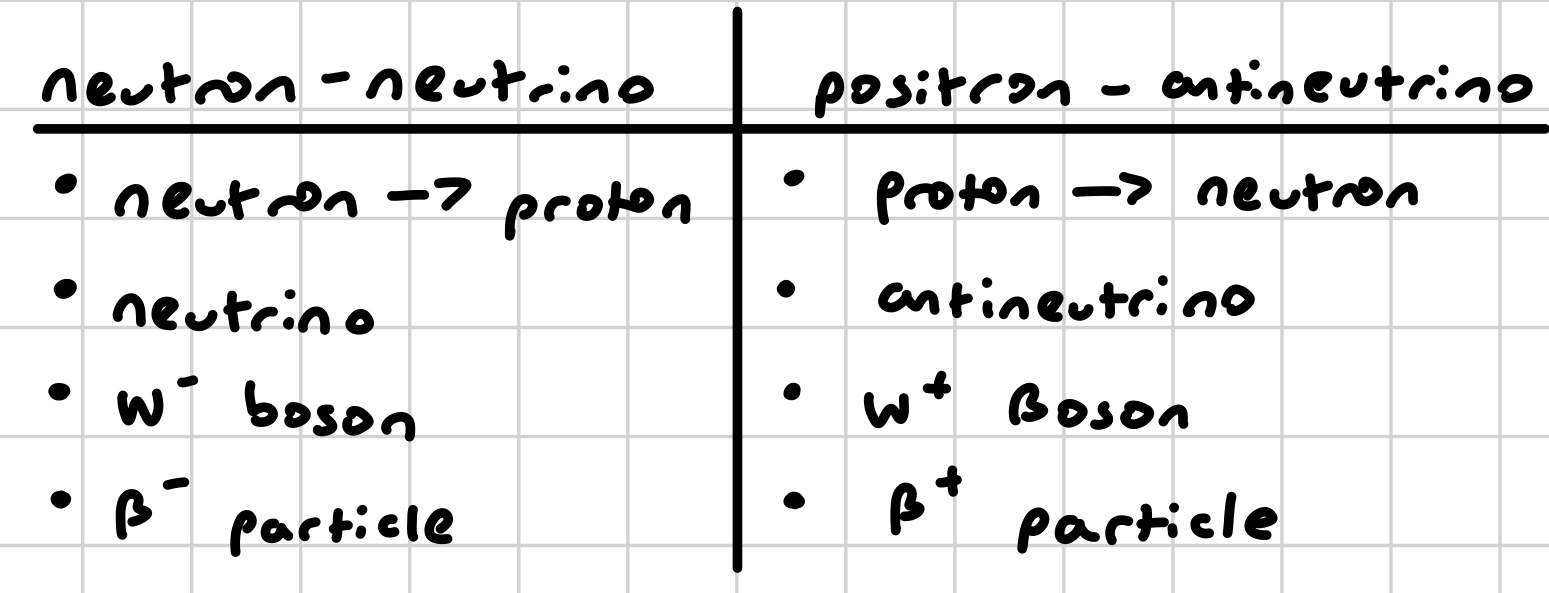
β- decay vs neutron-neutrino
β+ decay vs positron-antineutrino
what are the neutrino and antineutrino interactions similar yet different to?
β decays
which neutrino-antineutrino interaction involves a W- boson?
neutron-neutrinon
which neutrino-antineutrino interaction involves a W+ boson?
proton-antineutrino
which neutrino-antineutrino interaction involves a β- particle?
neutron-neutrino
which neutrino-antineutrino interaction involves a β+ particle?
proton-antineutrino
why are photons and W bosons called force carriers?
because they are exchanged when the electromagnetic force and weak nuclear force act (respectfully)
what are the exchange particles in weak nuclear interactions?
W bosons
what are the exchange particles in electromagnetic interactions?
photons
how are W bosons different to photons?
weak nuclear
non-zero rest mass
have very short range, ~0.001 fm
can be charged; positively or negatively
do W bosons have a rest mass?
yes, they have a non-zero rest mass
do photons have a rest mass?
no
which has a shorter range, W bosons or photons?
W bosons
what is the range of a W boson?
very short - no more than 0.001 fm
can photons be charged?
no
can W bosons be charged?
yes - they can be negatively or positively charged
what is electron capture?
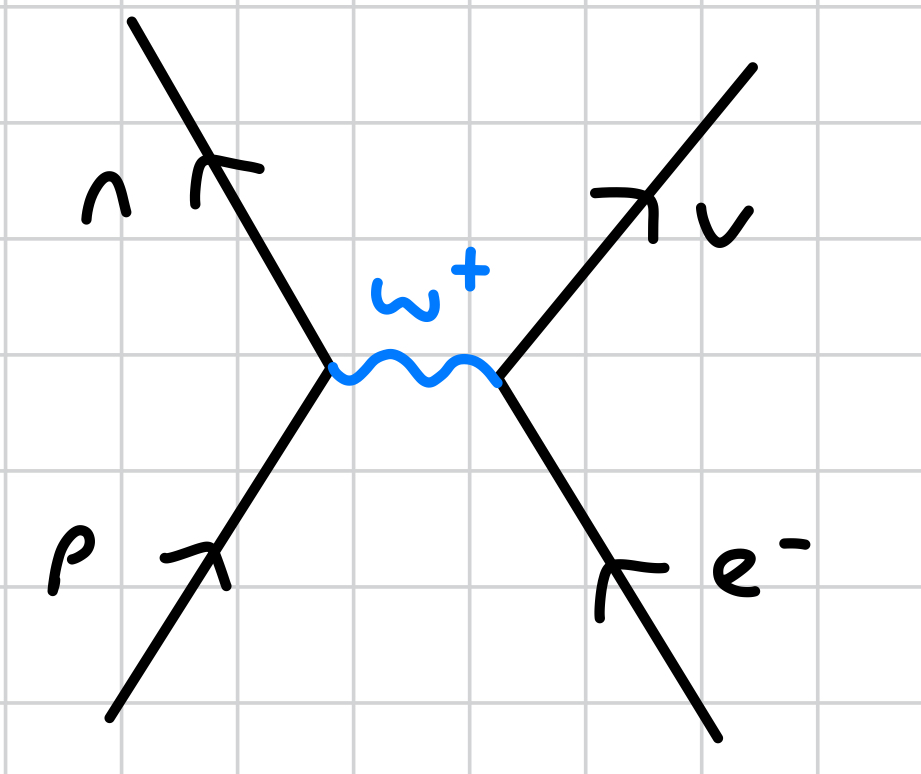
in a proton-rich nucleus, a proton turns to a neutron via a weak nuclear interaction with an electron from an outer shell. a W+ is released to turn the proton to a neutron and an electron to a neutrino
in which kind of unstable nucleus does electron capture occur?
in a proton-rich nucleus
what interaction is electron capture?
weak nuclear, because it involves a proton turning to a neutron
what are the products in electron capture?
a neutron and neutrino
feynman diagram for electron capture
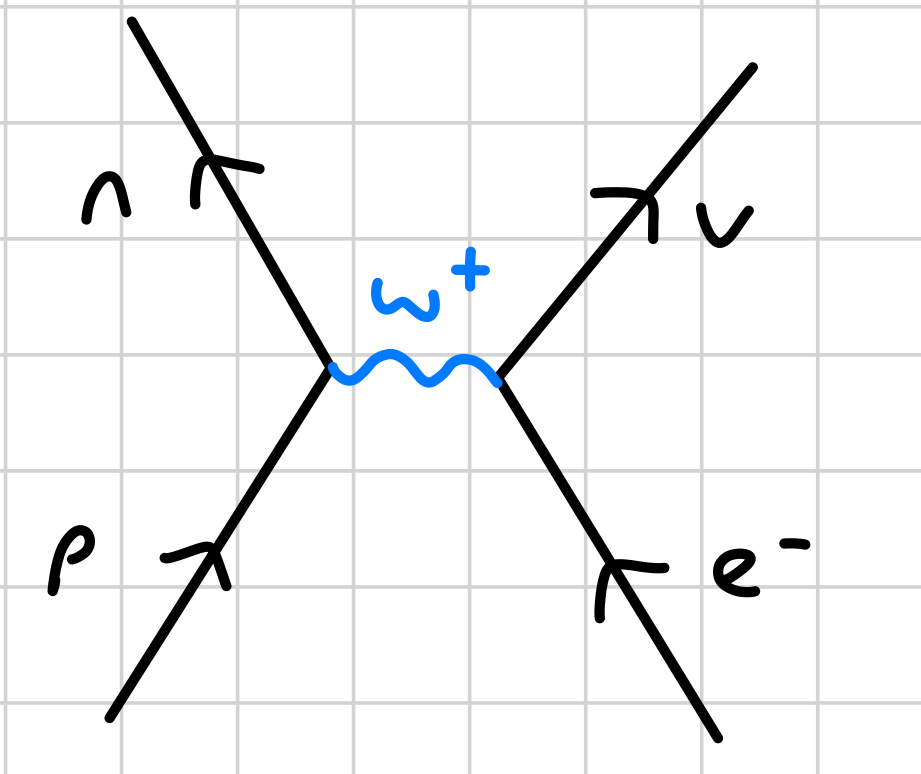
which W boson does the proton exchange to the electron in electron capture?
W+ boson
what does the proton turn into in electron capture?
a neutron
what does the electron turn into in electron capture?
a neutrino
does electron capture involve a neutrino or an antineutrino?
neutrino
when does electron capture occur?
in a proton-rich unstable nucleus in which a proton needs to turn to a neutron
very rarely when a proton and electron collide at a very high speed in a particle accelerator
with a W- exchange from the electron to the proton, if the electron has sufficient energy
how else can electron capture occur, other than an unstable proton-rich nucleus?
when protons and electrons collide at very high speeds in particle accelerators. this happens very rarely as a lot of energy is needed to overcome the electrostatic forces
why is electron capture via particle accelerator rare?
because a lot of kinetic energy is needed to overcome the electrostatic forces for the proton and electron to successfully collide
how else can electron capture happen if the electron has sufficient energy?
with the same overall change, except as a W- boson exchange from the electron to the proton