History of Economic Thought Lecture 2
 Call Kai
 Learn
Learn Practice Test
 Spaced Repetition
 Match
Match Flashcards
 Knowt Play
1/20

There's no tags or description
Looks like no tags are added yet.
Name | Mastery | Learn | Test | Matching | Spaced | Call with Kai | Chat |
|---|
No analytics yet
Send a link to your students to track their progress
21 Terms
What is Marx’s theory of history?
Factors of production are dynamic whilst the relations (rules, social relationships, and ownership) of production are static. This will lead to a revolution that will result in new relations of production and superstructure. Superstructure are things used to maintain the status quo, like art, religion, literature etc.
Marx was the first to perform a dynamic economic analysis!
Marxist labour theory of value
Marx believed that labour is the only production factor that generates value (similar to the belief that Physiocrats had about agriculture).
Absolute labour time determines this value, and NOT relative labour time (contrary to Classicals)
Thus according to Marx, the use value is the utility whilst the exchange value is the average production time
Theory of History in Practice
Under capitalism there will be concentrated and centralized production over time. Increasing unemployment and poverty cause workers to revolt and eventually the working class prevails and establishes dictatorship of proletariat »»»This results in socialism
Private ownership allowed
But capital and land are publicly owned
Production planned, no profit motive and no free markets
This eventually results in communism
Theory of exploitation
Marx's theory of exploitation argues that capitalists exploit workers by paying them less than the value of their labor, with the existence of a reserve army of unemployed worsening this imbalance.
The capitalist’s surplus is : productivity – subsistence wage
Why did Marx disagree with the harmony of interests? (Smith)
Traditional economy: C-M-C, person a produces product C to get money M to buy another product of equal value C
Capitalist economy: M-C-M’, capitalists are endowed with money M which they use to make product C to make more money M'
Profit: M’ - M
Capitalists’ profits are used to further accumulate capital
This is why people serving their own interest cannot lead to a socially efficient outcome (disagreeing with Smith's harmony of interests)
According to Marx, what will capital accumulation lead to?
Falling rate of profit: Efficiency drives capitalists to use more machines and inventions to save on labor BUT since labor is the only source of value and the only thing capable of impacting the surplus, an increase in capital, would result in a falling profit rate
Business crises: A falling rate of profit reduces the ability of businesses to expand. During a depression, the monetary value of fixed capital declines, leading to the closure of factories and a decrease in prices.
Technological unemployment: Business crises + falling rate of profit lead to technological unemployment: labor is replaced by capital (machines). First to mention substitution effect between these two!
Marx was the first to mention business cycles
What causes the centralization of capital and concentration of wealth?
Centralisation of capital and concentration of wealth is due to dynamics of capital accumulation and tendency for recurring business crises (Which will eventually lead to monopolies »» his prediction was correct!)
Reserve army of unemployed and immiserization of proletariat
Due to crises and capital/labour substitution more people became unemployed » greater reserve army » wages would be further depressed
Class conflict
Workers unite and revolt
State ownership of means of production replaces private ownership
Exploitation of workers ends
Major tenets of Marxism
Rejects of harmony of interests (contrary to classicists)
Rejects of laissez-faire
Reject Say’s law of markets (contrary to Ricardo)
Supports collective action and public enterprise ownership
Modern discussion of Marx
Revolution did not occur
His theories led to an emphasis on state ownership on the means of production
Call for social programs
He shed a light on monopoly power growth, income inequality and reality of business cycles
Major tenents of Marginalism
Microeconomic focus
Increased focus on demand side: focus on marginal principle
More reliance on mathematics in economics
Rational behaviour
Equilibrium approach
Limited role for government
Antoine Augustin Cournot
Pioneer marginalist
Used math
Law of demand: P↑ D↓ but there was no concept of marginal utility yet
He analysed imperfect competiton: Theories of monopoly and duopoly.
Jules Dupuit
Pioneer Marginalist
Gave us the marginal utility curve: utility attached to additional good depends on how much one already has of the good.
Johann von Thünen’s Theory of location
Positive and diminishing marginal productivity of labour
Central optimality condition: use labour up till MP=MR
Transportation costs: labour intensive companies have to be close to their employees
Jevons theory of utility
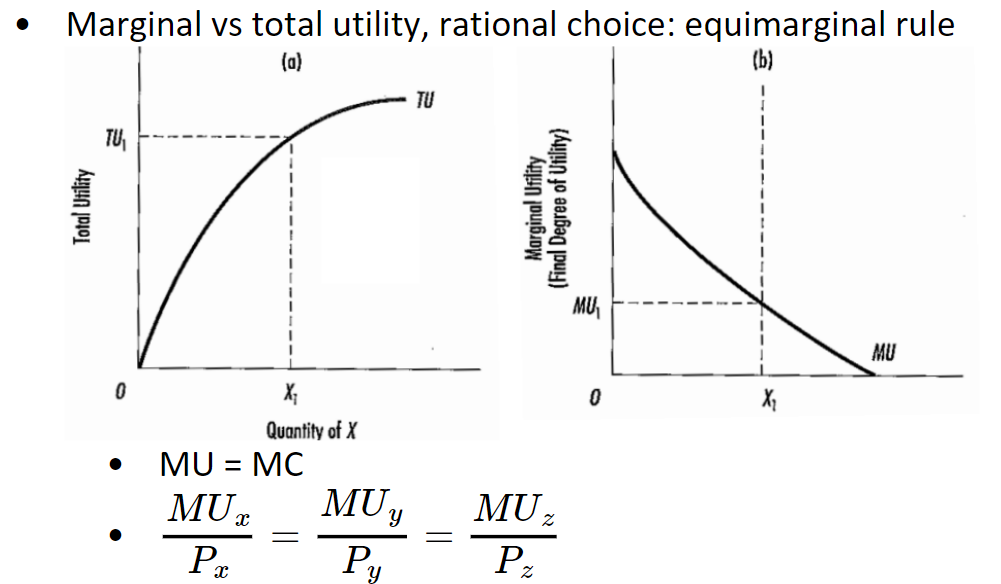
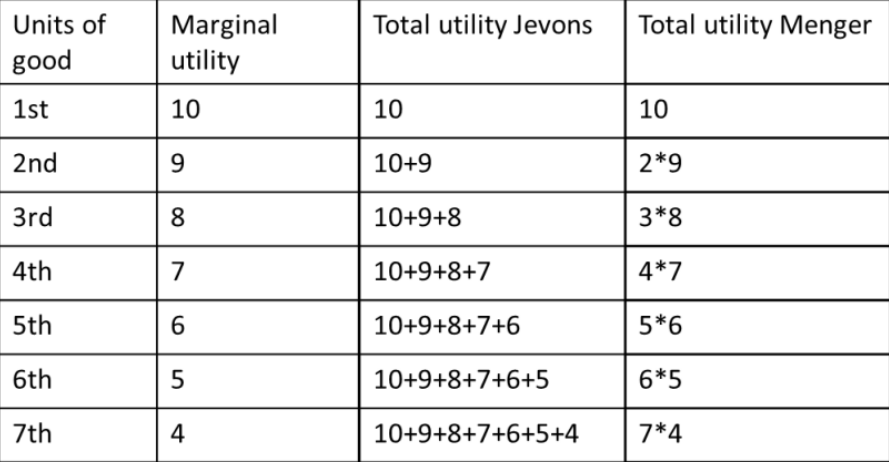
He solved the water diamond paradox!: He distinguishes the difference between total utility and marginal utility.
Law of decreasing MU » Price determined by marginal utility
Rational choices are determined by the equimarginal rule: consumers will distribute their spending so that they get the same level of satisfaction from the last dollar spent on each item.
No general equilibrium model
Principle of utility maximization applies to other domains
Equimarginal rule in international trade
Equimarginal rule in decision to work
Menger’s theory of value
Price is based on total utility
He didn’t use math
This was a model to explain all prices
Price of production factors imputed from consumer goods: it means that the value or usefulness of iron, as a raw material, is based on the value consumers place on the final products made from iron, such as thimbles or other items.
Walras main contributions
Marginalistic view: focus on margin
General equilibrium framework: Jevons and Menger considered partial equilibria
A lot of MATH!
Walras General equilibrium model
First relative prices are determined
Given these relative prices consumers in turn will optimize their consumption in order to then maximize their utility.
We speak of a general equilibrium if:
Consumers maximize utility, producers maximize profits
Consumer’s demand is equal to firm’s supply for all goods
Firm’s demand is equal to the consumer’s supply for all factors of production
This model extended to economy with production
In this model, he also believed that Money is neutral! (Hume, Ricardo, Smith)
Was there a Marginalist revolution?
Yes: Radical change in economics due to focus on demand, marginal utility and a more mathematical approach.
No: It was more of a gradual process as a lot of marginalist ideas had been formulated earlier. So it was a breakthrough rather than a revolution.
Lasting Contributions
monopoly model, duopoly model, theory of diminishing marginal utility, theory of rational consumer choice, law of demand, law of diminishing returns, returns to scale concept etc