Rads 107 Procedures Study Guide 1
 Call Kai
 Learn
Learn Practice Test
 Spaced Repetition
 Match
Match Flashcards
 Knowt Play
1/36

Earn XP
Description and Tags
Study guide based off slides
Name | Mastery | Learn | Test | Matching | Spaced | Call with Kai | Chat |
|---|
No analytics yet
Send a link to your students to track their progress
37 Terms
Radiography
Process and procedures of producing a radiograph.
Radiograph
Image of patients’ anatomic part(s) produced by x-rays on an image receptor (recording medium and the image.)
Image Receptor (IR)
Device responding to ionizing radiation to create the image after exiting patient.
Central Ray (CR)
Centermost portion of x-ray beam emitted from x-ray tube. (has least divergence)
If the radiograph is produced with use of traditional film-screen analog, the image is captured and displayed on…
Film is displayed with this
If the radiograph is produced via digital technology, the image is viewed and stored on…
The image is stored on Display monitors

What is the position used for imaging?
Anatomic Position
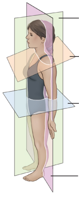
What is the green plane called?
Sagittal Plane (midsagittal, median) left/right parts
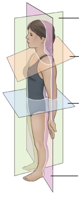
What is the purple plane called?
Coronal (midcoronal) Anterior/Posterior

What is the blue plane called?
Horizontal (axial) transverse plain passing through right angles to a longitudinal plane (separates top and bottom)
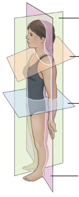
What is the orange plane called?
Oblique, longitudinal/transverse at an angle near the chest region.
Body Planes
Positioning terms describing CR angles or relation.

What do you call THE BOTTOM of the foot?
Plantar surface of foot

What is THIS SIDE of the body called?
Anterior

What do you call THE TOP of the foot?
Dorsum (dorsum pedis)

What is THIS SIDE of the body called?
Posterior
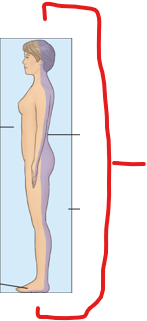
Which body plane is shown?
Midsagittal (sagittal) plane
Dorsal side of hand (dorsal manus)
Back of the hand, posterior
Palmar side of hand
Palm of hand is up and flat
Flexion
Bending movement of a joint that decreases the angle between the bones.
Extension
Increases the angle between the body and joints, straighten the limb.
Hyperextension
Excessive straightening/movement of a joint beyond anatomical limit
Extension
Movement increasing angle between 2 body parts or straightens a joint.
Flexion
Bending a joint to decrease the angle between 2 body parts.
Ulna
Longer Bone in your forearm on the medial (pinkie-finger) side.
Radius
Shorter bone in your forearm on the lateral (thumb) side.
Ulnar Deviation
Movement of bending your wrist sideways towards pinky finger.
Radical Deviation
Movement of bending your wrist sideways towards thumb.
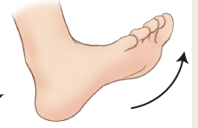
Dorsiflexion
Lifting your toes upward towards your shin.
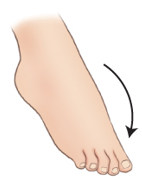
Plantar Flexion
Bending your foot downward, away from your shin.

Eversion Valgus
forced outward from midline

Inversion Varus
forced inward toward midline
Medial Rotation
movement of a bone/limb inwards towards the body
Lateral Rotation
Movement of a distal end of bone/limb away from the midline of body
Abduction
Arm goes up and away from the body
Adduction
Arm goes down and toward the body
Elevation
Shoulders shrugged up