BIOL1020 MOD3 WEEK 1
 Call Kai
 Learn
Learn Practice Test
 Spaced Repetition
 Match
Match Flashcards
 Knowt Play
1/15

There's no tags or description
Looks like no tags are added yet.
Name | Mastery | Learn | Test | Matching | Spaced | Call with Kai | Chat |
|---|
No analytics yet
Send a link to your students to track their progress
16 Terms
What is evolution
In layman’s terms:
Change in inherited characteristics of biological populations over successive generations
What is the difference between genotype and phenotype
GENOTYPE = Genetic Makeup
genotypes are an individual’s unique sequence of DNA
Inherited from each parent
PHENOTYPE = Observable Features
Phenotypes are the expressed results of a genotype + environmental factors
What is Natural Selection
Individuals that are better suited to their environment survive and have more offspring. Over time, favourable traits accumulate in the population.
For Natural Selection to occur there must be: (4)
Variation within populations
Heritability of variation (= DNA basis)
Excess offspring per generation
Non-random survival and reproduction
What are the Three modes of Selection
Directional selection
Disruptive selection
Stabilising selection
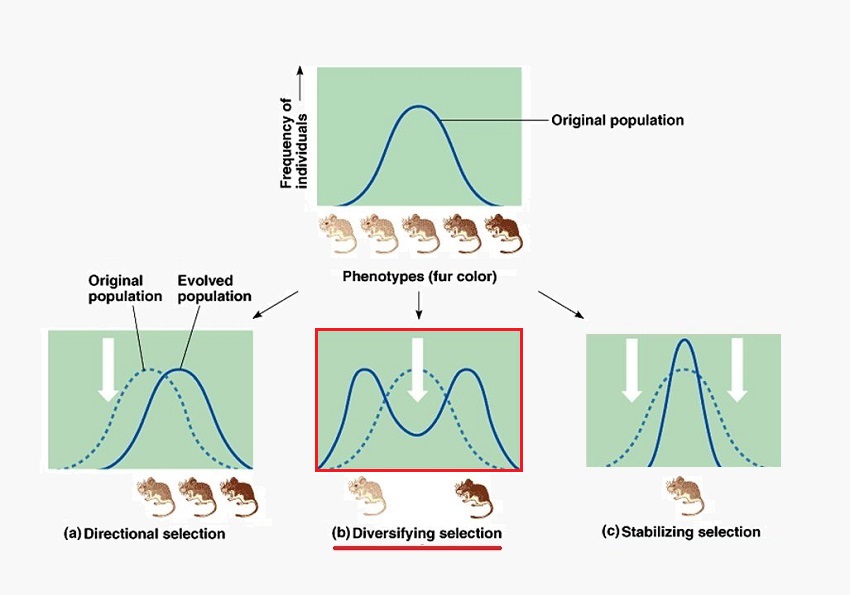
Which is better Genetic drift or Natural selection in a larger or smaller generation
Genetic drift works better in smaller populations as it works by chance. Smaller populations are more affected when a trait is randomly removed or a harmful trait is removed.
Natural selection works better in a larger population as it driven by environmental fitness. Random chance events are averaged out allowing selected genes to be passed on.
What is a Genome?
GENOME:
an individuals complete set of DNA, including all its genes and information required to build that organism for successful reproduction.
How do genomes differ depending on organism type
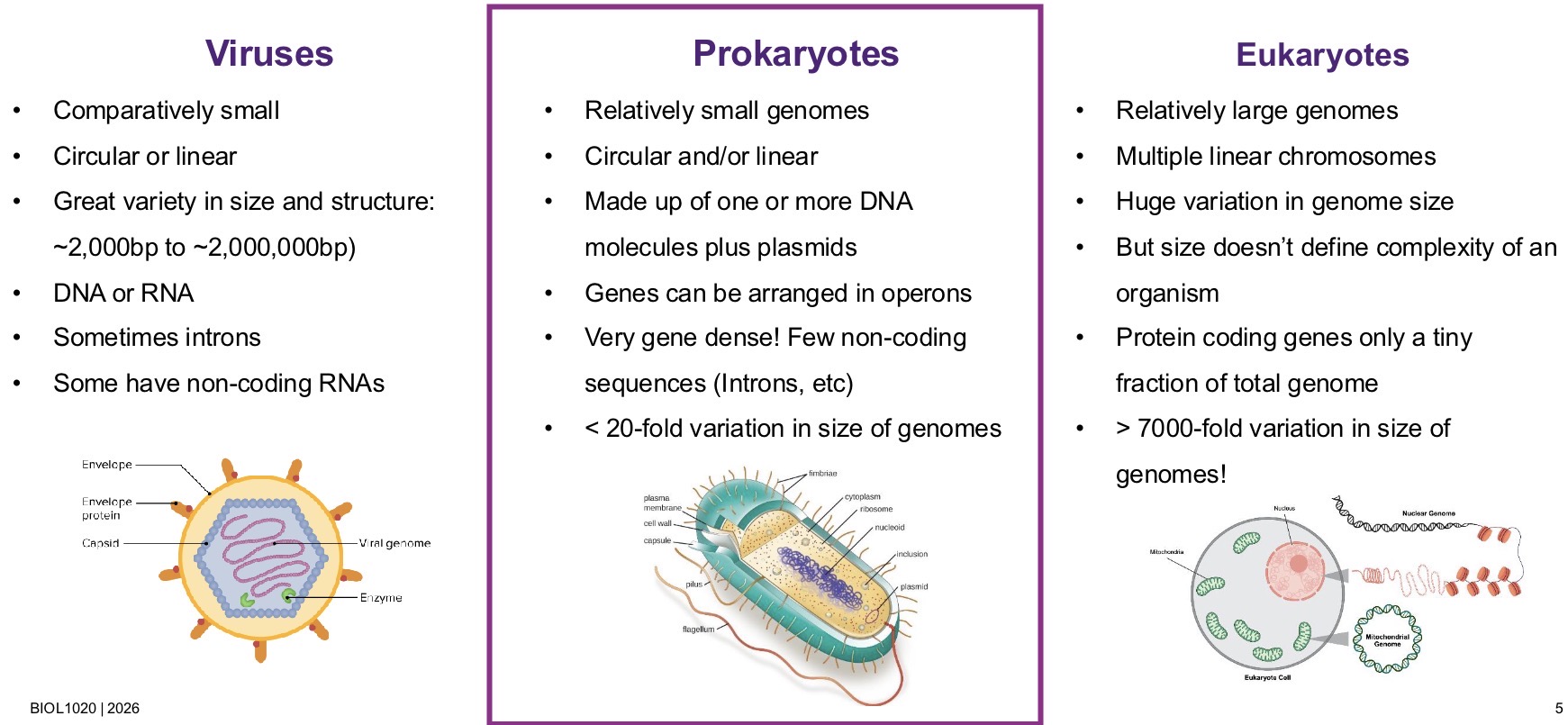
What is Lateral gene Transfer among Prokaryotes?
induced by stress (e.g environmental perturbation)
Occurs via conjugation and natural transformation
Is the movement of genetic material between different organisms, rather than between parent and offspring
What is the C-value paradox
In eukaryotes, there is no correlation between genome size and organismal complexity; genomes sizes vary widely.
What are Introns
“Intervening sequences”
Nucleotide sequences in DNA and RNA that DO NOT code for proteins
Are removed via RNA splicing during pre-mRNA stage
What are Exons
“Expressed sequences”
Nucleotide sequence in DNA and RNA that are retained while creating mature RNA
Typically includes 5’-end, 3’-end, start/stop codons, and protein coding genes
What are transposing
“Jumping genes”
Nucleotide sequence in DNA which can move to different locations via copying or cut/paste mechanisms
2 Types:
retrotransposons (revers transcription “copy/paste” using RNA)
DNA transposons (direct “cut/paste” movement)
What are some mechanisms of evolution? (Mutations)
Deletion - removes a chromosomal segment
Duplication - repeats a segment
Inversion - reverses a segment within a chromosome
Reciprocal Translocation -moves a segment from one chromosome to another nonhomologous one.
What are other mechanisms of evolution?
Changes to existing genes - mutations, exon shuffling
Changes to existing regulatory non-coding DNA and RNA
Changes in genome composition - Lateral/Horizontal gene transfer, whole genome duplication (polyploidy), Duplication of one or more genes.
Transposable elements - moves genes and/or regulatory elements to new positions in the genome.