MBios 305 Chapters 1-19 practice questions
 Call Kai
 Learn
Learn Practice Test
 Spaced Repetition
 Match
Match Flashcards
 Knowt Play
1/266

There's no tags or description
Looks like no tags are added yet.
Name | Mastery | Learn | Test | Matching | Spaced | Call with Kai | Chat |
|---|
No analytics yet
Send a link to your students to track their progress
267 Terms
The idea of spontaneous generation postulated that
Multiple Choice
organisms could spontaneously turn into other types of organisms.
living organisms must contain at least ten cells.
living organisms could spontaneously arise from other living organisms.
living organisms could spontaneously arise from non-living material.
organisms could evolve into the next generation of organisms.
living organisms could spontaneously arise from non-living material
The structures present in the hay infusions used in experiments on spontaneous generation that made them difficult to sterilize are _________blank.
Multiple Choice
nuclei
toxins
chloroplasts
organelles
endospores
endospores
The word "animalcule" was first used by _________blank.
Multiple Choice
Redi
van Leeuwenhoek
Hooke
Pasteur
Tyndall
van Leeuwenhoek
What was important about the shape of the flasks used by Pasteur in his experiments proving biogenesis?
Multiple Choice
There is no significance; Pasteur simply used any flasks available in his laboratory, in this case swan-necked.
Pasteur could place gel in the bend of the swan-necked flask, trapping any entering microbes.
The flask shape allowed Pasteur to use less broth, so the experiments were cheaper and could be repeated more often.
Swan-necked flasks have an opening too small for entry of microbes, while conical flasks have a wide neck that allows microbial entry.
The swan neck of the flasks allowed “vital force” to enter them but prevented bacteria from falling into the broth.
The swan neck of the flasks allowed “vital force” to enter them but prevented bacteria from falling into the broth.
If Pasteur had done his experiments investigating spontaneous generation in a horse stable,
Multiple Choice
the results would probably been the same as those obtained in a laboratory.
the results would probably have supported the idea of spontaneous biogenesis.
the results would probably not have supported the idea of spontaneous generation.
the results would probably have supported the idea of spontaneous generation.
it would probably have taken several years to obtain any results.
the results would probably have supported the idea of spontaneous generation.
Which of the following statements about newly emerging or reemerging diseases is FALSE?
Multiple Choice
Examples include hepatitis C, Ebola disease and COVID-19.
They are all caused by drug-resistant pathogens.
They may result when microbes evolve and develop new characteristics.
They may result from a breakdown in sanitation and social order.
They may be caused by changing lifestyles.
They are all caused by drug-resistant pathogens.
Smallpox
Multiple Choice
is an emerging infectious disease.
has little potential as a weapon of bioterrorism.
has not occurred anywhere in the word since 1977.
has occurred in a few countries since 1977.
very seldom kills people, but does scar them.
has not occurred anywhere in the word since 1977.
An illness outbreak occurs in New York City birds in the late 1990s. After an investigation, the Centers for Disease Control (CDC) determine that the agent causing the is the West Nile virus. Outbreaks of this illness have been observed in several other countries in Asia and the Middle East across the last 50 years, but not in the United States. With this information, what would be the best categorization of this infectious agent/disease?
Multiple Choice
This is a reemerging infection. It is been around for a long time, and it is reappearing in a susceptible population again.
This is a nosocomial (hospital-acquired) infection. It is transmitted from animals to humans in urban environments.
This is a chronic infection. It has been around for many years, and it has made a jump across continents into a new susceptible population.
This is an emerging infection. It hasn't been around that long, and it has made a jump across continents into a new susceptible population.
This is an unimportant infection that not a concern to human beings because it occurs in birds, so there is no need to classify it.
This is an emerging infection. It hasn't been around that long, and it has made a jump across continents into a new susceptible population
Microorganisms are involved in all of the following EXCEPT
Multiple Choice
production of medicinal products.
food production.
pollution cleanup.
converting nitrogen to a form useful to plants.
There are no exceptions here. There are microorganisms that participate in each of these activities.
There are no exceptions here. There are microorganisms that participate in each of these activities.
Why is monitoring emerging and reemerging infectious diseases important?
Multiple Choice
Because globalization leads to more chances for spread of illnesses into new areas and populations. Monitoring these illnesses will help us to protect people.
None of the answer choices is correct.
All of the answer choices are correct.
These represent growing threats to human health that will require new scientific research and resources to effectively combat.
Because the speed of travel has increased, so it is far more likely that a serious pathogen can spread rapidly across the globe. Monitoring these illnesses will help us protect populations.
All of the answer choices are correct.
Bacteria are good research models because they
Multiple Choice
have similarly complicated growth requirements.
vary in size from microscopic to macroscopic.
can be assembled into complex multicellular organisms.
develop the same diseases as humans and animals.
share many properties with more complex organisms.
share many properties with more complex organisms.
Microorganisms are involved in all of the following EXCEPT
Multiple Choice
production of medicinal products.
food production.
pollution cleanup.
converting nitrogen to a form useful to plants.
There are no exceptions here. There are microorganisms that participate in each of these activities.
There are no exceptions here. There are microorganisms that participate in each of these activities.
Bioremediation refers to
Multiple Choice
development of new vaccines.
using bacteria to clean up environmental pollutants.
monitoring newly discovered disease organisms.
destroying organisms causing infectious diseases.
rehabilitating wayward pathogenic bacteria.
using bacteria to clean up environmental pollutants.
The outbreak of measles within the last few years is due to
Multiple Choice
change in the environment and climate.
increase in sensitivity of detection techniques.
emergence of novel measles viruses.
a decline in vaccination of children in the previous years.
mutation of the measles virus.
a decline in vaccination of children in the previous years.
Plants are dependent on microorganisms for
Multiple Choice
providing water and carbon dioxide.
changing atmospheric nitrogen to a usable form.
providing simple carbohydrates in a usable form.
providing simple and complex proteins.
providing oxygen in a usable form.
changing atmospheric nitrogen to a usable form.
Lyme disease is an example of a disease that is due to
Multiple Choice
an increase in the number of people travelling to Asia and Africa.
failure to effectively vaccinate children.
increased interaction between humans and tick-carrying animals.
a mutation in the human genome.
climate change leading to a significantly greater mosquito population.
increased interaction between humans and tick-carrying animals.
Bacteria are present on the body
at all times.
only in certain areas.
only during disease-causing infections.
only after using public transport.
only after intense exercise.
at all times.
Bacteria are useful to study because
Multiple Choice
they have the same fundamental metabolic and genetic properties as higher organisms.
they both synthesize and are resistant to all known antibiotics.
they produce peptidoglycan in a simpler manner than more complex organisms.
they produce protein in a simpler manner than more complex organisms.
they produce energy in a simpler manner than more complex organisms.
they have the same fundamental metabolic and genetic properties as higher organisms.
Ulcers, previously thought to be caused by stress, are in fact often caused by
Multiple Choice
a bacterial infection.
a genetic mutation.
a viral infection.
a fungal pathogen.
an insufficient diet.
a bacterial infection
Which statement about normal microbiota is TRUE?
Multiple Choice
The microbiome includes members of a microbial community and the genetic makeup of that community.
The majority of microbes in a microbiome can be identified by culturing them in a laboratory.
Bacterial species associated with gum disease also always cause Alzheimer’s disease.
Normal microbiota is restricted to the gut and only plays a role in digestion and vitamin synthesis.
The body carries 100 times as many microbial cells as human cells.
The microbiome includes members of a microbial community and the genetic makeup of that community.
HIV/AIDS can be categorized as a new or emerging infectious disease. By putting it into this category, we are indicating that
Multiple Choice
the disease has always been in susceptible populations and causing disease, but we lacked the technology to detect it.
the infectious agent is still evolving and changing, unlike with older, more established diseases such as plague or polio.
this infection hasn't been observed in the human population prior to recent (within the last 50 years) outbreaks.
this infection hasn't been observed in the human population prior to recent (within the last 5 years) outbreaks.
this disease has been in susceptible populations for centuries, but has only recently achieved infection levels that became detectable.
this infection hasn't been observed in the human population prior to recent (within the last 50 years) outbreaks.
Which of the statements regarding smallpox is TRUE?
Multiple Choice
Smallpox continues to be a common, naturally occurring infection in human beings.
Smallpox outbreaks sometimes occur in chimpanzee populations but seldom kills the animals.
Smallpox still occasionally occurs in developing countries though failure to vaccinate everyone.
Smallpox outbreaks sometimes occur in chimpanzee populations and kills all the animals affected.
Smallpox has been eliminated as a naturally occurring infection in human beings through vaccination.
Smallpox has been eliminated as a naturally occurring infection in human beings through vaccination.
Cellulose is a major component of plants and is only directly digested by
Multiple Choice
microorganisms.
herbivores.
carnivores.
termites.
birds.
microorganisms.
Bacteria have been used to help produce or modify all of the following food products EXCEPT
Multiple Choice
pickled products.
beer and wine.
peanuts.
bread.
cheeses.
peanuts.
Which of the following regarding normal microbiota is TRUE?
Multiple Choice
Normal microbiota are only found in the lungs or digestive tract.
Normal microbiota typically cause disease when growing in or on our bodies.
Normal microbiota play little or no role in the general health of humans.
Normal microbiota are only found on small select parts of the human body.
Normal microbiota protect us from disease by competing with pathogenic bacteria.
Normal microbiota protect us from disease by competing with pathogenic bacteria.
Viruses may only be grown
Multiple Choice
in liquid broths.
in sterile growth media.
in living cells.
in darkness.
at body temperature.
in living cells.
Viruses and viroids are
Multiple Choice
agents that cause disease in animals.
larger than most bacteria in size.
capable of independent reproduction.
obligate intracellular parasites.
members of the domain Bacteria.
obligate intracellular parasites.
Which is usually NOT true of archaea?
Multiple Choice
They are found as single cells.
They reproduce by mitosis.
They are prokaryotes.
They contain rigid cell walls.
They move using flagella
They reproduce by mitosis.
A scientist has two samples—the first is a prion, while the second is a viroid. However, the samples are in unlabeled tubes. The scientist wants to run a simple analysis to determine which tube contains the prion and which one contains the viroid. What type of molecule would she look for to do this?
Multiple Choice
Lipids
Peptidoglycan
Polysaccharides
DNA
Protein
Protein
Which terms refer to bacterial morphology?
Multiple Choice
Bacillus AND polyhedral
Coccus AND polyhedral
Polyhedral, coccus, AND Bacillus
Coccus AND squarish
Coccus AND Bacillus
Coccus AND Bacillus
Which if the following is TRUE regarding viruses?
Multiple Choice
They are obligate intracellular parasites.
They contain only of DNA or RNA.
They are single-celled organisms.
They are composed of only proteins.
They belong to the domain Archaea.
They are obligate intracellular parasites.
You are examining a pea plant that is showing signs of disease—brown leaves and no pea pods. You isolate an agent from the plant that only contains RNA and protein. This is a(n) _________blank.
Multiple Choice
fungus
protozoan
bacterium
virus
viroid
virus
A scientist discovers a new species near coral reefs in Australia. He finds that this single-celled species is photosynthetic (using sunlight for energy), has a rigid cell wall structure with no peptidoglycan, uses a flagellum for motion, and contains a variety of internal structures that are membrane-bound. Given this information, this new species is most likely a(n) _________blank cell in the _________blank domain.
Multiple Choice
algal; Eukarya
protozoan; Bacteria
viral; Archaea
bacterial; Eukarya
fungal; Prokarya
algal; Eukarya
A patient’s throat swab yields organisms that appear as long chains of round cells under light microscope. Given this information, it is possible that the organism is
Multiple Choice
a virus.
Streptococcus pyogenes.
Streptococcus pyogenes OR Staphylococcus aureus.
Staphylococcus aureus.
Bacillus species
Streptococcus pyogenes.
Viruses are in the domain(s)
Multiple Choice
viridae.
eukarya.
archaea AND bacteria.
bacteria AND viridae.
None of the answer choices is correct.
None of the answer choices is correct.
An extreme environment in which archaea have been found is
Multiple Choice
animal digestive tracts.
refrigerators.
marshes and swamps.
lakes and oceans.
boiling hot springs.
boiling hot springs.
Select the FALSE statement regarding bacteria.
Multiple Choice
They are usually rod, sphere, or spiral in shape.
They reproduce by binary fission.
They are never photosynthetic.
They are found as single cells.
They contain a peptidoglycan cell wall.
They are never photosynthetic.
Outside of a host cell, viruses are
Multiple Choice
constructing a membrane known as an envelope.
inert, and not capable of replication.
capable of a few replication cycles.
carrying out a few biochemical reactions.
synthesizing proteins necessary for entry into the host.
inert, and not capable of replication.
What do viruses, viroids, and prions all have in common?
Multiple Choice
They contain only DNA or protein.
They cause neurodegenerative diseases.
They are acellular agents of disease.
They contain only RNA and protein.
They infect only animals.
They are acellular agents of disease.
Consider the Venn diagram pertaining to the three domains. Which answer shows CORRECT characteristics of the indicated section? Remember that characteristics shared by two or more items are found in the circle overlaps.
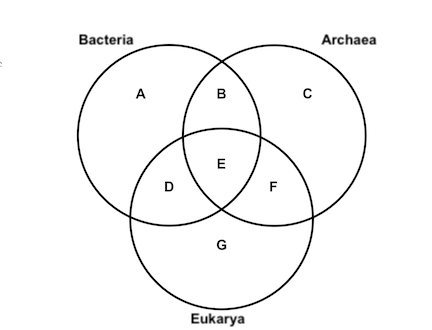
Multiple Choice
Prokaryote AND peptidoglycan - B
Eukaryote AND multicellular - G
Prokaryote - F
Prokaryote AND nucleus - E
Prokaryote AND multicellular - D
Eukaryote AND multicellular
Which group(s) below contain single-celled and multicellular organisms?
Multiple Choice
Fungi AND archaea
Algae AND fungi
Fungi AND protozoa
Algae AND bacteria
Protozoa AND bacteria
Algae AND fungi
All of the statements regarding archaea are true EXCEPT
Multiple Choice
they often grow in extreme environments.
they reproduce by binary fission.
they contain a rigid cell wall.
they contain peptidoglycan in their cell walls.
they are found as single cells.
they contain peptidoglycan in their cell walls.
Select the TRUE statement regarding viruses.
Multiple Choice
Viruses always cause death of the host cells they infect.
Most viruses are smaller than bacteria but bigger than mitochondria.
Viruses may be unicellular or multicellular.
Virus are considered living because they contain nucleic acid.
Viruses contain either DNA or RNA, not both.
Viruses contain either DNA or RNA, not both.
Which are the correctly written scientific name?
Multiple Choice
Staph
St. aureus
Staphylococcus a.
Staphylococcus aureus
Staphylococcus aureus
The cell types that lack a membrane-bound nucleus and have rigid cell walls of peptidoglycan are
Multiple Choice
archaea.
fungi.
eukaryotes.
bacteria.
protozoa.
bacteria.
All living organisms
Multiple Choice
may be classified in three domains.
are capable of causing disease.
probably do not have a common ancestor.
may be classified in four domains.
have never shared genes between domains.
may be classified in three domains.
A microbiologist obtained two pure isolated biological samples: one is a virus, and one is a viroid. The labels came off the samples during a move from one lab to the next, however. The scientist felt she could distinguish between the two samples by analyzing for the presence of a single type of molecule. What would she be looking for to differentiate between the two?
Multiple Choice
DNA
Protein
Lipid
Carbohydrate
RNA
Protein
Select the TRUE statement(s) regarding eukaryotes.
Multiple Choice
Eukaryotes have a membrane around the DNA.
Eukaryotes have a more complex internal structure than archaea or bacteria AND have a membrane around the DNA.
Eukaryotes have a simpler internal structure than archaea or bacteria AND have a membrane around the DNA.
Eukaryotes are all multicellular organisms AND have a membrane around the DNA.
Eukaryotes have a more complex internal structure than archaea or bacteria.
Eukaryotes have a more complex internal structure than archaea or bacteria AND have a membrane around the DNA.
Which is TRUE about prions?
Multiple Choice
They are only composed of DNA.
They are only composed of RNA.
They cause diseases in plants.
They are only composed of RNA and DNA.
They are only composed of protein.
They are only composed of protein.
The part of the atom that is most involved in chemical reactivity is the
Multiple Choice
electron.
nucleus.
ion.
neutron.
proton.
electron
Which list goes from heaviest to lightest?
Multiple Choice
Proton, molecule, atom, electron
Compound, atom, proton, electron
Atom, molecule, proton, neutron
Electron, proton, atom, molecule
Electron, proton, atom, compound
Compound, atom, proton, electron
The negatively charged component of the atom is the
Multiple Choice
valence.
neutron.
proton.
nucleus.
electron.
electron.
Which of the following is TRUE regarding electrons?
Multiple Choice
They are found in the area outside the nucleus known as the cloud.
They may gain energy but do not lose energy.
They cannot move from one shell to another within the cloud.
They are located farthest from the nucleus and have the least energy.
They are positively charged particles in an atom.
They are found in the area outside the nucleus known as the cloud.
Which is the positively charged component of the atom?
Multiple Choice
Electron
Cation
Neutron
Proton
Anion
Proton
Which is the uncharged component of the atom?
Multiple Choice
Neutron
Neulon
Electron
Proline
Proton
Neutron
Charged atoms are called
Multiple Choice
molecules.
ions.
neutrons.
polymers.
atoms.
ions.
If electrons are shared unequally, a(n) _________blank bond is formed.
Multiple Choice
ionic
hydrogen
polar
weak
nonpolar
polar
Which of the following pairs is mismatched?
Multiple Choice
RNA - ribose sugar
Sharing electrons - covalent bond
Lipids - hydrophobic
Dehydration synthesis - water removal
Carboxyl - CH3
Carboxyl - CH3
Which of the following statements about enzymes is FALSE?
Multiple Choice
Enzymes are composed of amino acids.
Enzymes help break covalent bonds.
Enzymes position reactants so covalent bonds form more easily.
Enzymes increase the temperature of a reaction.
Enzymes are essential for maintaining life.
Enzymes increase the temperature of a reaction.
Enzymes are required to break which of the following bonds?
Multiple Choice
Hydrostatic
Ionic
Polar
Covalent
Peptide
covalent
If electrons are gained or lost when a bond is formed, that bond is a(n) _________blank bond.
Multiple Choice
nonpolar
ionic
intermediate
covalent
hydrogen
ionic
In a redox reaction,
Multiple Choice
the reactant that loses an electron is oxidised and the reactant that gains an electron is reduced.
the reactant that loses an electron is reduced and the reactant that gains an electron is oxidised.
both the reducing agent and the oxidising agent gain electrons.
the reactant that loses an electron is a oxidising-oxidising agent.
the reactant that gains an electron is reduced and is an oxidising reagent.
the reactant that loses an electron is oxidised and the reactant that gains an electron is reduced.
Which of these bonds are weak individually but are much stronger as a group?
Multiple Choice
Covalent AND hydrogen
Hydrogen AND neutron
Neutron AND ionic
Ionic AND hydrogen
Ionic AND covalent
ionic AND hydrogen
Please identify the CORRECT definition.
Multiple Choice
A compound is a molecule composed of two or more identical elements.
Molecules that contain carbon and hydrogen are called inorganic compounds.
Electrons in a polar covalent bond are shared equally.
Electrolytes are salts that conduct electricity when they are dissolved in water.
The starting components of a chemical reaction are called products.
Electrolytes are salts that conduct electricity when they are dissolved in water.
Which of the statements about ions is TRUE?
Multiple Choice
An anion is an atom that has gained an electron and a proton.
Anions are positively charged atoms while cations are negatively charged atoms.
Anions are negatively charged atoms while cations are positively charged atoms.Correct
Cations and anions both have an overall positive charge.
The ion Mg2+ has gained two electrons while the ion Na+ has gained one electron.
Anions are negatively charged atoms while cations are positively charged atoms.
Sharing of electrons between two atoms forms a(n)
Multiple Choice
covalence bond.
hydrogen bond.
ionic bond.
covalent bond.
atomic bond.
covalent bond
Atoms that gain electrons become
Multiple Choice
lighter.
positively charged.
elements.
negatively charged.
neutral.
negatively charged.
Microorganisms use hydrogen bonds to attach themselves to the surfaces that they live on. Many of them lose hold of the surface because of the weak nature of these bonds and end up dying or being washed away. Why don't microbes just use covalent bonds instead?
Multiple Choice
Covalent bonds depend on completely giving up or completely accepting an electron to form the bond. This isn't possible for many microbes without dramatically altering their basic molecular composition.
Hydrogen bonds typically require enzymes to form/break, whereas covalent bonds don't. Microorganisms have more enzymes than any other type of cell, so it makes sense that they use hydrogen bonds rather than covalent bonds.
Bacteria grow in very moist environments, where water is freely available. Water is a supply of hydrogen atoms, so it makes sense for the bacteria to simply use hydrogen bonds for attachment.
Covalent bonds typically require enzymes to form/break, whereas hydrogen bonds don't. If covalent bonds were used, it would require much more energy and molecules to be contributed from the cell. Hydrogen bonds don't have these requirements.
None of the answer choices is correct.
Covalent bonds typically require enzymes to form/break, whereas hydrogen bonds don't. If covalent bonds were used, it would require much more energy and molecules to be contributed from the cell. Hydrogen bonds don't have these requirements.
Which of the following is the correct order from most acidic to least acidic?
Multiple Choice
Vinegar, blood, unpolluted rainwater, drain cleaner, stomach acid
Stomach acid, drain cleaner, unpolluted rainwater, blood, vinegar
Drain cleaner, blood, unpolluted rainwater, vinegar, stomach acid
Unpolluted rainwater, blood, vinegar, drain cleaner, stomach acid
Stomach acid, vinegar, unpolluted rainwater, blood, drain cleaner
Stomach acid, vinegar, unpolluted rainwater, blood, drain cleaner
Multiple Choice
pH is an abbreviation for "power of helium."
pH is a measure of the hydrogen ion concentration in a solution.
pH is measured using a linear (not logarithmic) scale.
pH is measured using a scale from 5 to 8.
pH reflects the tendency of a solution to donate or accept electrons.
pH is a measure of the hydrogen ion concentration in a solution.
The most important molecule(s) in the world is (are) _________blank.
Multiple Choice
water
nucleic acids
proteins
carbohydrates
nitrogen
water
Please select the CORRECT choice regarding pH and hydrogen ion concentration.
Multiple Choice
A pH of 4 is more acidic than a pH of 5 AND the pH 4 solution has an H+ concentration of 1 × 10^-4
A pH of 4 is more basic than a pH of 5 AND the pH 4 solution has an H+ concentration of 1 × 10^-4
A pH of 4 is less acidic than a pH of 5 AND the pH 4 solution has an H+ concentration of 1 x 10^-4
A pH of 4 is more acidic than a pH of 5 AND the pH 4 solution has an OH-concentration of 1 x 10^-4
A pH of 4 is more acidic than a pH of 5 AND the pH 5 solution has an H+ concentration of 1 x 10^5
A pH of 4 is more acidic than a pH of 5 AND the pH 4 solution has an H+ concentration of 1 × 10^-4
You are working in a laboratory, making media for growing bacteria. The recipe you are following calls for the addition of TRIS buffer. You can't find any TRIS in the lab, so you decide to leave it out of the medium. Select the FALSE statement regarding your decision.
Multiple Choice
The acidity of the medium without buffer may change dramatically as the bacteria grow.
Buffers are added to solutions to stabilize the hydrogen ion concentration of that solution.
Maintaining the correct pH is essential for cells, because crucial molecules such as enzymes may lose function in the incorrect pH.
The medium will likely not be useable, because bacteria live within a narrow pH range, near neutral.
The medium will likely not be useable, because bacteria live within a narrow pH range, near pH 14.
The medium will likely not be useable, because bacteria live within a narrow pH range, near pH 14.Correct
When the pH of a solution changes from 9 to 2, the H+ concentration
Multiple Choice
decreases as the solution becomes more basic.
decreases as the solution becomes more acidic.
remains unchanged as the solution becomes more basic.
increases as the solution becomes more basic.
increases as the solution becomes more acidic.
increases as the solution becomes more acidic.
Which statement regarding water is TRUE?
Multiple Choice
Water is a polar molecule.
Water is referred to as a universal solvent.
Water makes up over 70% of an organism.
Water is often a product or reactant in chemical reactions.
All of the answer choices are correct.
All of the answer choices are correct.
Which of the following are found in RNA but not in DNA?
Multiple Choice
Adenine AND ribose
Thymine AND uracil
Ribose AND thymine
Uracil AND deoxyribose
Ribose AND uracil
Ribose AND uracil
Select the CORRECT statement regarding carbohydrates.
Multiple Choice
They contain both ring and linear portions within the same molecule.
They form only linear structures.
They may interconvert between ring and linear structures.
They form only ring structures.
They are all structural isomers of each other.
They may interconvert between ring and linear structures.
Which base pairing example is INCORRECT?
Multiple Choice
G:C
A:T, G:C, AND A:U
G:T
A:U
A:T
G:T
Which of the following best describes the structure of DNA?
Multiple Choice
A triple helix consisting of three chains of nucleobases held together by bonds between with sugar-phosphate groups.
A double helix consisting of two parallel sugar-phosphate backbones with nucleobases oriented towards the interior.
A double helix consisting of two chains of nucleobases held together by bonds between with sugar-phosphate groups.
A double helix consisting of antiparallel two sugar-phosphate backbones with nucleobases oriented towards the interior.
A double helix consisting of two sugar-phosphate backbones with nucleobases oriented towards the exterior.
A double helix consisting of antiparallel two sugar-phosphate backbones with nucleobases oriented towards the interior.
How many carbon atoms do the sugars found in nucleic acids contain?
Multiple Choice
3 carbon atoms.
9 carbon atoms.
either 5 or 7 carbon atoms.
7 carbon atoms.
5 carbon atoms.
5 carbon atoms.
D-amino acids are associated with
Multiple Choice
all proteins.
human proteins.
plant proteins.
radioactive isotopes.
bacterial cell walls.
bacteria cell walls.
Select the CORRECT statement regarding acidic or basic amino acids.
Multiple Choice
They are readily soluble in water.
They are unable to form peptide bonds.
They are unable to form ions.
They are considered hydrophobic.
They are insoluble in water.
They are readily soluble in water.
Weak bonds are important for the _________blank structure of proteins.
Multiple Choice
primary AND secondary
primary, tertiary, AND quaternary
quarternary
primary, secondary, AND tertiary
secondary, tertiary, AND quaternary
secondary, tertiary, AND quaternary
Which is NOT true of lipids?
Multiple Choice
They are a major structural element of all cell membranes.
Examples include steroids and phospholipids.
They control the movement of molecules into and out of a cell.
They are a homogeneous group of molecules.
They separate a cell from its environment.
They are a homogeneous group of molecules.
A biologist determined the amounts of several amino acids in two separate samples of pure protein. His data showed that Protein A contained 7% leucine, 12% alanine, 4% histidine, 2% cysteine, and 5% glycine. Interestingly, Protein B had the same percentages of the same amino acids. He concluded from this data that Proteins A and B are the same protein. Based on this information and his conclusion, determine which of the following is the correct statement regarding his findings.
Multiple Choice
He is correct; the proteins have the same percentages of each amino acid, so they are identical protein molecules.
He is correct; although there is no information on the amino acid sequence in each protein, the order of the amino acids is irrelevant. It's only the total number of each molecule that is important to structure.
He is partly correct; the percentage of the listed amino acids is the same in each protein, but Protein A is hydrophobic and Protein B is hydrophilic.
He is incorrect; he hasn't accounted at all for the effects of pH on the composition of the protein and its effects on the individual amino acids.
He is incorrect; there is no information about the amino acids sequence (which dictates the overall structure of a protein), so the two proteins could be very different in shape.
He is incorrect; there is no information about the amino acids sequence (which dictates the overall structure of a protein), so the two proteins could be very different in shape.
Dehydration synthesis is involved in the synthesis of all of the following EXCEPT
Multiple Choice
triglycerides.
DNA and RNA.
peptidoglycan.
enzymes.
glucose.
glucose.
To which end of the nucleic acid chain are more nucleotides added during DNA synthesis?
Multiple Choice
C terminal.
5 prime (5') end.
3 prime (3') end.
-COOH terminal.
N terminal.
3 prime (3') end.
Select the FALSE statement regarding protein denaturation.
Multiple Choice
Denaturation can occur due to certain chemicals.
Denaturation cannot be reversed.
Denaturation can occur due to high temperature.
Denaturation may cause the protein to no longer function.
Denaturation can occur due to pH changes.
Denaturation cannot be reversed.
Side chains are important to proteins because they
Multiple Choice
form the peptide bonds that link amino acids to one another.
help determine protein shape AND are a source of energy for hydration reactions in the cell.
are a source of energy for hydration reactions in the cell.
help determine protein shape AND help determine the solubility of the protein in water.
help determine the degree of solubility of the protein in water.
help determine protein shape AND help determine the solubility of the protein in water.
The primary structure of a protein refers to
Multiple Choice
two or more polypeptides linked to one another.
the initial folding of a protein.
the helical folding of a protein.
the beta-pleated sheets in a protein.
the sequence of amino acids.
the sequence of amino acids.
The subunits (building blocks) of proteins are
Multiple Choice
phospholipids.
monosaccharides.
carbohydrates.
nucleotides.
amino acids.
amino acids.
How many different amino acids are there to choose from when assembling a protein?
Multiple Choice
20
64
5
10
25
20
You are a biochemist working on a molecule found in a recently discovered bacteria. You determine that the molecule is composed of a chain of similar subunits and can thus conclude that the molecule is unlikely to be a
Multiple Choice
carbohydrate.
lipid or protein.
lipid.
nucleic acid.
protein.
lipid.
Amino acids in proteins are linked to one another by peptide bonds between the
Multiple Choice
phosphate group and nitrogenous base.
methyl group of one amino acid and a side group of another amino acid.
carbon atoms of two adjacent amino acids.
nitrogen atom and carboxyl ion.
carboxyl group of one amino acid and the amino group of another.
carboxyl group of one amino acid and the amino group of another.
The -OH group in a carbohydrate
Multiple Choice
may be found above or below the plane of the ring.
is involved in the formation of stereoisomers.
is involved when linking monosaccharides together.
is involved in the formation of stereoisomers AND may be found above or below the plane of the ring.
All of the answer choices are correct.
All of the answer choices are correct.
Which statement(s) regarding a protein is/are CORRECT?
Multiple Choice
A protein assumes any number of equally functional shapes AND is always polar.
A protein can form any number of equally functional shapes.
A protein is always polar AND may need help from chaperones to assume the correct shape.
A protein consists of a chain of hydroxyl acids AND is always polar.
A protein may need help from chaperones to assume the correct shape.
A protein may need help from chaperones to assume the correct shape.
Which statement is true of nucleotides?
Multiple Choice
They are the basic subunits of DNA.
There are 20 naturally occurring nucleotides.
They are joined together by peptide bonds.
They are double-stranded.
All of the answer choices are correct.
They are the basic subunits of DNA.
The purines of DNA are
Multiple Choice
thymine and adenine.
serine and threonine.
thymine and uracil.
thymine, adenine AND uracil.
adenine and guanine.
adenine and guanine.
Select the CORRECT statement regarding saturated fats and unsaturated fats.
Multiple Choice
Unsaturated fats have a lower melting temperature than saturated fats.
Unsaturated fats have a higher melting temperature than saturated fats.
They have approximately the same melting temperature as each other.
Saturated fats are more liquid at room temperature than unsaturated fats.
Saturated fats have a lower melting temperature than unsaturated fats.
Unsaturated fats have a lower melting temperature than saturated fats.
Which statements about proteins are TRUE?
Multiple Choice
They are characterized by a 1:2:1 ratio of carbon to hydrogen to oxygen AND are composed of a chain of nucleotides.
They are composed of a chain of amino acids AND are characterized by a 1:3:1 ratio of carbon to hydrogen and oxygen.
They are involved in almost every important function performed by a cell AND are characterized by a 1:3:1 ratio of carbon to hydrogen to oxygen.
They make up more than 50% of the dry weight of a cell AND are composed of a chain of nucleotides.
They are involved in almost every important function performed by a cell AND make up more than 50% of the dry weight of a cell.
They are involved in almost every important function performed by a cell AND make up more than 50% of the dry weight of a cell.Correct