Anti-depressants
 Call Kai
 Learn
Learn Practice Test
 Spaced Repetition
 Match
Match Flashcards
 Knowt Play
1/17

There's no tags or description
Looks like no tags are added yet.
Name | Mastery | Learn | Test | Matching | Spaced | Call with Kai | Chat |
|---|
No analytics yet
Send a link to your students to track their progress
18 Terms


Monoamine oxidase inhibitors (MOAIs)
Irreversible inhibitors of MAOa and MOAb
Irreversibly causes long washout period
Selegiline is MAOb selective at low dose; mostly nonselective at high doses
MOA:
Molecular: irreversible inhibition of MAOa and MAOb
Cellular: blocks breakdown DA, 5HT, and NE
Clinical: increase synaptic levels of DA, 5HT, NE
Drugs:
Selegiline (Emsam)
Phenelzine (Nardil)
Tranylcypromine (Parnate)
NTs:
At low dose of selegiline DA levels are raised.
At high dose of selegiline NE/5HT/DA levels are raised.
Drug interactions
Any drug that increases NE/Adrenaline or 5HT
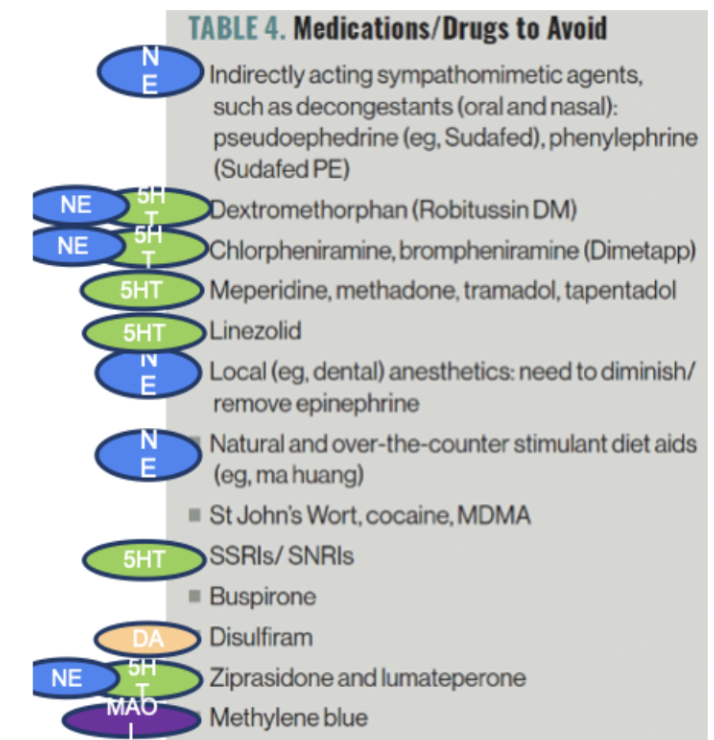
Hypertensive crisis
Sever htn
Sweating
Anxiety
Tachycardia
Chest pain
Too much adrenalin, ne, tyramine
Serotonin syndrome
Mental state
dry mouth
muscle rigidity
Tremor
N/V, diarrhea
Hyperthermia
Too much 5HT
Dietary Restriction
MAOIs at higher doses used for depression come with dietary restrictions including:
Aged cheese
Salami
Wine and tap bee
Miso and soy sauce
Cheese reaction
Sevre HTN
Sweating anxiety
Tachycardia
Chest pain
Hypertensive crisis
Sever htn
Sweating anxiety
Tachycardia
Chest pain
These foods all contain high levels of tyramine, which competes with NE and adrenaline at MAOA
MAOA normally breaks down NE effectively. However, both MAOA inhibitors and high levels of tyramine can compete at MAOA with NE and reduce its breakdown. Normally neither is enough to be dangerous, but with combination, the resulting high levels of NE/adrenaline can cause hypertensive crises
Tricyclic antidepressants
Inhibitors of SERT and NET
TCAs very nonselective
Large number of ADEs
MOAs:
Molecular: inhibit SERT and NET
Cellular: Block reuptake of 5HT and NE
Clinical: increases synaptic levels of 5HT and NE
Drugs:
Nortriptyline (Pamelor)
Desipramine (Norpramin) -more selective NET>SERT
Amitriptyline (Elavil)
Imipramine (Tofranil)
Doxepin (Sinequan, Silenor)
Serotonin and NE reuptake inhibitors (SNRI)
Inhibit SERT and NET
More selective than tricycles, fewer ADEs than TCA
MOAIs:
Molecular: Inhibit SERT and NET
Cellular: Block reuptake of 5HT and NE
Clinical: Increases synaptic levels of 5HT and NE
Drugs:
Venlafaxine (Effexor, Effexor XR) – SERT preferring
Desvenlafaxine (Pristiq) – R-enantiomer only
Duloxetine (Cymbalta)
Levomilnacipran (Fetzima)
Milnacipran (Savella)
Selective 5HT reuptake inhibitors (SSRIs)
SSRIs inhibit SERT only
Each drug has widely different binding profile and ADEs
All have latency to antidepressants effect
MOAs:
Molecular: inhibits SERT
Cellular: blocks reuptake of 5HT
Clinical: increases synaptic levels of 5HT
Drugs:
Fluoxetine (Prozac)
Paroxetine (Paxil)
Sertraline (Zoloft)
Citalopram (Celexa) – racemic; active and non-active enantiomers
Escitalopram (Lexapro) - active enantiomer (S)

NE and DA Reuptake inhibitors (NDRI)
Inhibits NET and DAT
Increases NE with no 5HT increases make this more activating than SSRIs: anxiety, tremors, decreased seizure threshold
MOAs:
Molecular: Inhibit NET and DAT
Cellular: Block reuptake of NE and DA
Clinical: Increases synaptic levels of NE and DA
Drugs: Bupropion (Wellbutrin SR, XL)
5HT1A agonist
Azapirone serotonin 1a receptor partial agonist
Partial agonist at presynaptic receptors with predominant antagonist effect
Block of presynaptic auto-receptor negative-feedback loop increases 5HT release
Antidepressant action due to increased 5HT
Primarily used to treat anxiety disorders
MOAs:
Molecular: Partial agonist with antagonist-like effect at presynaptic 5HT1A auto-receptors
Cellular: Disinhibits (increases) further 5HT release
Clinical: Increases synaptic levels of 5HT
Drugs: buspirone
Serotonin Modulator
Tetracyclic serotonin modulator antidepressants
Antagonist presynaptic a2 adrenergic auto-receptors to increase NE release
Antagonist presynaptic 5HT2 auto-receptors to increase 5HT release
Significant non-selective binding and ADEs
MOA:
Molecular: Inhibit presynaptic α2 receptors and 5HT2 receptors
Cellular: disinhibits (increases) further NE and 5HT release
Clinical: Increases synaptic levels of 5HT and NE
Drugs: Mirtazapine (Remeron)
Mixed Serotonergics
Mixed serotonergics are several related classes
All mixed serotonergic have dual MOAs:
SERT inhibition
Disinhibition of 5HT release: antagonism/partial agonism of presynaptic inhibitory 5HT auto-receptors increases further 5HT release

NMDA receptor agonist
Glutamate NMDA receptor antagonists
Antidepressant action due to increase in synaptic health and function
MOAs:
Molecular: Antagonism of NMDA receptors
Cellular: Increases Glu and BDNF release
Clinical: Increases neural health/plasticity
Drugs:
Esketamine (Spravato) (nasal spray) -active isomer of ketamine
Dextromethorphan
GABAA R positive allosteric modulator
GABAA R positive allosteric modulator aka allosteric potentiator
Analogues of neurosteroid allopregnanolone
For POST-PARTUM depression only
Reduces post-birth drop in allopregnanolone
Treats upstream cause of depression, not the mechanisms of depression
Drugs:
Brexanolone (Zulresso) iv
Zuranolone (Zurzuvae) PO
Recognize that TCAs are less selective drugs than SNRIs, and therefore have increased ADEs
TCAs are less specific drugs and have activity at a lot more receptors. This means they will have more ADEs
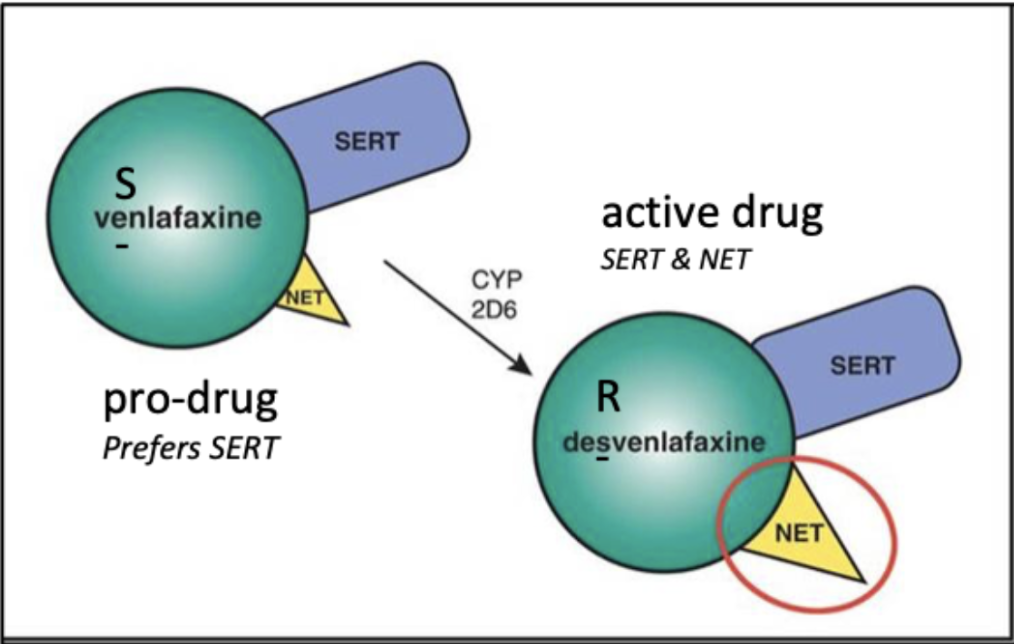
Recognize that venlafaxine is a pro-drug of desvenlafaxine and how effectiveness will depend on CYP activity.
Venlefaxine = racemic of active (r) and prodrug (s)
Desvenlafaxine = active R-enatomer only
CYP 2D6 activates pro-drug to activate drug
Recognize that escitalopram consists only of the active enantiomer of citalopram.
Citalopram is the racemic (active and non-active enantiomer) of the active enantiomer of escitalopram
Ex: Is 20mg daily citalopram the same as 20mg daily escitalopram?
NO. 20mg citalopram consists of 50% inactive enantiomer and 50% active enantiomer escitalopram. It has half the amount of active drug.
Explain how disinhibition at a synapse works.
Disinhibition = removal of inhibitory pressure
Presynaptic disinhibition → increased NT release
Inhibitory auto-receptors on serotonergic terminals inhibit further 5HT release
Turning off these receptors increases 5HT release:

Antagonist
Partial agonist = partial antagonist
Several drugs use about MOA
Explain the dual mechanisms shared by the Mixed Serotonergics and how this is different from SSRI MOA.
Mixed seronergics MOA:
SERT inhibition
Disinhibition of 5HT release: antagonism/partial agonism of presynaptic inhibitory 5HT auto-receptors increases further 5HT release
SSRI MOAs:
Molecular: inhibits SERT
Cellular: blocks reuptake of 5HT
Clinical: increases synaptic levels of 5HT
SSRIs only inhibit SERT, while mixed agents inhibit SERT AND cause disinhibition and increased 5HT release.

difference between disinhibition by buspirone and trazodone seen on this slide. Explain how these can both produce disinhibition of serotonin release.
Trazodone is an antagonist at presynaptic receptors, while buspirone is a partial agonist. These have the same effect because a partial agonist is also a “partial antagonist.” It just depends on which effect predominates.