L9: Enzyme Regulation, Inhibition, Mechanics
 Call Kai
 Learn
Learn Practice Test
 Spaced Repetition
 Match
Match Flashcards
 Knowt Play
1/49

Earn XP
Description and Tags
continuation of L8 material
Name | Mastery | Learn | Test | Matching | Spaced | Call with Kai | Chat |
|---|
No analytics yet
Send a link to your students to track their progress
50 Terms
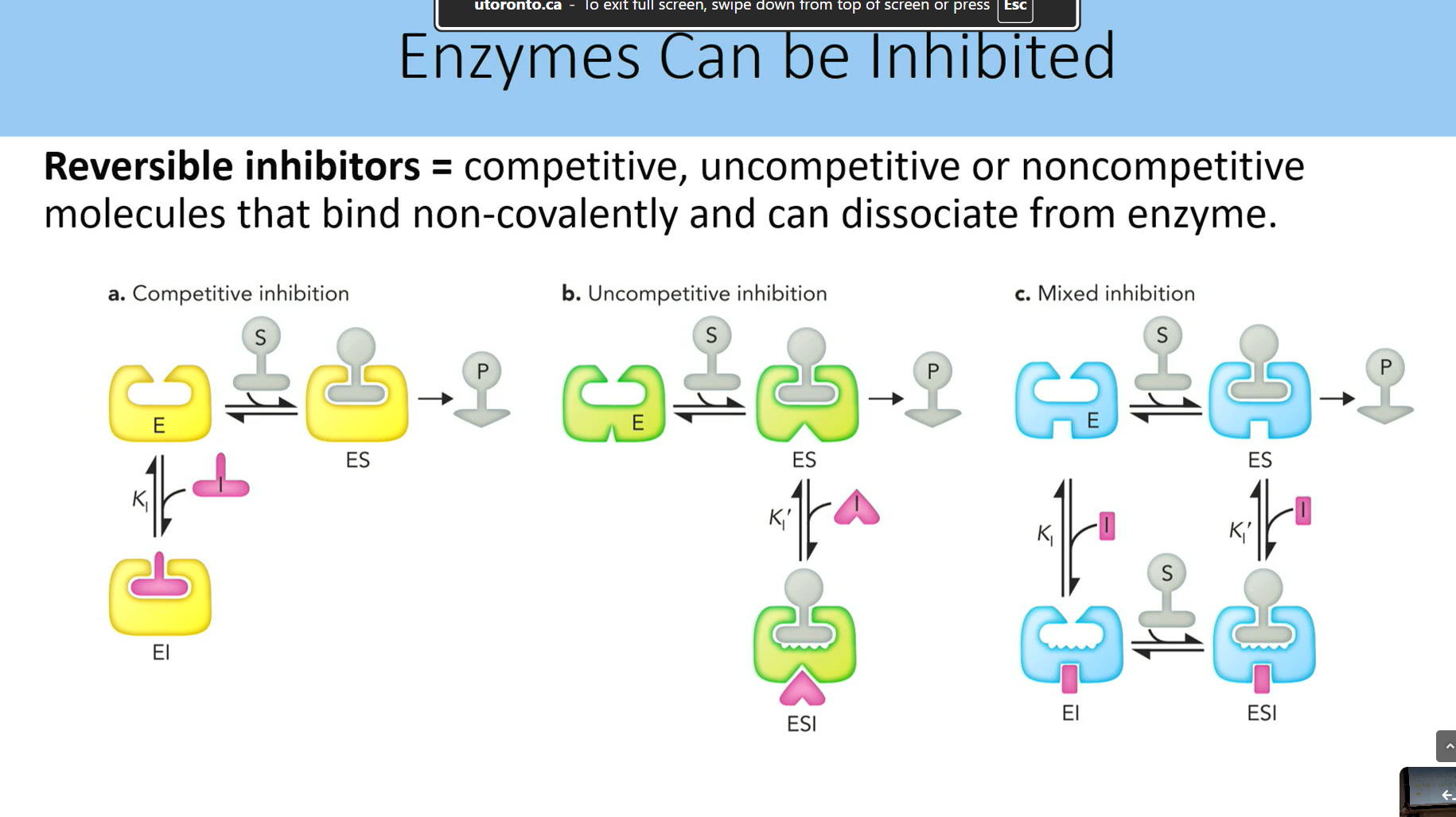
reversible inhibitors
competitive, uncompettive or non comp molecules bidning non covalently and can dissocate from enzume
KI IS FOR ACTIVE SITE BININDG, KI’ IS FOR OTHER SITE BINDING
COMPETITIVE INHIBIT
comp inhib bind to substrate active site forming an EI
dissociation is on free enzyme ki = [e][i]/[ei]
can help with blocking protein function, building good drug targets
more [s] needed for same reaction rate = increases apparent value of km, so half v max is being altered because curve is changing shape
![<ul><li><p><strong>comp inhib</strong> bind to substrate active site forming an EI </p></li><li><p>dissociation is on free enzyme ki = [e][i]/[ei]</p></li><li><p>can help with blocking protein function, building good drug targets</p></li><li><p>more [s] needed for same reaction rate = increases apparent value of km, so half v max is being altered because curve is changing shape</p></li></ul><p></p>](https://assets.knowt.com/user-attachments/a4d19b5f-6536-46b2-a5a2-744242f0f307.png)
uncomp inhibitors
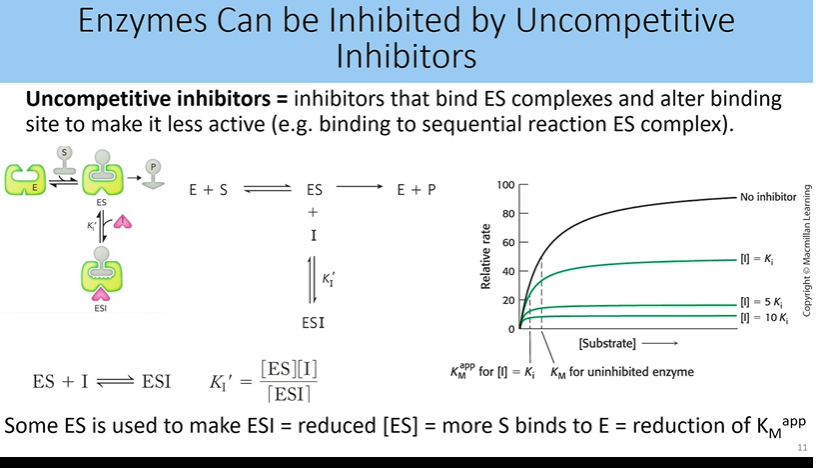
uncomp inhib doesnt bind to substrate binding site, can inhibit ES complex rather than free complex → ESI (enzyme substrate inhibitior compx) ki’
reduction of km that is apparent since nothing is converted to product
appears like you are using subtrate more efficiently but since esi complexes cant be broken, youll get a decrease in vmax
no matter how much substrate you throw at the enzyme, it doesnt change the product
vmax and km decrease by same factor
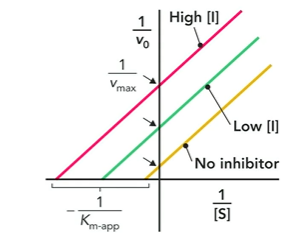
what inhibition is represented by this graph
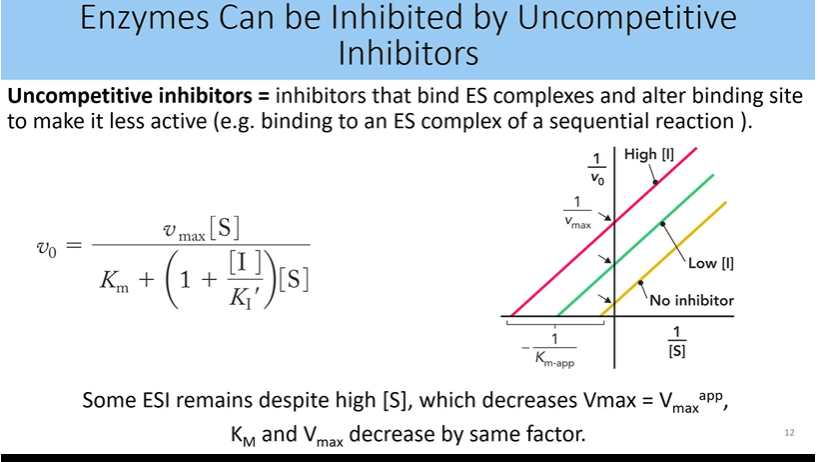
do comp inhib alter vmax?
they do not due to being overcome by high [s]
km is apparent instead of proper bc of high level of substrate
km increase, but vmax is not alterned because you can overcome comp inhibition
![<p>they do not due to being overcome by high [s]</p><ul><li><p>km is apparent instead of proper bc of high level of substrate</p></li><li><p>km increase, but vmax is not alterned because you can overcome comp inhibition</p></li></ul><p></p>](https://assets.knowt.com/user-attachments/0455db84-0e5d-4d5b-ad54-f7adb5f620d7.png)
mixed inhibition
bind different site from substrate and can bind either enyme or es complex = ESI cannot form product
for both cases vmax decreases because in both cases youll get some inhiitor binding to an es complex, so there is no product formation from esi complexes
km depends on which dissociation constant is higher:
is es diss is hgiher than free enzyme = mostly comp inhibitior activity = km increases since it stays bound and associates more with free enzyme = more substrate is needed to proceed
diss for free enzme is higher than es = mostly uncomp inhibitor = more inhibitor will stay bound to es complex: forming esi complex
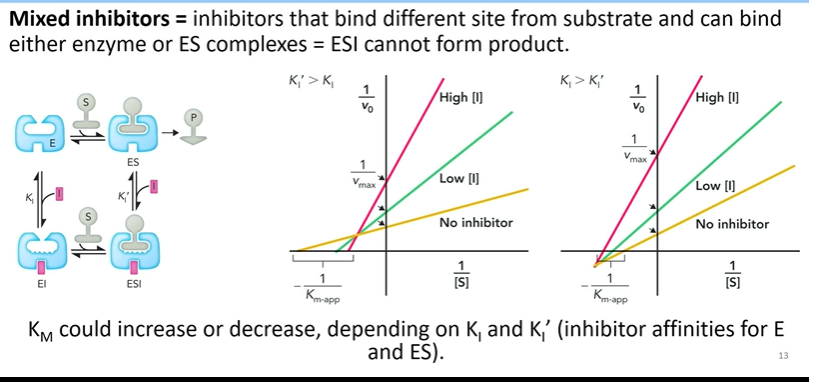
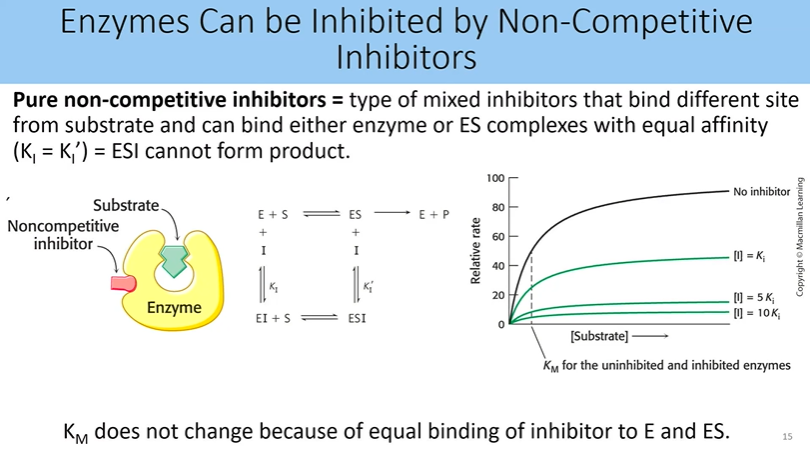
pure non-comp inhibitor
type of mixed inhibitor that binds different site from substrate and can bind either enzyme or ES complexes with equal affinity (ki = ki’) = ESI cannot form product
km does not change because of equal binding of inhibitor to E and ES
vmax: inhibotr has ability to bind to es complex so it cannot be rescued with high substrate concentration so vmax decreases
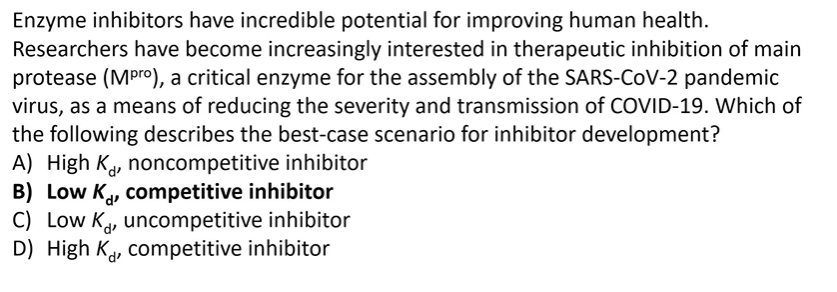
want low kd so it stays together
comp inhibit will be best at block any formation of product bc inhibiting es complex will not actually prevent any product happen (needs to bind to es complex) → stopping reaction earlier rather than later
monomeric follow what type of reaction kinetics does it follow
follow simple michealeic kinetics
commited step
the first step in a feedback inhibition pathway where once the reaction occurs, the rest is commited to the conversion of end product
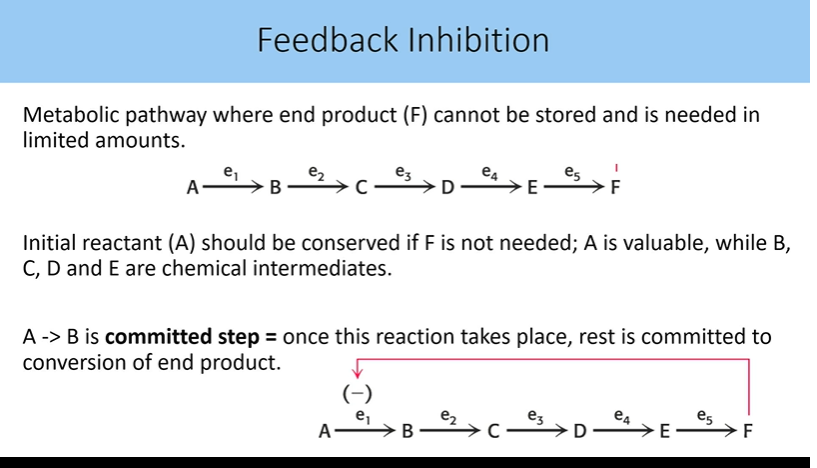
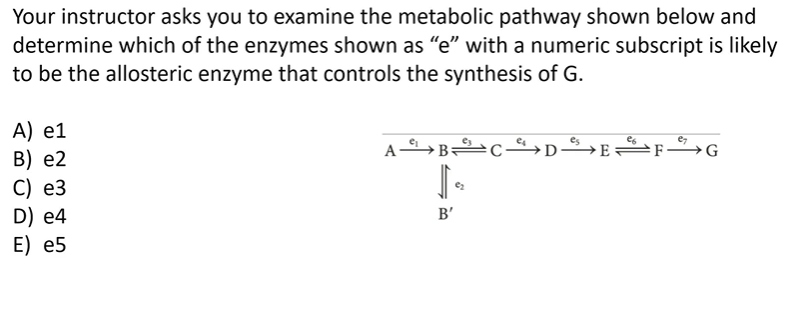
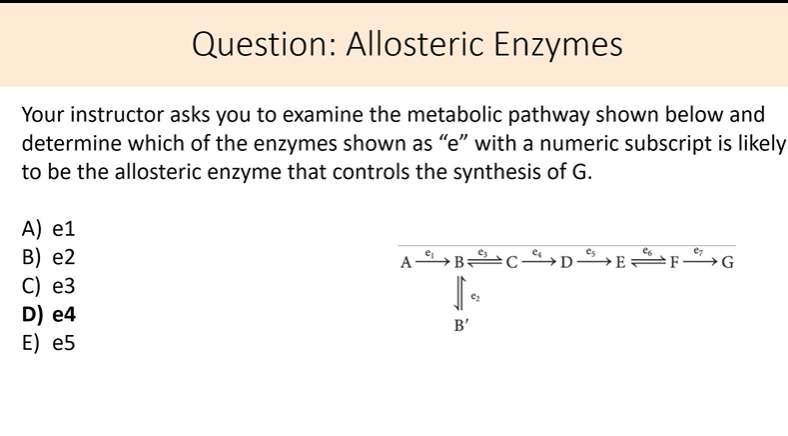
once D is made, you have to continue even though f can change back to e, it cant change back to D, also not e5 bc you need e4 first
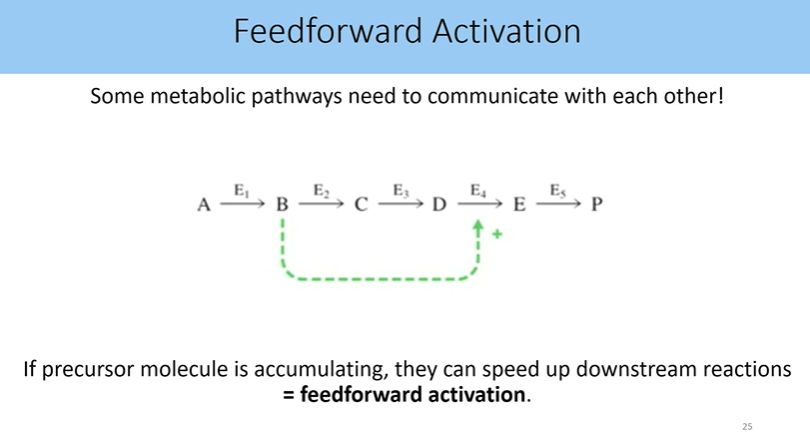
feedforward activation
if precuror molecule is accumulationg, they can speed up downstree reactions
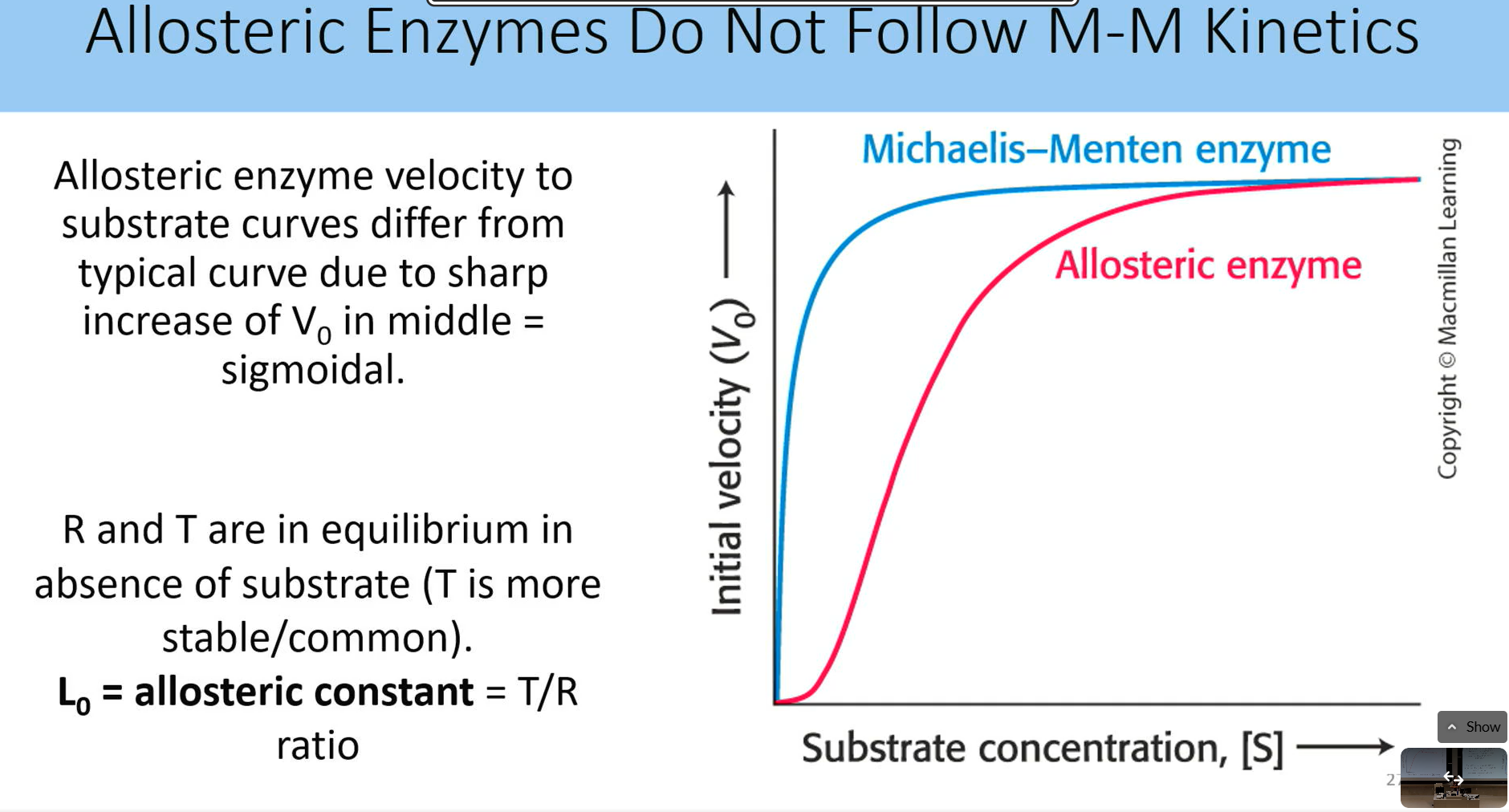
why does allosteric enzymes nto follow m-m kinetics
allosteric enzyme velocity to substrate curves differ from typuca curve due to sharp increase of V0 in middle = sigmoidal
R and T are in equillibim in absence of substrate (T is more stable/common)
l0 = allosteric constate = T/R ration
homotropic effect
homotropic effect
substrate and modulator are the same molecule
value of [s] at which v0 = vmax is referred to as k0.5 instead of km
can follow concerted or sequential models of cooperativity for enzymes with multiple subunits
R state hsas rapid increase of activity towards vmax compared to lower activity of t state hence the lag of the sigmoidal curve (black line)
![<p>homotropic effect</p><ul><li><p>substrate and modulator are the same molecule</p></li><li><p>value of [s] at which v0 = vmax is referred to as k0.5 instead of km</p></li><li><p>can follow concerted or sequential models of cooperativity for enzymes with multiple subunits</p></li><li><p>R state hsas rapid increase of activity towards vmax compared to lower activity of t state hence the lag of the sigmoidal curve (black line)</p></li></ul><p></p>](https://assets.knowt.com/user-attachments/55a0d3db-d626-4912-9660-5b96b22af9b0.png)
in narrow range of [s] what happens to allosteric enume transition
allosteric enzymes transition from less active to more active state in narrow range of [s]
![<p>allosteric enzymes transition from less active to more active state in narrow range of [s]</p>](https://assets.knowt.com/user-attachments/1b5b222b-5cd5-45f3-8e91-20d322d49a8a.png)
m-m kinetics vs allosteric, threshold effect means what
allosteric enzymes are more elastic near km than typical m-m enzymes with same vmax
threshold effect = enzyme active increases rapidly once [s] threshod is passed
![<p>allosteric enzymes are more elastic near km than typical m-m enzymes with same vmax</p><p><strong>threshold effect </strong>= enzyme active increases rapidly once [s] threshod is passed</p>](https://assets.knowt.com/user-attachments/b9ac5d57-d85e-440a-8732-9c6be76ab7e6.png)
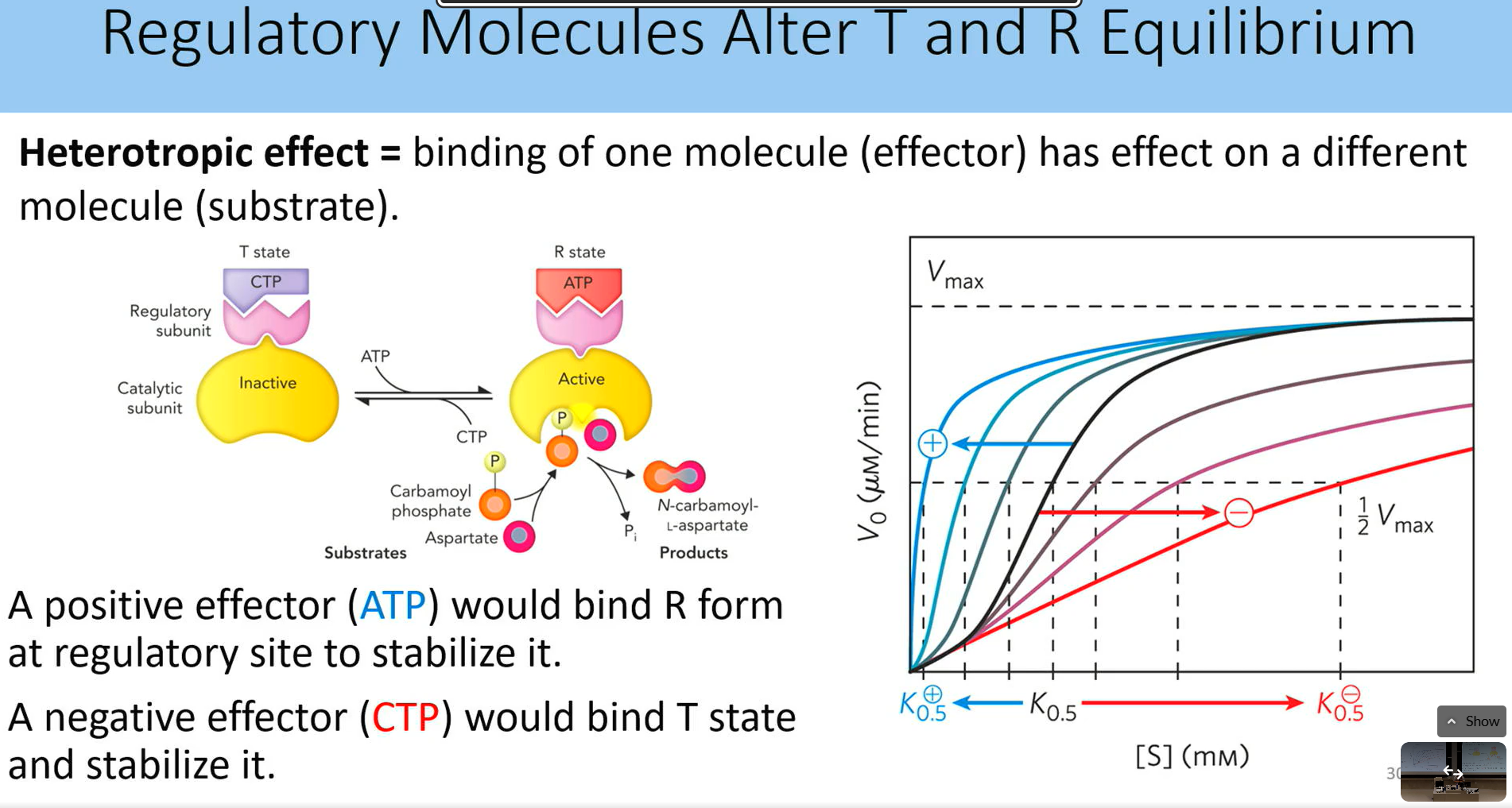
heterotropic effect
binding of one moleculer (effector) has effect on a different molecule (substrate)
a psotive effector (atp) would bind R form at regulatory site to stabilite it (more activation), smaller k0.5
a negative effector (ctp) would bind to T state and stabilize it (less activation), larher 0.5
gout
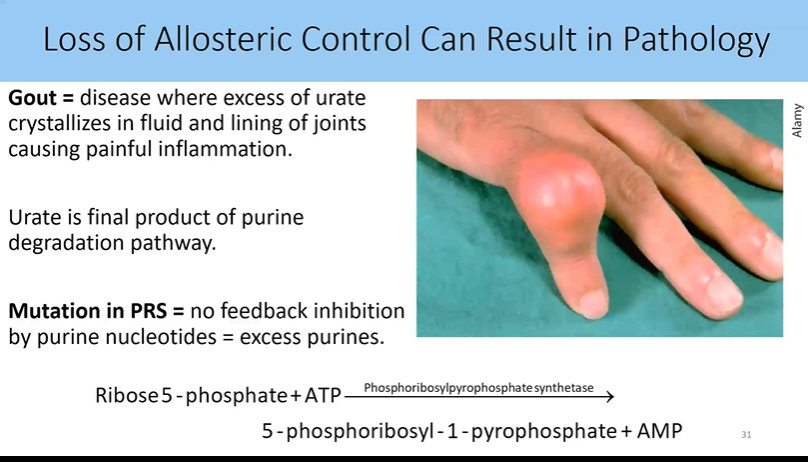
disease where excess of urate crystallizes in fluid and linig of joints causing painful inflammation
urate is final product of purine degradation pathway
mutation in PRS = no feedback inhinition by purine nucleotides = excess purienes
covalent catalysis (dont need mecahnism)
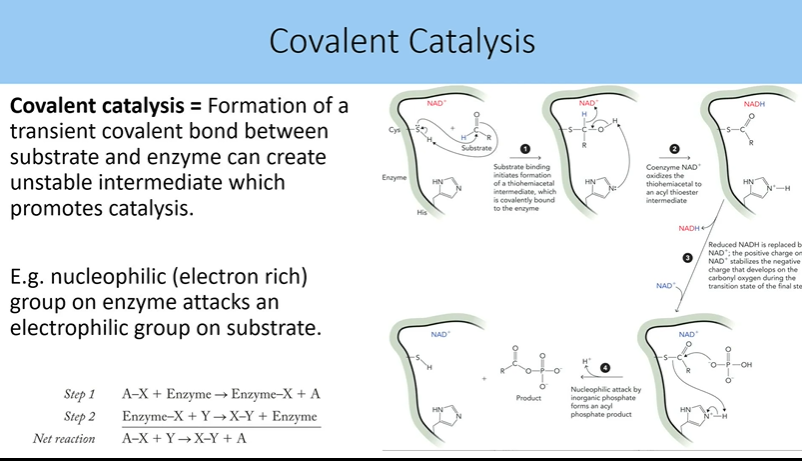
covalent catalysis:
formation of a transient covalent bond between substrate and enzyme can create unstable intermediate which promotes catalysis
e.g. nucleophilic (electron rich) group on enzyme attacks an electrophilic group on substrate (dont need to know mechanism)
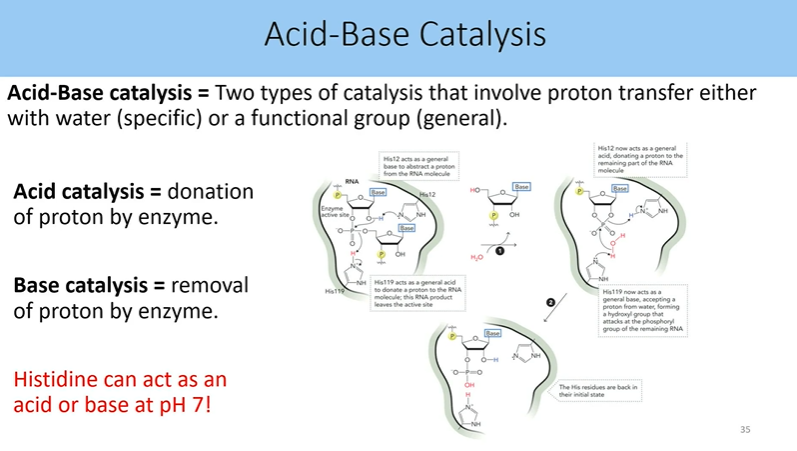
acid base catalysis
two types of catalysis that involve proton transer either with water (specific) or functional group (general)
acid catalysis = donation of proton by enzye
base cata = removal of proton by enzyme
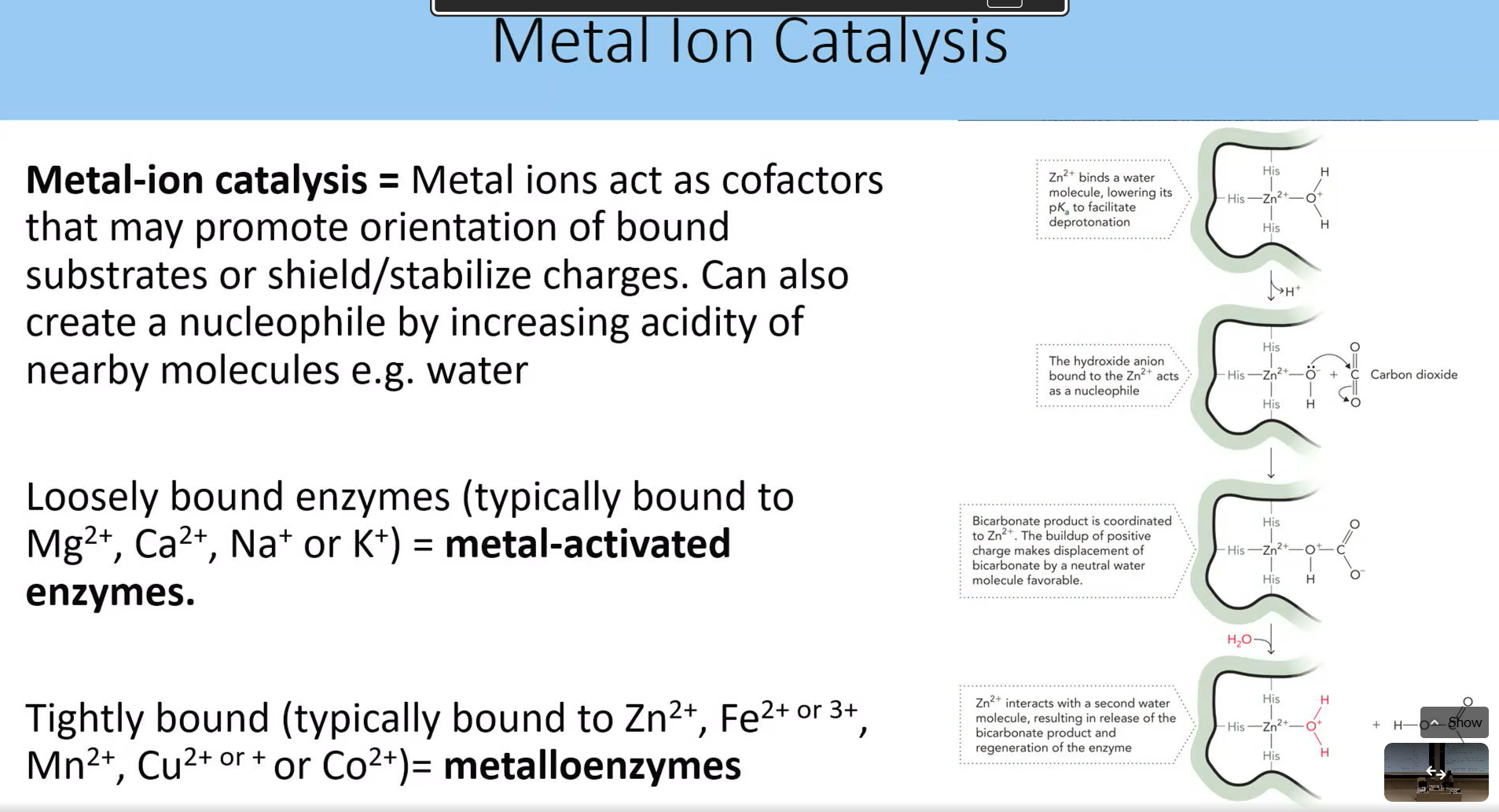
metal ion catalysis, metal activated enzymes, metalloenzymes
metal ions act as cofactors that may promote orientation of bound substrates or sheild stabilize charges.
can also create a nucleophile by increasing acidity of nearby molecuels like water
metal activated enzymes = loosely bound enzymes bound to mg2+, ca 2+ or na+, k+)
metalloenzymes = tightly bound (typicall to zn2+, fe 2+, mn, etc)
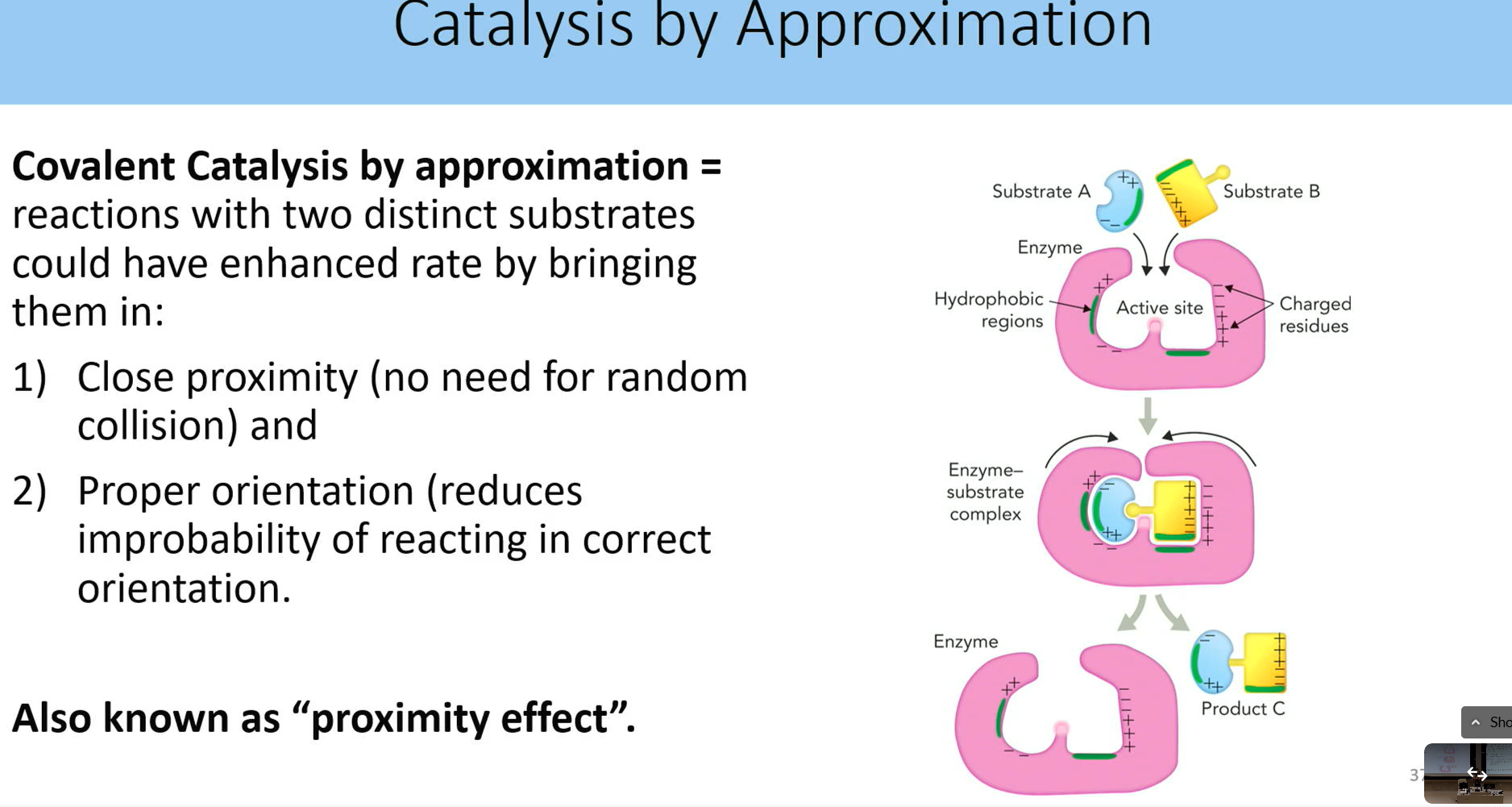
covalent catalysis by approximation
reactions iwth two distinct substrates could have enhanced rate b bring them in:
close proximinity (no need for random collision)
proper orientation (reduces imrpobability of reacting in correct orientation
aka proximity affect
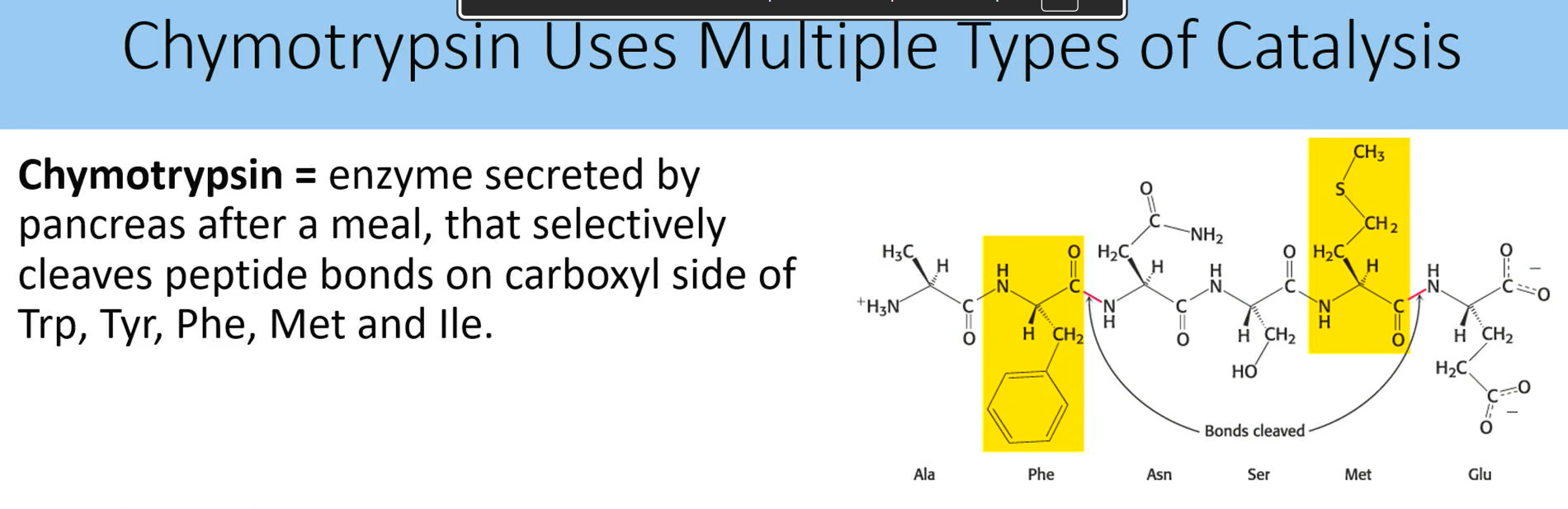
chymotrypsin (know the reaction mechanism), when is it secreted
serine protease enzyme that is secreted by pancrease after a meal, and it selectively cleaves peptide bonds on carboxyl side of trp tyr phe met and ille
contain ser, asp, and his
made up of one polypeptide chain that is cleaved into three pieces that are linked by disulfide bonds to form an enzyme with an active site on the surface
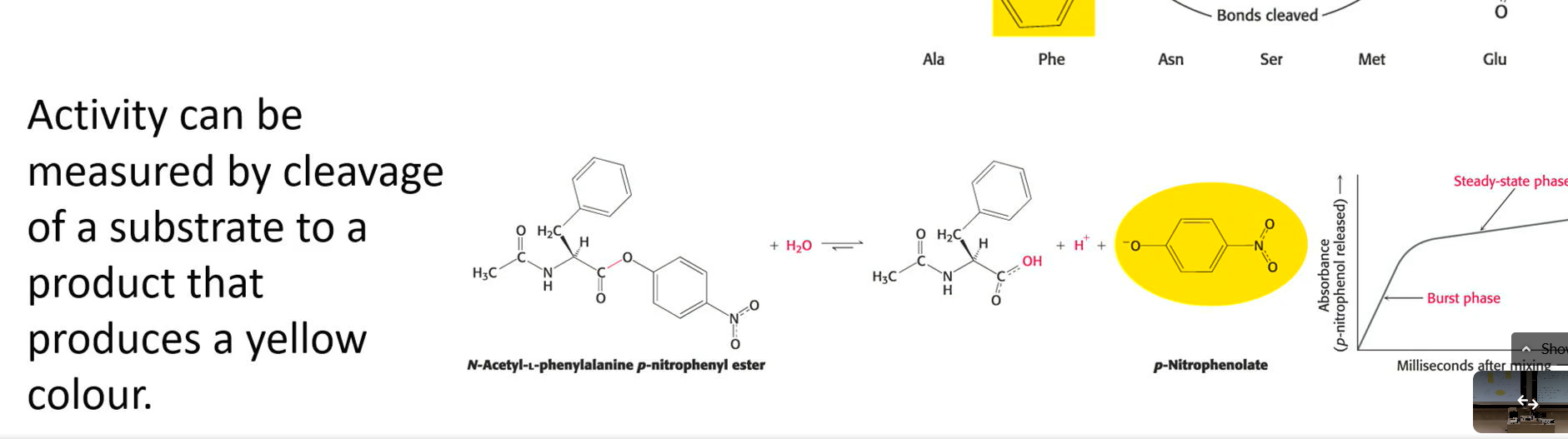
how can chymotrypsin activity be measured
measured by cleavage of a substrate to a product that produces a yellow colour
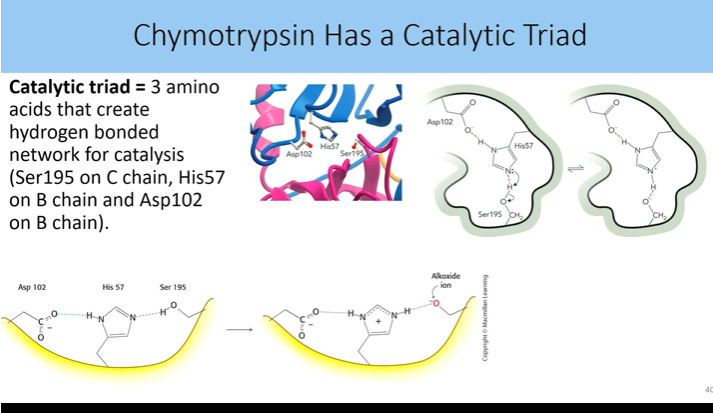
catalytic traid
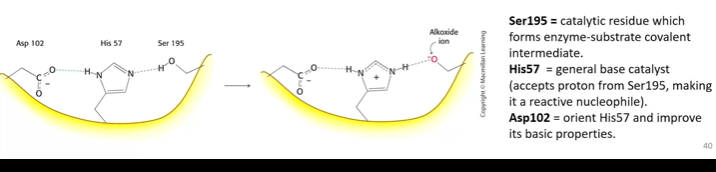
3 amino acids that create hydrogen bonded network for catalysis (ser on C chain, his on B chain, Asp on B chain)
in active site of chymotrypsin
ser195 in catalytic triad
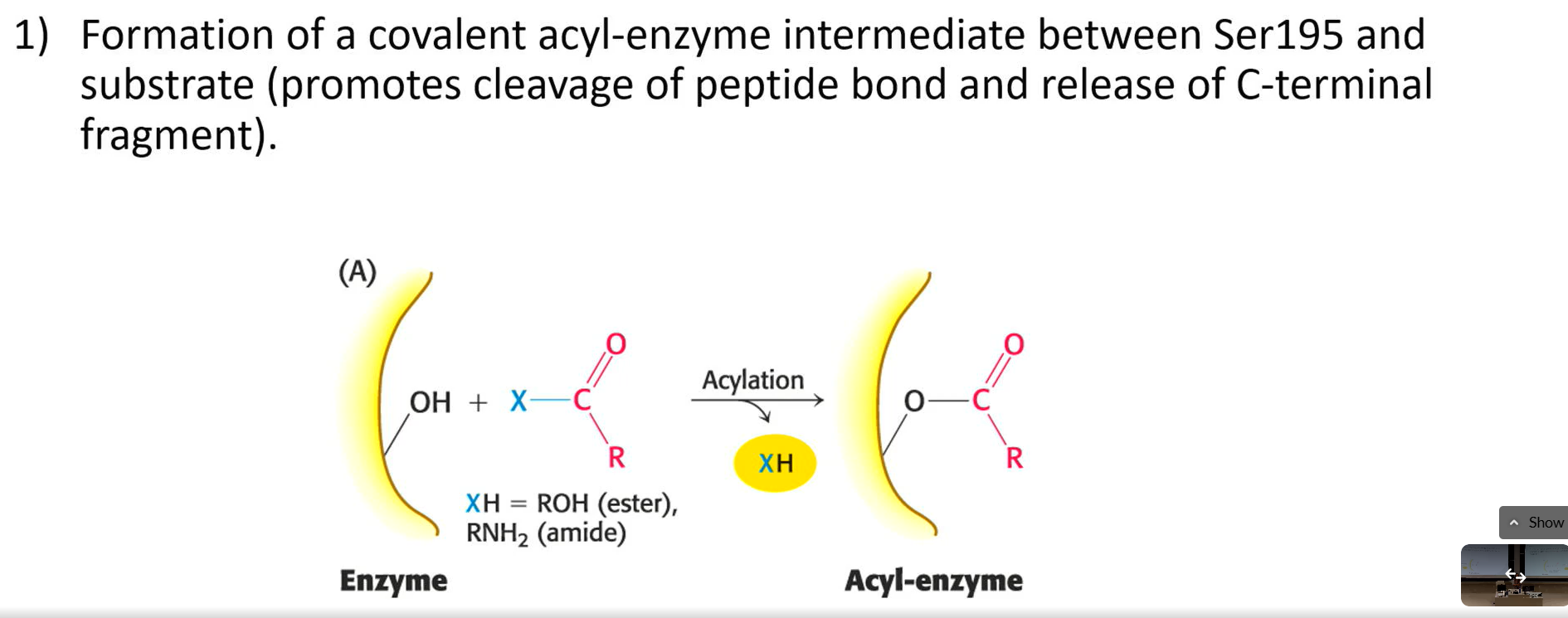
first step of proposed enzyme reaction mechanism of chymotrypsin
formation of a covalent acyl-enzyme intermediate between ser195 and substrate (promotes cleavage of peptide bond and release of C terminal fragment)
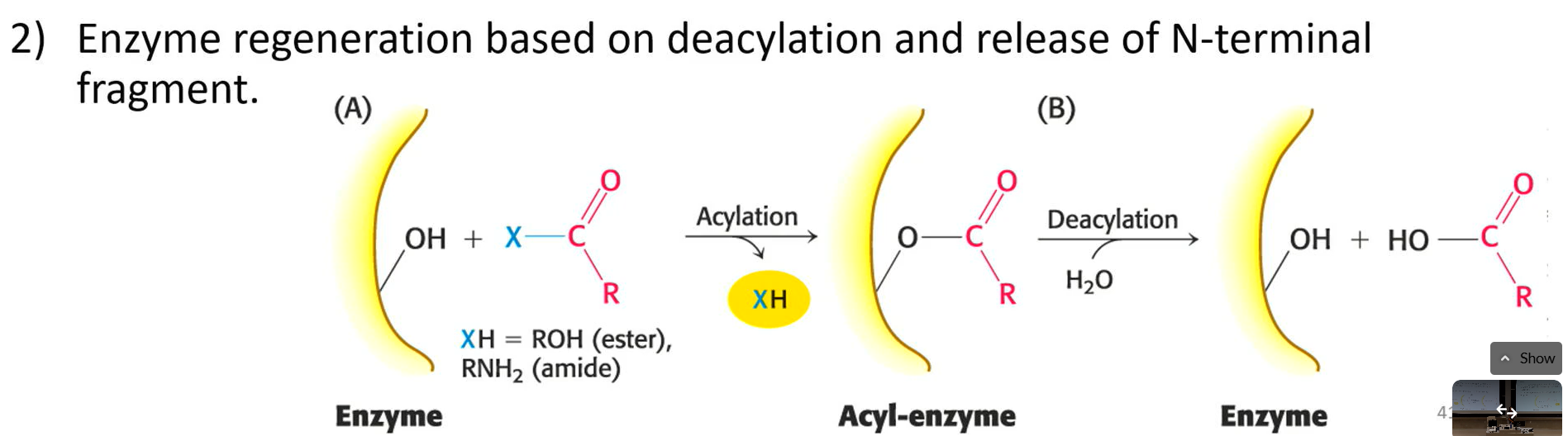
second step of proposed enzyme reaction mechanism of chymotrypsin
enzyme regeneration based on deacylation and release of n-terminal fragment
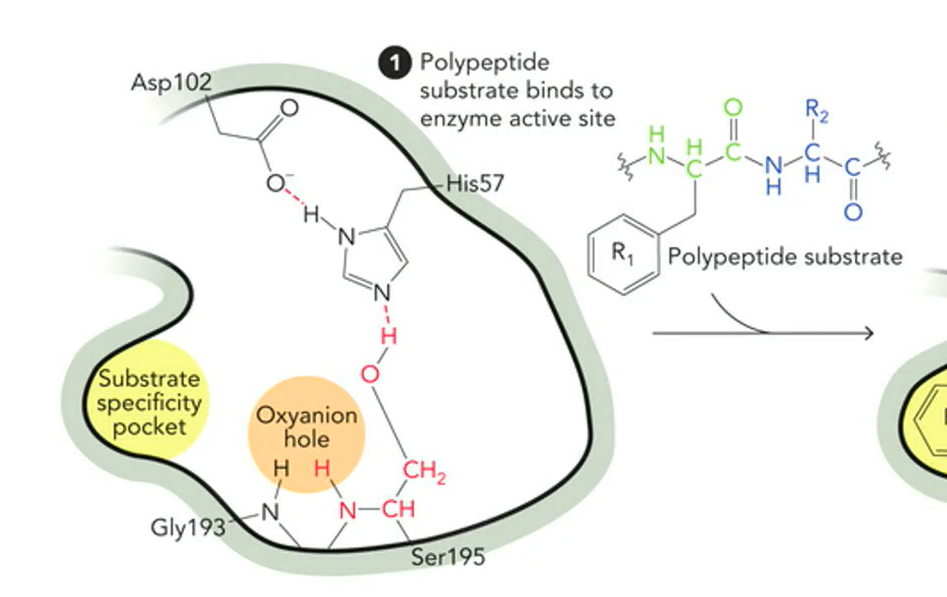
what is step one of reaction mechanism of chymotrypson based on?
the enzyme binding substrate (step 1) is based on aromatic side chain and specificity pocket alighning
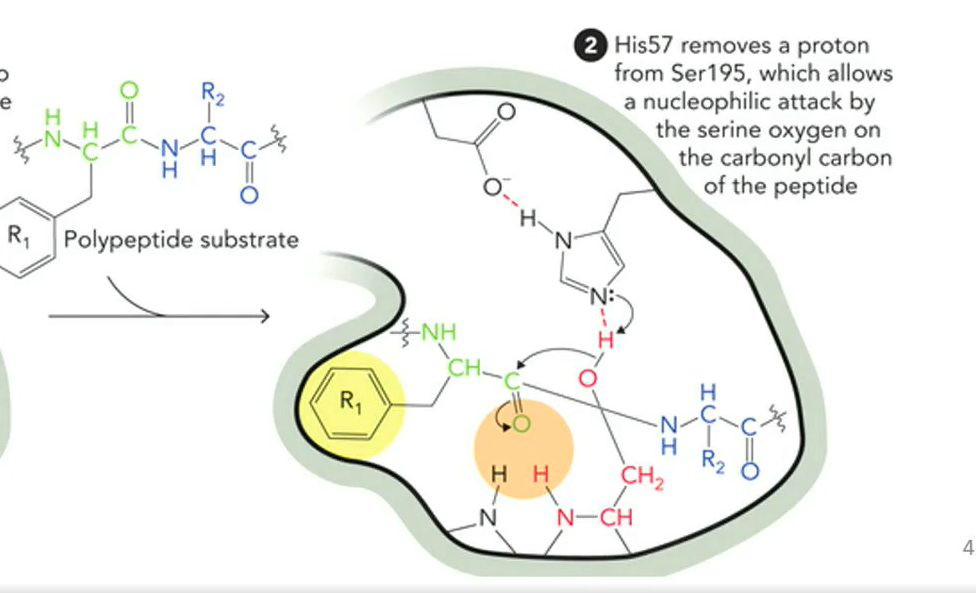
in step 2, where does the proton transfer occur and what does this create?
proton transfer from ser 195 to his 57 = ser195 is now a nucleophile that attacks carbonyl carbon on polypeptide backbones
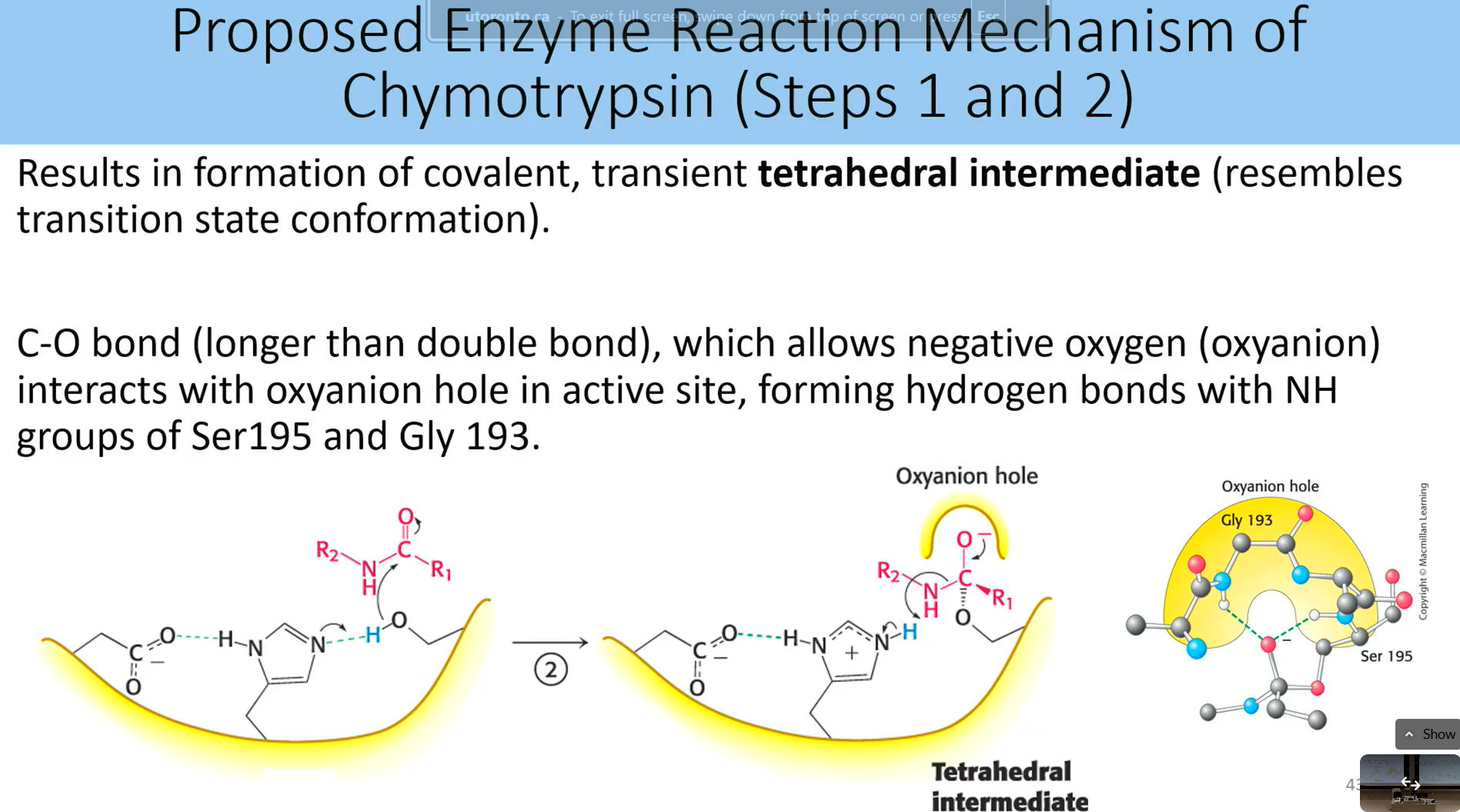
what is formed after steps 1 and 2 reaction mech of chymotrypsin
formation of covalent transient tetrahedral intermedia that resembles transition state conformation
C-O bond (is longer than c=o) allows negative oxygen to interact with oxyanion hole in active site
forms hydrogen bonds with nh groups of ser 195 and gyl 193
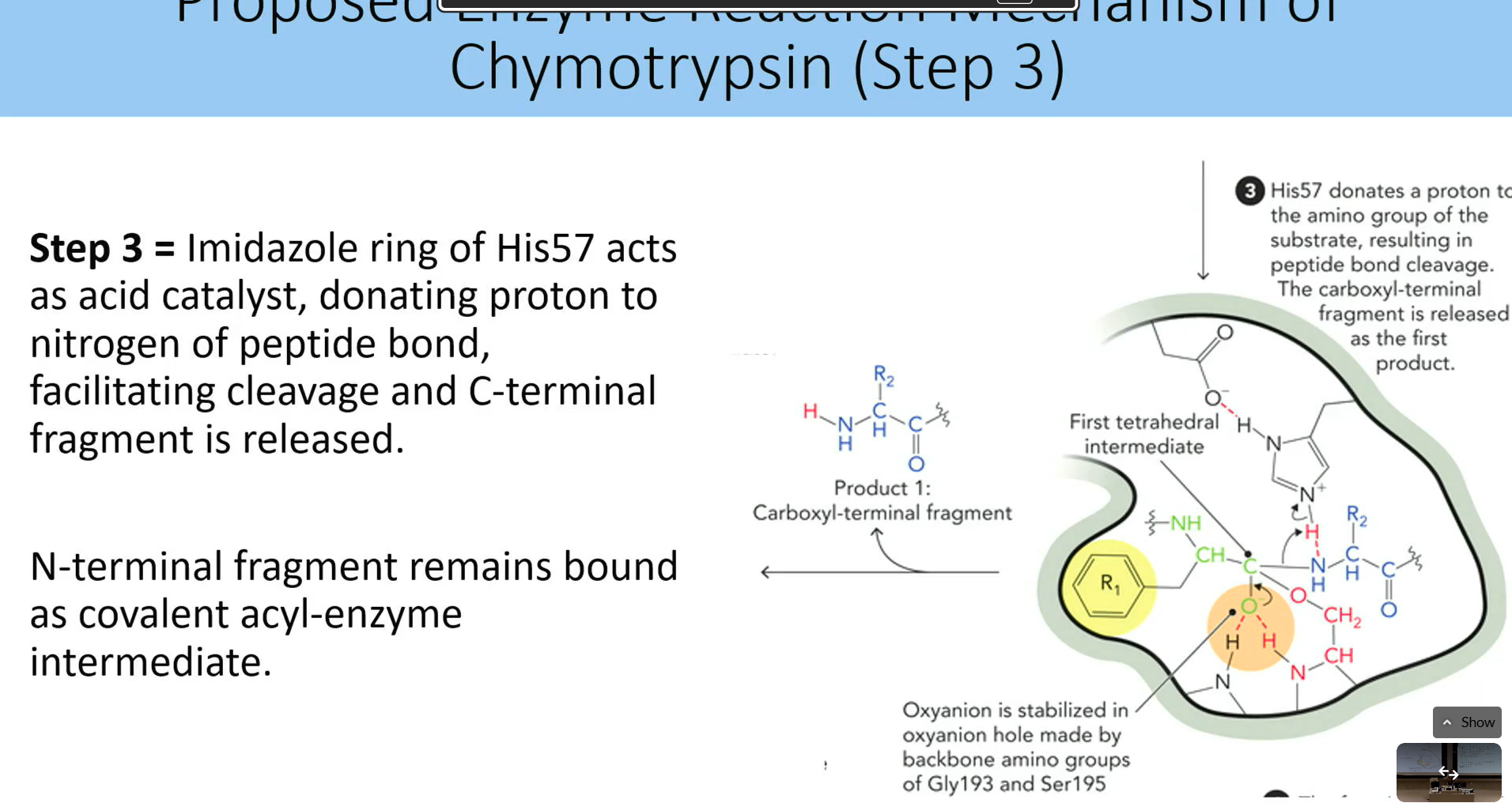
what is step 3 of chymotrypson mechanism
imiidole ring of his57 → acid catalys → donates proton to N of peptide bond → cleaves - > c terminal is released
n terminal frag remains bound as covalent acyl-enzyme intermediate
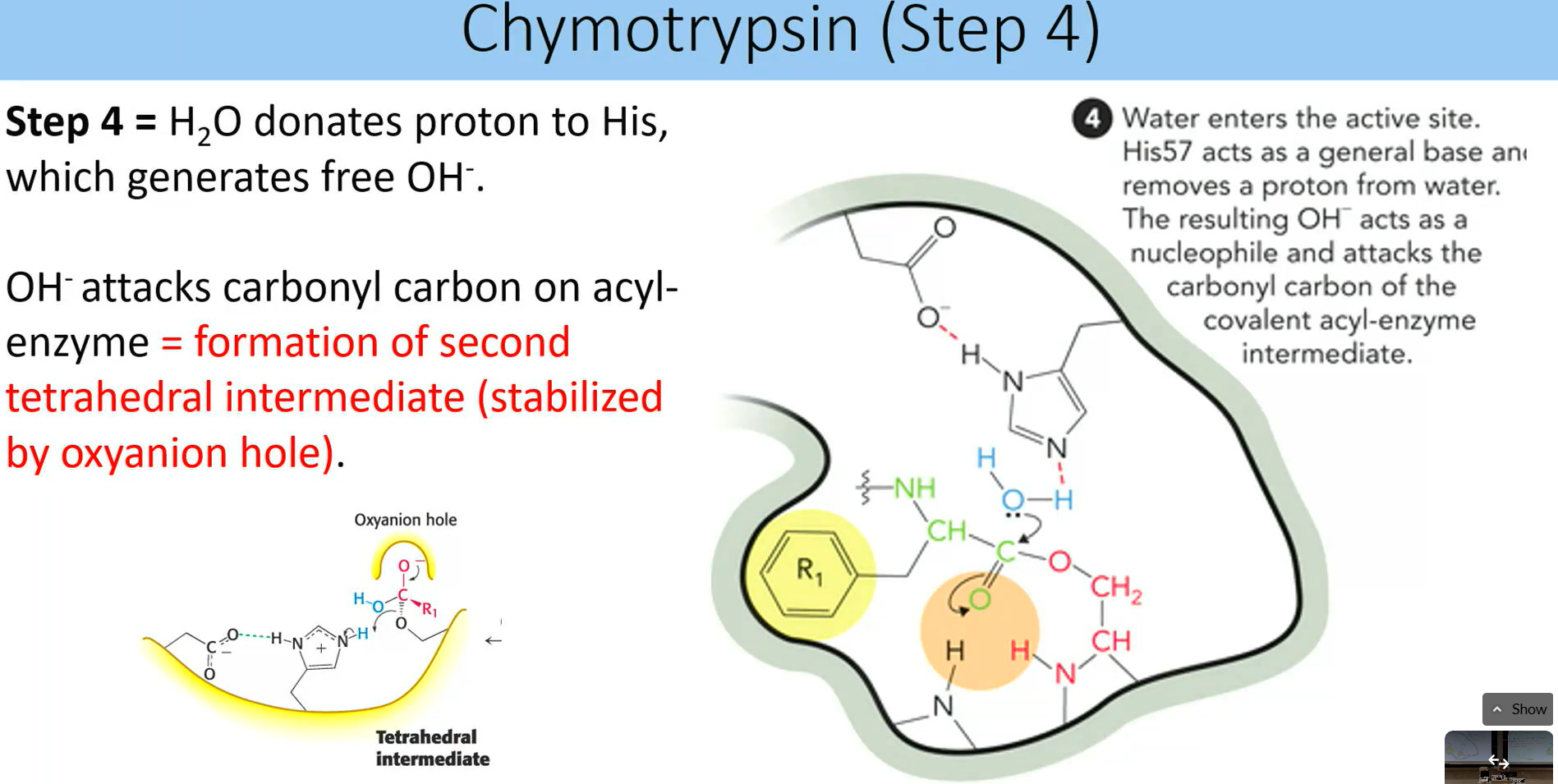
step 4 of cymotrypsin
water donates proton to his → free oh- → attacks carbonyl carbon on acyl-enzyme = forms second tetra intermediate thats stabilitized by oxyanion hole
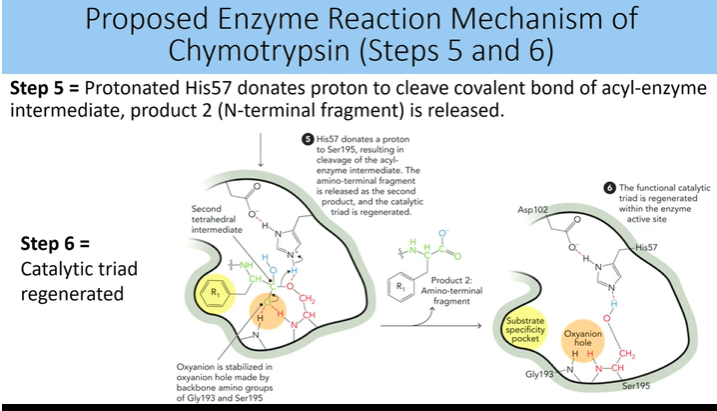
step 5 of chymotrypsin adn step 6
protonated his 57 donates h → cleaves covalent bond of ayl enzyme intermediate, product 2 (n terminal gragment is released
step 6: catalytic triad is regenerated
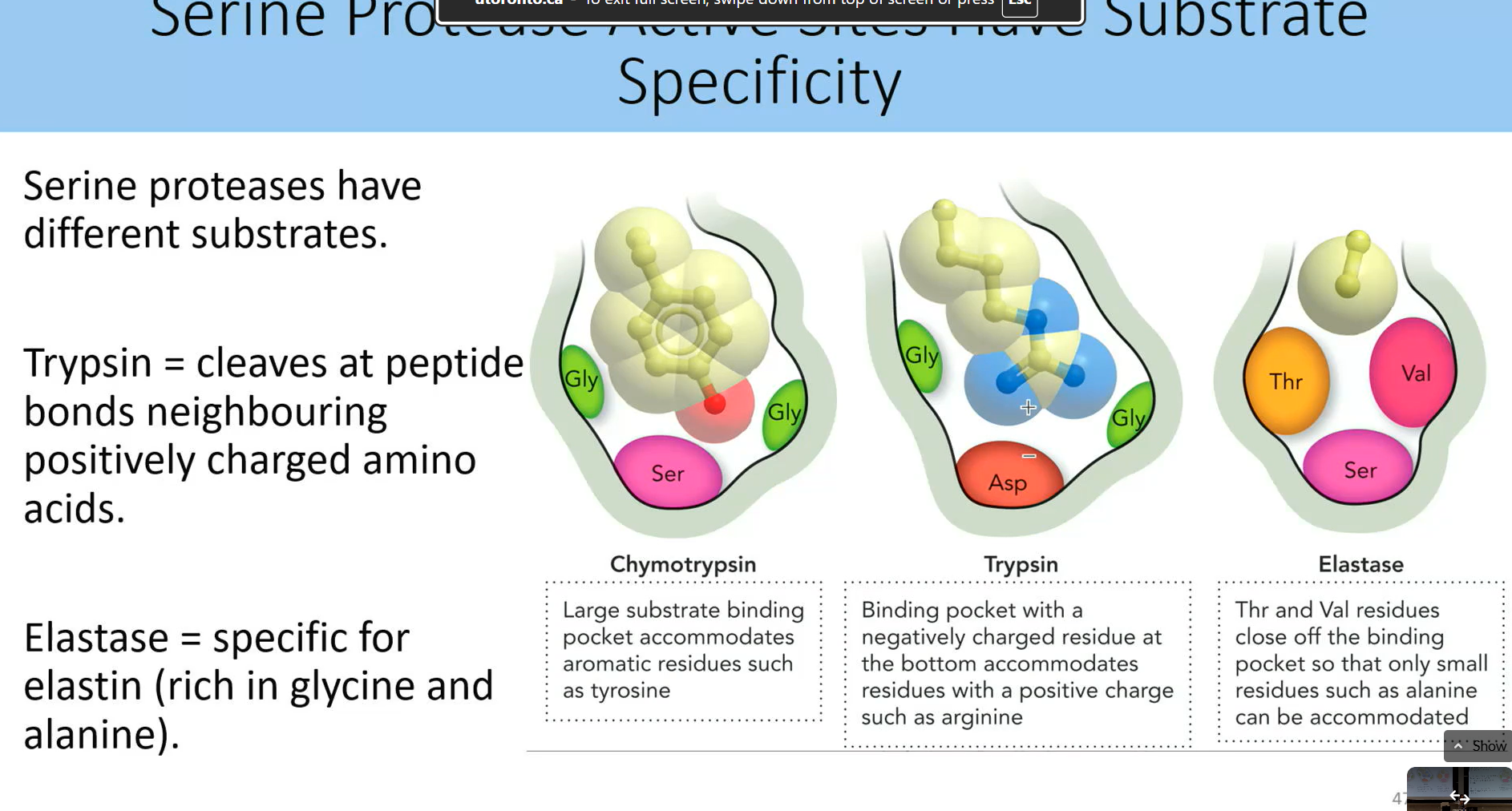
serine proteases have ___ substrates. define two of them
serine proteases have diff substrates hence substrate specificity
typrsin = cleaves at peptide bonds neighbouring postively charged amino acids
elastase = specific for elastin (rich in glycine and alanine)
binding pocket has huge affect on what they bind to
enolase
metalloenzyme that is part of glycolytic pathway, catalyzes dehydration of 2 phosphoglycerate to phopyruvate
two monoers, each have active site that contain two divalent metal ions
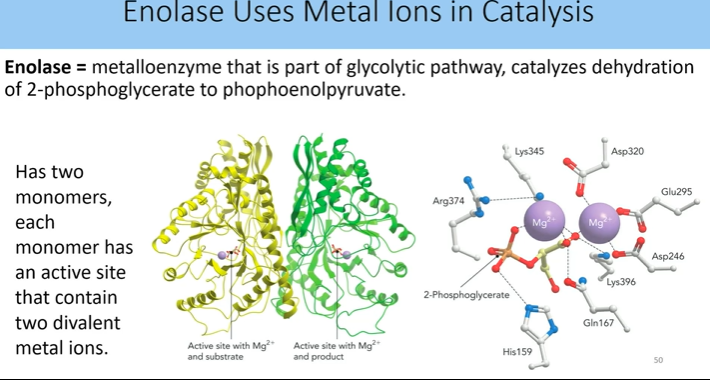
enolaste catalytic strategy: step 1
step 1:
lys345 acts as base to remove proton at C2 of substrate → enolate intermediate
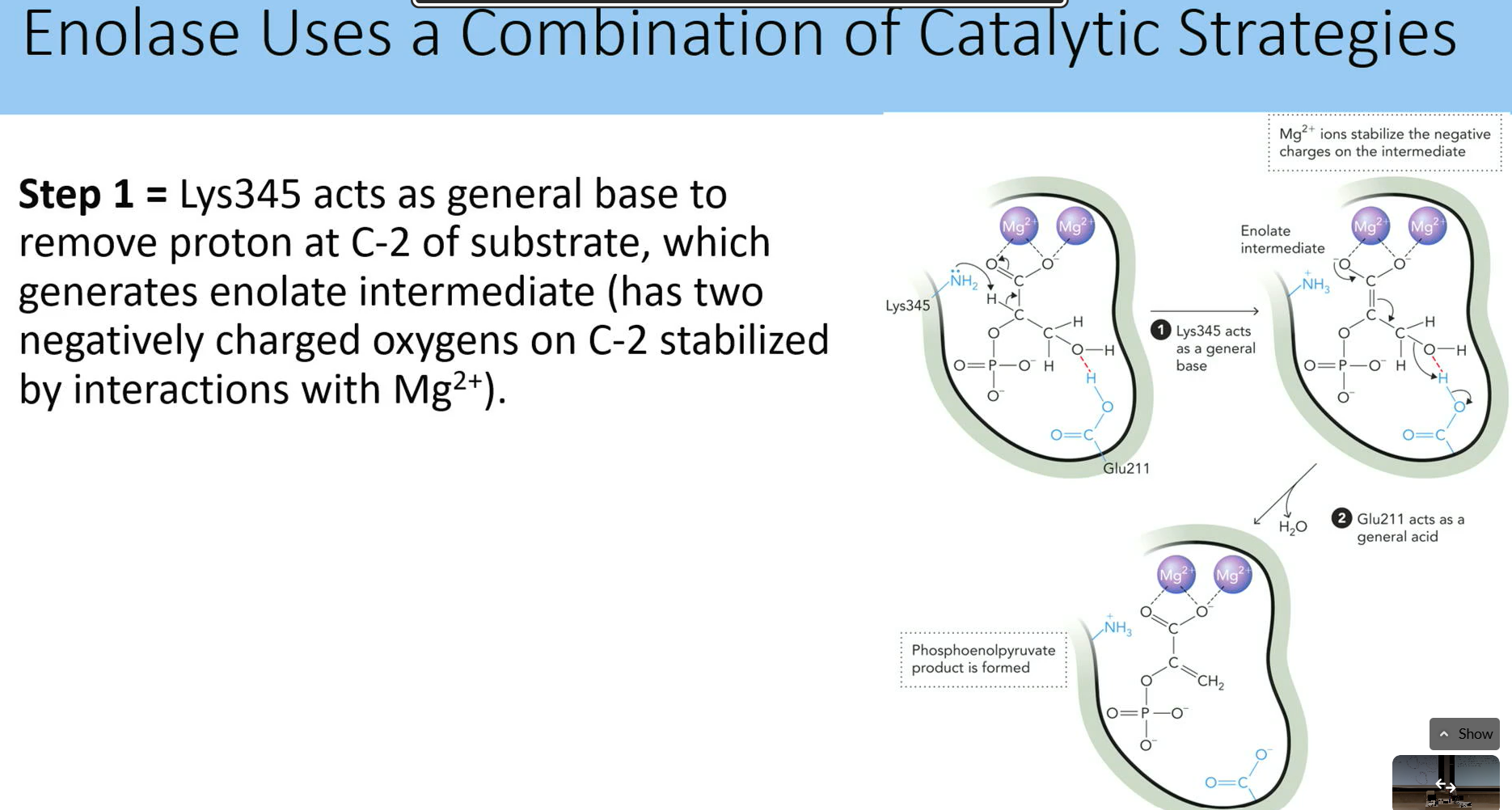
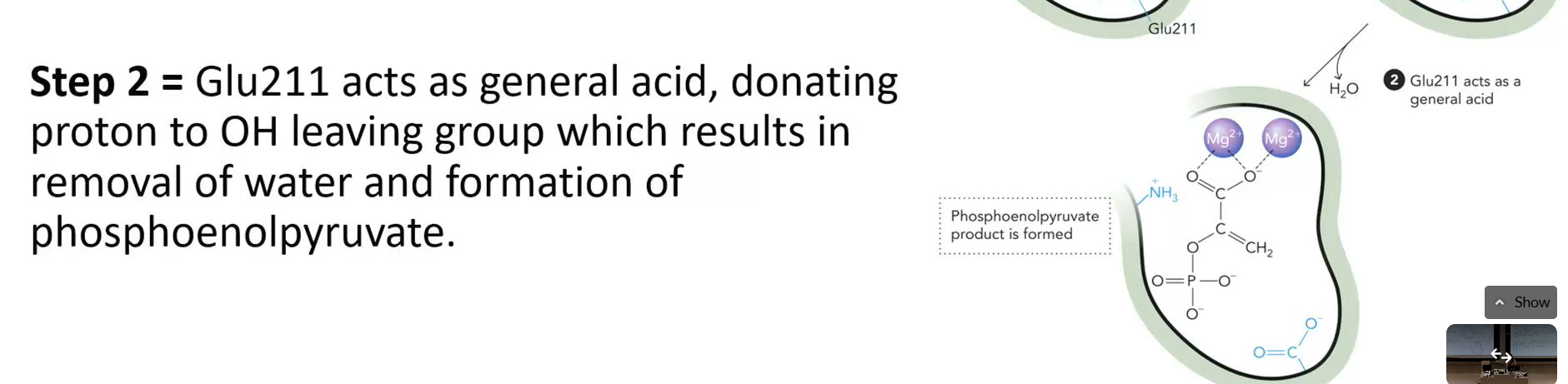
enolaste catalytic strategy: step 2
glu211 acts as general acid, donates H to oh leaving group → -h20 → forms phosphoenolpyruvate
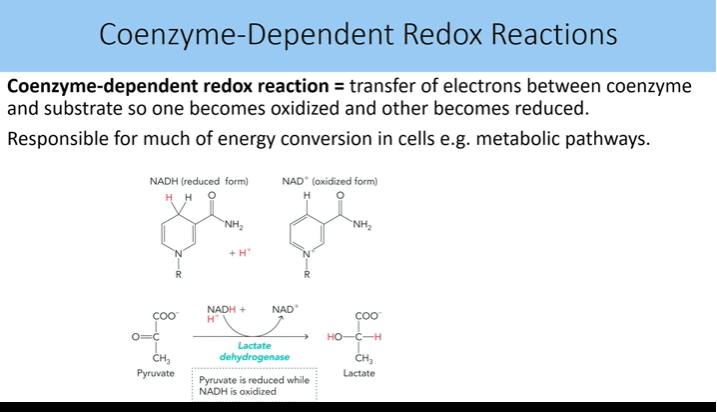
coenzyme dependent redox reactions
transfer of e between coenzyme and substrate so one is ox and other gets red
responsble for muc of energy converion in cells like metabolic pathways
fadh and nadh reactions
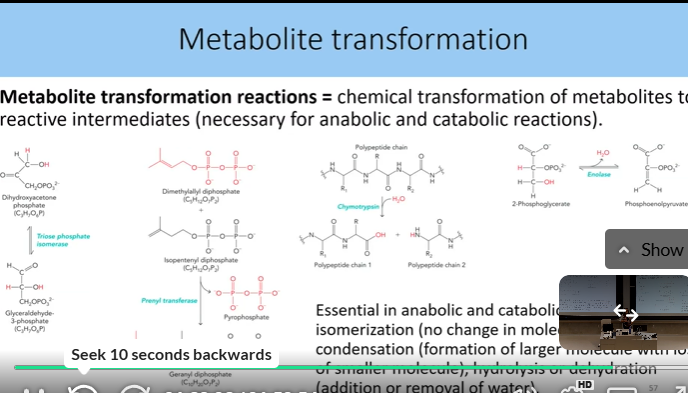
metabolite transofmration reactions
chemical transf of metabolites to reactiove intermediates
needed for anabolic and catabolic pathways like isomeration, condensation, hydrolysis oor dehydration
reversible covalent mod reacitons
atta or removal of molecular tags that control activity
cell signalling or gene expression, phosphorylation or methylation
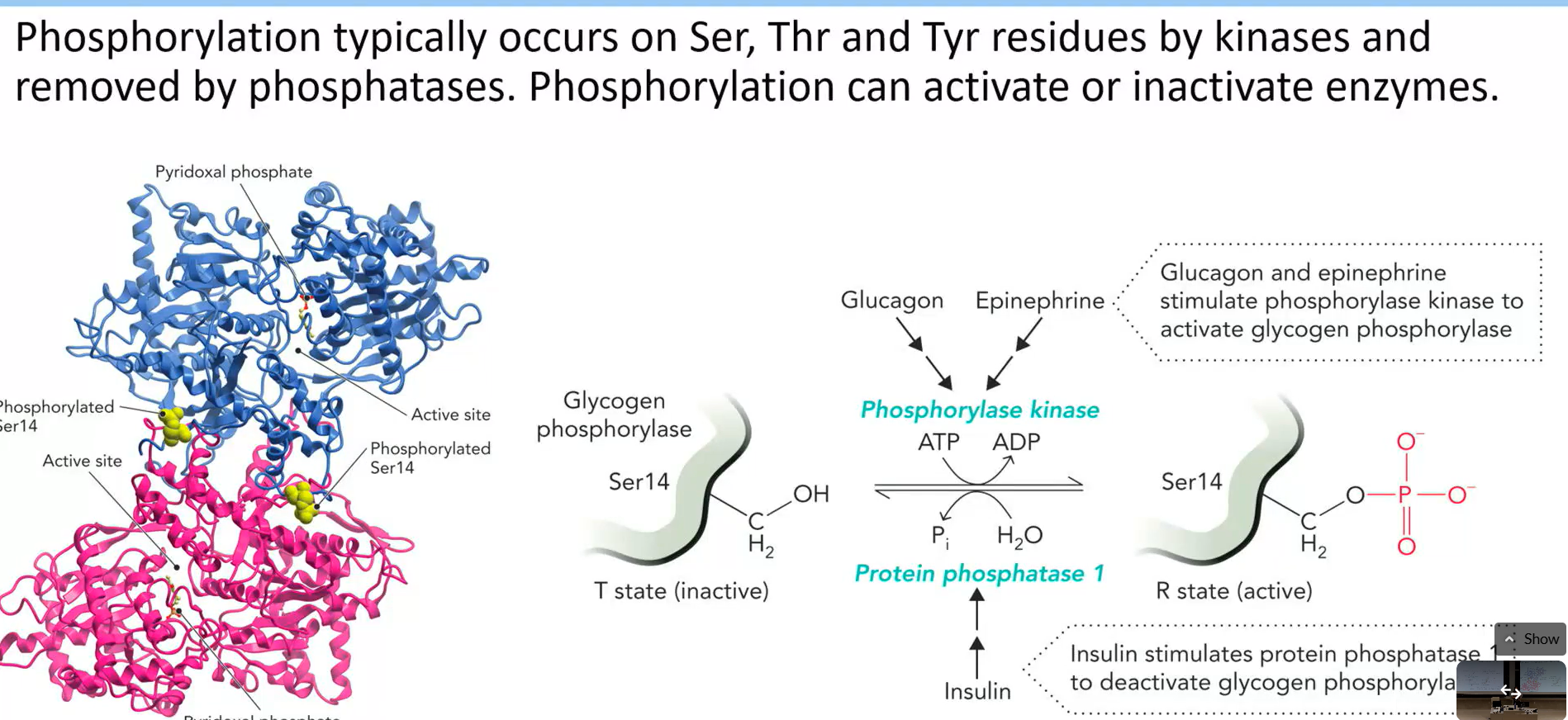
phosphorylation
occurs on ser, thr and try or his sometimes
added by kinase removed by phsophatase
activate or inactivate enzymes
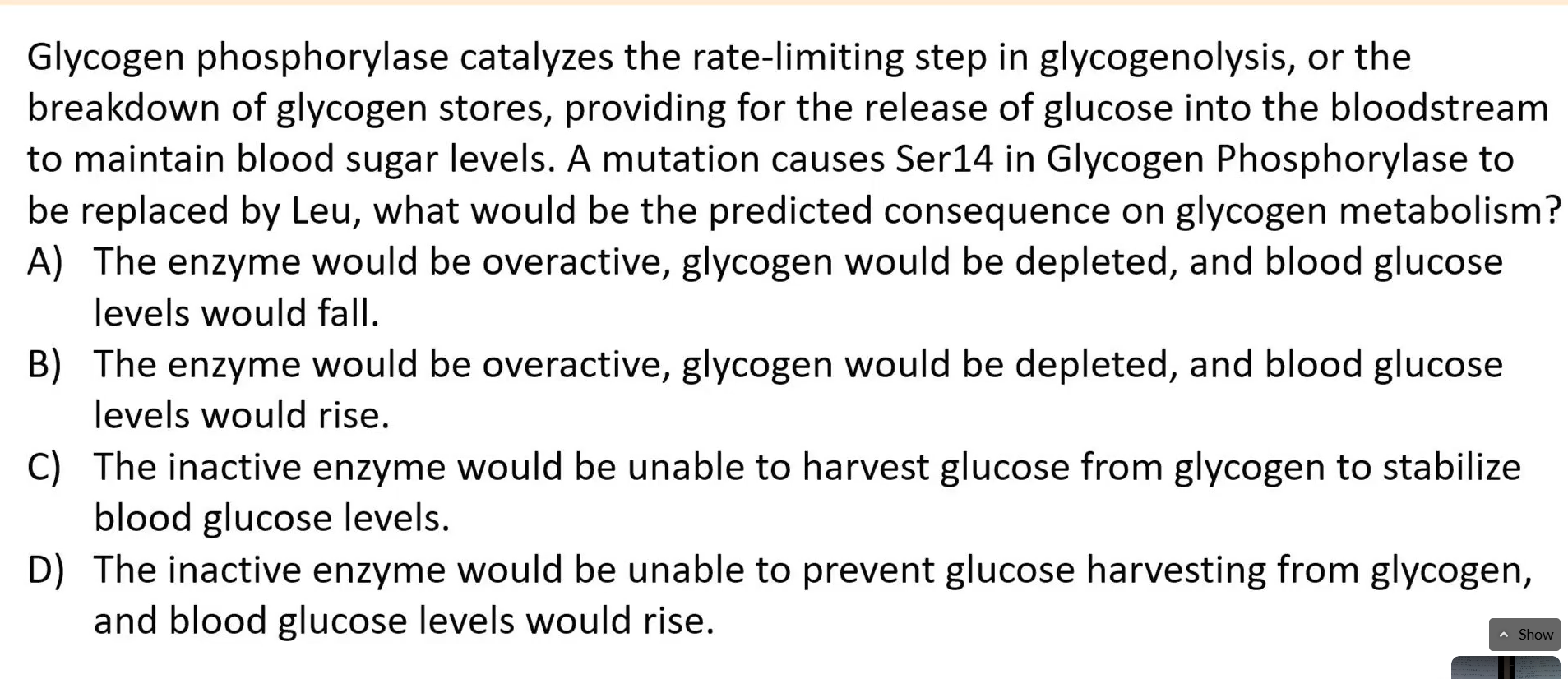
c bc ser can only be phsophorylated and so if it cant be, then it is inactive
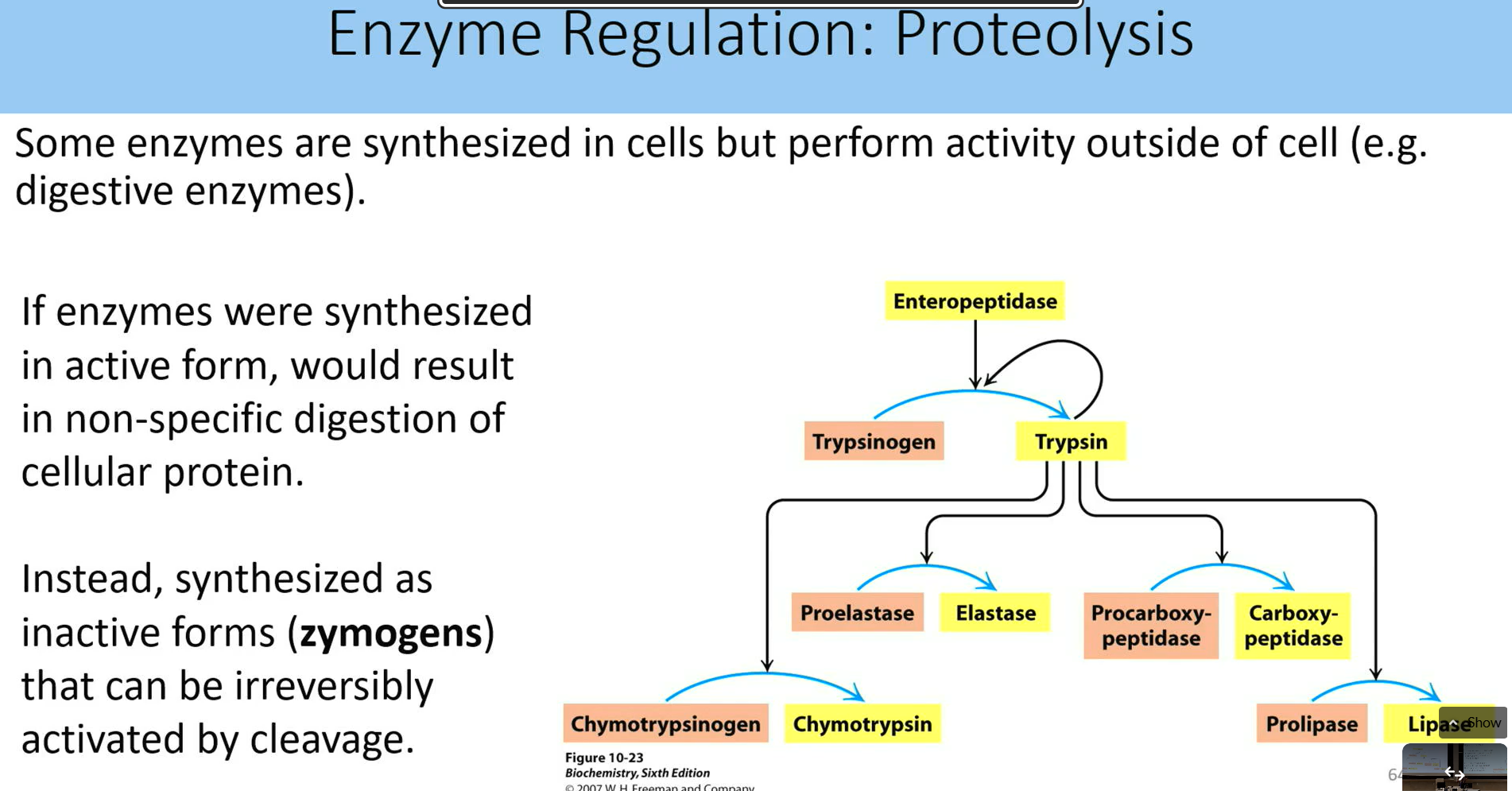
why are enzymes synthesized in inactive form? proteolysis
to prevent non specific digestion of cellular protein
synthesized as inactive forms (zymogens) that can be irreversibly activated by cleavage
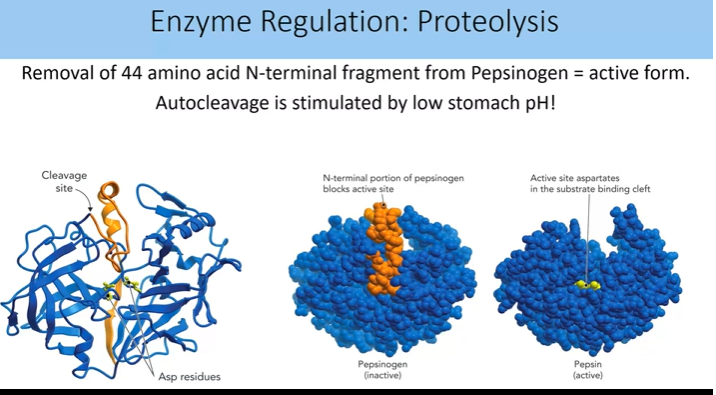
active form of pepsinogen is caused by: and what is autocleaveage stimulated by
celeaving the 44 aa n terminal fragment
autocleavage is stimulated by low stomach pH
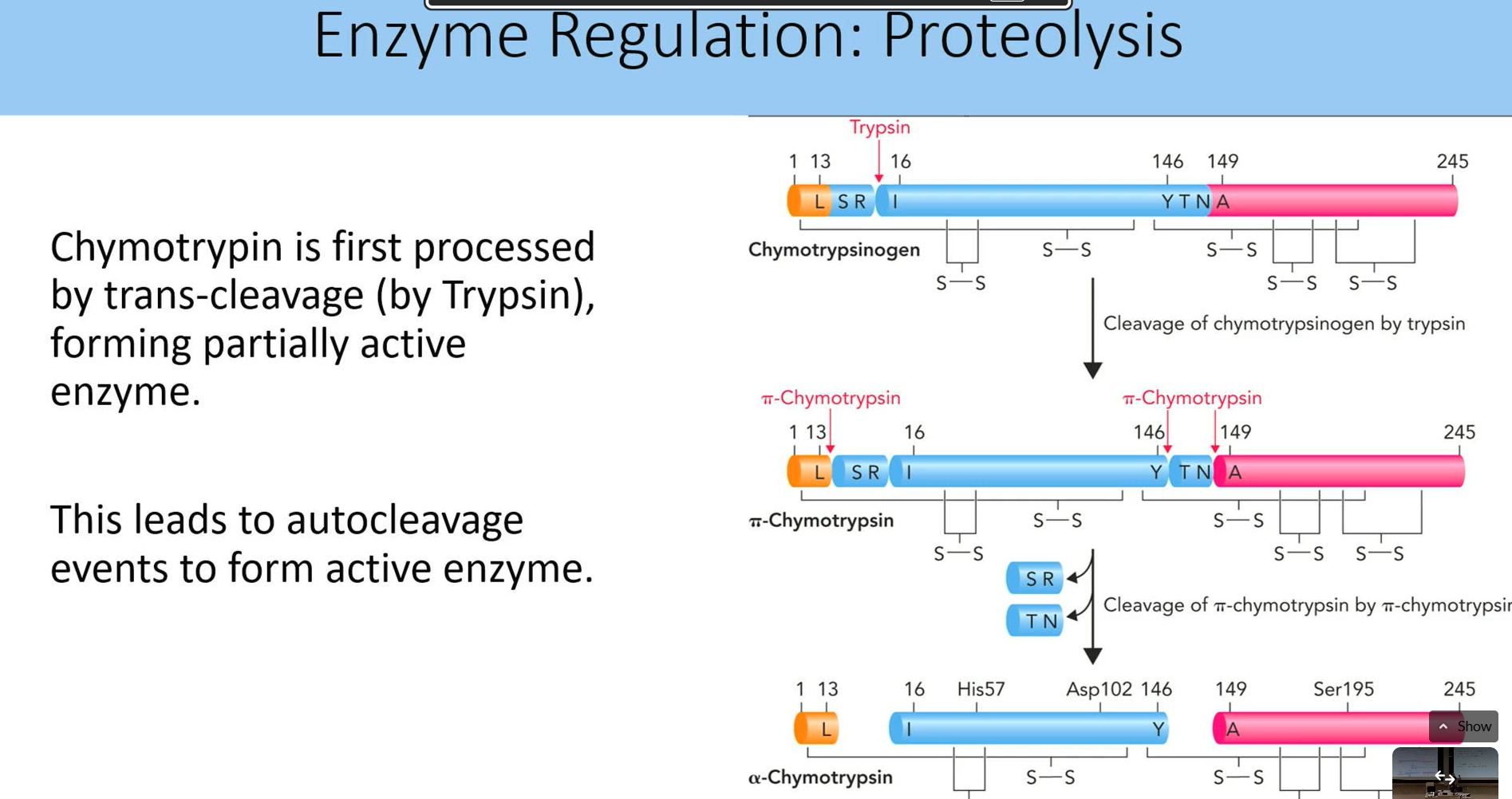
chrymotrypsin is first procesed by what?
trans cleavage by trypsin formting partially active enzyme, leading to autcleavage that fome active enzyme
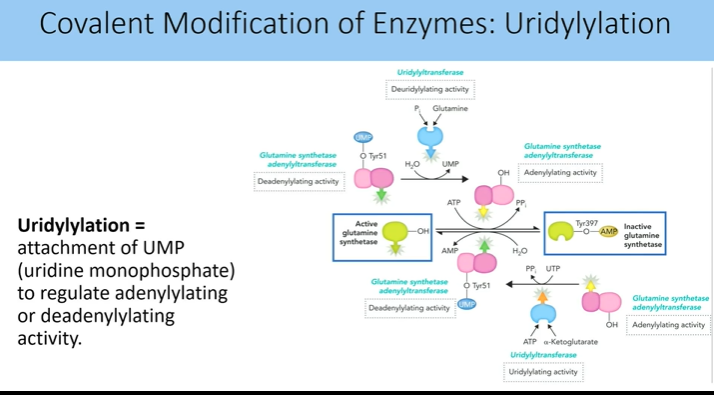
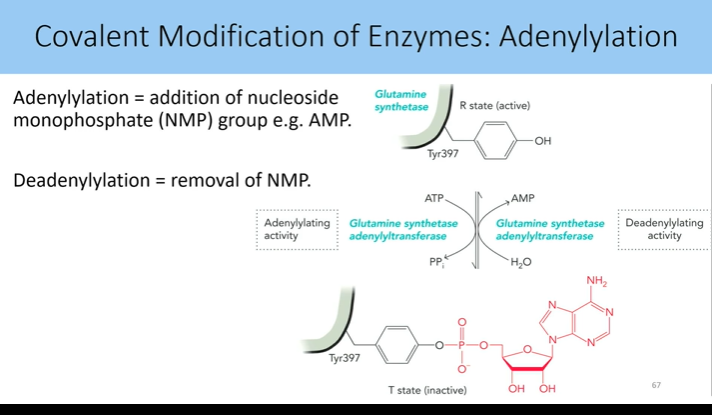
adenylytaion vs deadenlyation
addition of nucleoside monophospate group vs removal of it (like amp)
uridylylation
attached of ump to regulate adenylation or deadylation