Stretchlab, StretchLab Study Guide, MAPS Stretchlab, Mobility Stretchlab , stretchlab 50 min, Block 4 - Stretchlab 50 Minute Sequence, stretchlab course module 1, Block 2 Stretch Lab 50- minute Stretch Sequence, Block 3 Stretch Lab 50- minute Stretch…
 Call Kai
 Learn
Learn Practice Test
 Spaced Repetition
 Match
Match Flashcards
 Knowt Play
1/161

There's no tags or description
Looks like no tags are added yet.
Name | Mastery | Learn | Test | Matching | Spaced | Call with Kai | Chat |
|---|
No analytics yet
Send a link to your students to track their progress
162 Terms
MAPS (stand for)
Mobility, Activation, Posture, Symmetry
PNF (stand for)
Proprioceptive neuromuscular facilitation
4 D approach
Discriminate, describe, detect, direct
PILE- stand for
Physical activity, injuries, lifestyle, emphasis
How many stretches in 50 min routine
26 stretches
When is the massage tool used in 50 min stretch
When there is a tight spot to loosen up in order to get a deeper stretch
Steps to begin the stretch
1. Introduce yourself and ask for client to remove shoes
2. As they put away their belongings, Explain it is an assisted stretch and you will be touching them and holding on to their body (ask permission)
Steps once you start the stretch
1. Ask if they have any injuries, aches, or pain (if yes ask for details to decide if it is safe to continue)
2. Ask if there is a specific body part or muscle group they would like extra attention on
3. Explain the tension scale
Tension scale
1-10 (1 being no tension, 5 being moderate very pleasant tension, 10 quite painful)
What tension level should you have for larger and smaller muscle groups
Larger- 7 to 8 out of 10 (hamstrings, glutes, quads)
smaller- no more than 4 to 5 out of 10 (neck, shoulder, rotator cuff)
How to begin a stretch session
1. Start with mobilization
2. Slowly and gently move client into stretch asking for tension scale number (hold for 10-15 seconds then go into pnf)
Pnf stretching standard procedure
1. Ask client to gently contract muscle for 5-7 seconds (a slow 3,2,1)
2. Then have them release and immediately move them into a deeper stretch
3. Repeat 1 to 4 more times
4. Last round hold for 15 to 20 more seconds then ask client to slowly release and go back to starting position
After stretch prodecure
1. Ask client to take few deep breaths and help them off the bench if needed
2. Offer them water
3. Walk them to the front desk
What to tell the front desk personnel after a stretch with a client
Recap of the stretch-
a. Were there any aches, pains or injuries that you identified?
b. Did you identify any tight spots or restrictions that need attention?
c. Were there any imbalances that could lead to future injury
Making a recommendation for the client after the stretch
For example: To help with "X" (tight spot, imbalance, etc.) I recommend you get a stretch twice a week for the next 4 weeks.
Stretches for the lower back, glutes, hips and hamstrings
1. Lower back and glute stretch: Supine position
2. Straight leg hamstring stretch: Supine position
3. Adductors and medial hamstring stretch: Supine position
4. ITB stretch: Supine position
5. Piriformis and glute stretch: Supine position
6. Adductor and groin stretch: Supine position
Stretches for the core, hips and thigh
1. Lumbar rotation stretch: Supine position
2. Quad stretch: Prone position
3. Hip flexor stretch: Prone position
4. Internal hip rotation: Prone position
5. External hip rotation: Prone position
6. Lower calf stretch: Prone position
Stretches for the chest, shoulders, forearm and wrist
1. Pec minor stretch: Supine position lying on 1⁄2 foam roller
2. Upper traps and neck: Supine position lying on 1⁄2 foam roller
3. Upper pec and chest stretch: Supine position lying on 1⁄2 foam roller
4. Upper body traction: Supine position lying on 1⁄2 foam roller
5. Pec stretch: Supine position
6. Shoulder external rotation: Supine position
7. Shoulder internal rotation: Supine position
8. Wrist extension stretch: Supine position
9. Wrist flexion stretch: Supine position
Stretches for the neck, and upper and lower back
1. Neck traction: Supine position
2. Neck flexion stretch: Supine position
3. Lateral neck stretch: Supine position
4. Neck rotation stretch (Armpit sniff): Supine position
5. Forward flexion back stretch: Sitting position
Dorsiflexion
To point toes towards the sky
Which of the following statements are accurate in regards to stretching?
Stretching can sometimes cause delayed onset muscle soreness (DOMS).
Stretching programs take time to develop.
Which anatomical direction means closer to the center of the body or to the point of attachment of a limb to the body torso?
Proximal
In addition to stretching, additional components of health and wellness include which of the following? (Select 3 that apply.)
Strength and power; Mental and emotional stability; Cardio Vascular Fitness
Which of the following planes divides the body into superior and inferior parts?
Transverse Plan
If we say, "The fingers are distal to the wrist," we mean which of the following?
The fingers are further away from the center of the body.
Choose the correct description of the anatomical position:
The body in standing position, arms at side with palms facing forward
What is it called when a joint has been stretched past its normal range of motion?
Hypertension
The arm moves toward the body in the coronal plane in which of the following movements?
Adduction
Which of the following pairs are considered an agonist and antagonist?
Quadriceps and Hamstring
What is true about the quadratus lumborum?
It causes low back pain when chronically tight.
Soreness that usually accompanies strenuous physical activity is often referred to as:
Delayed onset muscle soreness
Which muscles are in the posterior abdominal wall and help with hip flexion?
Iliopsoas
Most increases in flexibility or range of motion come from which of the following?
The muscle and fascia adapting to external forces
A regular stretching routine can increase:
Coordination
What grows within the muscle in response to being stretched?
Sarcomeres
Which of the following are the major benefits of a regular stretching program? (Select 3 that apply)
Increased range of motion; Improved flexibility Improved freedom of movement
How is the stretch reflex activated? (Select 2 that apply.)
The stretch is pushed too far; The stretch is executed too quickly
What type of nerve receptors are responsible for sensing tension (length or stretch)? (Select 2 that apply.)
Golgi tendon organs; Muscle spindles
What role do synergists play in muscle movement?
Prevent unwanted movement.
What are the two types of flexibilty?
Dynamic and Static
Which views of the Overhead squat are detailed in the pre-work? (Select all that apply)
Anterior
Lateral
________________ muscles are lengthened muscles and are generally lacking neuromuscular drive.
Underactive
What compensations are best viewed in the anterior view when assessing the overhead squat? (Select all that apply)
Foot pronation
Knee valgus
Once you have identified the movement patterns, the long term goal becomes ______________.
Addressing each compensatory movement with the proper stretching solution.
What instructions provide correct coaching for the overhead squat? (Select all that apply)
Arms are fully extended above their head If the client has never completed an OHS, tell them to complete the same motion as sitting in a chair.
How deep they squat should be to their comfortability and capability.
What are key variables to movement as discussed in the video? (Choose 5 that apply)
Cardiovascular Health
Muscular Strength
Muscular Power
Muscular Endurance
Genetic Abnormalities
Flexibility
Body Composition
There is no video with this information
When do you use MAPS with an individual?
Before the session with a prospect.
After the last session of the month with a member.
What is a reason a client's scores could have decreased even if you feel they have been improving on the bench? (Choose all that apply)
Change in lifestyle since the last test session (underactive, additional stressors)
A very recent workout or activity that has induced soreness
An increase in mobility that has lead to a decrease in motor control (activation)
How does MAPS help you as a Flexologist? (Choose all the apply)
To heighten member experience, through educating individuals about their body and how it relates to assisted stretching.
By validating your expertise to the client in a visual and objective manner.
By identifying "areas of opportunity" in the client which will allow you to create a customized plan to address.
By objectively tracking progress or the lack thereof.
By helping you build and maintain your book of business.
To heighten member experience, through educating individuals about their body and how it relates to assisted stretching.
By validating your expertise to the client in a visual and objective manner.
By identifying "areas of opportunity" in the client which will allow you to create a customized plan to address.
By objectively tracking progress or the lack thereof.
By helping you build and maintain your book of business.
Lighting in the studio, the bagginess of the client's clothes, how close the client is to the kiosk and objects in the background of the client, can affect the machine's capability to deliver a MAPS score?
True
What does Mobility infer from the client?
Mobility interprets the overall range of motion in key joints during the 3 OHS. Target areas include: ankles, knees, hips, shoulders and elbows
What is the 4-D approach recommended when delivering and discussing a MAPS session as discussed in the video?
Discriminate, Describe, Detect and Direct
If a score is not generated when testing a client, what should you do? (Choose all that apply)
Try to identify and correct the source of the issue (ie client's clothing, distance from kiosk, client positioning, lighting etc.) then retest if possible.
If the issue can not be resolved at the time of testing. Then continue with moving on to the stretch and let the client know they will receive testing next time they come in.
Notify management of the issue so they can reach out to TRX support.
What are the four checkpoints that need to be achieved to start a MAPS screening according to the video?
Stand on the floor mark, feet shoulder width apart, square up your shoulders, extend arms to the ceiling
According to the video from TRX, activation in relation to the MAPS machine reporting refers to how strong or active the muscle is?
False
Mobility
Range of motion in a OHS
Ankle
Lit up=lack of ankle dorsiflexion
Can cause; decrease squat depth, increase knee load
Knee
At the bottom of the squat measures angle of knee flexion
Thigh
Lit up: squat depth limited
How close to the ground does one go
Hip
Lit up: decrease hip flexion
Hip mobility=support of spine
Elbow
Lit up: Assesses elbow flexion angle
People compensate for poor shoulder mobility by overusing elbow and upper body
Shoulder
Measures shoulder mobility
Specifically; arm lift compared to torso angle during a squat
High score = + rom
Low score = - rom
what is the first thing you need to get from the client in order to perform the 50 min stretch?
consent to touch
what side should you start with when stretching clients?
right side
how many stretching blocks are there?
4
what should you do before you begin the stretch
mobilize and provide traction
what is the ratio of stretch- contract- hold for one round of PNF?
10-5-20
What does PNF mean
Propioceptive Neuromuscular Facilitation
1st block of stretching
knee to chest- lumbar and glute
Straight leg raise- hamstrings
ADD- leg to side
ITB- leg crossed over body
Piriformis
*repeat on other side
Groin --> rock side to side post stretch
2nd block of stretching
lumbar twist
quad (hand on lumbar to stabilize)
HF (Hand at hamy and glute groove)
IR (hand at opp hip)
ER (hand on thigh to stabilize)
soleus
3rd block
USE FOAM ROLLER TO START
Pec Minor
Traps
full Chest- hands behind head and interlinked
traction
REMOVE FOAM ROLLER
Pec major ( bend legs to side and can bend elbow to decrease tingling)
shoulder ER (straighten legs out)
shoulder IR (use interlocking arms)
Wrist extension
Wrist Flexion
4th block
cervical Traction (c pattern)
Chin to chest (meet them where they are)
lateral flexion
rotation
full back forward fold
PILE stands for what?
Physical activity
injuries
lifestyle
emphasis- what they came in for today
What should you mention to a new client during their stretch?
1st get consent to assist with stretches
2nd mention time of stretch they will get
3rd explain tension scale (0 is nothing and 10 is pain)
4) communicate through session level of stretch
5) recommendations
What does FLEX stand for?
Flexibility- MAPS assessment
Listen- as questions while stretching them
Educate
X (execute) recommendation / X+ sell
what is tension?
tension is not pain
discomfort but not pain
what type of breathing do we want during a stretch
diaphragmatic
foundation phase
first month
1-2 PNF
3-6 tension
focus on global structures
Active Phase
2nd month
2-3 PNF
4-7 tension
focus on local structures
Performance Phase
evergreen
2-4 PNF
5-8 tension
maintain and mirco adjustments for continued progress
PNF for small muscles
2-4/ 10 tension
PNF for large muscles
5-7/ 10 tension
Neck traction: Supine position
Muscles being stretched
Muscles being stretched
1. Primary muscles - semispinalis capitis and cervicis; spinalis capitis and cervicis; longissimus capitis and cervicis; splenius capitis and cervicis.
2. Secondary muscles - levator scapulae; trapezius; rhomboids.
Instructions
1. Have the client lie supine with legs straight and arms resting on the stomach.
2. Then place either your interlocked hands or a towel under the base of their skull.
3. Then gently pull head horizontally (and
slightly upward) away from their shoulders and body.
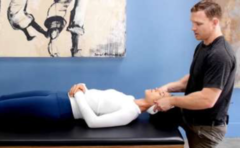
Neck flexion stretch: Supine position
Muscles being stretched
Primary muscles - semispinalis capitis and cervicis; spinalis capitis and cervicis; longissimus capitis and cervicis; splenius capitis and cervicis.
Secondary muscles - levator scapulae; trapezius; rhomboids.
Instructions
*Have client lie supine with legs straight and arms resting on stomach.
*Either stand or kneel behind the client and then interlock your hands under the base of their skull.
*Have client tuck their chin in towards their chest (ALWAYS TUCK CHIN FIRST).
*Then gently lift their head and move their chin towards chest.
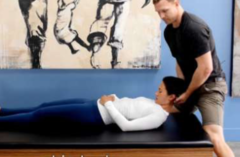
Lateral neck stretch: Supine position
Muscles being stretched
Primary muscles - levator scapulae; trapezius.
Secondary muscles - sternocleidomastoideus; scalenus anterior, medius and posterior.
Instructions
*Have client lie supine with legs straight and hands resting on the stomach.
*Have client raise their head off the bench, then place your hand underneath the client's neck supporting their head.
*Place your other hand on their shoulder and gently push their shoulder horizontally towards their feet. Stabilize the client's shoulder in this position before starting the neck stretch (ALWAYS STABILIZE FIRST).
*Then gently move the client's head laterally away from their shoulder.
*Warning: The small muscles of the neck can be easily damaged by applying too much force too quickly during this stretch. Apply force gently and very gradually, and ask for feedback from the client during this stretch.
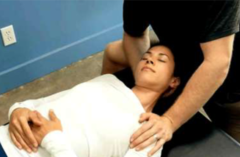
4. Neck rotation stretch (chin down towards shoulder): Supine position
Muscles being stretched
Primary muscles - levator scapulae; trapezius; rhomboids.
Secondary muscles - semispinalis capitis and cervicis; spinalis capitis and cervicis; longissimus capitis
and cervicis; splenius capitis and cervicis.
Instructions
*Have client lie supine with legs straight and hands resting on the stomach.
*Sit beside the client's head and have the client raise their head off the bench.
*Place your hand underneath the client's neck supporting their head.
Then turn their head towards you and rest their head on your thigh.
*Place your other hand on their shoulder and gently push their shoulder down and away from their head. Stabilize the client's shoulder in this position before starting the neck stretch (ALWAYS STABILIZE FIRST).
*Then gently rotate the client's head towards their opposite shoulder/armpit by slowly leaning backward.
Warning: The small muscles of the neck can be easily damaged by applying too much force too quickly during this stretch. Apply force gently and very gradually, and ask for feedback from the client during this stretch.
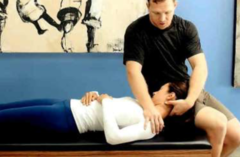
Now move to the other side of bench and work through the same stretch on the other side of the client's body.
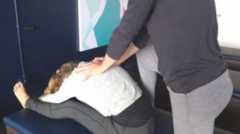
5. Forward flexion back stretch: Sitting position
Muscles being stretched
Primary muscles - semispinalis cervicis and thoracis; spinalis cervicis and thoracis; longissimus cervicis and thoracis; splenius cervicis; iliocostalis cervicis and thoracis.
Secondary muscles - interspinales; rotators; semimembranosus; semitendinosis; biceps femoris; gastrocnemius.
Instructions
Stand on the ground at the end of the bench behind the client.
Move the client to the end of the bench (facing away from you) and have them sit on the bench with both legs straight out in front and feet about shoulder width apart.
Make sure client's feet are pointing upward, not falling to the side.
If the client struggles to get into forward flexion, have the client bend their knees slightly (upward, not out to the side).
Start the stretch by having the client move their chin towards their chest and then slump forward letting their head and shoulders fall towards their knees (ALWAYS TUCK CHIN FIRST).
Move one foot in front of the other for stability and leverage, and place your hands on the client's shoulder blades.
Activate your core, keep your back straight and lockout your arms.
Using your body weight, lean forward and gently apply forward and downward pressure, pushing the
client's chest towards their knees and feet.
what are components of health?
-stretching
-cardio vascular fitness
-strength & power
-balance & agility
-diet & nutrition
-mental & emotional stability
every muscle group in the body has an opposing muscle group which are?
agonist & antagonist (ex. quads and hammys)
why is stretching full body a bad idea?
creates an imbalance
what is the standard body position called?
anatomical position
anterior
in front of; toward or at the front of the body
Posterior
behind; toward or at the backside of the body
superior
above; toward the head or upper part of the structure or the body
inferior
below; away from the head or toward lower part of a structure or body
medial
toward midline of body; or inner part of structure or body
lateral
away from midline; or outer side of body or limb
proximal
closer to center of body (navel), or from the point of attachment of limb to torso
distal
further from center of body; or from point of attachment of a limb to torso