Solutions
 Call Kai
 Learn
Learn Practice Test
 Spaced Repetition
 Match
Match Flashcards
 Knowt Play
1/36

There's no tags or description
Looks like no tags are added yet.
Name | Mastery | Learn | Test | Matching | Spaced | Call with Kai | Chat |
|---|
No analytics yet
Send a link to your students to track their progress
37 Terms
Heterogeneous mixture
A non-uniform mix with visibly separate parts.
Homogeneous mixture (Solution)
A uniform mixture with evenly distributed components.
What is a solvent?
The substance that dissolves another.
Largest in concentrations.
What is a solute?
The substance being dissolved.
Dispersed at lower concentrations.
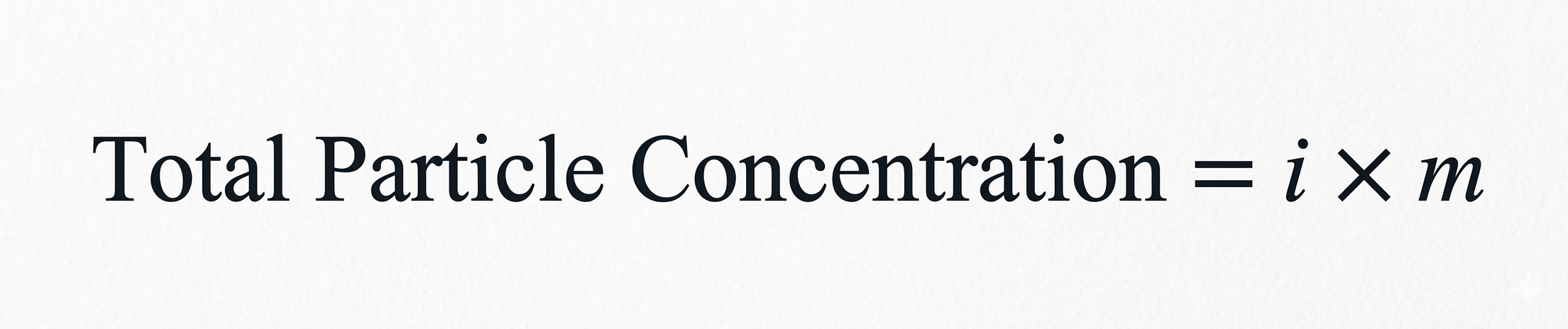
Particle concentration calculation …
What is dissolution?
The process of a solute dissolving into a solvent to form a solution.
Breaking solute-solute and solvent-solvent attractions …
H > 0
Always endothermic
Breaking solute-solvent attractions …
H < 0
Always exothermic
What is Hess’ Law for total enthalpy?
Total enthalpy change equals the sum of its individual step reactions.
Endothermic conditions
Old attractions are stronger than new attractions
Reactant bonds are stronger than the product bonds
Solute-solute and solvent-solvent attractions are strongest
Exothermic dissolution
New attractions are stronger than old attractions
Product bonds are stronger than the reactant bonds
Solute-solvent attractions are strongest
What is a weak electrolyte?
Ionizes only partially in solution.
Conducts electricity poorly.
What is a strong electrolyte?
Dissociates completely into ions.
Conducts electricity effectively
What is a nonelectrolyte?
A substance that does not form ions when dissolved.
Dissolves entirely as intact molecules.
Does not conduct electricity.
Polar-polar / nonpolar-nonpolar mixtures are …
Miscible (mix)
Polar-nonpolar mixtures are …
Immiscible (do not mix)
What is an unsaturated solution?
Holds less than maximum equilibrium capacity.
What is a saturated solution?
Holds maximum stable solute concentration.
What is a supersaturated solution?
A solution holding more dissolved solute than normal maximum at that temperature.
Highly unstable.
“Like Dissolves Like”
Similar intermolecular forces mix.
What do you identify an electrolyte?
Salts and strong acids dissociate fully.
Temperature v. gas solubility
T increase then S decrease
T decrease then S increase
Pressure v. gas solubility
P increases then S increases
P decreases then S decreases
Henry’s law formula (solubility)
S = (kH)(P)
Henry’s law formula (concentration)
Cg = (k)(Pg)
What is a mole fraction (X)?
Moles of compound / total moles
Molality (m)
Molsolute / Kgsolvent
Colligative Properties
Depends strictly on particle count.
More electrolytes or particles increase the effects
Vapor Pressure Lowering
Psolution = (Xsolvent)(Psolvent)
Electrolytes or particles increase then vapor pressure decrease.
Boiling Point Elevation
ΔTb = (i)(Kb)(m)
Electrolytes or particles increase then boiling point increase.
Freezing Point Depression
ΔTf = (i)(Kf)(m)
Electrolytes or particles increase then freezing point decrease.
Osmotic Pressure
π = (i)(M)(R)(T)
R = 0.08206
Electrolytes or particles increase then osmotic pressure increase.
Ideal van 't Hoff (i) calculation …
Total number of moles in product (add coefficients).
Osmosis Flow
Solvent moves toward higher solute concentration.
Isotonic
Equal osmotic pressure with no net movement.
Hypotonic
Lower concentration; solvent leaves the solution.
Hypertonic
Higher concentration; solvent enters the solution.