Advanced Molecular Cell Biology - Lecture 25
 Call Kai
 Learn
Learn Practice Test
 Spaced Repetition
 Match
Match Flashcards
 Knowt Play
1/38

There's no tags or description
Looks like no tags are added yet.
Name | Mastery | Learn | Test | Matching | Spaced | Call with Kai | Chat |
|---|
No analytics yet
Send a link to your students to track their progress
39 Terms
antibodies are a.k.a?
immunoglobulins (or Ig)
Describe the basic structure of B-cells:
consists of two antigen-binding sites and consists of two light and two heavy chains
what are the 5 classes of antibodies?
IgG, IgM, IgA, IgD and IgE
What distinguishes the 5 classes of antibodies from each other?
Each has its own heavy chain, each has a different hinge and tail structure, giving unique characteristics, different half-lives, and functions
Give an example of the sub-classes of antibodies?
IgG1, IgG2, IgG3, IgG4
what does the basic structure of antibodies consist of?
2 antigen-binding sites
how do B-cells work?
Normally at rest but has antibodies or immunoglobulins presented on its plasma membrane surface.
If an antigen binds to the variable domain, it would stimulate the cell to proliferate and differentiate
leading to the production of effector B cells
what are IgMs?
IgMs are the first class of antibody that a developing B cell makes and the major class secreted into the blood on first exposure to an antigen.
describe the structure of IgMs:
IgM is a pentamer composed of five four-chain units, giving it a total of 10 antigen-binding sites.
what happens when antigens with multiple identical antigens bind to IgM?
When an antigen contains multiple identical binding sites and binds to IgM it alters the structure of the pentamer, allowing it to activate the complement system or lock them so that they don’t float about and infect other cells
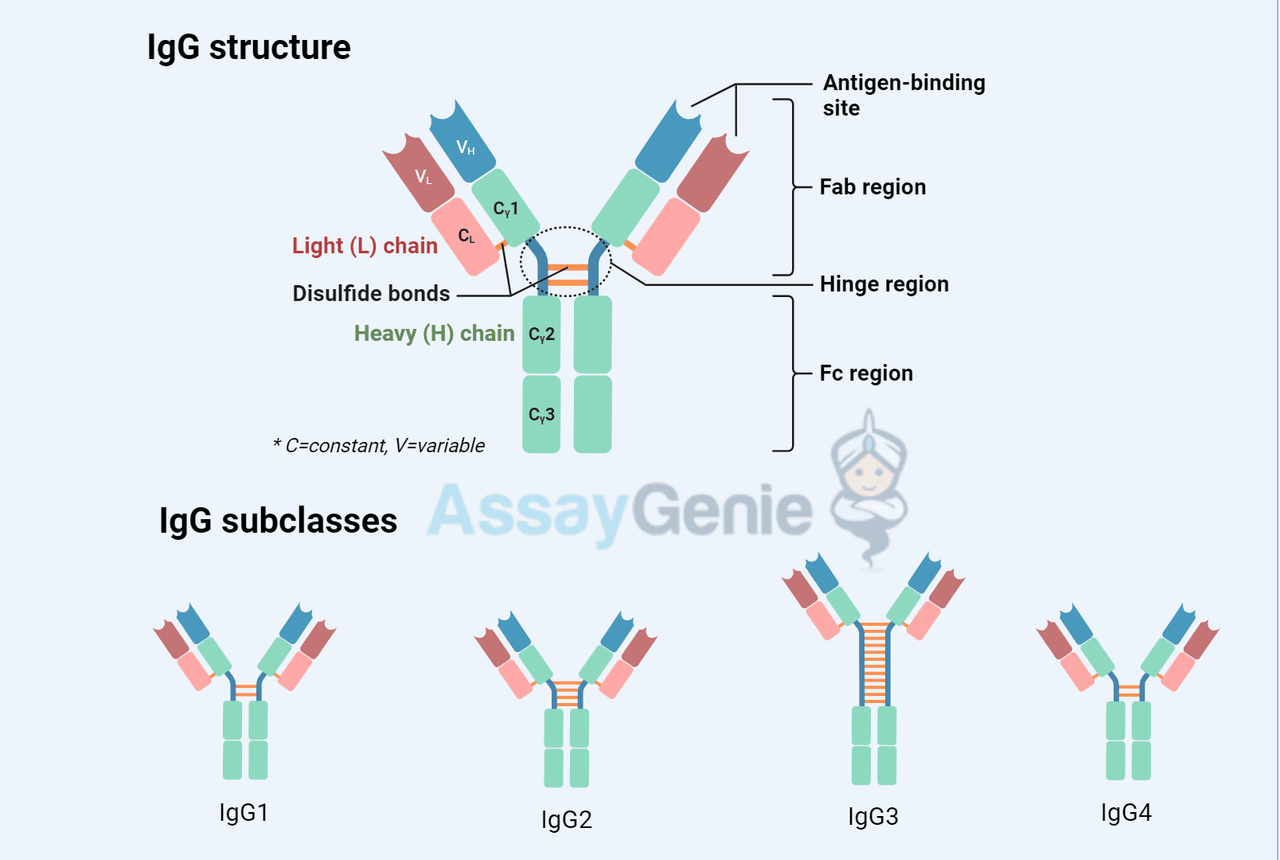
describe the structure of IgGs:
made up of two copies of two proteins (4 in total) linked by covalent disulfide bonds: 2x Heavy chains (around 440aa) and 2x Light chains (around 220aa)
each chain consists of variable and constant domains
constant domains interact with other parts of the immune system (eg., innate immune & complement systems)
variable domains make up the antigen-binding sites
both light & heavy chains are made up of repeating 110aa domains as Immunoglobulin domains, each of which contains an internal disulfide bond.
(Likely to be the result of gene duplications during evolution)
Antigen-binding region consists of two variable domains made up of a single modified Ig domain and containing three hypervariable regions
How many hypervariable regions are within the overall variable domain?
3 (3 on the light and 3 on the heavy chain come together to form the antigen-binding domain)
The 3D structure of the hypervariable domains varies following in vivo evolution that selects the ____ structure to best _______ with the antigen
best, interact
the Ig domains that make up the constant part of the heavy chain are encoded by?
a single exon
A naive, unchallenged human immune system can generate around how many different antibody molecules (a primary antibody repertoire)?
1×10^12
A mature immune system can make antibodies able to bind any antigen; therefore, it is?
essentially infinitely flexible
How is a mature immune system able to make antibodies able to bind any antigen when the entire genome only encodes 25k genes?
In the germline, a k-light chain gene variable domain contains 40x V domains (exons), 5x J domains and a single C domain
and a heavy chain gene variable domain contains 40x V domains, 25x D domains, 6x J domains and 5x C domains
In developing B-cells, the V, C, and J domains are recombined in a process called what?
VJ or V(D)J recombination
Developing B cells join together separate gene segments of DNA in order to?
Create the genes that encode the primary repertoire of low-affinity antibodies.
during the development of a B cell, a coding sequence joining a V to a J segment is assembled by?
removing the intervening genomic DNA
Transcription starts immediately upstream of the
fused V segment, which lies immediately upstream of a J region. What happens to extra J segments?
Extra downstream J segments are transcribed but edited out of the mRNA transcript via RNA splicing
After RNA splicing of the mRNA transcript of the light chain, what happens?
translation, to form the light chain protein
describe the process of V(D)J recombination:
The process of V(D)J recombination joins separate antibody gene segments together
This forms a functional VL or VH-region coding sequence
DNA splicing is driven by the V(D)J recombinase enzyme (encoded by RAG1 & RAG2 genes)
During joining of gene segments, a variable number of nucleotides are often lost or inserted from the ends of the recombining gene segments.
This is called junctional diversification.
Developing B & T-cells are diploid (one maternal & one paternal copy) but choose just one allele to recombine (this is known as allelic exclusion)
RAG1 and RAG2 mutants have?
Severe combined immunodeficiency phenotype (SCID).
(Such mice are often used in xenograft experiments)
During V(D)J recombination, when gene segments are being joined and nucleotides are lost or inserted from the ends, it will do what?
In many cases, this shifts the reading frame, producing a nonfunctional gene (if the number of nucleotides lost or inserted is divisible by 3, it can go on to form a functional protein).
These developing B cells never make a functional
antibody molecule and die in the bone marrow.
How do we go from a naive, unchallenged human immune system to a mature immune system that can bind to any antigen?
antigen-driven somatic hypermutation
describe what affinity maturation is:
after initial immunisation, there is a progressive increase in the affinity of the antibodies
how does affinity maturation work?
The accumulation of point mutations in both heavy and light chain V-region coding sequences (via antigen somatic hypermutation)
when does affinity maturation occur?
AFTER recombination has assembled the gene segments to generate the primary repertoire.
how does antigen somatic hypermutation work?
Developing B cells present their antibodies on their surface and binding of antigens stimulates their proliferation
Most somatic mutations will either have no effect or will make the antibody worse.
This will stop antigen binding, remove stimulus
Cells containing mutations that increase affinity of the antibody to the antigen will increase the stimulus.
These clones will survive and proliferate
(especially as antigen levels get very low)in vivo evolution that selects cells with beneficial mutations
Developing B cells present their _______ on their surface and binding of antigens stimulates their _________
antibodies, proliferation
most _______ ________ will either have no effect or will make the antibody worse. This will stop antigen binding and remove the stimulus
somatic mutations
Cells containing mutations that increase the antibody's ______ for the antigen will increase the stimulus. These clones will _______ and _________ (especially as antigen levels get very low)
affinity, survive, proliferate
affinity maturation involves in vivo evolution that selects cells with ________ _________
beneficial mutations
Describe antigen somatic hypermutation:
After B cells have been stimulated by antigen and helper T cells in a peripheral lymphoid organ, some of the activated B cells proliferate rapidly in
the lymphoid follicles and form structures called germinal centres.B cells mutate at the rate of about one mutation per V-region coding sequence per cell generation.
(approximately 1 million times faster than the ‘background’ mutation rate)
Mutations that are driven by activation-induced deaminase (AID) that is expressed in the germinal centres
Normally, cells experiencing double-stranded breaks [eg during V(D)J recombination] and high levels of DNA damage [eg somatic hypermutation] will apoptose via?
The p53 pathway that acts as a ‘watchkeeper’ to kill cells with potentially oncogenic mutations
describe what BCL-6 is:
a transcriptional repressor only expressed in germinal centres
what does BCL-6 bind to?
sites in the p53 promoter switching off expression, leaving germinal centres without ‘watchkeeper’ oversight (this is high risk, high reward)
VJ and V(D)J recombination ______ the light & heavy chain genes in the region encoding the ________ domains
shuffle, variable