HLTH 230 (25% Exam Content)
 Call Kai
 Learn
Learn Practice Test
 Spaced Repetition
 Match
Match Flashcards
 Knowt Play
1/250

Earn XP
Name | Mastery | Learn | Test | Matching | Spaced | Call with Kai | Chat |
|---|
No analytics yet
Send a link to your students to track their progress
251 Terms
What is malnutrition? *
Any condition caused by excess or deficient food energy or nutrient intake or by imbalance of nutrients
Malnutrition includes:
Undernutrition: nutrient or energy deficiencies
Overnutrition: nutrient or energy excesses
the only 2 lifestyle habits that have more influence on health than nutrition:
Smoking/tobacco use
Alcohol consumption
top 5 leading causes of death in 2021
2021: Cancer, heart disease, accidents, COVID, cerebrovascular disease
explain calories and how they are misrepresented often
Units by which energy is measured
The heat required to raise 1kg of water 1 degree C
1000 calories = 1 kilocalorie
1000 calories = 1 Calorie
The “calorie” used in everyday literature is actually a kilocalorie or kcalorie or kcal or calorie
Kilocalorie or kcal will generally be used for this course
Lowercase c is often used incorrectly, should be C (little c is used for smaller scale, we don’t use little c)
name the 6 classes of nutrients *
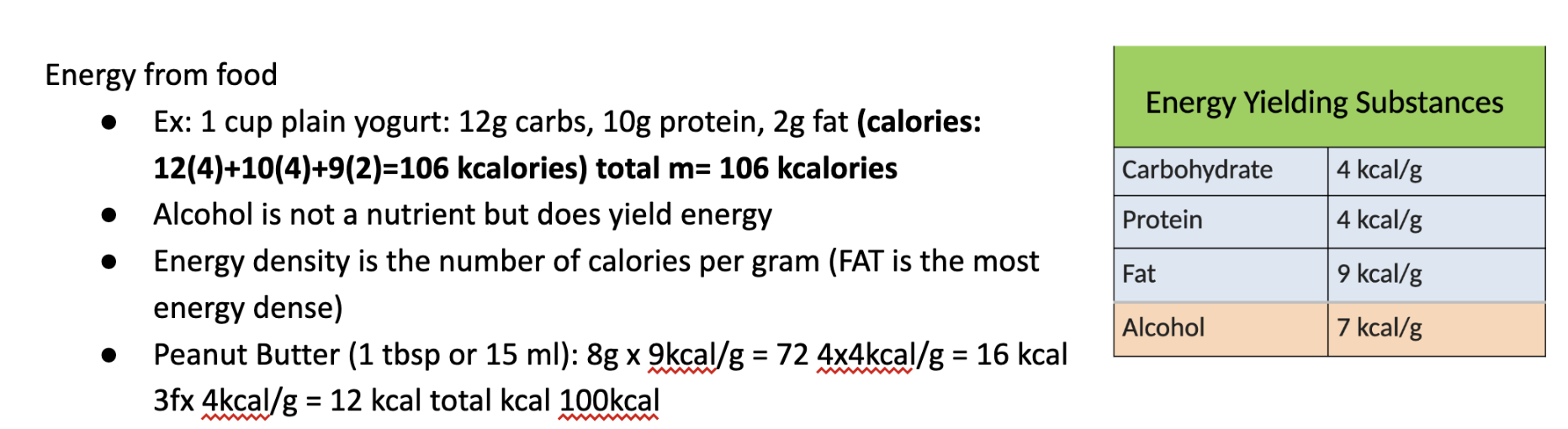
Carbohydrates (4kcal/g)
lipids/fats (9kcal/g)
Proteins (4kcal/g)
Vitamins
Minerals
Water
Alcohol is not a nutrient (interferes with body processes) - exam (7kcal/g)
Is energy-yielding but not a nutrient
Micronutrients vs Macronutrients (and which ones are Energy yielding nutrients?)
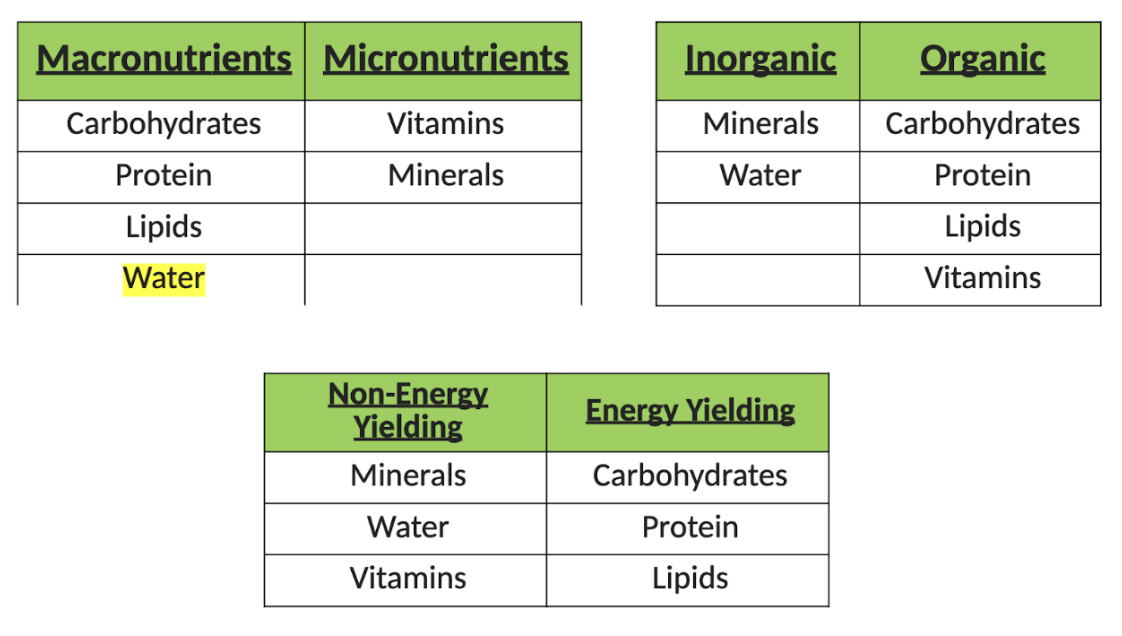
Micronutrients:
Required in small amounts per day (usually milligrams or micrograms per day)
Vitamins and minerals
Macronutrients:
Required in relatively large amounts per day
(usually grams/day)
Carbohydrates, protein, fat and water
Energy-yielding Nutrients - Nutrients that can be broken down to provide energy to the body: Carbs, lipids, protein (3 of the macros)
How much energy does each of the three energy yielding substances provide?
Essential nutrients
Must obtain from food because sufficient amounts cannot be made by the body
Carbs are a gray area cause the body can make it
Vitamin D is also a gray area (people in Canada need from diet cause not enough sun, but people living near the equator can make all their vitamin D)
Inorganic nutrients vs Organic nutrients
Nutrients that contain no carbon (water and minerals)
Carbon-containing
Nutrients that contain carbon-to-carbon bonds or carbon-to-hydrogen bonds
Carbohydrates, lipids, protein, vitamins
List names of categories under macros, micros, inorganic, organic, energy-yielding, and non-energy yielding
how does the body store nutrients?
–Some nutrients are stored without limit, even if they reach toxic levels
•Example: vitamin D
–Other nutrients are stored in only small amounts & can readily be depleted
•Vitamin C
Is oil, pork lettuce or milk the most energy dense?
oil - fat is always the most energy dense (9kcals/g)
Can we live on supplements alone? What is an elemental diet (disadvantages)?
Yes, but….
People who use TPN live off of supplements alone eating through a feeding tube. NOT IDEAL BUT WORKS.
Disadvantages:
weakens bodies defence
lack of phytochemicals
What are enriched foods and fortified foods?
Foods that have had nutrients added
“If the starting material is a whole food such as milk or a whole grain it may be a nutritious food”
“If the starting material is high in fat or sugar, the result may be less nutritious”
enriched/fortified food can be good/bad for you
What are functional foods vs Natural Foods vs Superfoods vs Processed Food vs Nutraceutical vs Staple foods
Functional Foods
A term that reflects an attempt to define as a group the foods known to possess nutrients or non nutrients that might lend protection against disease.
Ex. orange juice with calcium (reduces risk of osteoporosis), oatmeal (functional because reduces blood pressure)
Natural foods
Has no legal definition - often used for advertising (doesnt mean its good for you)
SuperFoods
Has no legal definition, often used in fads (ie kale, flax seed)
Processed Foods
“Foods subject to any milling, alternation in texture, additives, cooking or others”
Processed foods can be nutritious or not
Canada’s food guide recommends limiting highly processed foods
Ex: chocolate bar, loaf of bread
Often rich in sugar, salt, saturated fat
Nutraceutrical
A term used to describe a product that has been isolated - often sold in a pill form (ie fish oil, cranberry pills, omega 3 oil)
Staple foods:
Used frequently or daily (depends on culture, family)
5 KEY PRINCIPALS of a Nutritious Diet (and how do you achieve M?)
Adequacy
Provide all essential nutrients, fiber and energy in sufficient amounts to maintain health and body weight
Balance: “providing foods of a number of different types in proportion to eachother, such that foods rich in some nutrients do not replace foods that are rich in other nutrinets
Calorie-control
Control of calorie intake
Nutrient density - a measure of the nutrients provided per kcalorie of food (the more nutrients and the fewer calories the higher the nutrient density (nutrient per calorie, ie: (compared to energy density which was Cal/g)
Ie: skim milk: 300 mg calcium and 80 calories, 3.25 milk and 130 calories (most nutrient dense foods are non-starchy veggies b/c not high in calories but have a lot of nutrients)
Variety: “providing a wide selection of foods”
Increases the likelihood a diet will be adequate in nutrients
Some non-nutrient food components are higher in some foods than others and they may be important to health
Helps limit toxins or contaminants in a certain food or type of food
Can make the diet more interesting
Ie: swordfish has mercury, good for you but only rarely
Moderation
The dietary characteristic of providing constituents within set limits, not to excess
Sugar, fat, salt
There is a place for birthday cake
How to achieve moderation
Achieving moderation: Nutrient Density
Recommended that the most nutrient dense foods be chosen in each group
Unprocessed foods and lightly processed foods are generally best
Having foods high in fat, sugar and salt in moderation
Why does mainstream news regarding nutrition not reliable? What makes a relationship causation?
Mainstream news is faulty
News media can report ideas before they have been fully tested
reporters, lack a science background -exaggerate or minimize findings
What makes a relationship causation?
For it to be causation there must be a mechanism of action
What make Registered Dietitian vs. Nutritionist
Dietitians: have a degree from a university and receive a title
Nutritionists: do not require a degree and anyone can call themselves a nutritionist
Recall Malnutrition is “any condition caused by excess or deficient food energy or nutrient intake or by an imbalance of nutrients”; explain the difference between Primary deficiency vs a Secondary deficiency of nutrients…
Primary deficiency
inadequate intake of a nutrient due to diet
ie vegans don't get enough B12 - primary vitamin B12 deficiency
Secondary deficiency
inadequate intake of nutrients due to disease condition or drug interaction that reduces absorption
ie medication interactions, genetic condition - happens even if you eat enough b12
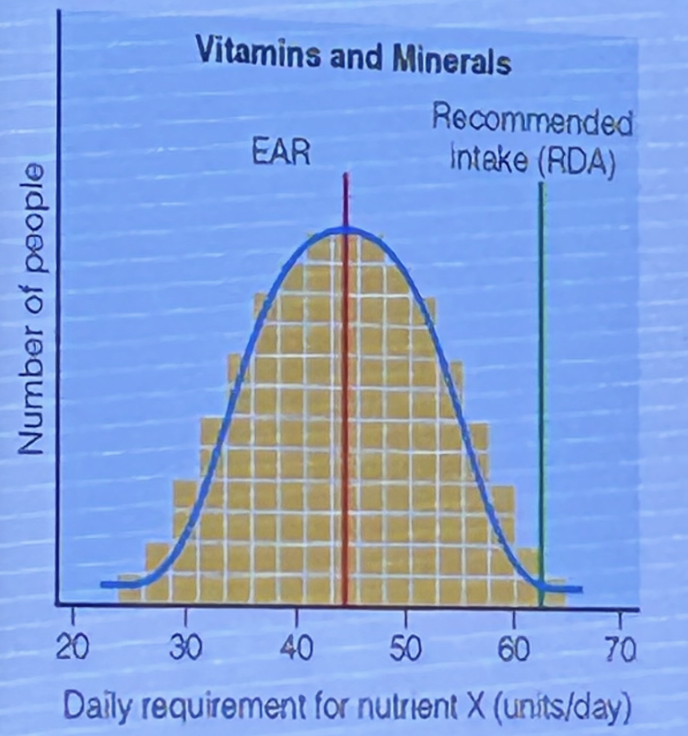
What is an RDA, how is it derived? Why can these be overestimated?
What is a DRI?
What is AI, and what is it based on? and when is it used?
What does EAR stand for, and what are they used to make?
What is the EER, and why can this NOT be overestimated?
What are UL, and WHO are these important for?
What is the CDRR and what are the diet(percentages) that supports this?
Recommended Dietary Allowance (RDA)
“the average daily nutrient intake level that meets the needs of nearly all (97-98%) healthy people in a particular life stage and sex group” (Sizer et al., 2021)
Derived from estimated average requirement (EAR)
We can overestimate an RDA because you will excrete the remaining nutrients
Dietary Reference Intake (DRI)
DRI is the dietary reference intake and refers to all the numbers including AI and EER
Different Groups of DRIs
Pregnant individuals
Lactose intolerant individuals
Infants
Children
Specific age ranges
Sex
Adequate Intakes(AI)
“the recommended average daily nutrient intake level based on the intakes of healthy people (observed or experimentally derived) in a particular life stage and sex group and assumed to be adequate” (Sizer et al., 2021)
Set when insufficient evidence for an EAR therefore RDA
Nutrient intake goals for individuals
If you have enough evidence for an RDA, you don't need an AI (they serve the same purpose)
Estimated Average Requirement (EAR)
“the average daily nutrient requirement intake is estimated to meet the requirement of half of the healthy individuals in a particular life stage and sex group” (Sizer et al., 2021)
Used in research and policy-making (assess nutrient intake of groups)
Basis for RDAs
What is the Estimated Energy Requirements (EER)
The average dietary energy intake predicted to maintain energy balance in a healthy adult of a certain age, sex, weight, height & level of physical activity consistent with good health
Cannot overshoot energy requirements (based on whole pop), because then 97% of pop would be overfed
Tolerable Upper Intake Levels (UL)
“the highest average daily nutrient intake level that is likely to pose no risk of toxicity to almost all healthy individuals in a particular life stage and sex group”
Usual intake above this level may put a person at risk of nutrient toxicity
Especially important for those taking supplements
not all nutrients have UL vaules
Chronic Disease Risk Reduction (CDRR)
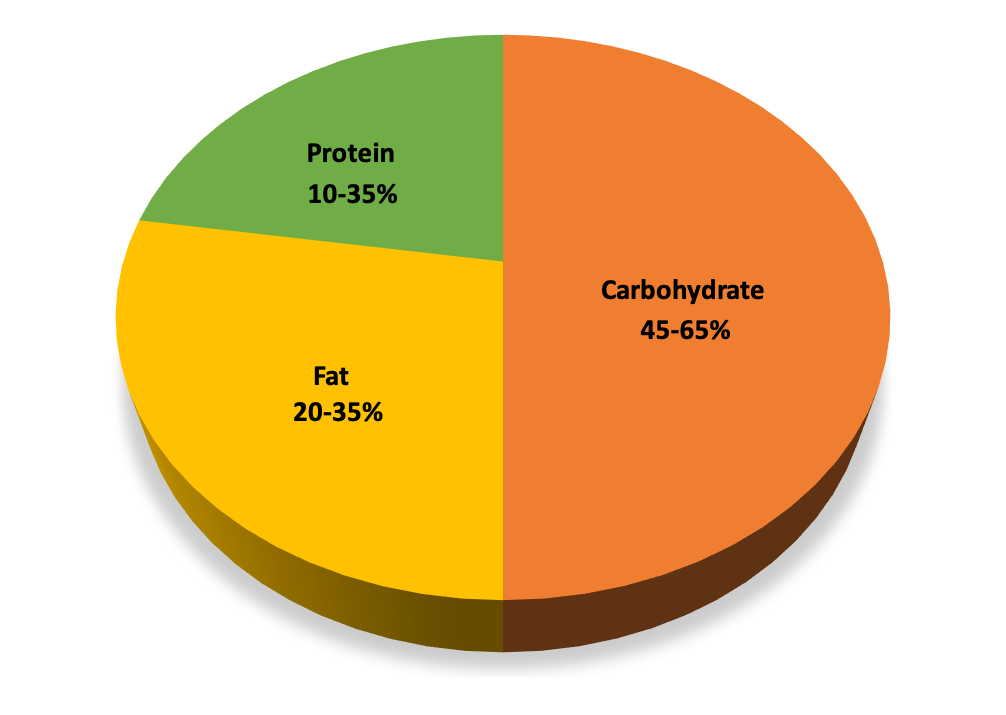
A diet that provides adequate energy, and nutrients, and reduces the risk of chronic diseases:
45-65% of energy intake from carbohydrates (fruits veggies and whole grain fibre NOT 65% fructose LOL)
20-35% of energy intake from fat
10-35% of energy from protein
What is is the Daily fitness recommendations DRI and in canada?
DRI Recommendations
recommends 60 minutes of moderate activity each day
Canada’s Physical Activity Guide:
150 minutes of physical activity per week (at least 10 mins per session)
What is Nutrient Density? Which food are nutrient dense?
Measure of nutrients provided per kcalorie of food
Can help to distinguish between more & less nutritious foods
Understanding nutrient density can help people add bulk without a lot of calories
Can have nutrients you need without a lot of calories (non-starchy veggies are the best)
which foods are nutrient dense?
generally vegetables (non-starchy)
Also generally rich in phytochemicals
Current Revision of Canada's food guide (proportions)? Recommendations for food guide? Changes to Canada’s food guide and when were these changes made?
Canadas Food Guide Plate Proportions
½ fruits and veggies
¼ protein
¼ grain
Current recommendations from canada's food guide:
Be mindful of your eating habits
Cook more often
Enjoy your food
Eat meals with others
Eat plenty of vegetables and fruits, whole grain and protein foods. Choose protein foods that come from plants more often
Limit highly processed food. Eat them less often and in smaller amounts
Make water your drink of choice
Use food labels
Beware (understand how) how food marketing influences your choices.
Sidenote:
“Health Canada and Indigenous Services Canada are committed to working with Indigenous peoples to support the development of healthy eating tools for: – First Nations – Inuit – Métis
Until these new tools are available, Canada's Food Guide for First Nations, Inuit and Métis is still a trusted source of information on healthy eating.”
What are the changes to canada’s food guide?
–Making serving sizes more consistent – easier comparison
Realistic for the amounts Canadians eat, and standardizing between brands
–Revising the % daily value (ie sodium 2400→2300)
–Adding a new % daily value for total sugar
–Adding potassium to the list of required nutrients
–Removing vitamin A and C (b/c no longer a concern for most)
–Adding mg for calcium, potassium and iron (previously just %)
–Adding a footnote at the bottom about % daily value (<5%, >15%)
Talked about adding added sugar but didnt happen (USA has it)
When were these implemented?
started process in 2017 - had 5 years to make changes, i year extension b/c covid to 2022
between 2022 and 2023, canadian food inspection agancy was checking complience
Even with Canada’s food guide, Canadians still are not listening… What section of the plate should Canada choose to eat more of? What section of the plate do we need to choose to eat less of?
It is recommended that they choose more:
Vegetables (especially green and orange)
Fruits
Protein foods such as beans, lentils, tofu, lean meats, low-fat dairy
Whole-grain foods
Water as the drink of choice
It is recommended that they choose fewer:
Refined grains
Saturated fats, trans fats and cholesterol
Added sugars
What is a discretionary calorie allowance?
What is a discretionary calorie allowance?
It is the difference between the calories needed to maintain weight & those needed to supply nutrients which means it is a individual allowance to eat whatever once their daily nutrients are reached
Sidenote:
Discretionary kcalories can be omitted for weight loss
Physically active people burn more kcalories each day – More discretionary kcalories
People who need fewer kcalories to maintain weight – Fewer discretionary kcalories to spend
What is an exchange system useful for?
•Exchange systems can be useful for diet planning
ex: calorie control
ex: controlliung carb intake for diabetes
each serving has 15g carbs, they are exchangable and help in carb control
What are the two different units used on nutrition tables?
what foods are exempt from carrying a nutrition facts table?
Two different units are used on nutrition tables
absolute quantities (ie grams)
percentages of standards (% daily value based on a 2000 calorie diet)
what foods are exempt from carrying a nutrition facts table?
•Beverages with an alcohol content over 0.5% (coolers dont tell you theyre full of sugar)
•Foods that contain very few nutrients, such as spices and vinegar
•Raw single ingredient meat, marine or freshwater animal product (grided not exempt)
•Foods sold only in the retail establishment where the product is prepared and processed from its ingredients (ie cafe sandwich)
fresh fruits and veggies
An intake to strive for ie fibre and healthy daily maximums ie max amount of sugar or salt. Both of these are an example of what?
Daily values
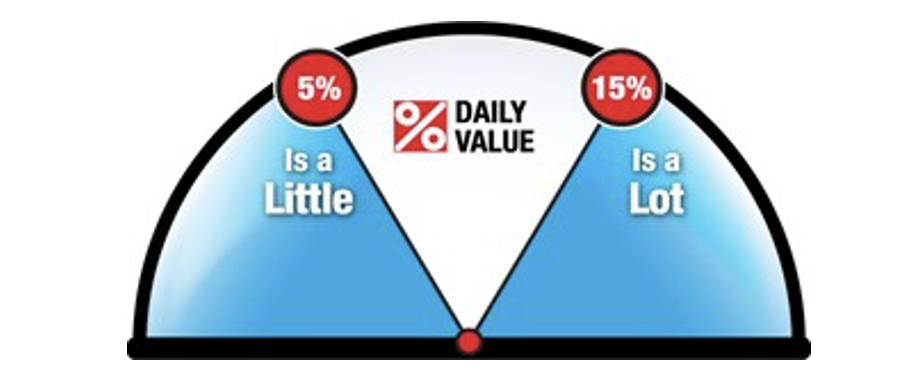
Explain what this scale is tell you….
This scale allows one to see if a food contains a little or a lot of a nutrient.
a little = 5% DV or less
a lot = 15% DV or more
arbitrary for any food
What are the 2 types of nutrient claims?
Nutrient content claims
May highlight a nutrition feature of a food such as light, low, less, free. (ie low in sodium, excellent source of vitamin C)
Health claims
Include two different types of claims: disease reduction claims (i.e. lowers BP) and function claims (ie: 7g helps with constipation), and nutrient function claims (defined by the Government of Canada as "a subset of function claims and describe the well-established roles of energy or nutrients that are essential for the maintenance of good health or for normal development and growth” - ie carbohydrates supply energy - basic claims about basic nutrients)
Nutrient function claims are a subset of function claims
What were the two changes made to ingredient lists that are found on food labels?
What is front-of-package nutrition labelling and when will it be implemented?
What were the two changes made to ingredient lists that are found on food labels?
1. grouping sugars-based ingredients in brackets after the name ‘sugars’ (so you know where sugar really stands on the list)
listing food colours by their individual common names
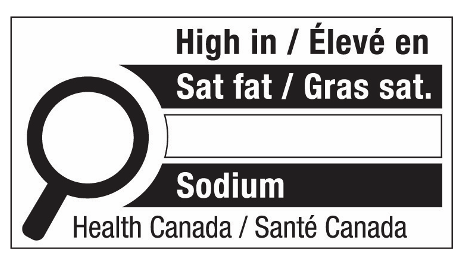
What is front-of-package nutrition labelling and when will it be implemented? (photo included)
•By January 1st 2026, a front-of-package symbol will be required on foods high in at least one of the following:
–Sodium
–Sugars
–Saturated fat
to help make fast, informed desisions
some foods are exempt (ie fruits dont have to say theyre high in sugar, cause theyre good in other ways)
What are the different types of sugar and what is also included under the unbrella of the sugar category?
Refined sugars:
White sugar
beet sugar
raw sugar
brown sugar
Under sugar umbrella….(contain a natural source of sugar)
Agave syrup
honey
maple syrup
barley malt extract
fancy molasses
high fructose corn syrup(glucose-fructose)
fructose
glucose
maltose
sucrose
dextrose
Sugar replacements in foods:
Fruit juice concentrates
puree concentrates
Who has to display calories on menus? what must be posted? How can the information on menus be misinterpreted?
Any food-service chains that has 20+ locations open in Ontario
What needs to be posted:
a statement like: –Adults and youth (ages 13 and older) need an average of 2,000 calories a day, and children (ages 4 to 12) need an average of 1,500 calories a day. However, individual needs vary.
\n
Information can be misrepresented:
only telling calories and not specific nutrients protein, fat, sugars etc,
triggering for ED
what is a phytochemical and what is good about them?
should we take phytochemicals a supplements?
what is a phytochemical and what is good about them?
the biologically active chemical in food that has health benefits
Some phytochemicals can have significant effects on the body through actions such as:
Sensory properties
Acting as antioxidants
Mimicking hormones
Altering blood constituents in ways that may protect against some diseases
Health benefits observed with intakes of certain foods generally cannot be narrowed down to a specific phytochemicals
Concentrated supplements of phytochemicals can be toxic when taken in too high a dose
should we take phytochemicals as supplements?
can alter body functions in ways we don’t understand
evidence is lacking
better in food form
Classify a flavour. classify the different types of taste?
Flavour (which includes taste):
Flavour is the total sensory impression when a food is eaten
Flavour includes:
Aroma
sense of smell is far more sensitive than taste
Texture
Temperature
Taste
Sweet
Sour
Bitter
Salty
Umami (the taste of MSG/meaty flavour)
why do people like sugar, fat and salt, and avoid bitter?
–Sugars: provide energy for the brain
–Fats: provide energy & essential nutrients
–Enjoyment of salt: assures the consumption of sodium & chloride
–Aversion to bitterness: discourages consumption of foods containing bitter toxins
this instinctive liking of sugar, fat and salt leads to overconsumption
Steps of Mechanical Digestion of food
mastication in the mouth
peristalsis in the esophagus, stomach and small intestine (wave-like muscular squeezing)
lower esophogeal sphincter prevents reflux
Chyme: liquified food forcefully released into SI when pyloric valve opens
stomach makes by denaturing the proteins and breaking them down (via acidity)
vast majority of absorption happens in the small intestine b/c segmentation (“ alternating forward and backward movement allows for greater contact between partially digested food and intestinal juices and enzymes” - SA)
Large intestine/colon: digestion and absorbtion is nearly finished, reabsorbs water, fibre and undigested materials makeup feces, rectum stores till excreted
Steps of Chemical digestion of food
Mouth:
•Salivary amylase (an enzyme) breaks down starch
•Lingual lipase begins the digestion of fat
•Very minor role but a more important role in infants
•Saliva helps maintain the teeth
Stomach: (pH 2)
–A mixture of water, enzymes, hydrochloric acid (HCl)
The acid is needed to activate a protein-digesting enzyme (pepsin)
Acid also begins the denaturation of proteins
digestive tract is protected from acid by mucus
Small intestine:
–Hormonal messengers (i.e. cholecystokinin CCK) stimulate the gallbladder to release bile into the intestine
•Bile is an emulsifier produced in the liver and stored in the gallbladder
•CCK release is stimulated by fat or protein in the small intestine
Hormonal messengers (i.e. secretin) stimulate the pancreas to release pancreatic juice
•Contains enzymes & bicarbonate
–enzymes to digest carbs, protein and fat
bicarbonate neutralizes stomach acid
parts of the small intestine
duodenum, jejunum, ileum
Can we get energy from/digest fibre?
•Only water, fibre, & some minerals remain in the digestive tract
•Fibres cannot be digested by human enzymes
–Some are digested by bacteria living in the digestive tract
•Results in short chain fatty acids that can be absorbed (so we can kinda get energy from it)
what is absorbed in the stomach?
what is absorbed in the small intestine?
what is absorbed in the large intestine (colon)?
what is absorbed in the stomach?
•Some absorption of alcohol and some drugs occurs in the stomach
what is absorbed in the small intestine?
–Some sugars are absorbed soon after they enter the small intestine
–Bile emulsifies fat
–Pancreatic enzymes break down starch, fat and protein
•(ex. pancreatic amylase, pancreatic lipase and proteases)
–Cells of the small intestine also produce enzymes that complete chemical breakdown
–Small fragments are then absorbed into blood & lymph via the cells of the small intestine’s wall
–Vitamins & minerals are also absorbed
SA is increased via villi and microvilli to increase absorption
absorption is selective (ie low in calcium, will absorb more calcium)
what is absorbed in the large intestine (colon)?
–Fibre fragments, fluid, & some minerals are absorbed
–Fibres are partly digested by bacteria in the colon
–Most fibre is not absorbed and is excreted as feces
What is microbiota? How can intestinal bacteria affect the body?
refers to the mix of microbial species of a community for example those in the digestive tract.
bacteria disgusting fibre
The intestinal bacteria may affect many body systems; this is by-products of the bacteria communicating with:
muscle
adipose tissue
the brain
the immune system etc.
What are Probiotics and Prebiotics and what is the relationship between them? How do these two things assist in the digesting of fibre?
Probiotics:
food that contains enough microorganisms to join bacterial colonies in the body - believed to benefit health
Prebiotics: substances that may not be digestible by the host, but serve as food for probiotic bacteria and thus promote their growth of probiotic bacteria
How do these assist in the digesting of fibre?
probiotic bacteria in the human large intestine can digest prebiotic-like fibres by fermenting them - creating small fragments that the colon absorbs
Note: all prebiotics are dietary fibres
What are the purposes for blood and lymph? (inside their respective vessels)
Blood vessels: transport most of the products of carbohydrate & protein digestion, most vitamins & minerals to the liver
Lymphatic vessels: transport most of the products of fat digestion (large components)
–These are later delivered to the bloodstream
What is the mechanism that leads to belching, gas and hiccups
Belching and gas may be caused by air swallowed during eating, some vegetables, beans and milk products (for those with a lactose intolerance)
Hiccups are spasms of the vocal cords & the diaphragm
Can be caused by irritation of the diaphragm, indigestion, etc.
heartburn (and what does it lead to?)
•( progresses to GERD – gastroesophageal reflux disease)
–The reflux of acidic stomach contents into the esophagus
–Acid burns the unprotected surface of the esophagus
–Lying down after a meal can open the muscular sphincter allowing acid into the esophagus
–Excess body fat can squeeze the stomach causing acid to back up
antacids are only good in the short term and cause the body to produce more acid
Contributers:
•Overeating
•Coffee
•Fat
•Chocolate
•Carbonated soft drinks
•Alcohol
•Smoking
•“Hot” components of chili peppers
Helpers:
•Limit/avoid problem foods
•Try eating smaller meals
•Drink liquids an hour before or after eating, but not during meals
•Wear reasonably loose clothing
•Relax, but sit up, after eating
GERD (Gastroesophogeal reflux disease)
–Severe & chronic exposure of the esophagus, throat, mouth, or airway to stomach acid & enzymes, causing inflammation & injury
–Untreated GERD may increase the risk of esophageal cancer
•Barrett’s esophagus (stomach tissue forming in the lower esophagus to protect it)
–Treatment may require surgery or management with medication
ulcer & hernia
•Ulcer: an erosion in the layers of cells that form a lining
–The bacterium that causes stomach ulcer may also have a role in stomach cancer
–Treatment involves antibiotics
•Hernia: a protrusion of an organ or body part through the wall of the body chamber that normally contains the organ
–A hernia can cause food to back up into the esophagus
–Hernias may require surgery
choking and dysphagia
•Choking: Food is lodged in the trachea and blocks the passage of air
–Prevention
–cut your food into small pieces
–chew your food until it is crushed & moistened with saliva
–don’t talk or laugh before swallowing
–never attempt to eat when you are breathing hard
–learn the Heimlich manoeuvre
•What is Dysphagia?
–difficulty in swallowing
–sometimes seen in individuals with ALS, Parkinson’s disease or following a stroke
can cause asparation pneumonia
Constipation vs Diarrhea prevention, treatment, and chronic or prolonged risks
Constipation:
infrequent and difficult bowel movements
Prevention/ Treatment - Poo regularly, consume enough fibre, drink water be physically active
Chronic disease risk: colon cancer
Diarrhea:
frequent and liquidy bowel movements
Prevention/ treatment - change diet, reduce stress, drink water
Prolonged risk: dehydration and mineral imbalances
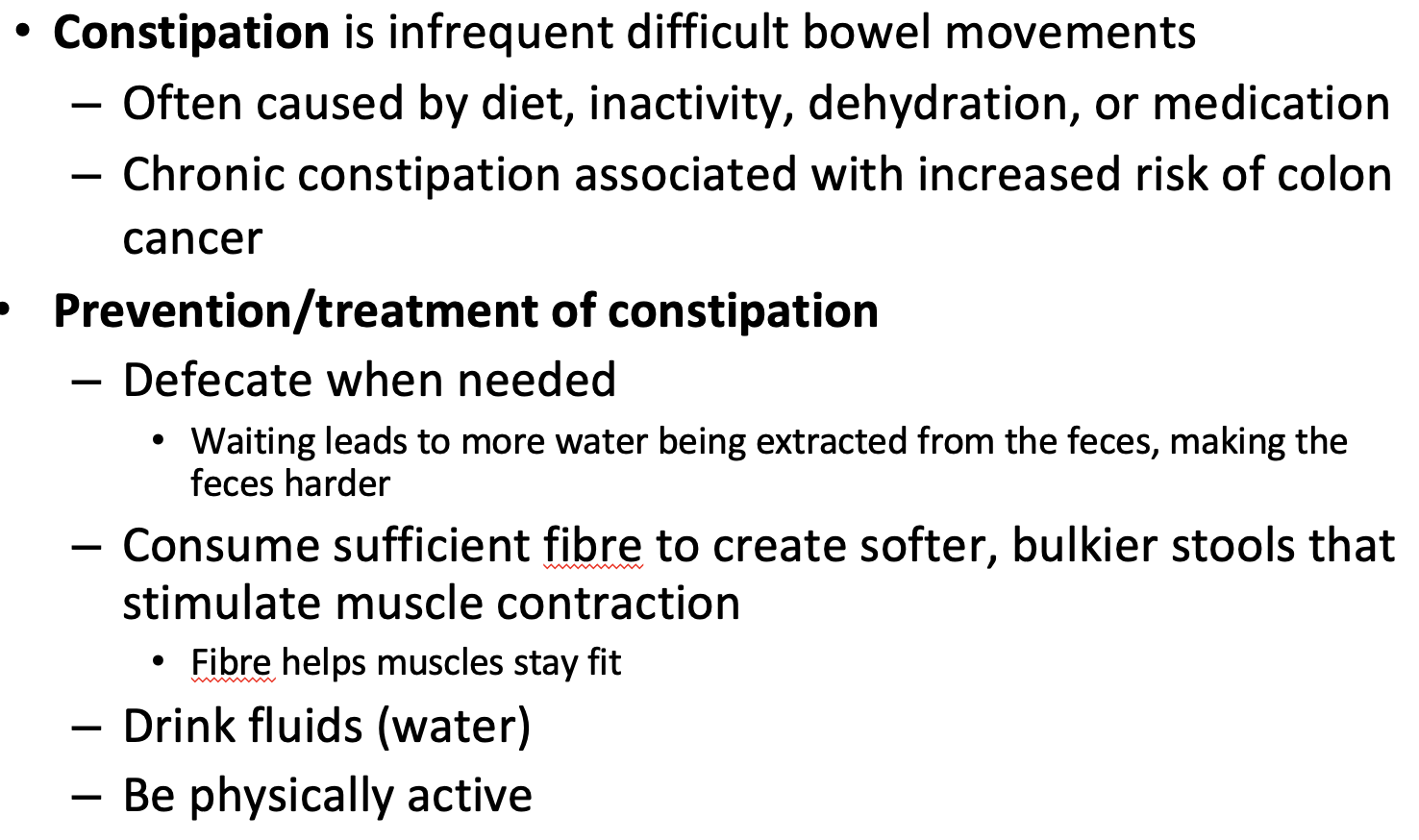
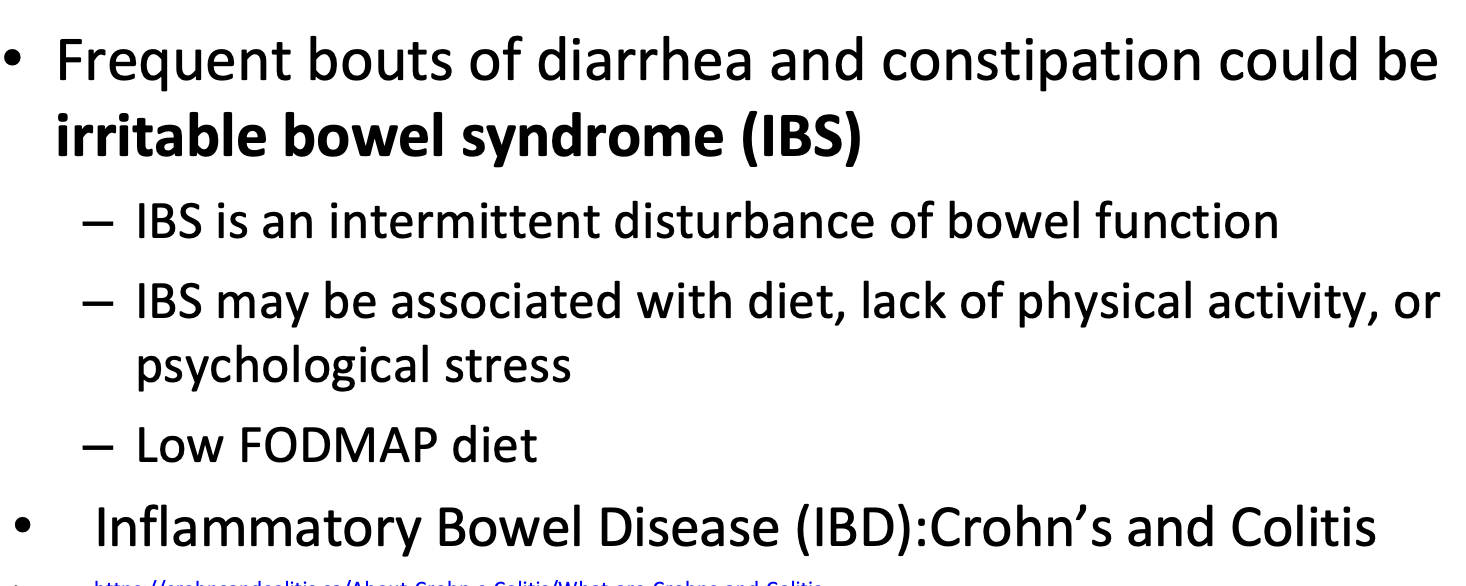
Compare IBS VS IBD: what do they stand for? defintion? Typically caused by? Treatment?
IBS: irritable bowel syndrome
Definition: Short-term disturbance of bowel function causing bouts of diarrhea and constipation
Caused by: diet, lack of physical activity, or stress
Treatment: low FODMAP diet
IBD: inflammatory bowel disease
Definition: Long-term chronic disturbance of bowel function causing diarrhea and constipation
Caused by: chrons and colitis (inflammation and ulcers in the digestive tract)
Treatment: antibiotics
Function of the Liver vs the Kidney
Liver function: excretion of food
–Some wastes are pulled out of the blood by the liver. The liver processes these wastes & either:
–Sends them to the digestive tract with bile, to leave the body with feces
–Or prepares them to be sent to the kidneys for disposal in the urine
Kidney function: filtration
•Kidneys are waste & water removal specialists
–Kidneys filter blood
–Waste becomes concentrated in the urine which travels through tubes to the bladder, which is periodically emptied
•The excretion or retention of sodium by the kidneys is a vital part of the body’s blood pressure-controlling mechanism
•Kidneys also regulate fluid volume & the concentrations of substances in the blood & extracellular fluids
Kidney function is regulated by hormones
What 2 ways can Kcals(excess energy-containing nutrients) be stored?
•Glycogen: storage of some excess carbohydrate
•Fat: storage of excess fat, protein and carbohydrate (if glycogen stores are full
–The liver ships out fat in packages to be picked up by cells that need it
–Excess fat is stored in the cells of adipose tissue
To have a diet following the DRI should people be eating carbs and/or fat at every meal?
Carbs: YES (harder to access so eat them)
Fat: NO (fat storage can be accessed)
What foods are rich in carbohydrates (3)
Plants-based foods – almost exclusively
whole grains
legumes
vegetables and fruit
Milk products are the only animal-derived foods that contain significant carbohydrate
milk
yogurt
sour cream
Concentrated sugars: soft drinks, candies, cake etc.
monosaccharides, disaccharide and polysacchairdes: Which are Simple carbs and which are Complex carbs? What are the three primary monosaccharides? and what are the three disaccharides these monosaccharides produce? What reactions form and spilt disaccharides?
Simple Carbohydrates:
Monosaccharides – single sugar
glucose
fructose
galactose
Disaccharides – pairs of monosaccharides
Lactose (glucose + galactose)
Maltose (glucose + glucose)
Sucrose (glucose + fructose)
Join by condensation reactions
Split by hydrolysis reactions
Complex Carbohydrates:
Polysaccharides – chains of monosaccharides
Characteristics to compare Glucose vs Fructose vs Galactose: Order based on the sweetness of each sugar. Which is present in every disaccharide? What is high fructose corn syrup? which single sugar could be found as a monosaccharide in food and how?
Glucose:
MID sweetness
present in every disaccharide (essential energy)
Polysaccharides are made almost exclusively of glucose
Fructose: (fruit sugar)
MOST sweet
Occurs naturally in fruits and honey
High-fructose corn syrup:
Fructose is commercially known as high-fructose corn syrup
HFCS is a syrup made from cornstarch that has been treated with an enzyme that converts some of the glucose to sweeter fructose (a cheap way to get a sweet taste)
Galactose:
NOT sweet at all
Included in disaccharide lactose so present in milk products.
Could be found as single sugar in fermented milk products like yogurt and aged cheese (b/c bacteria breaks lactose bond into glucose and galactose)
Where are each of the disaccharides Lactose, Maltose and Sucrose found in foods?
Lactose(milk sugar)
Principle carbohydrate of milk
Provides about ½ kcal in skim milk
Maltose (Beer sugar)
Produced during the starch breakdown
Occurs during the process of alcohol fermentation
Not very common in foods
Sucrose (plant sugar)
Occurs naturally in fruits veggies and grains
refined sugars: ie beet, and cane sugar
sweetest of the dissacrides
When are mono and disaccharides absorbed into the bloodstream? How are disaccharides broken down? Which of the sugars is the most used nutrient in the body? How do we know the sugar needed in our diet?
Monosaccharides are absorbed directly into the blood
Disaccharides are digested before absorption
Split into monosaccharides by enzymes
Glucose is the most used nutrient in the body
We know sugar is needed because the nutrition facts table has %DV for sugars(indicating to much to less)
What do fruits and veggies contain that makes them different from purified sugars (found in candy and soft drinks)?
Fresh fruits and veggies contain:
Fibre
Phytochemicals
Vitamins and minerals
What are the three polysaccharides? What sugar is the main component of all polysaccharides?
Starch
Glycogen
Fibre
Main component of Polysaccharides: glucose
Starch: Where is it found? What are the two mechanisms causing unbranched vs branched? What is meant by the sentence “Starch is nutritive”? What are 3 types of foods rich in starch?
Glycogen: Where is it found? Where is it stored? Why is there less carbs present in meat products compared to carbs present in individual livestock on farms
Fibre: Where is it found? Most fibre is what if it is a complex sugar? Why can humans not break down fibre? Does fibre provide energy?
Starch
ØStorage form of glucose found in plants
branched (amylopectin)
unbranched (amylose)
ØStarch is nutritive: we digest starch to glucose and thus get energy from it
ØRich food sources of starch:
grains
tubers (yams and potatoes)
legumes (peas and beans)
Glycogen
ØStorage form of glucose found in animals
ØEasy to break down for quick energy
ØGlycogen is stored in muscle and liver
ØMeat doesn’t contain a lot of carbs because glycogen(carbs in animals) breaks down after the animal is killed
Fibre
Found in vegetables, fruit, whole grains and legumes
Provide support and structure to plants
Retain water to protect seeds from drying out
Most fibres are polysaccharides
Human digestive enzymes cannot break the bonds that hold together the sugar units of fibre
Most fibres pass through the human body without providing energy (unless acted on by bacteria in GI - produces short-chain fatty acids for energy)
soluble fibres vs insoluble fibres:
which is easy to break down and form gels and which is not easliy broken down and retains its structure?
Food example of each?
which fibre decreases cholesterol and which alleviates constipation?
Soluble fibres
Dissolve in water (therefore must drink lots of water when eating soluble fibre)
Form gels (are vicious)
Can be digested by bacteria in the human colon
Rich sources include barley, legumes, oats, apples, citrus fruits (know)
Are associated with a lower risk of chronic disease - decreased cholesterol
Slow glucose absorption (good for diabetic bs control)
Soften stool
Used as a thickening agent (pectin in jam, salad dressing)
Gums, pectin (jam), psyllium, some hemicellulose
Insoluble fibres
Do not dissolve in water
The outer layers of whole grains, the strings of celery, etc. contain insoluble fibres such as cellulose
These fibres retain their structure & texture even after hours of cooking
They ease elimination, can alleviate constipation, speed passage of feces through colon
Are less easily fermented & do not form gels
not easily broken down
Carbs, protein and fat provide energy for the body:
What is an important fuel for the body that is obtained from carbs?
Why can’t we just eat a diet solely of protein?
Fats are not normally used for fuel by brain and central nervous system because____ is typically used
Carbs as source of fuel
Glucose is an important fuel for most body functions and is obtained through carbs
Protein as only source of fuel is not helpful
protein-rich foods are usually expensive protein diet
ØProtien provides no advantage when used as fuel
ØOveruse of proteins has potential disadvantages
Often have a high saturated fat content
Fats as a source of fuel
Fats are not normally used as fuel by the brain & central nervous system - Glucose is.
% carbs recomended daily by DRI
45% - 65%
This is of daily kcalories come from carbohydrates – AMDR (Acceptable Macronutrient Distribution Range)
Should one Avoid Carbs for Health and Healthy Body Weight?
NO
Carbohydrates are wrongly accused of being a "fattening" ingredient in food.
Looking at gram for gram: carbohydrates actually contain fewer calories (4 kcal/g) than dietary fats (9 kcal/g)
Gluten free diet?
used to lead to healthier diets, not because of the lack of gluten, but b/c it leads to healthier choices/making whole foods
now not so much b/c prepackaged gf food is easier to find
Why are fibre-rich foods recommended?
•Generally, supply vitamins, minerals & phytochemicals
•Generally contain little or no fat
So lower energy density
•Soluble fibres (ex. found in apples) have a significant cholesterol-lowering effect
•Maintenance of healthy bowel function
Wheat bran, high in insoluble (nonviscous) fibre, is a stool-softener
•Fibre helps maintain a healthy body weight
Modulation of blood glucose concentrations
how do diets rich in complex carbs lower cholesterol and risk of heart disease (4 ways)
ØDiets rich in complex carbohydrates may protect against heart disease and stroke
•Generally are:
•low in saturated fat, trans fat & cholesterol, high in fibres, vegetable proteins & phytochemicals
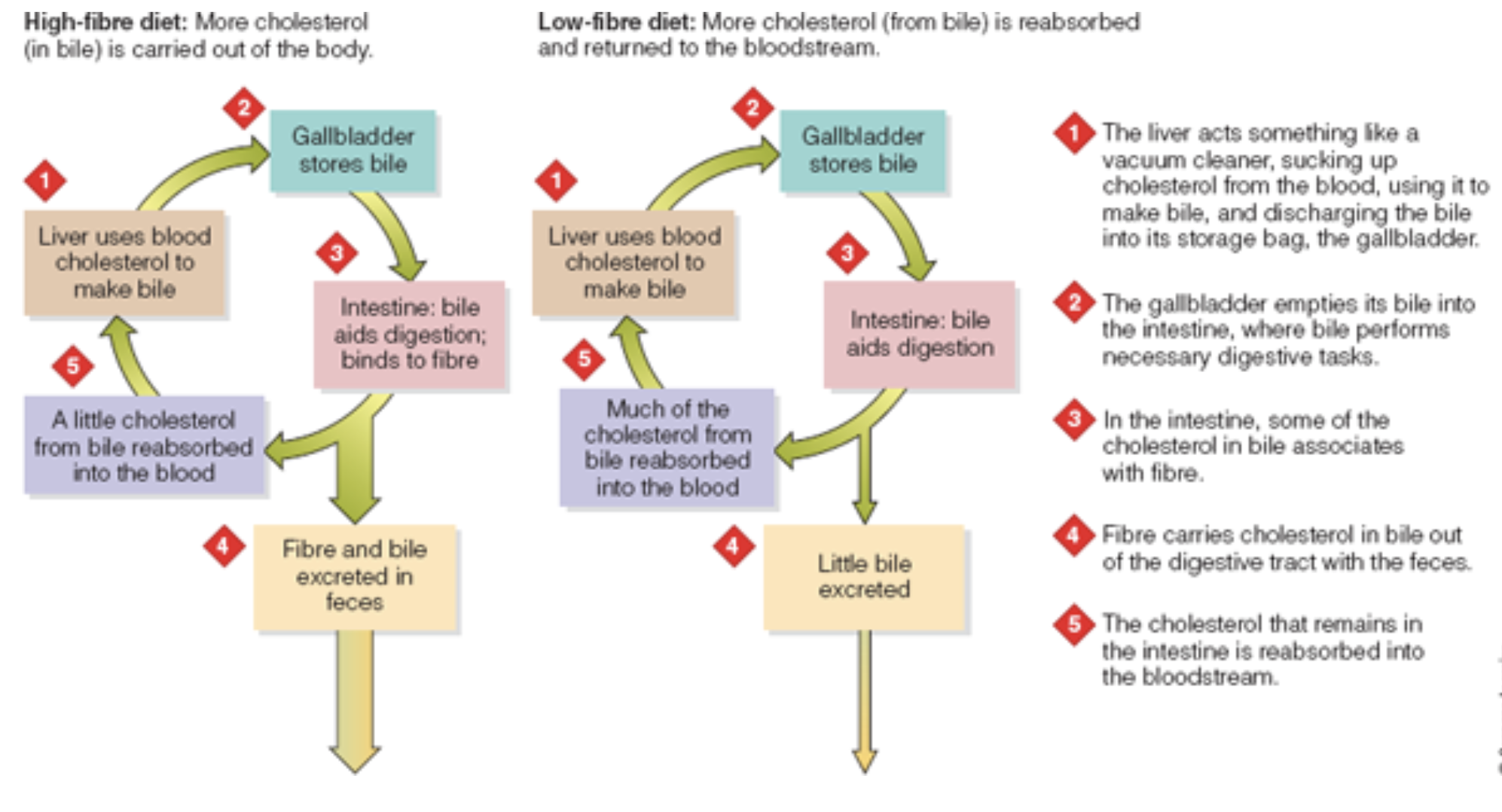
•Foods rich in viscous fibres lower blood cholesterol by binding with cholesterol-containing bile & carrying it out with the feces
•Bile is needed for digestion, so the liver responds to its loss by drawing on the body’s cholesterol to make more (Fig 4-5)
•Bacterial fermentation of fibre produces a small fatty acid produced travels to the liver where it may help reduce cholesterol synthesis
How does fibre help with blood sugar control and the maintenance of digestive tract health?
Blood Glucose Control
ØSoluable(viscus) fibres:
Lower glycemic index (slows glucose absorption)
Helps steady levels of blood glucose & insulin
ØFibre & fluid intake play a role in maintaining colon function and preventing & alleviating constipation
enlarge & soften stools
how does fibre help prevent constipaiton?
ØLarge, soft stools ease elimination helping prevent hemorrhoids
ØFibre helps prevent compaction of intestinal contents
•Such compaction could obstruct the appendix & permit bacteria to invade & infect it (appendicitis)
ØFibre stimulates the GI tract muscles so they retain their strength & resist bulging out into pouches (diverticula)
•Diverticulitis is the inflammation of diverticula
what is diverticulitis/diverticulosis?
diverticulosis: condition where pouches form off intestine
diverticulitis: pouches get inflammed
how do High-fibre diets lower the rates of colon cancer relative to low-fibre diets?
ØFibre rich foods contatin nutrients & phytochemicals
ØFibres dilute & speed the removal of cancer-causing agents from the colon
ØFibre-rich diets promote bacterial reproduction, binding nitrogen & carrying it out of the body in feces
ØBacteria ferment soluble fibres into short chain fatty acids
•Butyrate (a SCFA) may help the colon resist chemical injury that could lead to cancer
•Cancer experts recommend a high-fibre diet – from foods (supplements don’t have the same results)
•Healthy Weight Management via high carb/fibre diet
ØFoods rich in complex carbohydrates tend to be low in fats & added sugars
•Promote weight loss by providing less energy
•Fibre creates feelings of fullness & delays hunger
•swells as it absorbs water
ØPure fibre compounds usually not necessary – use with caution
•Most benefits of fibre come from foods with fibre
•Too much fibre without enough water can cause constipation
fibre recomended intake (female vs male)
•AI: Females age 19-50: 25 g/day
•AI: Males, age 19-50: 38 g/day
canadas food guide recomends: plant proteins (b/c also has carbs), lotsa veggies and fruit, whole grains
there isnt enough evidence for a EAR, or RDA, therefore AI is used
•Can My Diet Have Too Much Fibre? (___agents do what?)
YES
oPurified fibre (like that from oat bran or wheat bran) can lead to a blocked intestine especially if too little fluid.
oBinders in some fibres act as chelating agents
•These bind minerals & carry them out of the body (trapped amongst fibres and leave body w/ poop)
•may limit the absorption of iron, zinc & calcium
oToo much bulk in the diet can limit food intake & cause both nutrient & energy deficiencies
•The malnourished, the elderly & children who consume no animal products are especially vulnerable
oFibres remove water from body: can contribute to dehydration
•Increase water to go along with the fibre added to the diet
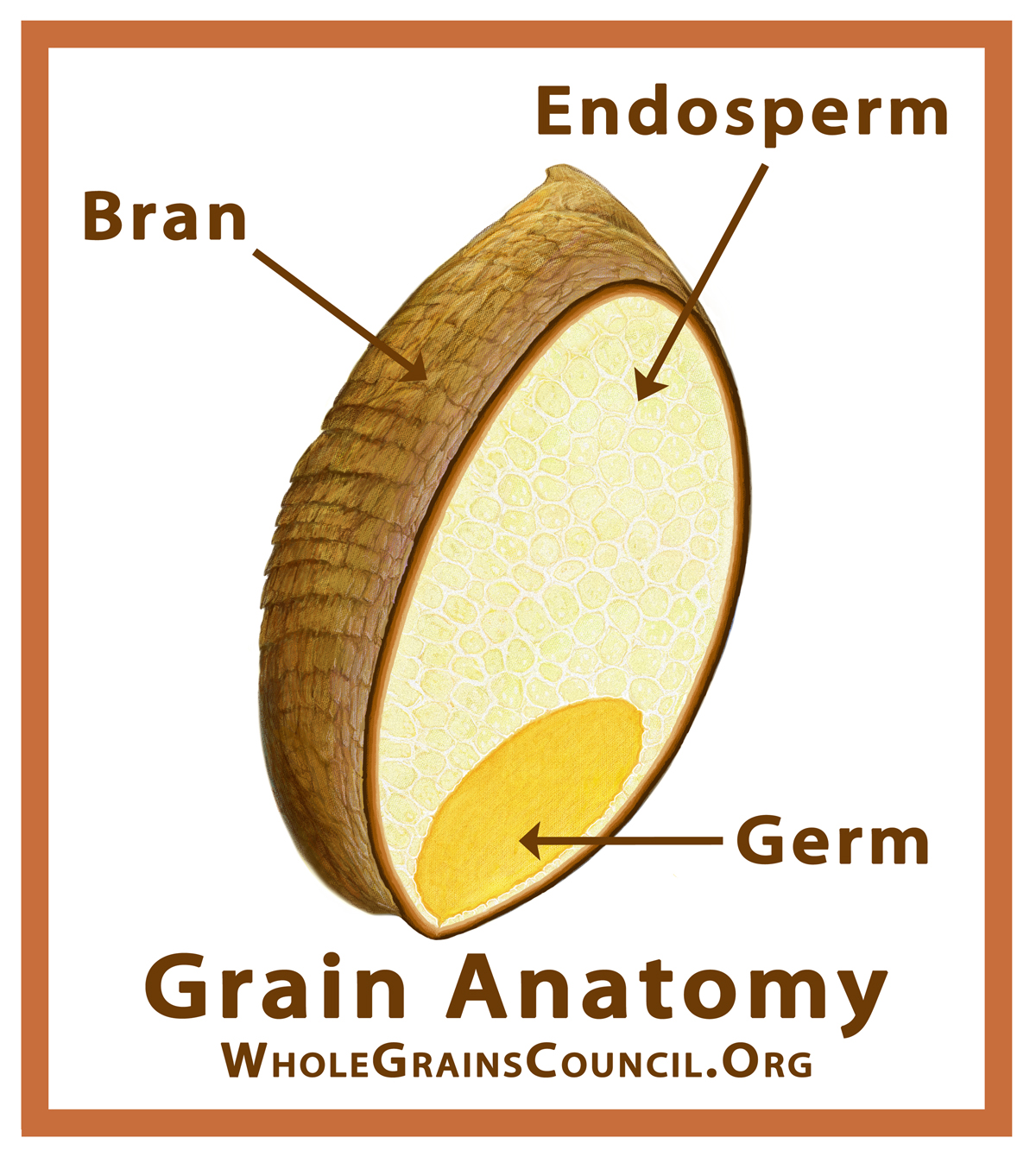
3 parts of a grain
•Bran: is largely made out of cellulose
Protects the grain (outside part of grain, taken out for white bread)
Generally removed in milling
•Endosperm: largely starch grains embedded in a protein matrix
Endosperm is generally what is used in refined flour
•Germ: part where new grain develops
Majority of fat in the grains are located here (goes in fridge)
Often left out of processing to avoid rancidity
modern milling (and mandated additions to bleached wheat flour - 5)
•removes the germ & bran - whiter, smoother-textured flour increasing the starch content & lowering the fibre content
•White bread meant a loss of nutrients:
•know: Canada mid 1970’s: mandatory addition of riboflavin, thiamin, niacin & iron to bleached wheat flour
•know: Canada late 1990’s: mandatory addition of folic acid (important for pregnant women - reduces risk of neural tube defects)
these things (B vitamins) were added b/c lost in modern milling
how are carbs digested/absorbed (mouth, stomach, small intestine)
•Carbohydrates must be broken into monosaccharides to obtain glucose
•Starch digestion begins in the mouth
Salivary amylase (found in saliva)
becomes deactivated by stomach acid
•Some digestive enzymes, ex. protein digesting enzyme found in the stomach, work best in acidic environments
•Starch digestion resumes in the small intestine:
pancreatic enzymes: split starch into smaller polysaccharides and disaccharides
Intestinal enzymes: split these into monosaccharides
how starch is digested (& resistant starch)
•Starch found in refined grains is rapidly broken down to glucose which is then absorbed
•Starch, such as that of cooked beans, digests more slowly & releases glucose later in the digestive process
•Resistant starch behaves like fibre
Found in raw potatoes, unripe bananas & inside the unbroken husks of swallowed seeds
Some resistant starches may be digested slowly
Most remains intact until the bacteria of the colon break it down
Sometimes classified as insoluble fibre
how sugars are digested
•Digestible carbohydrates are ultimately split into monosaccharides before they are absorbed
•Pancreatic amylase splits most starch to disaccharides
•Small polysaccharides and disaccharides (from diet and starch digestion) are split by enzymes attached to the cells lining the small intestine
(lactase, sucrase and maltase)
•Once in the bloodstream, the sugars travel to the liver
•Fructose & galactose are converted to glucose or related products
•Circulatory system transports the glucose & other products to the cells
•Liver & muscle cells may store glucose as glycogen
All cells may use glucose for energy
how fibre is digested
oMany fibres can be fermented by intestinal bacteria
•Odourous gases are a bi-product
•When increasing fibre, gas production can be minimized by:
•Starting with small servings
•Gradually increasing serving size
•Why Do Some People Have Trouble Digesting Milk?
•Some people produce less lactase (enzyme that digests lactose)
•Ancestry - high prev. in Asians; low prev. in Northern Europeans
•Ability to produce lactase tends to decline with age
•Lactase deficiency may also occur because of damage to intestinal villi due to:
•disease, malnutrition, medications or prolonged diarrhea
•
ØLactose intolerance
•Intestinal bacteria ferment the undigested lactose producing gas & intestinal irritants
•Symptoms: nausea, pain, diarrhea, excessive gas
•Some people produce less lactase
how is a milk allergy different from lactose intollerance?
•Milk allergy is not the same as lactose intolerance
•Milk allergy is an allergic reaction to the protein in milk
•Individuals with milk allergy cannot tolerate any milk products
•Must find nondairy calcium sources of calcium
•calcium-fortified orange juice
•calcium- & vitamin D-fortified soy beverage
•canned sardines & salmon with the bones
•DRI Committee carbohydrate recommendations (g/day and % of total energy intake)
•The minimum intake to feed the brain & reduce ketosis is 130 grams a day for an average adult – RDA 130 g/day
•More is recommended (AMDR: 45% - 65% of total energy) to maintain health & glycogen stores
was set to prevent ketosis
what is ketosis?
when body uses protein to make glucose, then wont build muscles/antibodies b/c thats what protein usually does
if you have enough protein, the carbs can do what they need to do
can fat be converted into glucose? what is used instead?
•Body fat cannot be converted into glucose to feed the brain
•With a severe carbohydrate deficit, the body uses protein to make glucose - gluconeogenesis
•Diverting protein from critical functions of its own
•Carbohydrates have a protein-sparing action - prevent the use of protein for energy
•Fat fragments usually combine with a compound derived from glucose (or protein) before being used for energy
•Without this compound, fat fragments combine with each other producing acidic ketone bodies
•The accumulation of ketone bodies in the blood (ketosis) can disturb normal acid-base balance
Low carb diet mimics fasting, breaks down muscle to get protein energy, CNS adapts to use ketones instead of glucose for energy
(ketones are fat, therefore loose fat)
negatives and positives of keto
•Adults with chronic ketosis may face: -
•Vitamin & mineral deficiencies
• Loss of bone minerals – osteopenia and osteoporosis
• Altered blood lipids (higher blood cholesterol)
• Increased kidney stone risk
•Constipation, nausea and vomiting
•Glycogen stores that are too low to meet a metabolic emergency or support maximal high-intensity muscular work (cant get instant energy)
•Ketogenic diet: +
•used to reduce seizures in children (and adults) with severe refractory epilepsy
•research is ongoing for other neurological conditions (ie: brain tumours)
Blood sugar regulation (what happens with high/low blood sugar)
•Eating increases blood glucose
High blood glucose: insulin is secreted from pancreas
Insulin stimulates:
uptake of glucose into cells
storage of glucose into glycogen
excess glucose into fat
•Cells in the body use glucose thereby decreasing blood glucose
Low blood glucose: glucagon is secreted from pancreas
Glucagon stimulates
Breakdown of glycogen therefore glucose released into bloodstream
•Epinephrine also breaks down liver glycogen as part of the body’s defense mechanism in times of danger
what is the glycemic index (& glycemic load), what are things scored against, how is it used
vThe glycemic index (GI) is a measure of the ability of a food to elevate blood glucose & insulin levels
•Scored against standard: usually white bread or glucose (score =100)
•Many influences on glycemic index:
•i.e., ice cream (a high-sugar food) ranks lower than baked potatoes (a high-starch food) - see figure 4-13
vGlycemic load is the glycemic index multiplied by grams of carbohydrate
vThe glycemic index, & glycemic load, may be important to people with diabetes who must regulate their blood glucose
scale that compares/ranks food compared to glocose OR white bread (top of scale)
high on scale: lotsa fast absorbing carbs, refined
low on scale: low carbs, high in fibre and fat (which slow sugar absorbtion)
how is extra glucose stored?
•Excess glucose is stored as glycogen
•Until the muscle & liver are full to capacity
•2/3 of the body’s total glycogen is stored in & used by muscle
1/3: liver
•Remainder is in the liver with a small emergency store in the brain.
•If there is still excess glucose:
•The liver converts it into fats then stored in fat tissues
•Fat cells may also convert glucose to fat
•Fat cells can store practically unlimited quantities of fats
T1D
•Type 1 Diabetes
oLittle or no pancreatic secretion of insulin
oOften diagnosed in childhood
oLess common (up to 10% of cases), but is on the rise
oLeading chronic disease among children & young adults
•Treatment:
oAn external source of insulin
oMeal planning to balance blood insulin & glucose concentrations
why is insulin injected and not taken orally?
would just digest it/break it down because its a protein
stomach would denature it
T2D
oBody produces insulin at first – then insulin resistance
oAs blood glucose rises, so does blood insulin
oEventually, the pancreas may become less able to make insulin
oOften diagnosed in adulthood
oMost prominent type of diabetes (approximately 90%)
oIf drugs are necessary:
•May stimulate insulin secretion
•May improve tissue uptake of glucose
•External source of insulin may also be used
Genetic component
Type 2 Diabetes & Obesity
obesity is a risk factor for diabetes
•Children and adolescents are being diagnosed
•People with obesity require much more insulin
•The more body fat, the more insulin resistant, the higher the blood glucose
•Even moderately overweight people exhibit slightly elevated blood glucose (impaired glucose tolerance - sugar drink)
•Impaired glucose tolerance: blood glucose levels higher than normal but not high enough to be diagnosed as diabetes …sometimes called prediabetes (also includes impaired fasting glucose)
Tighter glucose control=
(what are complications?)
this card confuses me…
•Tighter glucose control = less severe the complications
oHigh Blood pressure
oImpaired circulation/amputation
oKidney disease (requiring dialysis or kidney transplant)
oCataracts, retinopathy
oNerve damage (peripheral neuropathy), skin damage
oStrokes & heart attacks
all these complications are either blood or nerve related.
•Some of this damage may be the result of the oxidation that accompanies elevated blood glucose
¡A diet high in antioxidant-containing vegetables & fruits may be protective, but more research is needed to confirm the oxidation hypothesis
lifestyle changes T2D
•Nutrition plays a major role in managing diabetes, with a focus in type 2 diabetes on weight control
•In those who are overweight, weight loss alone can help control diabetes
•The same diet that best controls diabetes also helps control body weight & supports physical activity
•Adequate in nutrients
•Adequate fibre
•Moderate in added sugars
•Provides a controlled amount of total carbohydrates
•Low in saturated fat & provides unsaturated oils
•Adequate but not too high in protein
¡
•Regular physical activity: major role in preventing & controlling Type II diabetes
ohelps to achieve & maintain a healthy body weight
oheightens tissue sensitivity to insulin
oincreasing physical activity, even without weight loss, in those who are overweight seems to delay diabetes onset
oincreased activity, even without weight loss, often helps to control diabetes
physical activity even without weightloss makes tissues more insulin sensitive
¡
Canadian Diabetes Association Clinical Practice Guidelines 2018: Nutrition Therapy
nutrition patterns are easier to follow that % per day
ex of eating patterns rec for diabetes
Mediterranean style diet
vegan or vegiterian
DASH
fruits and veggies
nuts
emphasise dietary pulses (beans, peas, chickpeas, lentils)
If I Feel Dizzy between Meals, Do I Have Hypoglycemia?
and what are the 2 types of hypoglycemia?
hypoglycemia: low blood sugar
hypoglycemia is rare in healthy people
postprandial hypoglycemia
low blood sugar after a meal
rare, occurs after large amounts of weight loss
fasting hypoglycemia
can be seen with cancer and other diseases
low blood sugar when not eating
•What causes low blood sugar in people with Diabetes?
o“More physical activity than usual
oNot eating on time
oEating less than you should have
oToo much medication
oDrinking alcohol”