1 - Cardiovascular Agents - Jinn
 Call Kai
 Learn
Learn Practice Test
 Spaced Repetition
 Match
Match Flashcards
 Knowt Play
1/83

There's no tags or description
Looks like no tags are added yet.
Name | Mastery | Learn | Test | Matching | Spaced | Call with Kai | Chat |
|---|
No analytics yet
Send a link to your students to track their progress
84 Terms
What is angina pectoris?
A condition where the coronary arteries don't supply enough blood and oxygen to the heart
Causing myocardial ischemia → low O₂ to heart tissue
Typical angina?
Caused by atherosclerotic narrowing of coronary arteries → low blood/O₂ to heart
Triggered by exercise, food, or emotional stress
Unstable angina?
Plaque rupture + platelet/thrombus formation
Inhibit platelet aggregation and thrombus formation
Variant / acute angina?
Caused by sudden coronary artery spasm → not necessarily atherosclerosis
Can occur at rest
What are the 3 main classes of antianginal drugs?
Organic nitrates
Calcium channel blockers
β-adrenergic blockers
What is the main goal of antianginal therapy?
Alleviate and prevent anginal attacks by improving blood/O₂ supply to the heart → primarily through coronary artery dilation

What are organic nitrates?
Esters of simple organic alcohols or polyols with nitric acid
Alcohol + HNO3 or HNO2
Ex: nitrate, amyl nitrate
5 members of the organic nitrates class that is still in use today?
Nitroglycerin
Amyl nitrite
Isosorbide Dinitrate
Pentaerythritol tetranitrate
Erythrityl Tetranitrate
What problems do organic nitrates have when being formulated?
Volatile → easily evaporate
Hydrolyze the ester bond with moisture → break down when exposed to water
Pure/concentrated form → requires extra caution
What types of angina can nitrates treat?
Both typical and variant
Typical → angina caused by atherosclerotic coronary narrowing
Variant → angina caused by coronary artery vasospasm
How do nitrates decrease preload?
Nitrates dilate veins → blood stays in veins → decreased blood returning to heart → decreased preload
How do nitrates decrease afterload?
Nitrates dilate arteries → decreases peripheral resistance, making it easier for blood to flow in arteries → decreased afterload
What are preload and afterload?
Preload → How much blood returns to the heart → more blood = more stretch/work.
Afterload → How much resistance the heart pumps against → more resistance = more work.
How do nitrates improve the oxygen balance of the heart?
They increase oxygen going to the heart and decrease how much oxygen the heart needs → less ischemia and chest pain
MOA of nitrates?
Nitrates → release NO / nitrous oxide → activate guanylate cyclase → increasing cGMP → decreasing Ca²⁺ → reduces Ca2+ catalyzed vascular contraction → blood vessels relax / vasodilation
Pharmaceutical preparations / dosage forms of nitrates?
Inhalation
Injection
Tablets
Capsule
Transdermal disks
Ointments
What kind of nitrates do you use for acute anginal attack?
A rapid acting preparation!
Examples of fast acting nitrates for acute anginal attacks?
Sublingual glyceryl trinitrate → onset within 2 min
Amyl nitrite by inhalation → fastest acting preparation, onset of 10-15 seconds but lasts 1 minute
Isosorbide dinitrate
What kind of nitrates are used for long acting prevention of anginal attacks?
Long acting preparations!
Examples of slow acting nitrates for prevention of anginal attacks?
Isosorbide dinitrate
Pentaerythritol tetranitrate
Erythrityl tetranitrate
What nitrite preparation can be used for both acute anginal attacks and prevention of anginal attacks?
Isosorbide dinitrate
Adverse effects of nitrites?
Headache and postural hypotension
Dizziness
Nausea and vomiting
Rapid pulse
Restlessness
What a concern with long-term use with nitrates?
Tolerance
Intermittent use of long-acting and sustained release preparations may limit the tolerance development
Drug interactions with nitrates?
Other BP-lowering drugs, alcohol, TCAs → increased risk for hypotension/orthostatic hypotension
What drugs can mess with the antianginal efficacy of nitrates?
Sympathomimetic amines → ephedrine / norepinephrine
Congestive heart failure (CHF)?
Inability to pump blood effectively at a rate that meets the needs of the tissues
Is the direct result of reduced contractility of cardiac muscles → especially reduced contractility of the ventricles
What types of medications are used to treat heart failure?
Drugs that increase the force of heart contraction
Cardiac glycosides → Digoxin, Digitoxin
Other positive inotropes → Amrinone, Milrinone, Dobutamine
Cardiac glycosides?
Naturally occuring positive inotropic drugs that increase the force of the heart’s contraction
Used to treat heart failure
Examples of cardiac glycoside drugs?
Digoxin
Digitoxin
What are cardiac glycosides composed of?
The sugar and the aglycone moiety

What is the aglycone of the cardiac glycoside?
A steroid nucleus
A-B Cis → both point up
B-C Trans → one down, one up
C-D Cis → both point up
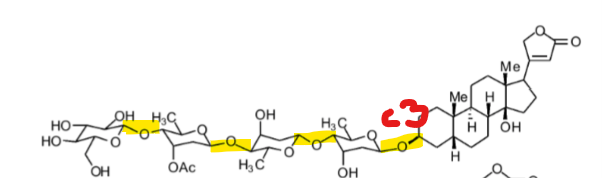
Where are sugars attached in cardiac glycosides?
Attached to the C-3 position of the aglycone via → a β-1-4-glycosidic linkage
Most commonly found sugars → D-glucose, D-digitoxose, L-rhamnose, and D-cymarose

What cardiac glycosides come from plants?
Digitalis lanata → leaf
Digitalis purpurea → leaf
Strophanthus Kombe → seed
MOA of cardiac glycosides?
Inhibit the Na⁺/K⁺-ATPase pump → which normally exchanges Na⁺ and K⁺ across the cell membrane → increase Ca+ so heart contract harder
What are the structural requirements for intrinsic activity of cardiac glycosides?
The C-D cis ring junction → is critical
α,β-unsaturated lactone ring, A-B cis ring junction, and 14-β-OH are → not essential and can be modified without major loss of activity
What drugs can decrease cardiac glycoside absorption?
Laxatives, antacids, antidiarrheals, and cholestyramine
How can protein-binding drugs increase cardiac glycoside toxicity?
They can displace digoxin/digitoxin from plasma proteins → increasing free drug → and increasing toxicity
What are the common signs of mild-to-moderate cardiac glycoside toxicity?
Anorexia
Nausea/vomiting
Muscle weakness
Bradycardia
Ventricular premature contractions
What are the signs of severe cardiac glycoside toxicity?
Blurred vision
Disorientation
Diarrhea
Ventricular tachycardia → may progress to ventricular fibrillation
What happens during cardiac glycoside toxicity?
Na⁺/K⁺-ATPase blocked → increases Na⁺ inside → which then increases Ca²⁺ inside via the Na/Ca exchanger → toxicity
Why does hypokalemia make cardiac glycoside toxicity worse?
Low K⁺ → further inhibits the Na⁺/K⁺ pump → increases Na⁺ and Ca²⁺ inside further → increasing toxicity
How is cardiac glycoside toxicity treated?
Stop the drug and give K⁺ salt
Increasing K⁺ → stimulates Na⁺/K⁺ pump → decreasing Na⁺ inside → and decreasing Ca²⁺ inside → therefore decreasing toxicity
What is amrinone used for?
Short-term IV treatment of severe heart failure that has not responded to other treatments
MOA of Amrinone?
Inhibits phosphodiesterase in the myocardium → increases cAMP → increases heart muscle contraction
Adverse effects of amrinone?
GI disturbances
Thrombocytopenia
Impairment of liver function
How is milrinone related to amrinone?
Is an analog of amrinone and is about 10× more potent
Same MOA
Adverse effects of Milrinone?
Better tolerated than amrinone
No apparent thrombocytopenia or GI disturbances
What are B-adrenergic receptor agonists?
Drugs that stimulate β₁ receptors in the heart → increase cAMP → increase the force of heart contraction
Ex → Dobutamine, IV only
What is the major limitation of B-adrenergic receptor agonists?
Myocardial B-receptor desensitization → receptors get used to it over time
Cardiac Arrhythmias?
Is an abnormal heartbeat caused by abnormal electrical impulses in the myocardium
Manifests as an abnormal rate, site, or conduction through the myocardium
What causes arrhythmias?
Pacemaker cells don't work properly or when there is a block in electrical transmission through the AV node
What underlying diseases can cause arrhythmias?
Atherosclerosis
Hyperthyroidism
Lung disease
What are the main classes of antiarrhythmic agents?
Class I: Sodium (Na⁺) channel blockers → IA, IB, IC
Class II → β-adrenergic receptor blockers
Class III → Potassium (K⁺) channel blockers
Class IV → Calcium (Ca²⁺) channel blockers
What is a general effect of many antiarrhythmic agents?
They are negative inotropic agents
They decrease the force of heart contraction
What are Class I antiarrhythmic drugs?
Drugs that block Na⁺ channels
Slows electrical conduction in the heart

How are Class I antiarrhythmics divided?
They are divided into IA, IB, and IC based on → their effects on Na⁺ channels and cardiac action potentials

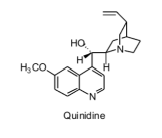
Quinidine?
Prototype Class IA antiarrhythmic
Is an alkaloid found in Cinchona bark
Adverse effects of Quinidine?
GI disturbances → nausea/vomiting, diarrhea, headache, dizziness
Anti-cholinergic effects

What is the relationship between quinidine and quinine?
Quinidine is a diastereomer of quinine
Same molecule formula/connectivity, different 3D orientation, but NOT mirror images of each other

Procainamide?
Class IA
Actions are similar to quinidine → may be effective in patients who are unresponsive to procaine
Is a non-hydrolyzable analog of procaine
Orally active

Adverse effects of Procainamide?
Drug-induced lupus syndrome
Anti-cholinergic effects

Disopyramide?
Class IA
Orally used for treatment of certain ventricular/atrial arrhythmias

Adverse effects of Disopyramide?
Anti-cholinergic effects
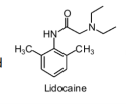
Lidocaine?
Class IB
Used for emergency treatment of ventricular arrhythmias
Only injection → IV
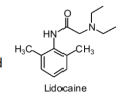
Adverse effects of Lidocaine?
CNS and cardiac effects
Dizziness, and paresthesia
Severe toxicity can lead to seizures

Tocainide?
Class IB
Similar to lidocaine → used to treat and prevent ventricular arrhythmias
Orally active
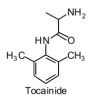
Adverse effects of Tocainide?
GI disturbance
CNS effects

Mexiletine?
Class IB
Oral activity
Similar adverse effects to those with tocainide/lidocaine
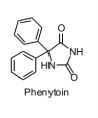
What is Phenytoin used for?
Treatment of arrhythmias from digitalis toxicity → digoxin, digitoxin
Oral / IV
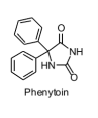
Why can phenytoin toxicity occur with highly protein-bound drugs?
It is highly plasma protein bound so drugs that displace/liberate phenytoin → increase free phenytoin → leading to toxicity
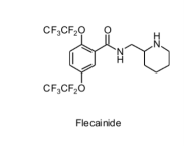
Flecainide?
Class IC
Orally active

Adverse effects of Flecainide?
Can aggravate existing arrhythmias or cause new arrhythmias → can be life-threatening
Other effects include blurred vision, headache, nausea, and abdominal pain

Encainide?
Class IC
Similar to flecainide → but has less negative inotropic effect
How do Class II antiarrhythmics work?
They block β₁-adrenergic receptors → blocking the effects of catecholamines → decreasing sympathetic activity → decreasing cAMP → decreasing Ca²⁺ influx → decreasing AV node conduction.

Propranolol?
Class II
Prototype
How do Class III antiarrhythmic drugs work?
Block K⁺ channels → slow repolarization → prolong the action potential and refractory period → help prevent abnormal heart rhythms

Bretylium Tosylate?
Class III
Injection → only used in hospital setting

Adverse effects of Bretylium Tosylate?
Hypotension, including → orthostatic hypotension
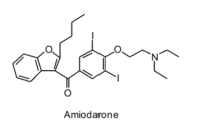
Amiodarone?
Class III
Has serious side effects, only should be used for → significant ventricular arrhythmias
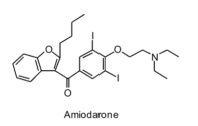
Common side effects of amiodarone?
Fatigue, tremor, nausea, and constipation

Serious adverse effects of amiodarone?
Lung toxicity, liver problems, arrhythmias, vision problems, and thyroid problems
It can also harm the baby during pregnancy/breastfeeding
How do Class IV antiarrhythmics work?
Block Ca²⁺ channels → slow conduction through the AV node → help control abnormal heart rhythms
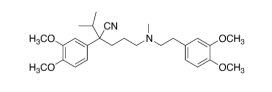
Verapamil?
Class IV
Prototype drug
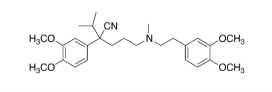
Adverse effects of verapamil?
Few AE with oral verapmil
IV → may lead to hypotension, bradycardia, or asystole in individuals with atrioventricular block