WOOD FRAME AND LIGHT RC CONSTRUCTION
 Call Kai
 Learn
Learn Practice Test
 Spaced Repetition
 Match
Match Flashcards
 Knowt Play
1/28

There's no tags or description
Looks like no tags are added yet.
Name | Mastery | Learn | Test | Matching | Spaced | Call with Kai | Chat |
|---|
No analytics yet
Send a link to your students to track their progress
29 Terms
Balloon Frame
This the lightest form of framing, in which the studding and corner posts are set up in continuous lengths from first floor line or sill to roof plate.
ribbons
Boards called __________ are notched and nailed into the studs and corner posts at the proper height to support the second story joists.
Combination Frame
A modification of the old braced frame which was of heavy timbers with every joint mortised and tenoned
Braced Frame
The frame of a building in which the resistance to lateral forces or to frame instability is provided by diagonal bracing, K-bracing, or other type of bracing.
Full Frame
Heavy, braced wood framing for a structure which uses girts that are mortised into solid posts; the posts are full frame height, with one-story-high studs between, usually diagonally braced.
Platform Frame
A system of framing for a building of wood construction several stories high, in which the studs are only one story high;
the floor joists for each story rest on the top plates of the story below or on the sole plate first story
Platform Frame
Also called Western Framing
Heavy Wood Framing of Beam and Girder Framing
This is the type of framing used in the Philippines in which the floor joists are carried by girders, and the roof trusses or rafters by girts which frame into the posts. Studs rest on floor sills and extend up the girder or girt in every floor.
Top Plate
The top horizontal member of a frame building to which the rafters are fastened.
Top Plate
The horizontal member at the top of the partition studs.
Sole Plate
Same as solepiece.
Sole Plate
A horizontal timber which serves as a base for the studs in a stud partition
Sole Plate
A plate riveted to the bottom flange of a plate girder to bear on the masonry plate.

Plain Joint (Lap Joint)
is used in very hasty construction for temporary framing and is made by lapping one piece over the other and nailing then together. It is not a very strong joint.
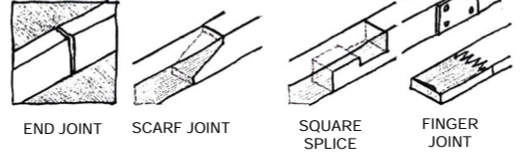
Butt or Square Joint (End Joint)
is made by placing full thickness of wood directly against the second piece. The butt end should be squared and the sides against which it butts smooth so that the pieces will be perpendicular to each other. The joint is toe-nailed.
Oblique Joint
This type of joint is made when the two pieces do not meet at right angles, e.g. bracings. One piece is cut at an angle to fit the other and the two pieces nailed securely together.

Scarf Joint
A joint by which the ends of two pieces of timber are united to form a continuous piece; the mating surface may be beveled, chamfered, notched, etc. before bolting, gluing, welding, etc

Scarf Join
In welding, a butt joint between tow pieces of metal whose ends are beveled. In electrical systems, a joint in electrical cable in which the ends are beveled before soldering.

Mortise and Tenon Joint.
This type of joint is used for building wooden framework where great strength and rigidity are all important. It is made by cutting a hole or mortise in one piece and a tenon or tongue in the second piece to fit the hole in the other. The tenon may extend fully through the other piece or only part of the way.
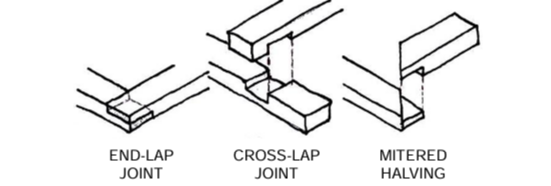
Halved Joint
This joint is made by cutting half the thickness of the wood from each piece at the ends to be joined so as to bring the sides flush. The purpose of this type of joint is to maintain a level surface at the joint.
Rabbet Joint
This joint is made by cutting a shoulder or edge from one piece to receive the other piece. It is used in window or door frames, or in shelf and drawer construction.
Dado Joint
This is similar in shape and purpose to the rabbet joint.

Dado Joint
a groove is made in one piece at right angles to the grain of the other board. If nails are used, they are needed only at the end piece since the groove will provide the necessary strength to hold the other piece in place.

Miter Joint
a joint between two pieces which come together at a corner.

Miter Joint
It is made by cutting the two ends at angles complementary to each other, usually 45, and then butting them together. The joint is secured by clamp nails or finishing nails, corrugated fasteners or dowels, or by gluing.

Dovetail Joint.
This type of joint, used for cabinet work and furniture work, is strong and durable. It is made by cutting a pin in the shape of a dovetail in one piece to fit a groove similarly shaped in the other piece.

Coped Joint
used when fitting one piece of moulding at right angles to the second piece.
Shiplap, shiplap boards, shiplap siding
Wood sheathing whose edges are rabbeted to make an overlapping joint.
Tongue and Groove Joint, T & G Joint
A joint formed by the insertion of the tongue of one member into the corresponding groove of another.