Ch. 5 Bonding and Intermolecular Forces
 Call Kai
 Learn
Learn Practice Test
 Spaced Repetition
 Match
Match Flashcards
 Knowt Play
1/12

There's no tags or description
Looks like no tags are added yet.
Name | Mastery | Learn | Test | Matching | Spaced | Call with Kai | Chat |
|---|
No analytics yet
Send a link to your students to track their progress
13 Terms
The physical properties of a substance are determined at the molecular level, and the chemistry of molecules is dominated by the reactivity of covalent and ionic bonds. An understanding of fundamentals of bonding can provide an intuitive grasp necessary to answer a wide range of questions in both general and organic chemistry. This chapter will briefly outline some basic principles, that when mastered, will help lay a strong foundation for many chemistry concepts you will encounter on the MCAT.
5.1 Lewis Dot Structures
Each dot in the picture below represents on of fluorine’s valence electrons. Fluorine is a halogen, with a general valence-shell configuration of ns2np5, so there are 2+5=7 electrons in its valence shell. We simply place the dots around the symbol for the element, one on each side, and, if there are more than 4 valence electrons, we just start pairing them up. So, for fluorine, we’d have:
-take a picture of fluorine on page 90 and attach it to this flashcard
This is known as the Lewis dot symbol. Here are some others:
-take a picture of the other atoms with the dots on page 90 and attach it to the next flashcard
example 5-1
Lewis dot structures cont
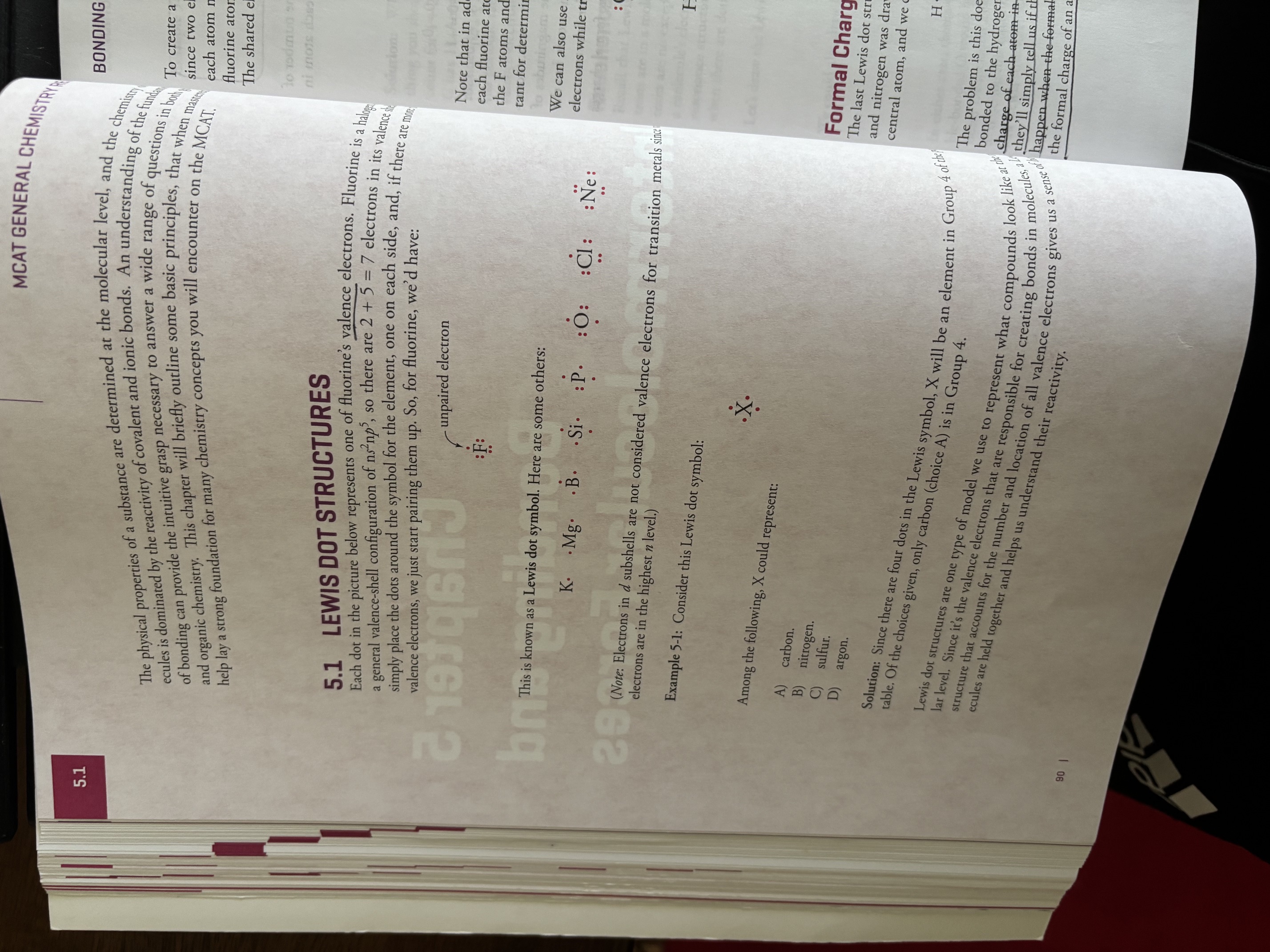
To create a lewis dot structure for a molecule, we begin to pair up electrons from two separate atoms, since two electrons are required to form a single bond. By sharing a pair of electrons to form a bond, each atom may acquire an octet configuration, thereby stabilizing both atoms. For example, each of the fluorine atoms below can donate its unpaired valence electron to form a bond and give the molecule F2. The shared electrons are attracted by the nuclei of both atoms in the bond, which hold the atoms together:
attach the picture at the top of page 91 to this flashcard.
Lewis dot structures cont
Note that in addition to the single bond (a bond formed from two electrons) between the fluorine atoms, each fluorine atom has three pairs of electrons that are not part of a bond. They help satisfy the octets of the F atoms and are known as “lone pairs” of electrons. We’ll see in a bit how these lone pairs are important for determining physical properties compounds, so don’t forget to write these out too.
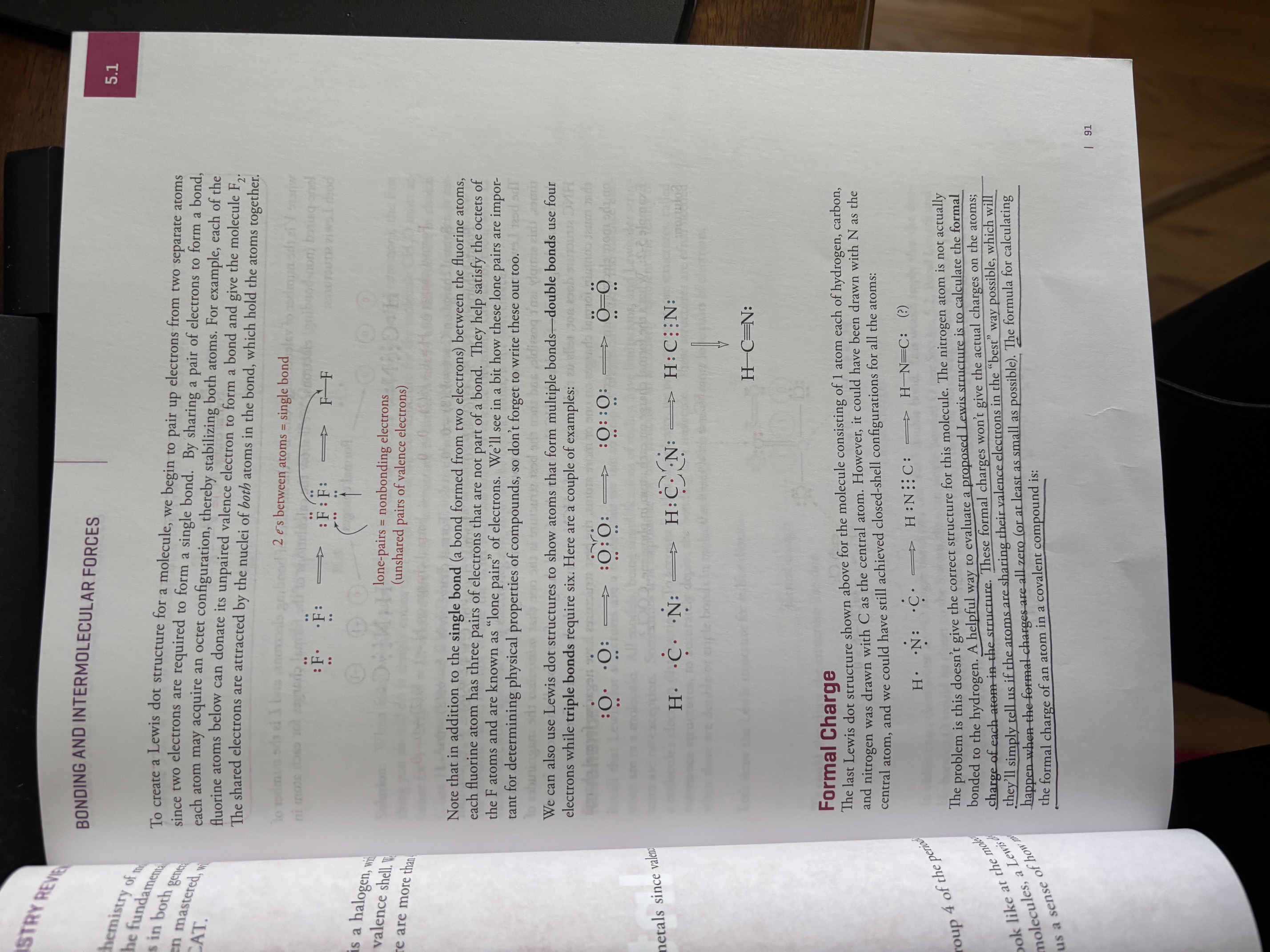
We can also use Lewis Dot Structures to show atoms that form multiple bonds-double bonds use four electrons while triple bonds require six. Here are a couple of examples:
please attach the picture in the middle of page 91 to this flashcard
Formal charge
The last Lewis dot structure shown above for the molecule consisting of 1 atom each of hydrogen, carbon, and nitrogen was drawn with C as the central atom. However, it could have been drawn with N as the central atom, and we could have still achieved closed-shell configurations for all the atoms:
attach the picture at the bottom of page 91 to this flashcard
The problem is this doesn’t give the correct structure for this molecule. The nitrogen atom is not actually bonded to the hydrogen. A helpful way to evaluate a proposed is to calculate the formal charge of each atom in the structure. These formal charges won’t give the actual charges on the atoms; they’ll simply tell us if the atoms are sharing their valence electrons in the “best” way possible, which will happen when the formal charges are all zero (or at least as small as possible). The formula for calculating the formal charge of an atom in a covalent compound is:
Formal Charge (FC)=V-1/2B-L
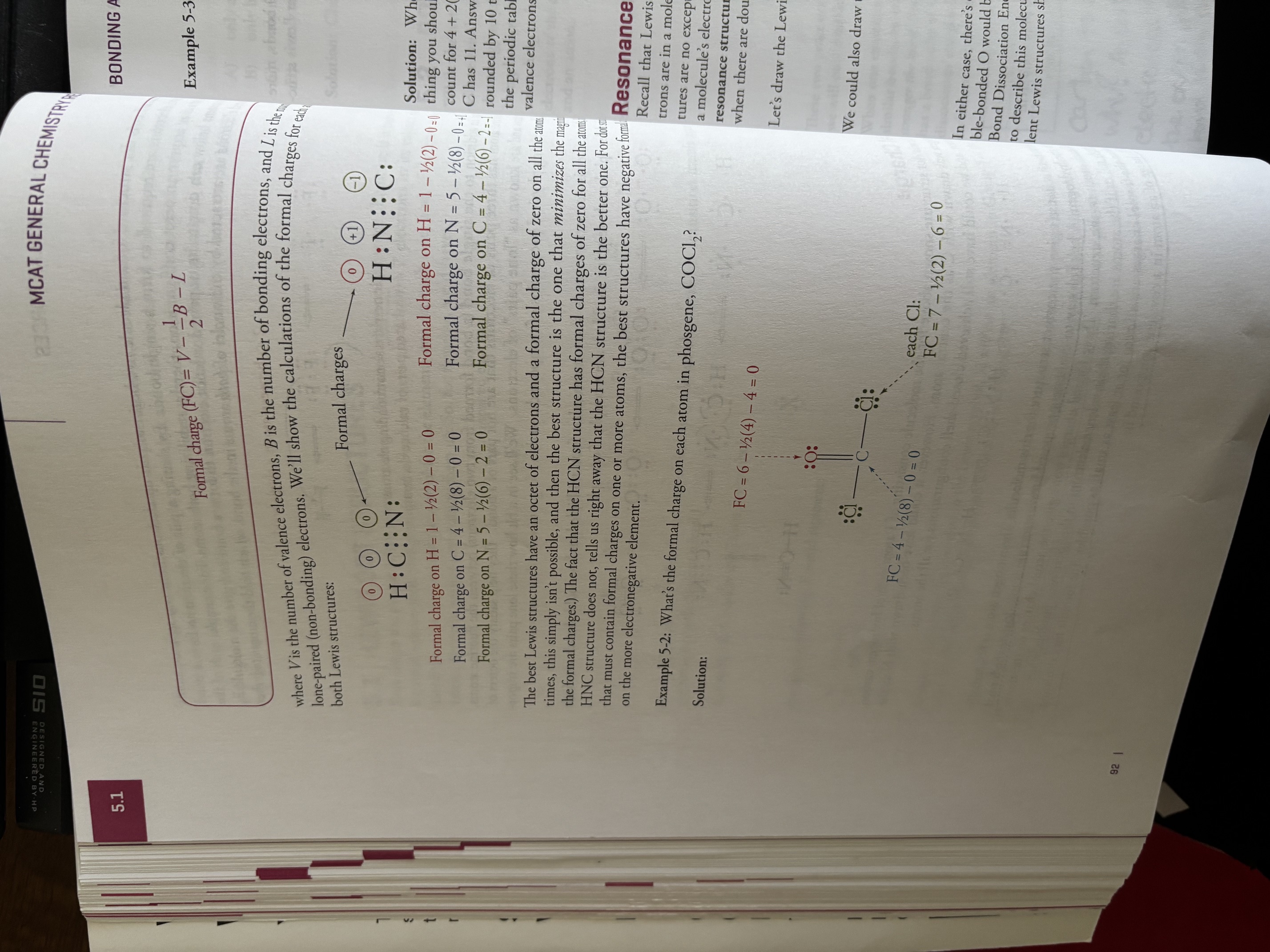
where V is the number of valence electrons, B is the number of bonding electrons, and L is the number of lone-paired (non-bonding) electrons. We’ll show the calculations of the formal charges for each atom in both Lewis Structures:
attach the picture in the middle of page 92 to the next flashcard
Formal charge con’t
The best Lewis structures have an octet of electrons and a formal charge of zero on all the atoms. (Sometimes, this simply isn’t possible, and then the best structure is the one that minimizes the magnitude of the formal charges). The fact that the HCN structure has formal charges of zero for all the atoms, but the HNC structure does not, tells us right away that the HCN structure is the better one. For dot structures that must contain formal charges on one or more atoms, the best structures have negative formal charges on the more electronegative element.


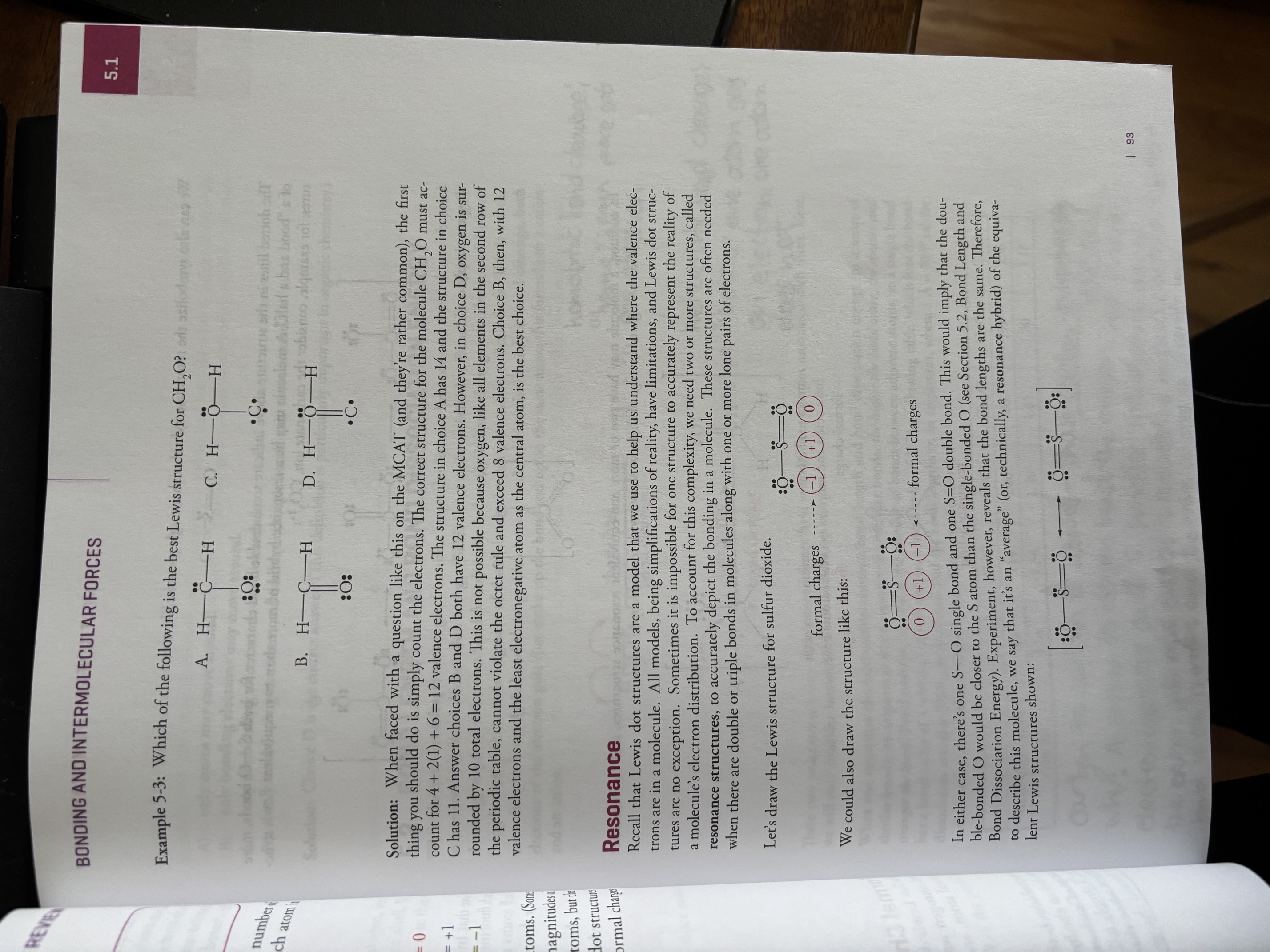
put example 5-3 here
Resonance
Recall that Lewis dot structures are a model that we use to help us understand where the valence electrons are in a molecule. All models, being simplifications of reality, have limitations, and Lewis dot structures are no exception. Sometimes, it is impossible for one structure to accurately represent the reality of a molecule’s electron distribution. To account for this complexity, we need to or more structures, called resonance structures, to accurately depict the bonding in a molecule. These structures are often needed when there are double or triple bonds in molecules along with one or more lone pairs of electrons.
finish the rest of 93-94

5.2 Bond length and bond dissociation energy
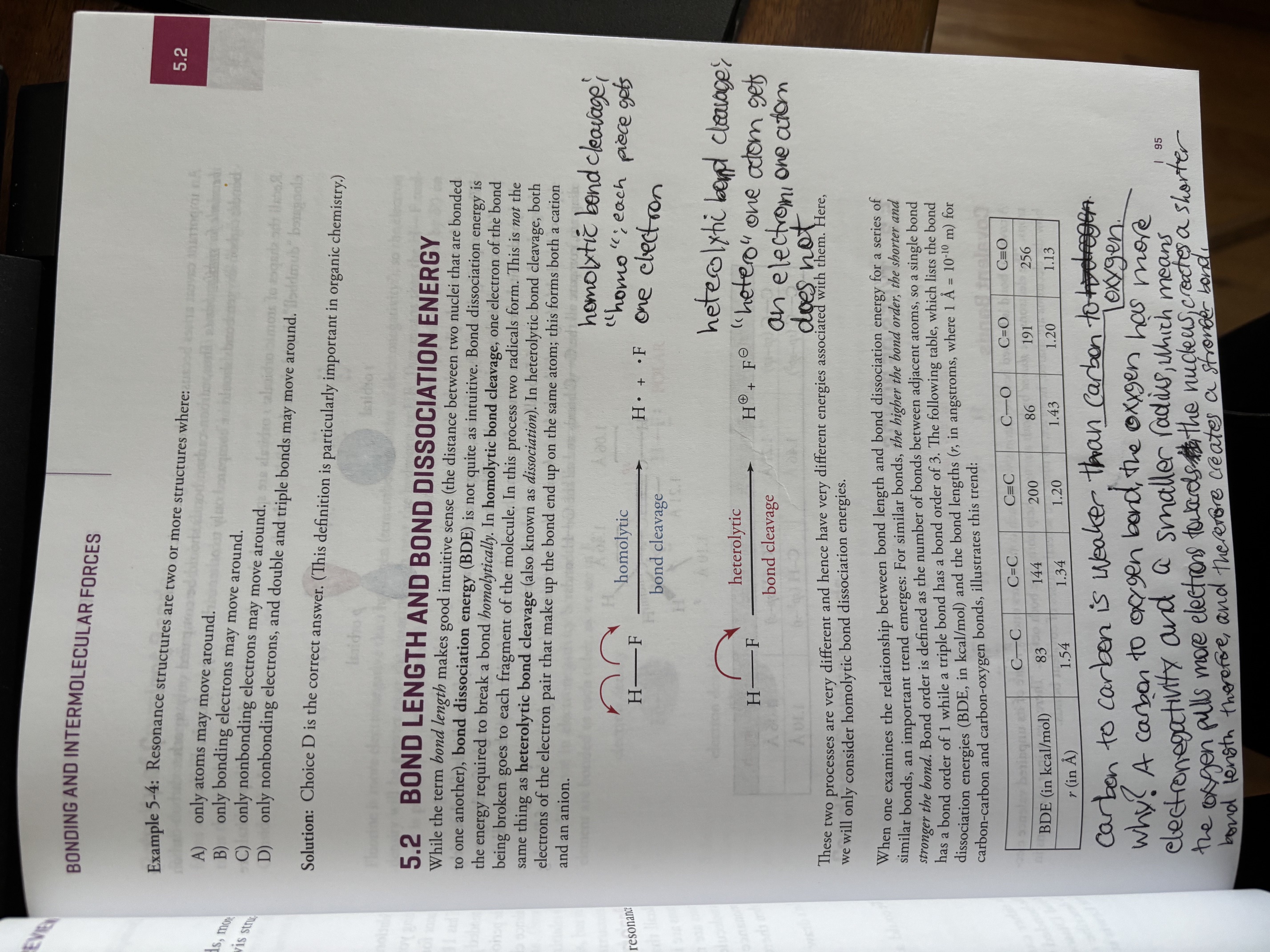
While the term bond length makes good intuitive sense (the distance between two nuclei that are bonded to one another), bond dissociation energy (BDE) is not quite as intuitive. Bond dissociation energy is the energy required to break a bond homolytically. In homolytic bond cleavage, one electron of the bond being broken goes to each fragment of the molecule. In this process two radicals form. This is not the same thing as heterolytic bond cleavage (also known as dissociation). In heterolytic bond cleavage, both electrons of the electron pair that make up the bond end up on the same atom: this forms both a cation and an anion.
attach the picture in the middle

5.2 Bond length and bond dissociation energy con’t
These are two processes are very different and hence have very different energies associated with them. Here, we will only consider hemolytic bond dissociation energies.
When one examines the relationship between bond length and bond dissociation energy for a series of similar bonds, an important trend emerges: For similar bonds, the higher the bond order, the shorter and stronger the bond. Bond order is defined as the number of bonds between adjacent atoms, so a single bond has a bond order of 1 while a triple bond has a bond order of 3. The following table, which lists the bond dissociation energies (BDE, in kcal/mol) and the bond lengths (r, in angstroms, where 1 A= 10-10 m) for carbon-carbon and carbon-oxygen bonds, illustrates this trend:
attach the table at the bottom of page 95 to this flashcard

5.2 Bond length and bond dissociation energy con’t
An important caveat arises because of the varying atomic radii: bond length/BDE comparisons should only be made for similar bonds. Thus, carbon-carbon bonds should be compared only to other carbon-carbon bonds; carbon-oxygen should be compared only to other carbon-oxygen bonds, and so on.
Recall the shapes of atomic orbitals: s orbitals are spherical about the atomic nucleus, while p orbitals are elongated “dumbbell"-shaped about the atomic nucleus.
please attach the picture of the s orbital and p orbital to page 96.
5.2 Bond length and bond dissociation energy con’t
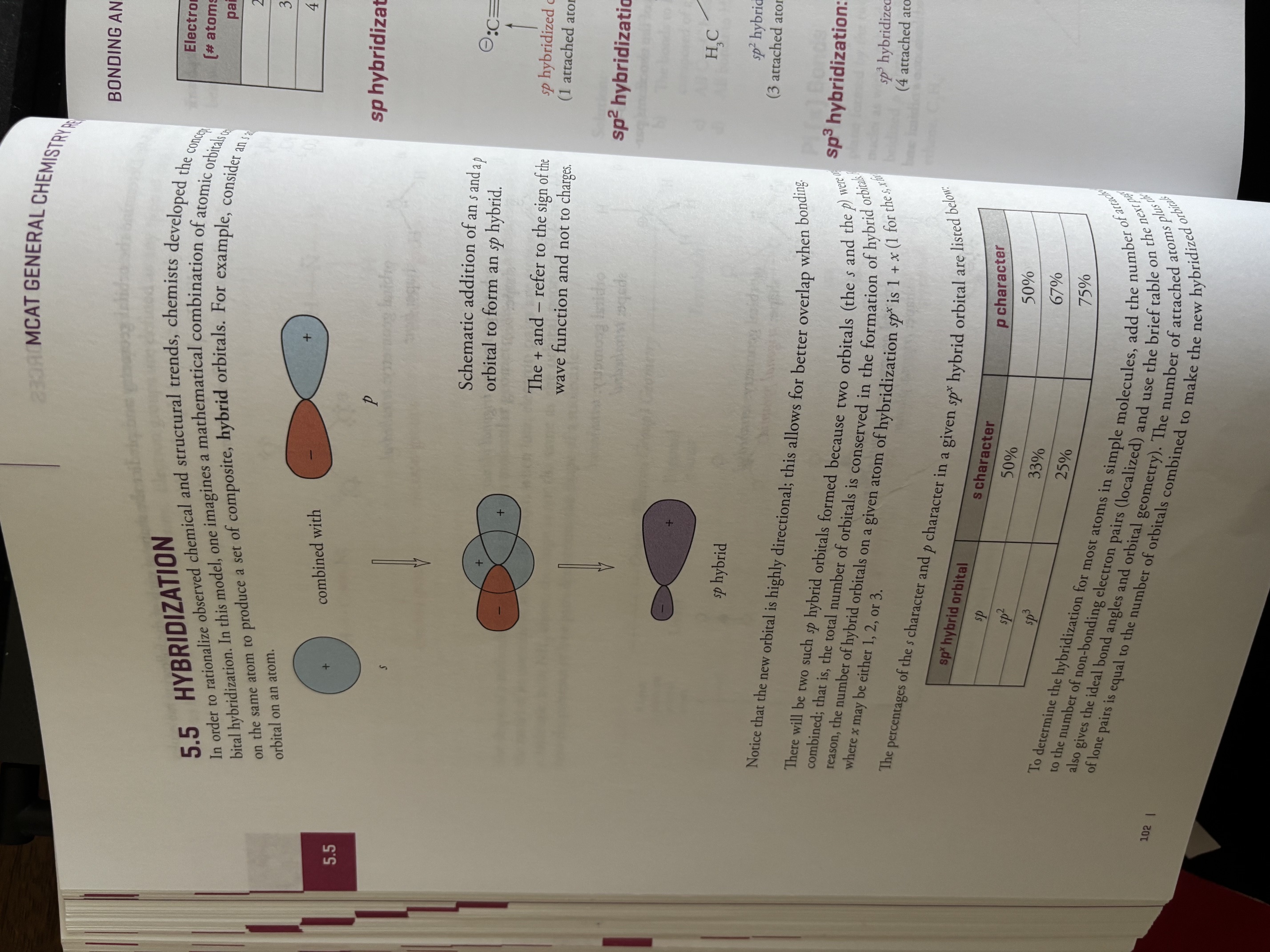
When comparing the same type of bonds, the greater the s character in the hybrid orbitals, the shorter the bond (because s-orbitals are closer to the nucleus than p-orbitals). A greater percentage of p character in the hybrid orbital also leads to a more directional hybrid orbital that is farther from the nucleus and thus a longer bond. In addition, when comparing the same types of bonds, the longer the bond, the weaker it is, the shorter the bond, the stronger it is. In the following diagram, compare all the C-C bonds and all the C-H bonds.
please attach the diagram in the middle of page 96
5.3 Types of Bonds
Covalent Bonds
A covalent bond is formed between atoms when each contributes one or more of its unpaired valence electrons.
The electrons are shared by both atoms to help complete both octets. There are minor variations in how the electrons are shared, however, so there are several classes of covalent bonds.

5.3 Types of Bonds
Polarity of covalent bonds
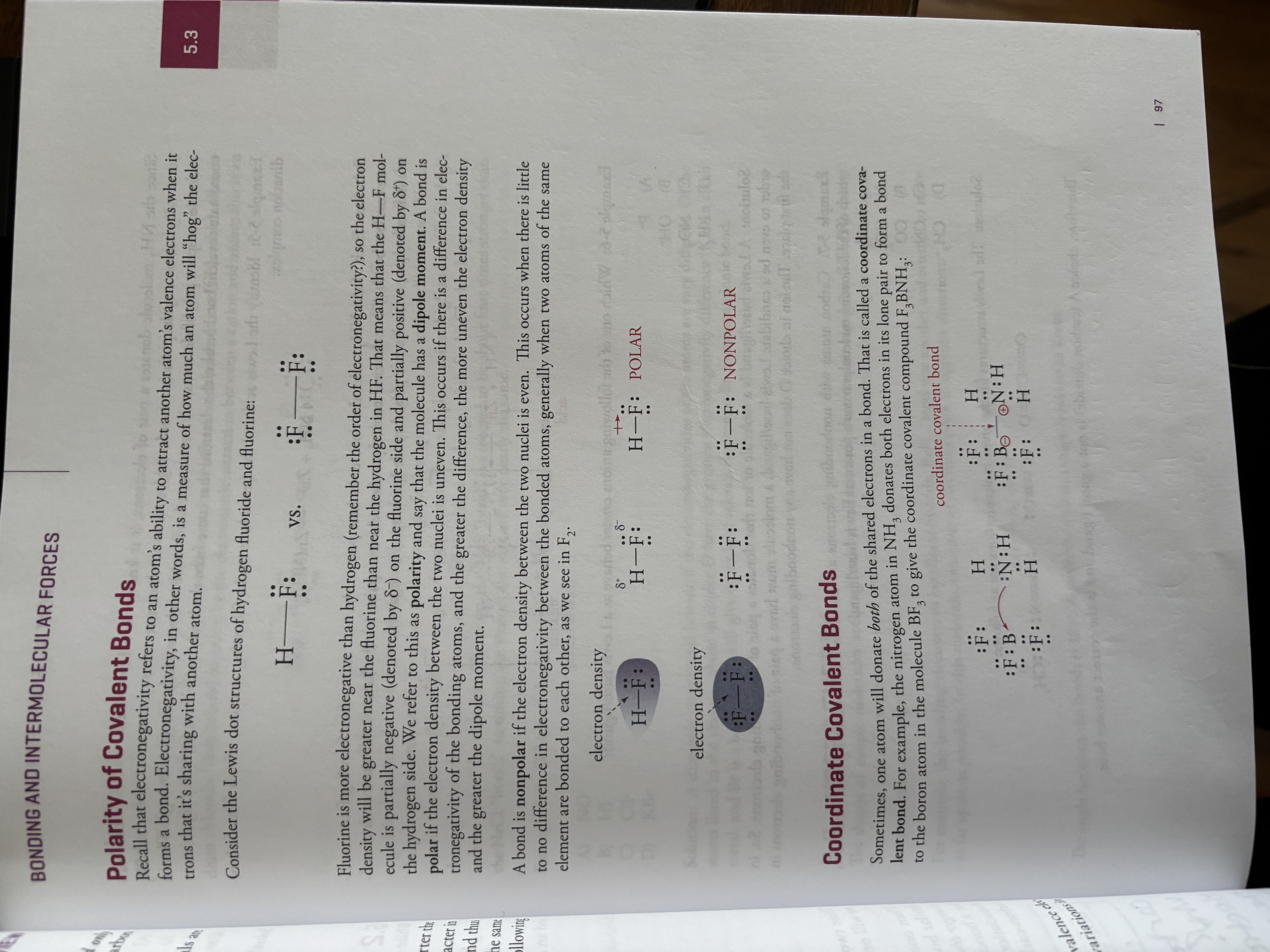
Recall that electronegativity refers to an atom’s ability to attract another atom’s valence electrons when it forms a bond. Electronegativity, in other words, is a measure of how much an atom will “hog” the electrons that it’s sharing with another atom.
Consider the Lewis dot structures of hydrogen fluoride and fluroine:
-please attach to the picture of the H-F and F-F to this flashcard
Fluorine is more electronegative than hydrogen (remember the order of electronegativity?0, so the electron density will be greater near the fluorine than near the hydrogen in HF. That means the H-F molecule is partially negative (denoted by partial negative charge) on the flurorine side and partially positive (denoted by partial positive charge) on the hydrogen side. We refer to this as polarity and say that the molecule has a dipole moment. A bond is polar if the electron density between the two nuclei is uneven. This occurs if there is a difference in electronegativity of the bonding atoms, and the greater the difference, the more uneven the electron density and the greater the dipole moment.
A bond is nonpolar if the electron density between the two nuclei is even. This occurs when there is little to no difference in electronegativity between the bonded atoms, generally when two atoms of the same elements are bonded to each other, as we see in F2.
please attach the picture of “electron density” on the middle of page 97 to this flashcard
Coordinate covalent bonds
Sometimes, one atom will donate both of the shared electrons in a bond. That is called a coordinate covalent bond. For example, the nitrogen atom in NH3 donates both electrons in its lone pari to forma bond to the atom in the molecule BF3 to give the coordinate covalent compound F3BNH3.
please put a picture of the coordinate covalent bond on the bottom of page 97 on this flashcard
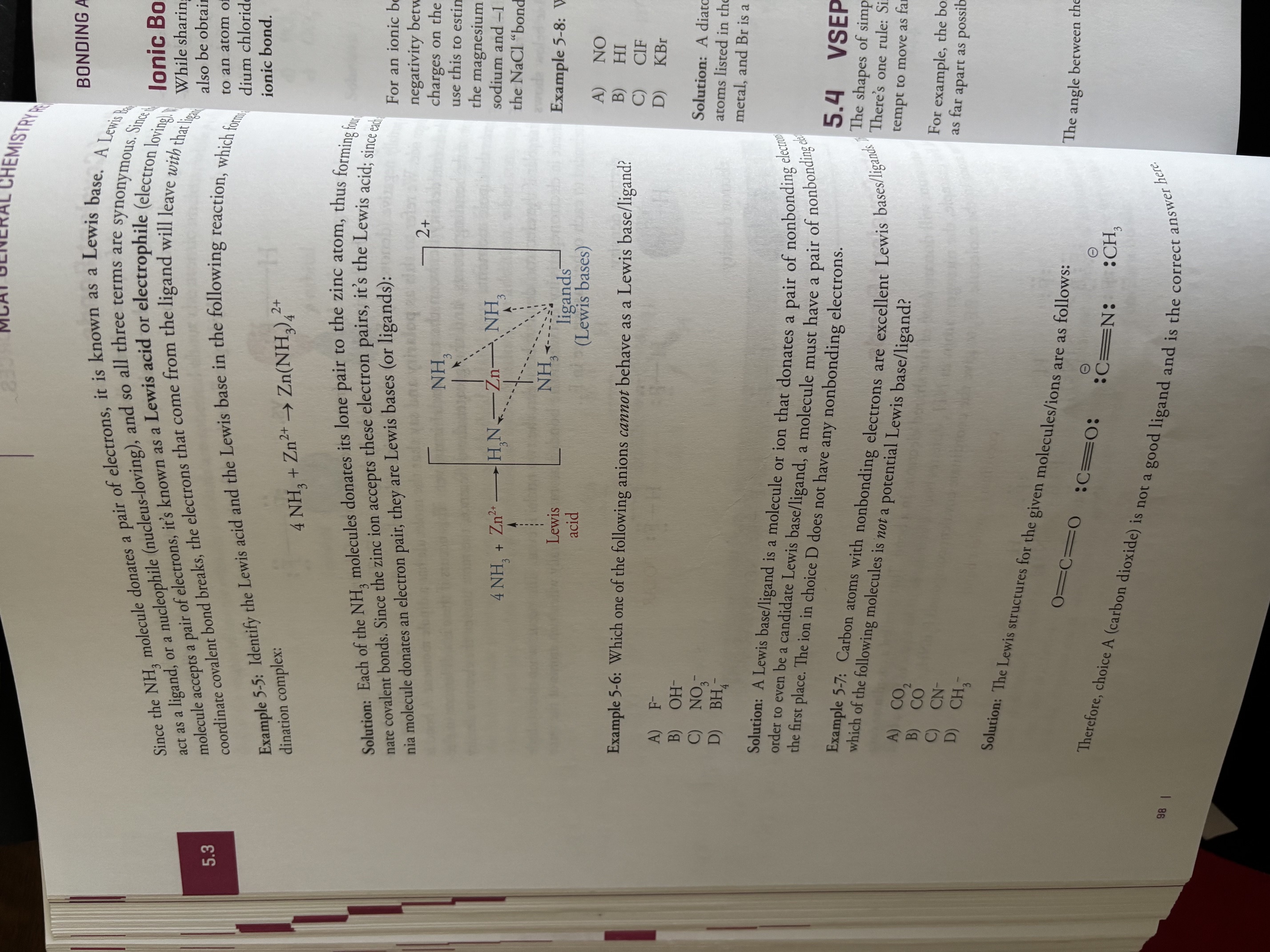
Since the NH3 molecule donates a pair of electrons, it is known as a Lewis base. A lewis base can act as a ligand, or a nucleophile (nucleus-loving), and so all three terms are synonymous. Since the BF3 molecule accepts a pair of electrons. It’s known as a Lewis acid or electrophile (electron-loving). When a coordinate covalent bond breaks, the electrons that come from the ligand will leave with that ligand.
ionic bonds
While sharing valence electrons is one way to achieve the stable octet configuration, the octet may also be obtained by gaining or losing electrons. For example, a sodium atom will give its valence electron to an atom of chlorine. This results in a sodium cation (Na+) and a chloride anion (Cl-), which form sodium chloride. They’re held together by the electrostatic attraction between a cation and anion; this is an ionic bond.
put the picture in the upper middle on page 99 on this flashcard
For an ionic bond to form between a metal and non-metal, there has to be big difference in electronegativity between the two elements. Generally speaking, the strength of the bond is proportional to the charges on the ions, and it decreases as the ions get farther apart, or as the ionic radii increase. We can use this to estimate the relative strength of ionic systems. For example, consider MgS and NaCl. For MGS, the magnesium ion has a +2 charge and sulfide ion has a -2 charge, while for NaCl, the charges are +1 for sodium and -1 for chloride. Therefore, the MgS “bond” is expected to be about four times stronger than the NaCl “bond”, assuming the sizes of the ions are very nearly the same.

5.4 VSEPR Theory
The shapes of simple molecules are predicted by the valence shell electron-pair repulsion (VSEPR) theory. There’s one rule: Since electrons repel one another, electrons pairs, whether bonding or nonbonding, attempt to move as far apart as possible.
For example, the bonding electrons in beryllium hydride, BeH2, repel one another and attempt to move as far apart as possible. In this molecule, two parts of electrons point in opposite directions:
-attach the picture on the bottom of page 99 to this flashcard
The angle between the bonds is 180 degrees. A molecule with this shape is said to be linear.
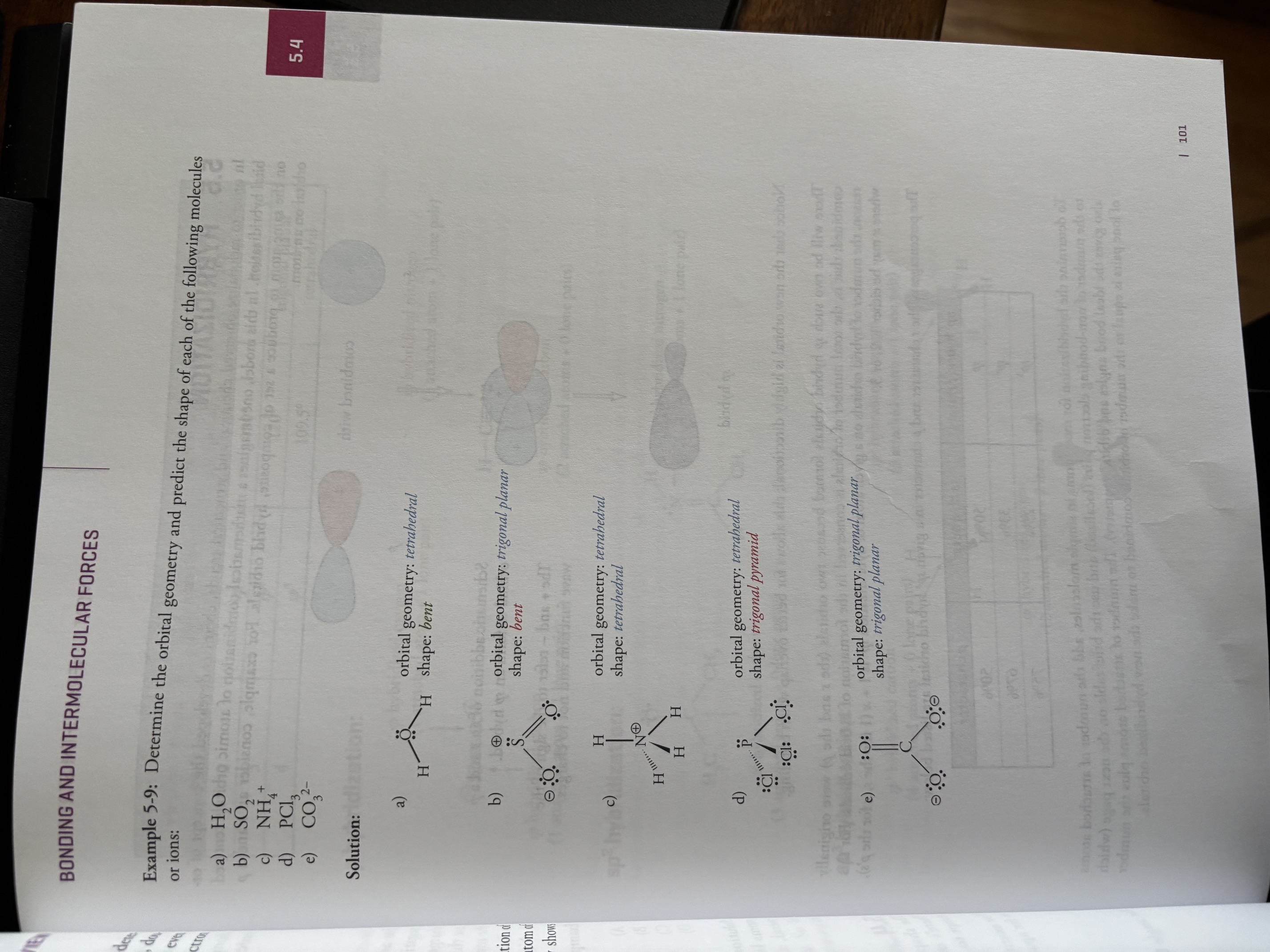
As the BeH2 example shows, the total number of electron groups on the central atom of a molecule determines the bond angles and orbital geometry. Electron groups are defined as any type of bond (single, double, triple) and lone pairs of electrons. Double and triple bonds count only as one electron group, even though they involved two and three pairs of electrons, respectively. To illustrate, the number of electrons groups and orbital geometries of the central atom are shown for some example molecule:
attach the “electron group” photos to the flashcard below

The shape of a molecule (also referred to as the molecular geometry) is also a function of the location of the nuclei of its constituent atoms. Therefore, when the lone electron pairs are present on the central atom of a molecule, as in NH3 above, the shape is not the same as the orbital geometry. The table below shows how the presence of lone pairs determines the shape of a molecule:
take a picture of the bottom of page 100 and add it to this flashcard.