Ch.5 DNA Replication I
 Call Kai
 Learn
Learn Practice Test
 Spaced Repetition
 Match
Match Flashcards
 Knowt Play
1/53

There's no tags or description
Looks like no tags are added yet.
Name | Mastery | Learn | Test | Matching | Spaced | Call with Kai | Chat |
|---|
No analytics yet
Send a link to your students to track their progress
54 Terms
Mitosis
A single parental cell divides to produce 2 identical daughter cells
Meiosis
A cell with diploid genome produces 4 haploid germ cells
DNA replication is essential for life and as a process, it must be…
accurate (make few mistakes)
fast
complete
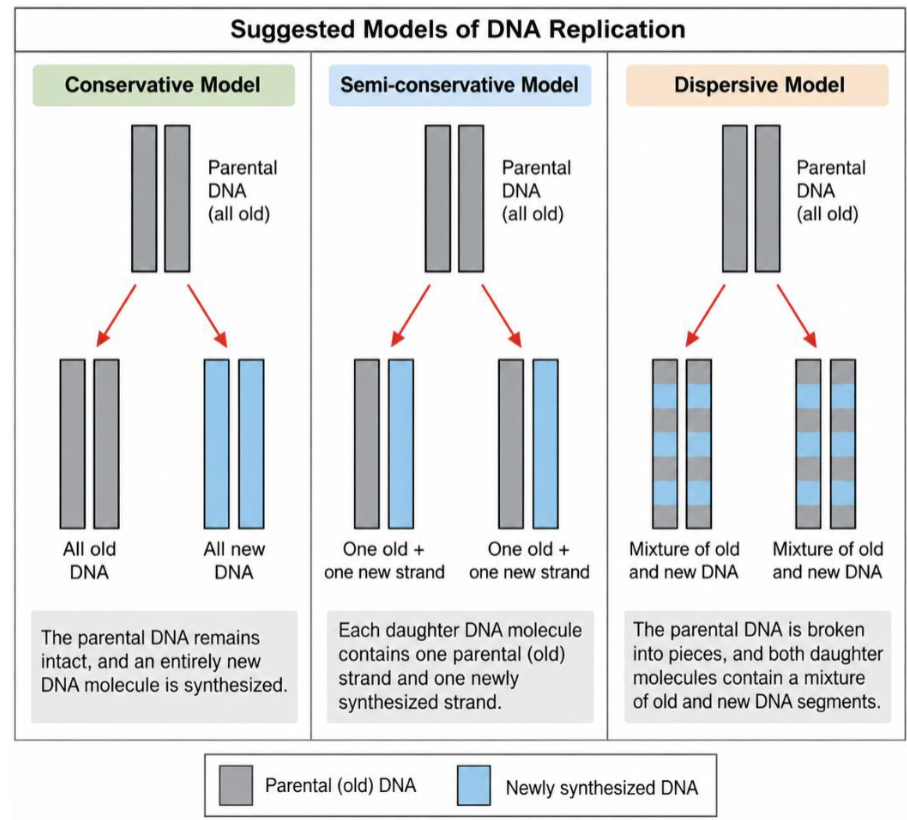
What were the 3 suggested models of DNA replication?
conservative
semiconservative
dispersive
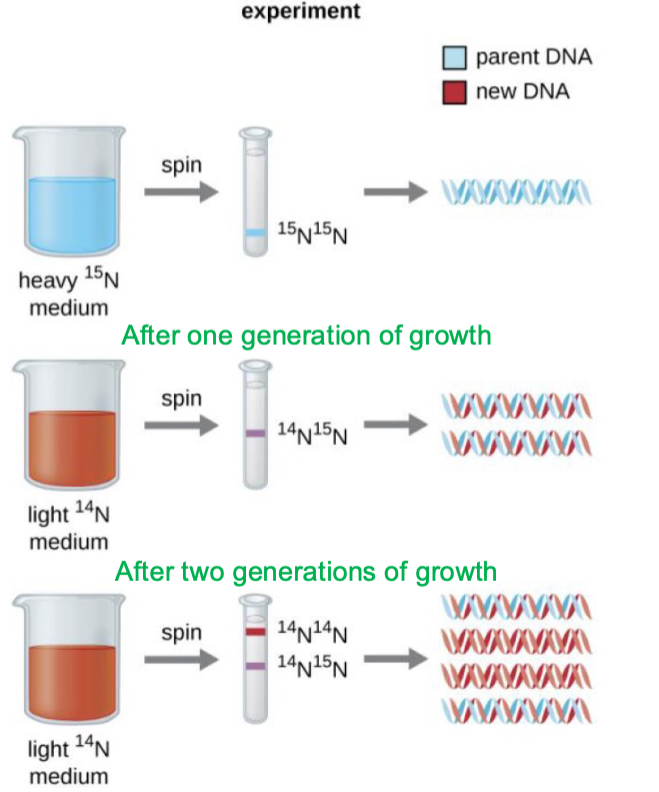
What was the Meselson and Stahl experiment?
It tested the 3 models of DNA replication.
E. coli cells were grown in a medium containing the heavy 15N isotope. After many generations, all of the DNA in the cells had become labeled with the heavy isotope.
The 15N-tagged cells were transferred to a medium containing the light 14N isotope and allowed to grow for exactly one generation or two generations
14N-labeled and 15N-labeled DNA would form separate bands after centrifugation on CsCL (Cesium chloride) density gradients

In the Meselson and Stahl experiment what was the observation after one generation of growth?
DNA formed a single band with a density between that of 15N-labeled DNA and 14N-labeled DNA
14N15N hybrid DNA
Eliminates the conservative model of DNA replication

In the Meselson and Stahl experiment what was the observation after two generations of growth?
DNA formed 2 bands of DNA
14N14N light DNA
14N15N hybrid DNA
eliminates the dispersive model of DNA replication
DNA replication is…
conservative, semi-conservative or dispersive?
semi-conservative
What does semi-conservative DNA replication mean?
each time a chromosome is replicated, an older “template” strand is used to copy a new strand
Each chromosome after replication is half-old, half-new

John Cairns’ experiment (1963)
• Grew E. coli in ³H-thymidine (3H-T) to make its DNA radioactive.
• Extracted the DNA (during replication) and allowed it to adhere to membranes.
• A sensitive film was placed over the membrane, and time was allowed for the
radiation to expose the film, which was later developed to generate the
autoradiographs.
• The dark lines in the autoradiographs revealed the pattern of replicating DNA
molecules.
• Observation: Theta (θ)-shaped replication structures.
• Inference: Replication starts at a single origin of replication on the bacterial
chromosome, proceeding around the circle to completion.

Where does DNA replication start?
at a single origin of replication


Cairns’ theta images showed that DNA replication involves the formation of a replication bubble and replication forks (Y-shaped junctions). What is happening at these forks?
DNA is being separated and replicated

Uni-directional replication
A new DNA molecule is synthesized in one direction only. DNA unwinds at ONE replication fork and moves around the entire circular DNA until complete.

Bi-directional replication
There are 2 growing points, where DNA unwinds and new DNA is synthesized at both replication forks until they meet at the opposite end from the origin of replication

Is DNA replication uni-directional or bi-directional?
bi-directional
David Prescott’s experiments
• Cells were labeled with 3H-thymidine with low specific activity to lightly label the replication bubble.
• Then the cells were labeled with a much stronger radioactive isotope for a short time.
• Any newly synthesized DNA would be labeled with the stronger label and appear darker.
• Visualization of chromosome revealed darker segments on BOTH ends of the replication bubble.
Conclusion:
• Replication indeed begins at an origin of replication, but that double helix then unwinds in opposite directions, replicating DNA both ways away from the origin from two replication forks.
• DNA replication is bidirectional
DNA polymerase
a class of enzymes that catalyze the step-wise addition of nucleotides to a DNA strand
template-directed enzyme
DNA polymerase synthesizes a product with a base sequence complementary to that of the template
True or False: All DNA polymerase discovered to date can only elongate a preexisting DNA or RNA strand, they cannot initiate chains.
True
If a DNA strand breaks in ½ , can polymerase replicate the chain like it was before?
No
True or False: RNA polymerases require a preexisting base-paired 3’ end to initiate synthesis.
False, it does not require a preexisting base-paired 3’ end to initiate synthesis
RNA polymerase is also called…
primase

Primase (RNA polymerase)
synthesizes a short stretch of RNA, called RNA primer, that base-pairs with the parental DNA template

Can RNA primer be made anywhere on the strand?
Yes
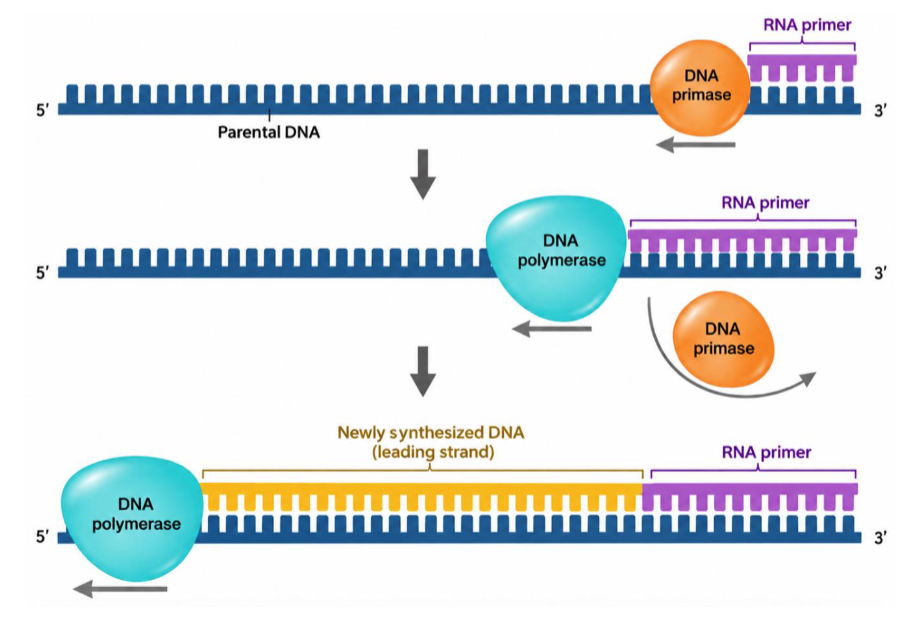
How does DNA polymerase add new DNA nucleotides to the new DNA strand?
Because RNA and DNA are chemically similar, DNA polymerases can extend from the primers free 3’-OH group, adding DNA nucleotides to synthesize the new DNA strand
primer-template junction
substrate recognized by DNA polymerases, which extends to the new DNA strand from the primers free 3’-OH group

Is primase quick or slow?
relatively slow
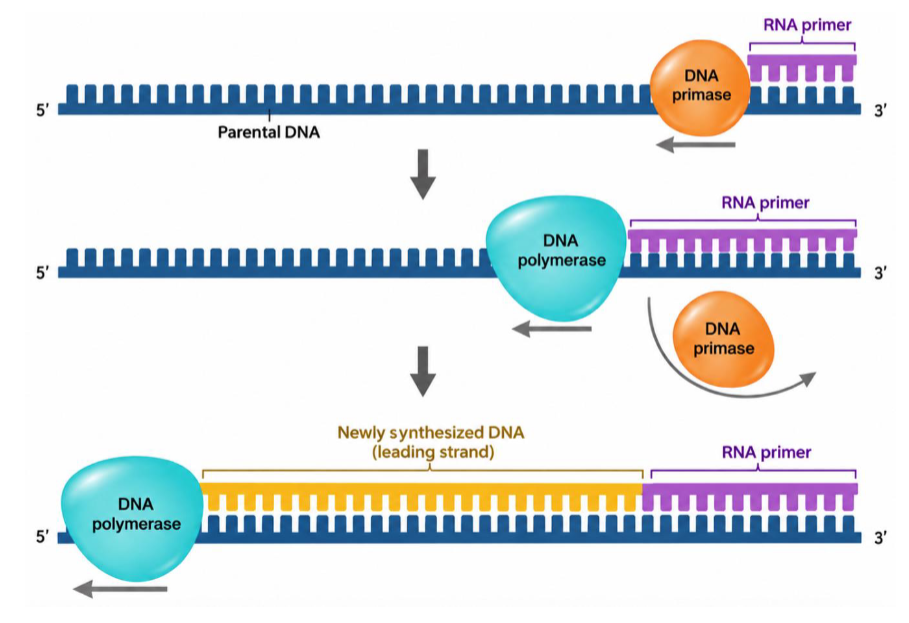
error-prone polymerase
primase

Is it ok if primase is relatively slow and error-prone?
its low accuracy is not a major concern because the RNA primers are later removed and replaced with DNA nucleotides during DNA replication

DNA polymerase catalyzes the addition of an incoming dNTP (deoxyribosenucleoside triphosphate) complementary to the template strand, to the what?
3’-OH group of the last nucleotide in the growing DNA strand

DNA synthesis occurs through the nucleophilic attach by the 3’-OH group of the last nucleotide of growing strand on the alpha phosphate of the incoming dNTP. The 5’ phosphate of the new nucleotide binds to what?
the 3’-OH group of the nucleotide to make a phosphodiester bond
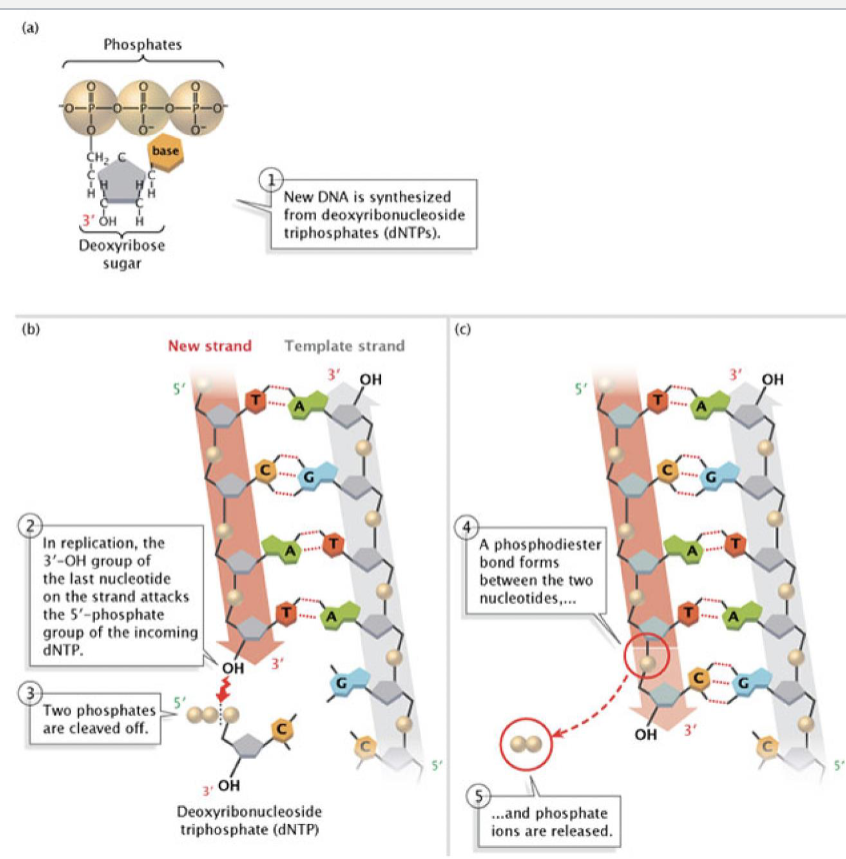
The immediate hydrolysis of the pyrophosphate that is cleaved off helps with what?
the incoming dNTP drives the reaction forward

Each added nucleotide provides a new…
3’-OH, allowing the chain to be extended for as long as the DNA polymerase continues to synthesize the new strand
DNA polymerases can only extend in what direction?
in 5’ to 3’ direction

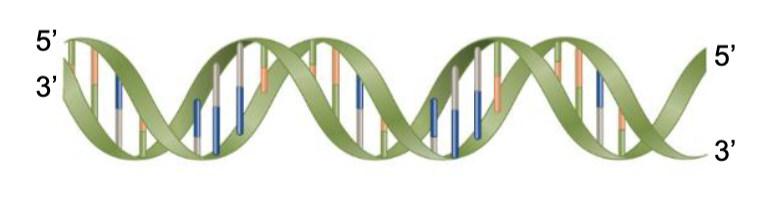
What occurs to the 2 parental DNA strands at the replication fork?
They are separated and act as templates for making new daughter strands
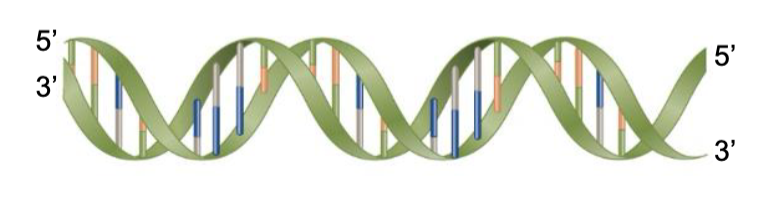
Fill in the blank: Based on the structure of the DNA double helix, the newly synthesized must run ____________ to its parental template strand.
antiparallel

At the replication fork one template runs 3’ —> 5’ toward the replication fork. DNA polymerase can follow this template and make the new strand 5’—> 3’ toward the fork. What’s the issue with the other template?
It runs 5’ —> 3’ toward the replication fork. Its new strand must be antiparallel, so it would need copy DNA discontinusoly in the 5’ —> 3’ direction.

Leading strand synthesis is continuous. What is the lagging strand?
discontinuous
DNA polymerase can still synthesize DNA 5’ —> 3’, but this direction is away from the replication fork.
Therefore, the new strand is synthesized discontinuously in short DNA segments

DNA ligase
joins the short DNA fragments together to form one continuous DNA strand

Okazaki fragments
the short stretches of DNA generated during lagging strand synthesis

True or False: Okazaki fragments are longer in prokaryotes than in eukaryotes.
True
• Bacteria: 1,000–2,000 nucleotides
• Higher organisms: 100–200 nucleotides
DNA polymerase has a similar shape to what?
a right hand

DNA polymerase contains what 3 domains? Out these 3 which is the most highly conserved?
fingers
thumb
palm - the most highly conserved of the 3 domains

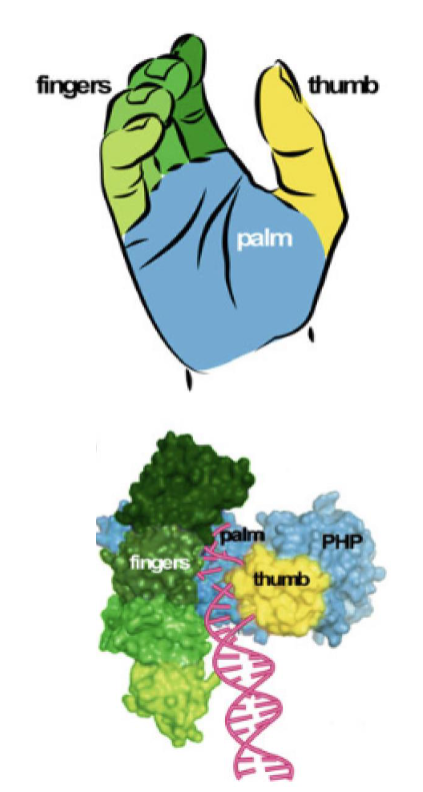
What is the function of the fingers in DNA polymerase?
bind the incoming dNTP

What is the function of the thumb in DNA polymerase?
helps grip the double-stranded DNA in place

What is the function of the palm in DNA polymerase?
contains the active site where DNA synthesis is catalyzed
What is the accuracy of DNA replication?
DNA synthesis is extremely high fidelity, making only 1 error per 109 bases
What 3 mechanisms assure the accuracy of replication?
correct nucleotide selection
3’-5’ exonucleolytic proofreading
strand directed mismatch repair
correct nucleotide selection
• DNA polymerase tests each incoming dNTP at its active site.
• Correct complementary base pairing is required:
A pairs with T
G pairs with C
• A correct base pair has the proper shape and width to fit the active site.
• When the correct dNTP binds, the fingers domain changes conformation, forming a tight pocket into which only the correct base pair will readily fit.
• Correct base pairing is also stabilized by hydrogen bonds, making incorrect nucleotides less favorable because the interactions are energetically weaker.
3’-5’ exonucleolytic proofreading
• Many DNA polymerases can proofread their own work.
• If an incorrect nucleotide is added, the polymerase uses 3′-5′ exonuclease activity to snip out the incorrect base and replace it with the correct base and resume replicating the template strand.
• Some polymerases, such as DNA polymerase I, also have 5′-3′ exonuclease activity, which can be used to remove RNA primers.
Strand directed mismatch repair
• Some mismatches escape proofreading and remain in the newly synthesized DNA.
• This is a special mechanism inside cells to correct mismatches that already got incorporated.
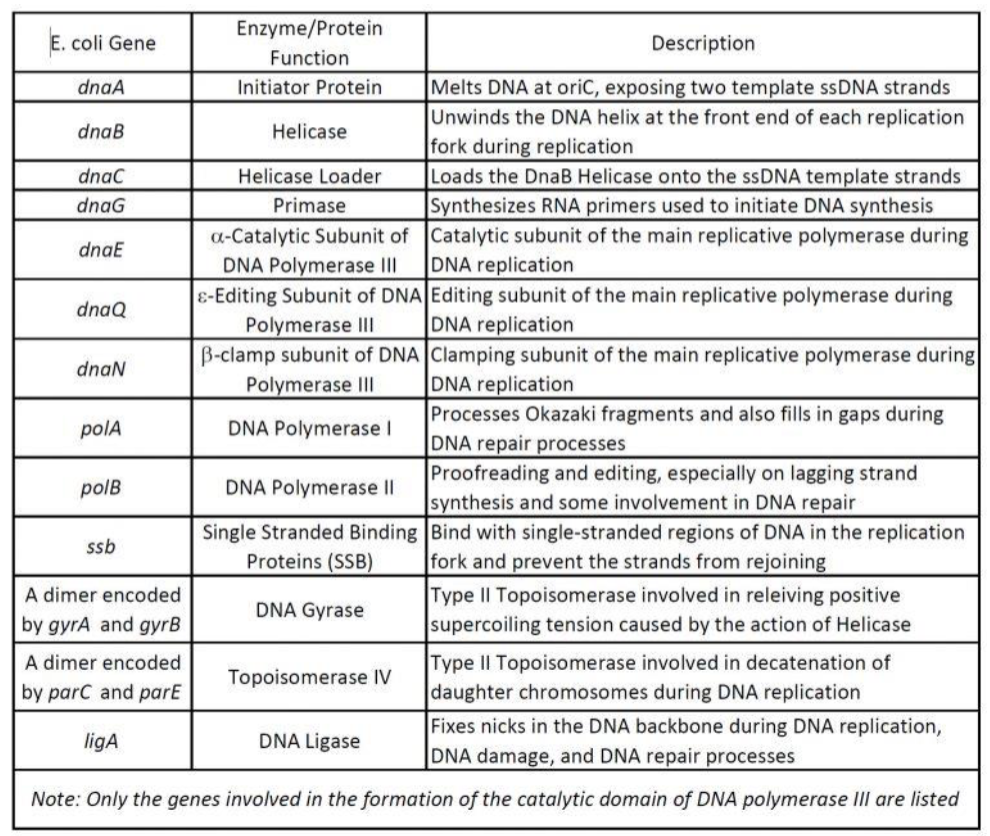
DNA replication is carried out by the action of a large number of proteins that act together as a…
complex protein machine
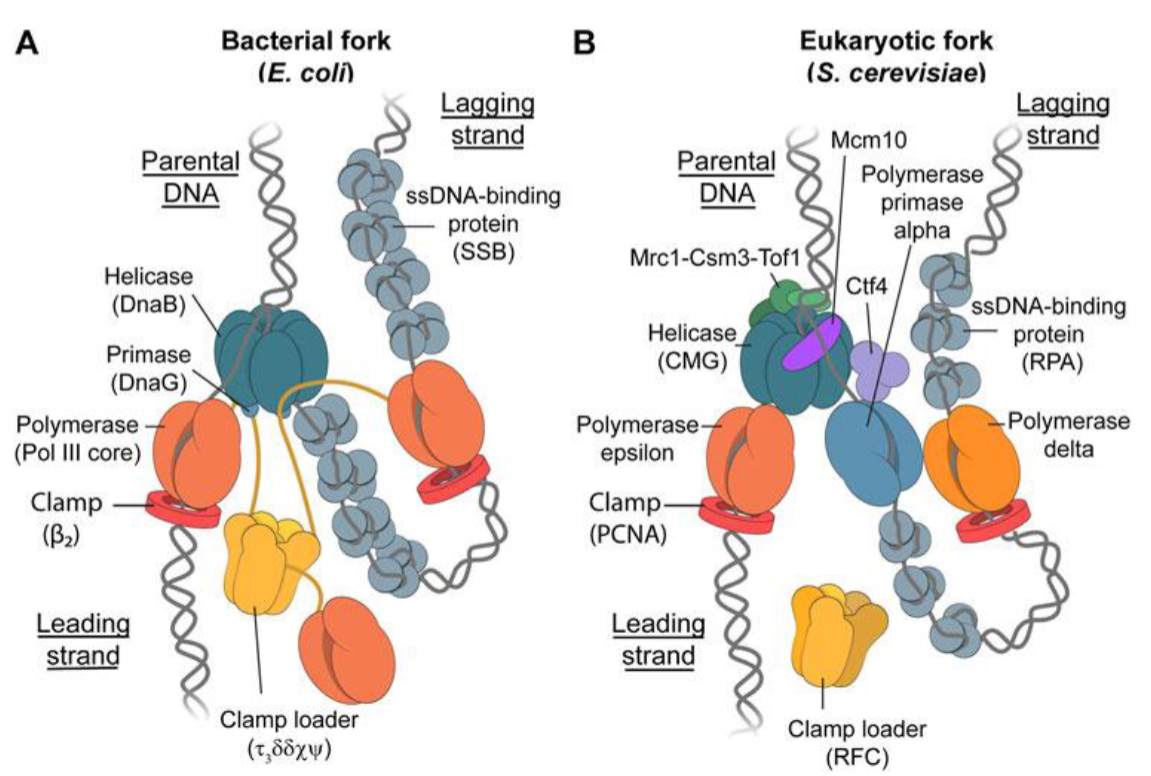
DNA replication is carried out by the action of a large number of proteins that act together as a complex protein machine. This complex machine is known as…
replisome
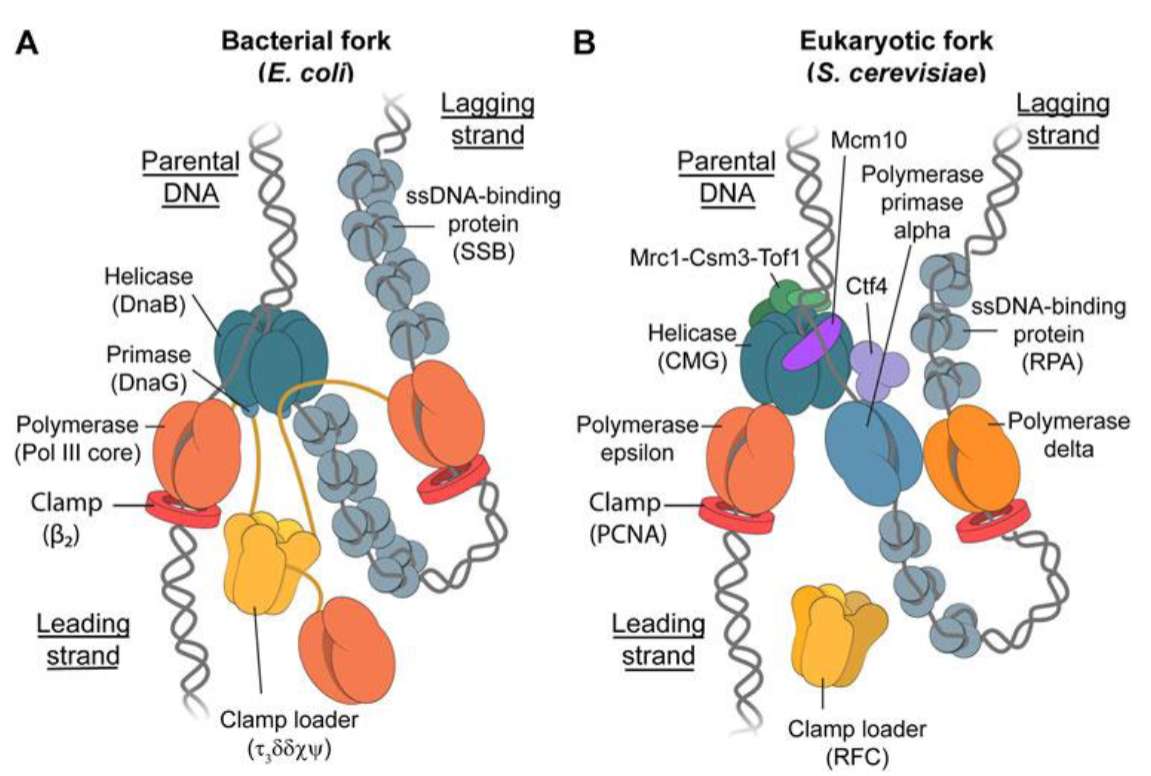
True or False: Although the specific proteins involved are different in bacteria and eukaryotes, the basic mechanisms and principles are relevant in all cells.
True