ec2104 lecture 2
 Call Kai
 Learn
Learn Practice Test
 Spaced Repetition
 Match
Match Flashcards
 Knowt Play
1/12

There's no tags or description
Looks like no tags are added yet.
Name | Mastery | Learn | Test | Matching | Spaced | Call with Kai | Chat |
|---|
No analytics yet
Send a link to your students to track their progress
13 Terms
a function is _____ when small changes in independent variable x leads to _____ changes in the ____________
a function is continuous is small changes in independent variable x leads to small changes in the function value y
geometrically a function is continuous if it has no ______
geometrically a function is continuous if it has no breaks

in this definition, the 3 conditions are:
the function f must be defined at _______
the _______________ must exist
the limit must = ___
the function f must be defined at x = a
the limit of f(x) which is x → a must exist
the limit must = f(a)
if f and g are continuous at a then (f + g) and (f - g) must both be continuous at a
if f and g are continuous at a then fg and f/g must both be continuous at a
[f(x)r] is continuous at a only if:
_____ is defined
r is a ___ _____
[f(a)]r is defined
r is a real number
if f has an ______ on the interval l then its inverse f-1 is ________ on ______
if f has an inverse on the interval l then its inverse f-1 is continuous on f(l)
INTERMEDIATE VALUE THEOREM: let f be a function which is continuous upon (a,b)
if f(a) and f(b) have ______ ____, then there is at least _ __ in (a, b) such that __ = 0
if f(a) and f(b) have different signs, then there is at least one c in (a, b) such that f(c)= 0 (meaning c is a root)
INTERMEDIATE VALUE THEOREM: let f be a function which is continuous upon (a,b)
if f(a) __ f(b), then for every intermediate value y in the open interval between __ and __ there is at least one c in (a,b) such that f(c) = _
if f(a) =/= f(b), then for every intermediate value y in the open interval between f(a) and f(b) there is at least one c in (a,b) such that f(c) = y
strengths of IVT
tells you that at least 1 root exists
the range of a continuous function over an interval is itself an interval
limitations of
doesn’t tell you how many roots
doesn’t tell you how to get the roots
5 steps to using the IVT:
D_____ the function: Let f(x) be …
E________ f(x) c_________: The polynomial f(x) is continuous for all x
Choose an i_______: For x in [-2, 1]
Check for s____ r_______: f(-2) = -4.2 and f(1) = -0.6
Invoke IVT: So IVT implies that there exists at least 1 number c in [-2,1] such that f(c) = 0
5 steps to using the IVT:
Define the function: Let f(x) be …
Establish f(x) continuous: The polynomial f(x) is continuous for all x
Choose an interval: For x in [-2, 1]
Check for sign reversal: f(-2) = -4.2 and f(1) = -0.6
Invoke IVT: So IVT implies that there exists at least 1 number c in [-2,1] such that f(c) = 0
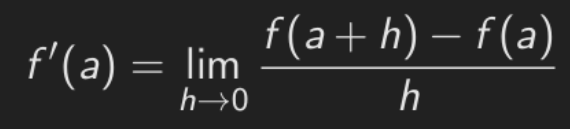
a function f(x) is differentiable at x=a as long as the limit in the definition of the derivative exists