Bio 161 - Genes & Transcription
 Call Kai
 Learn
Learn Practice Test
 Spaced Repetition
 Match
Match Flashcards
 Knowt Play
1/126

There's no tags or description
Looks like no tags are added yet.
Name | Mastery | Learn | Test | Matching | Spaced | Call with Kai |
|---|
No analytics yet
Send a link to your students to track their progress
127 Terms
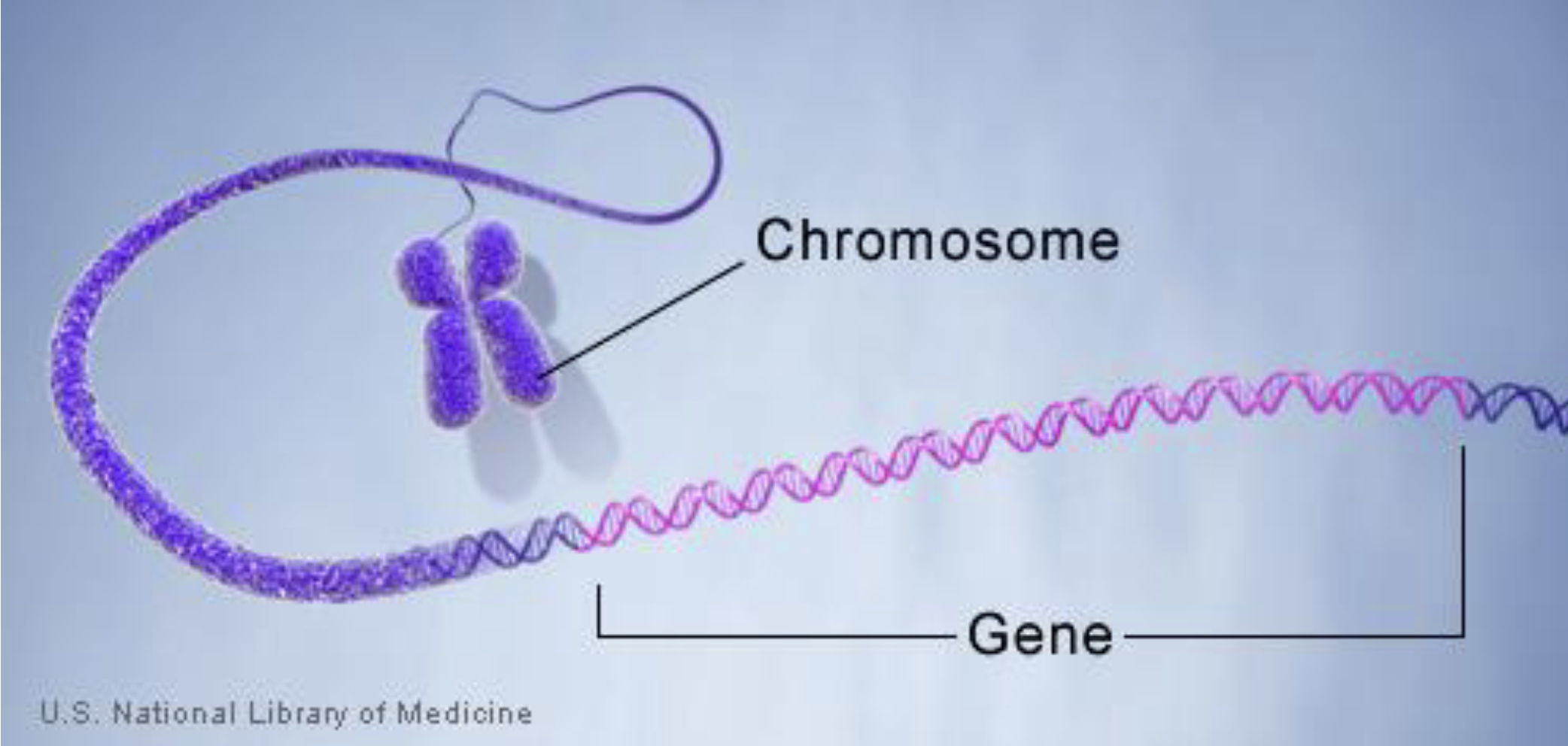
A gene is
sequence of nucleotides that codes for proteins
What is the central dogma of molecular biology?
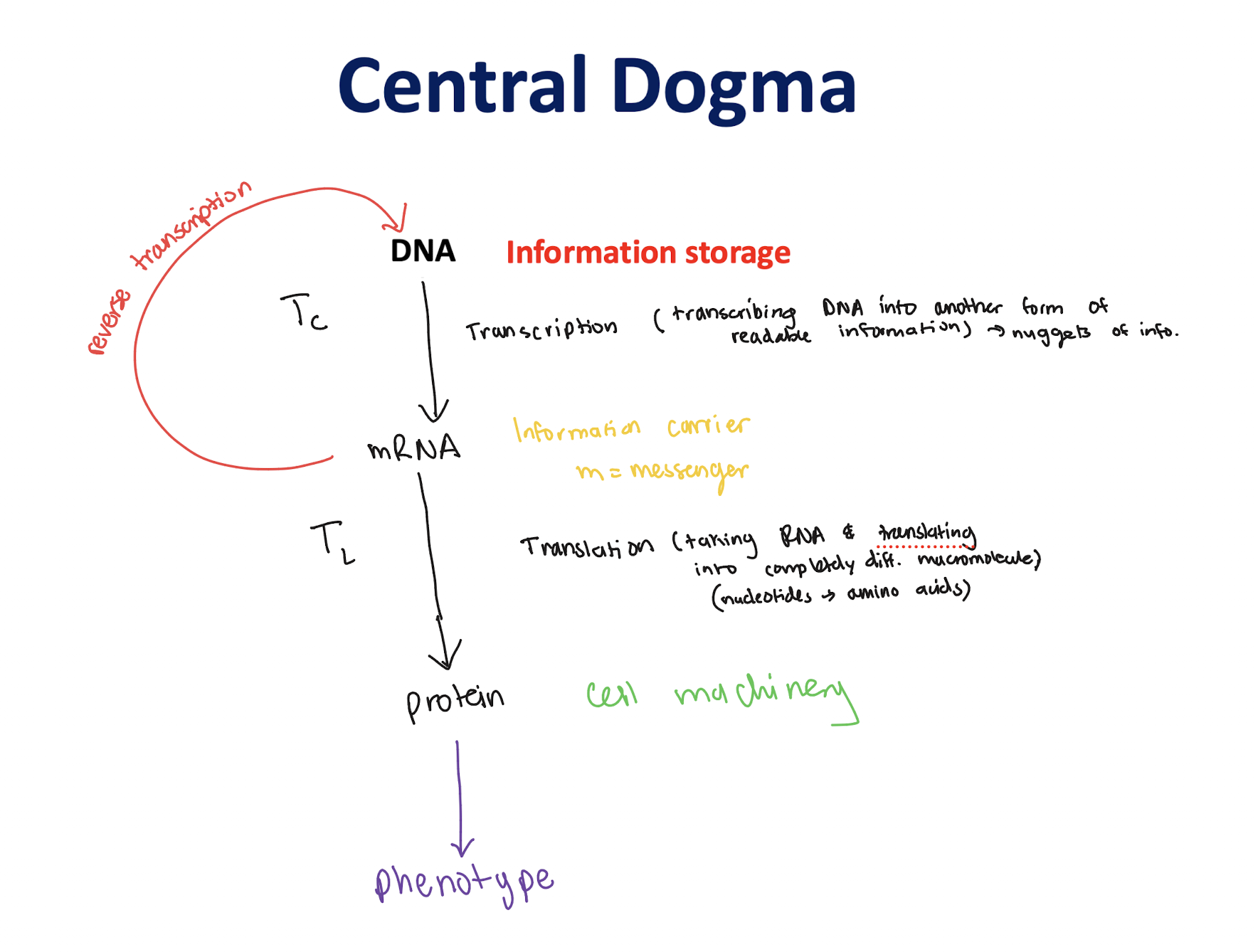
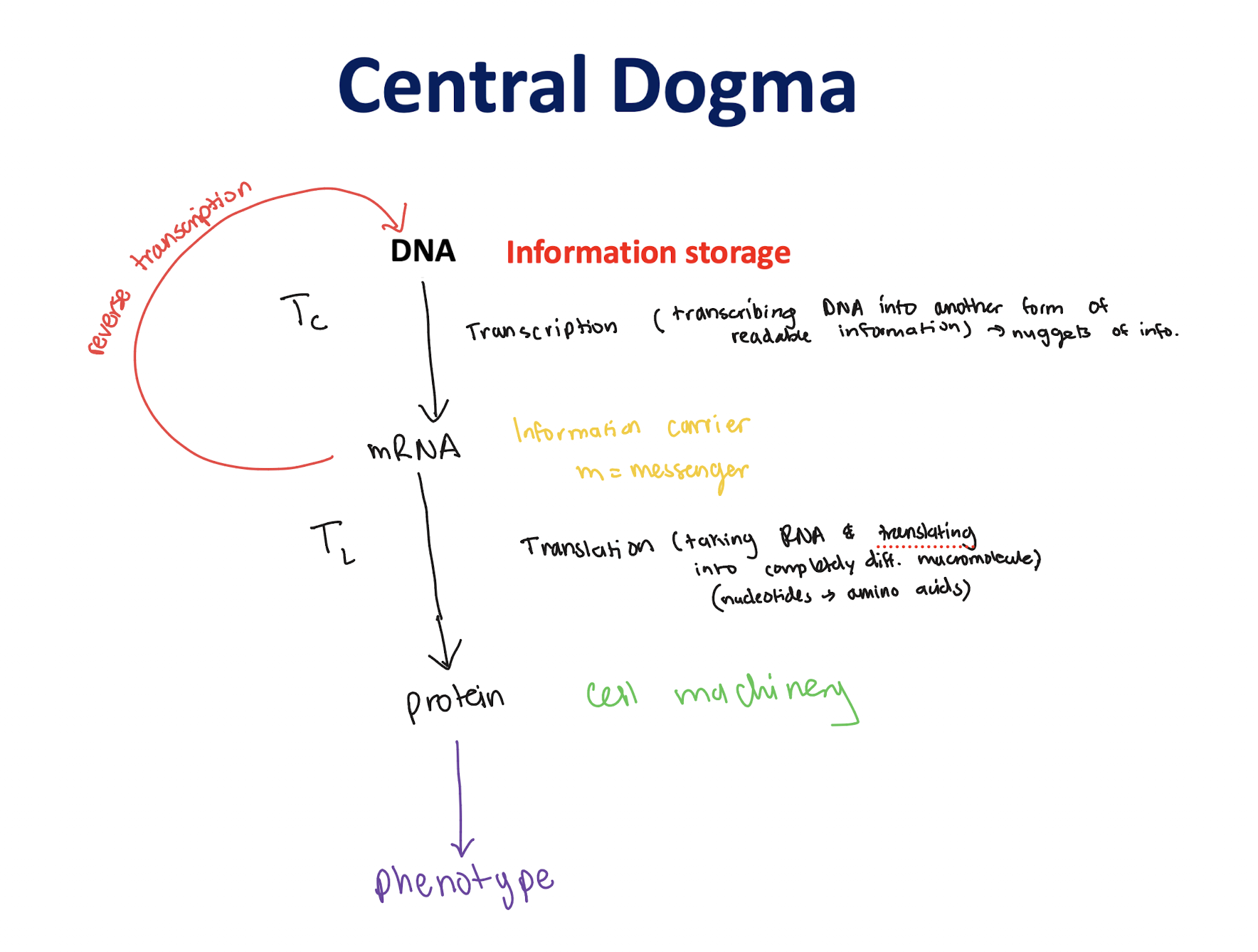
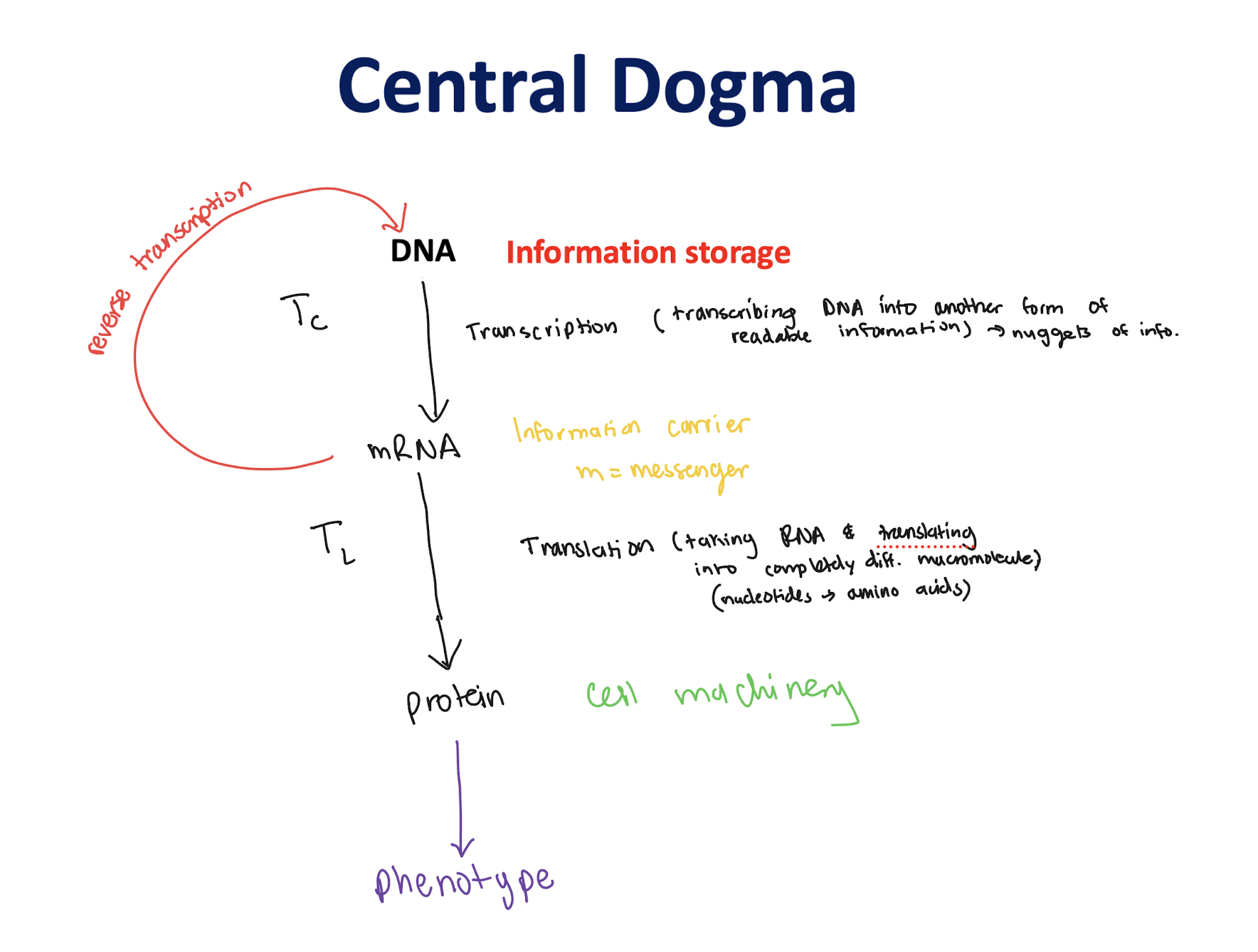
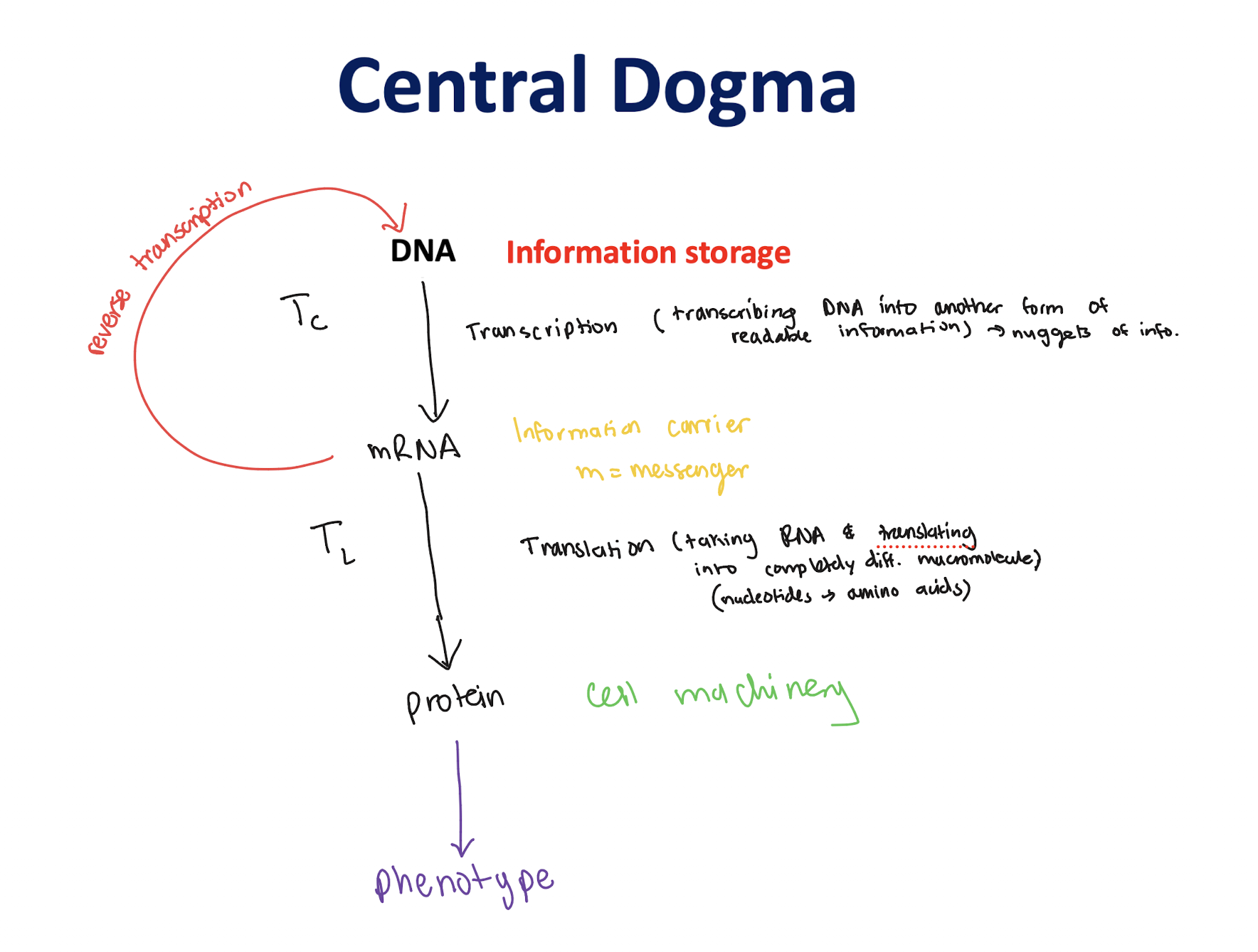
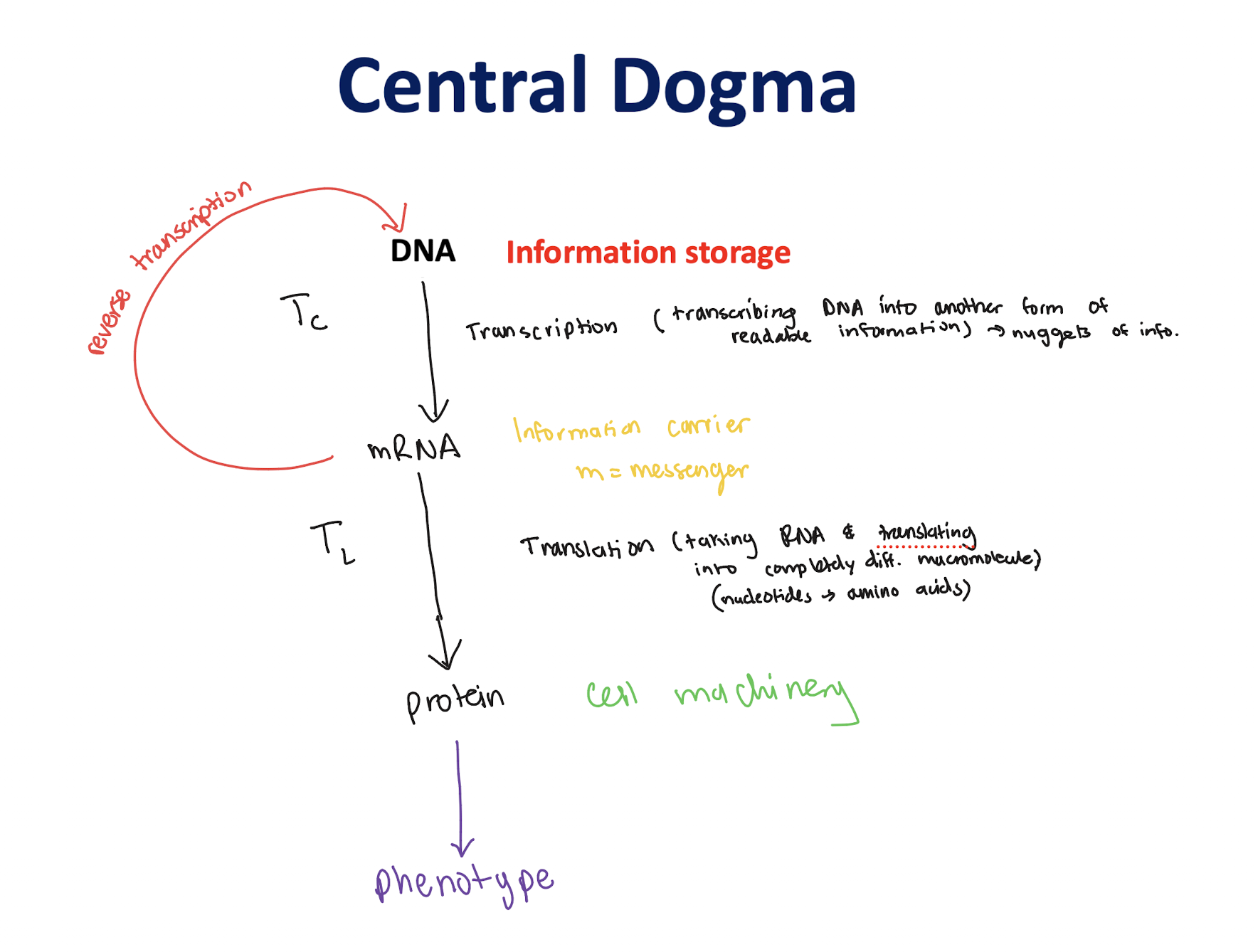
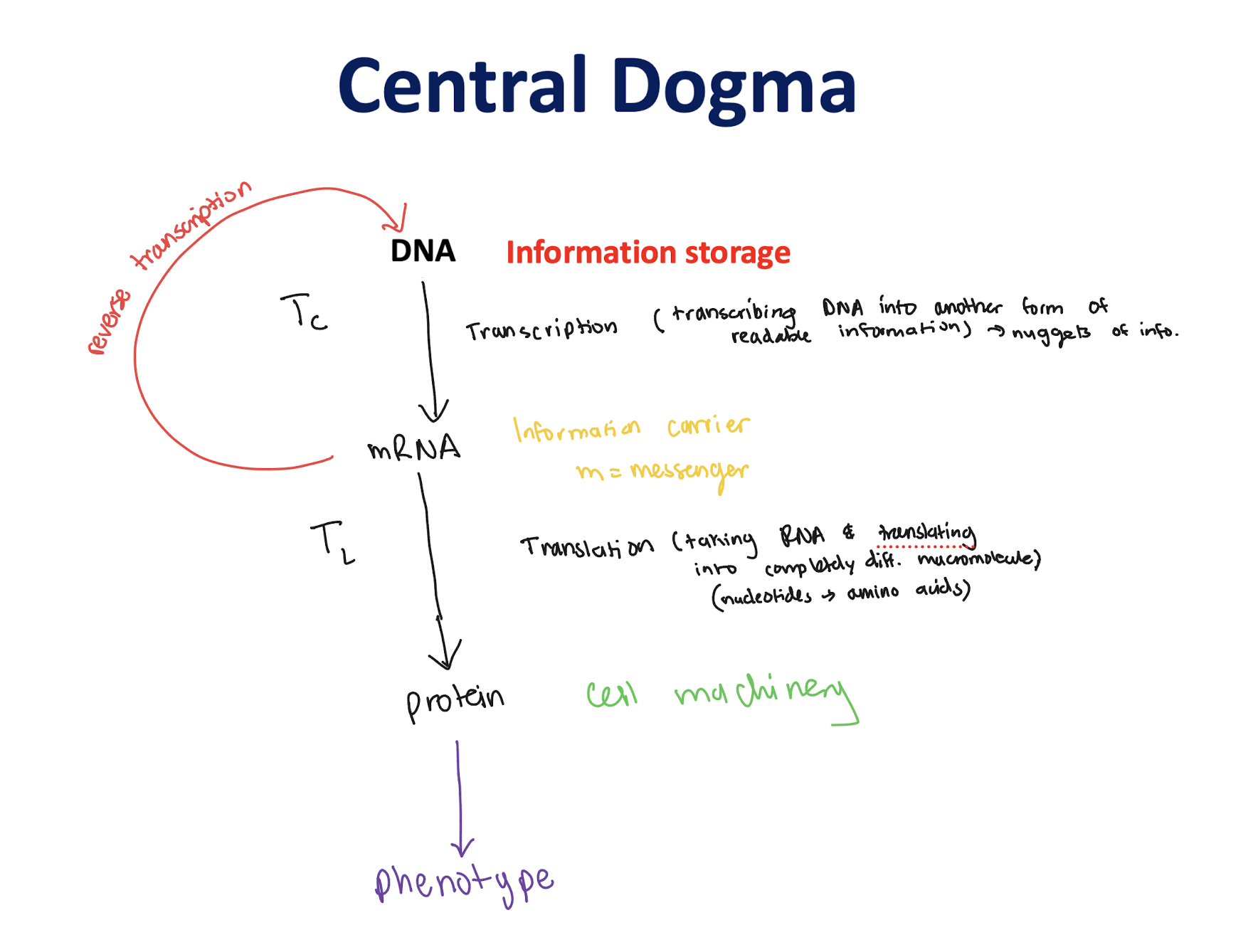
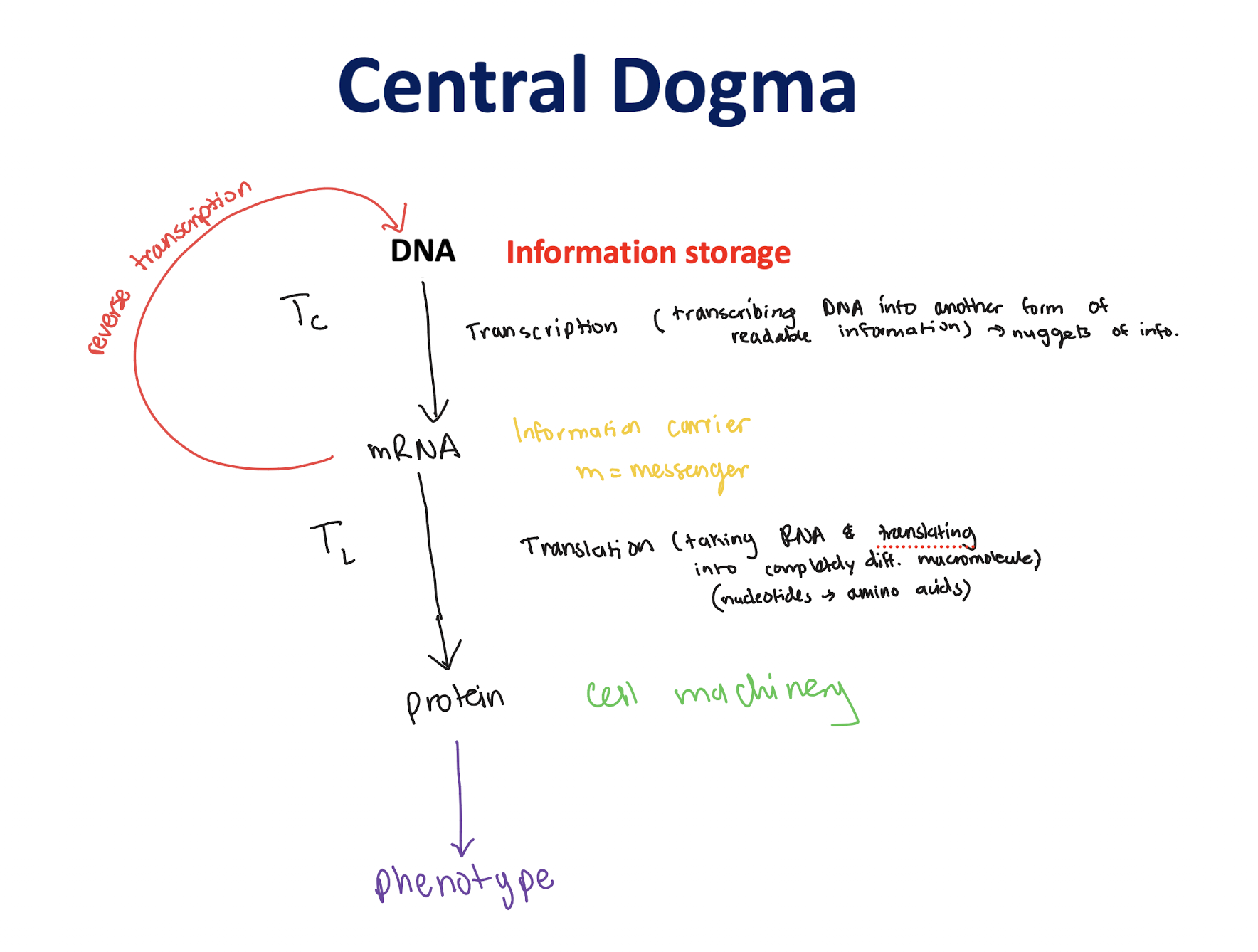
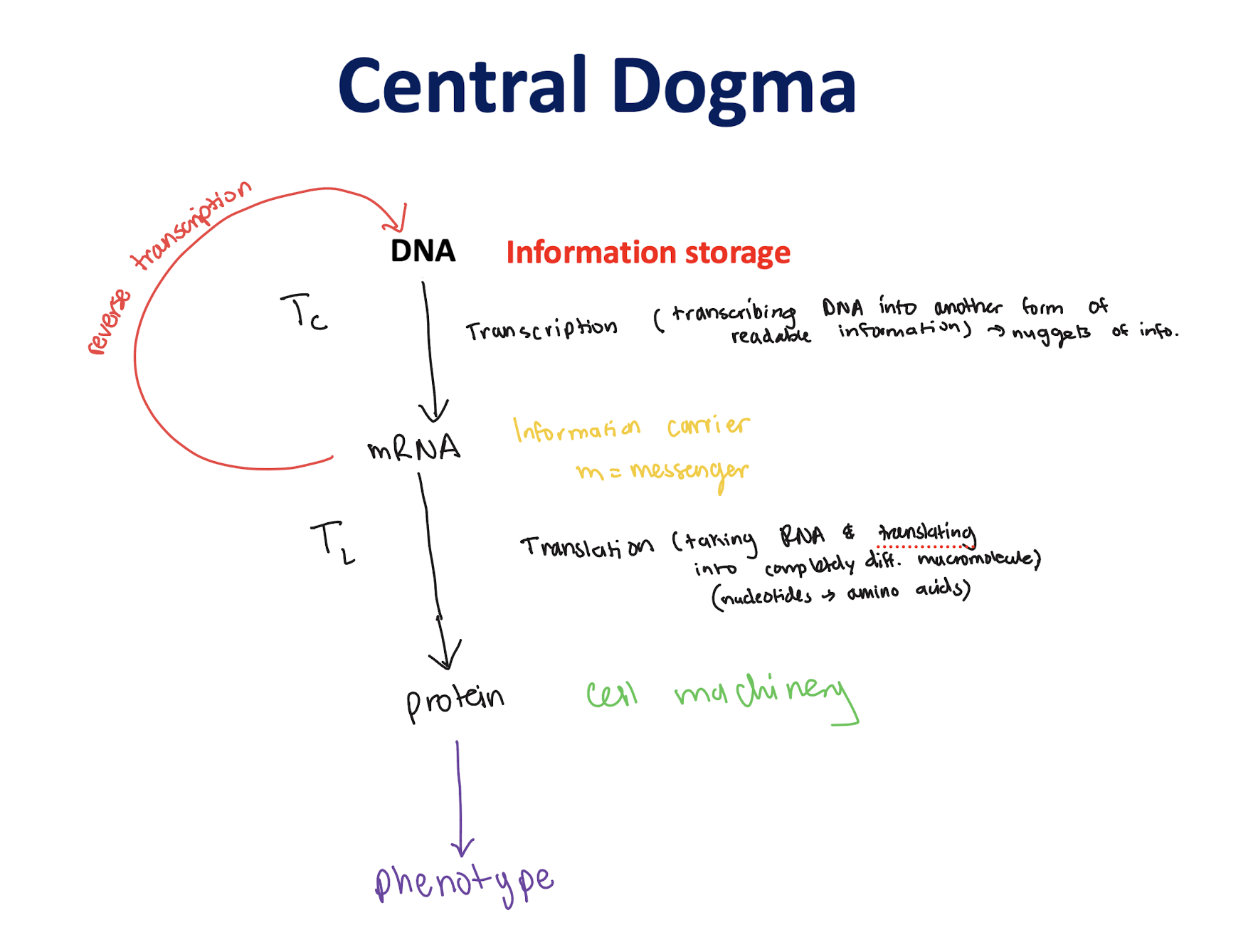
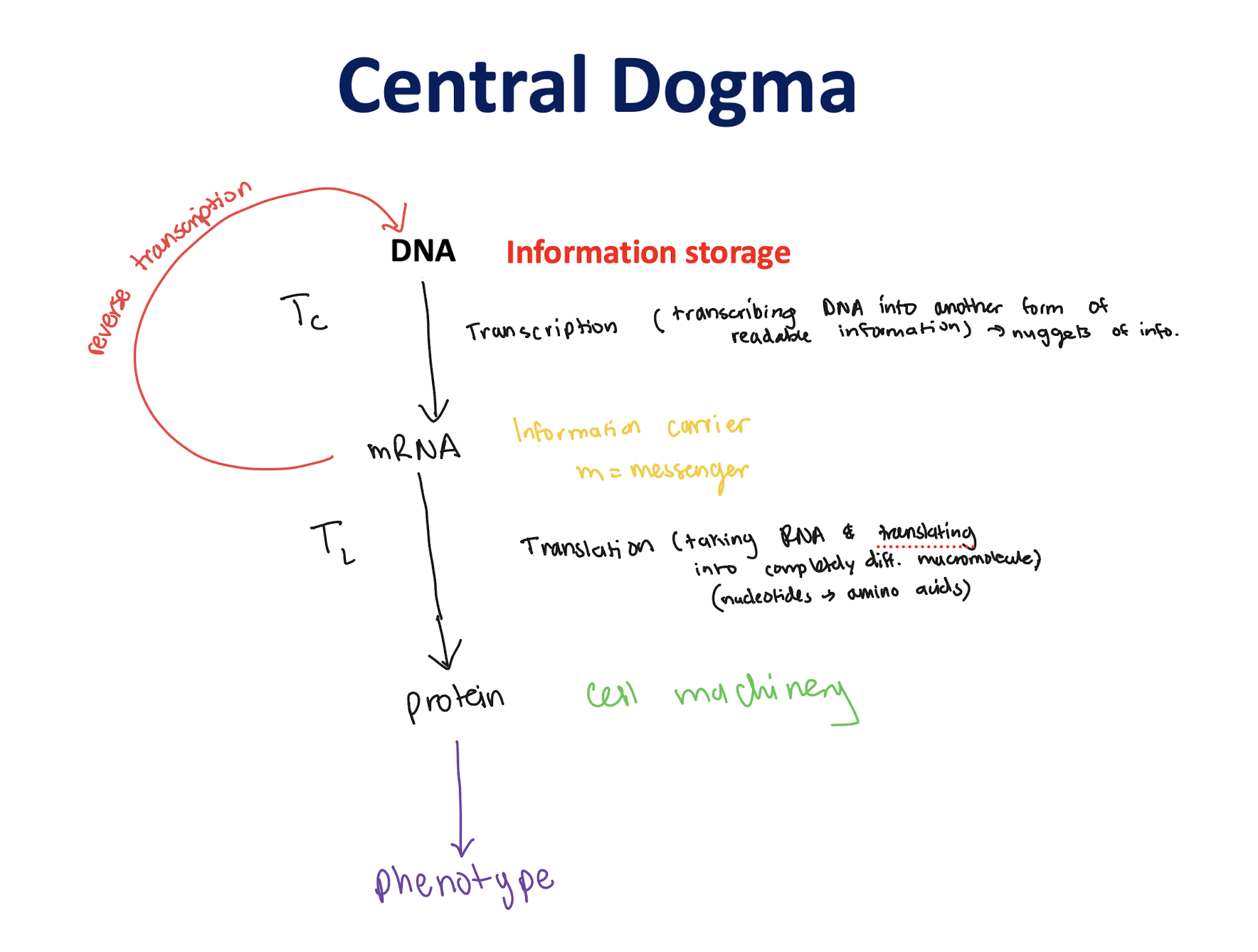
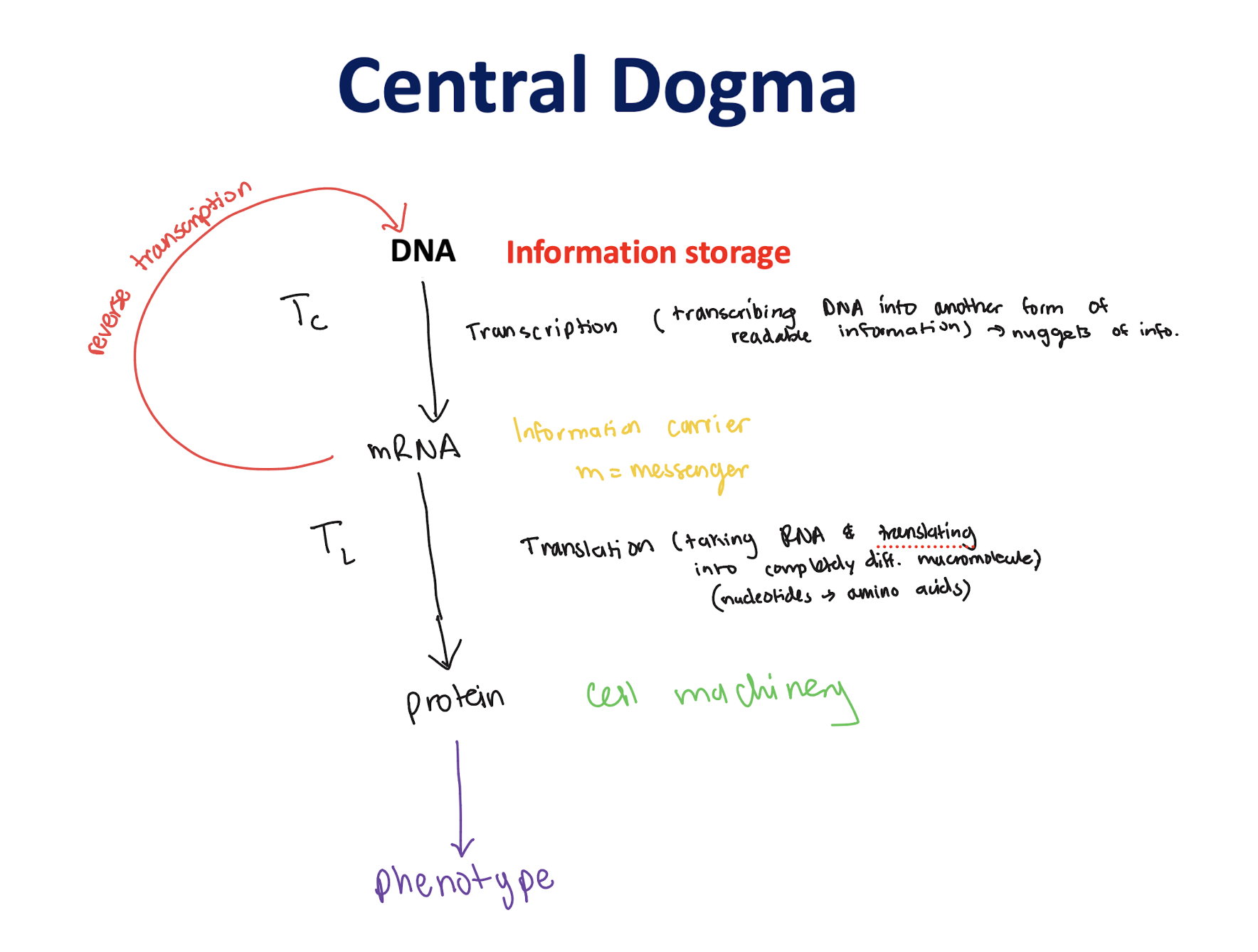
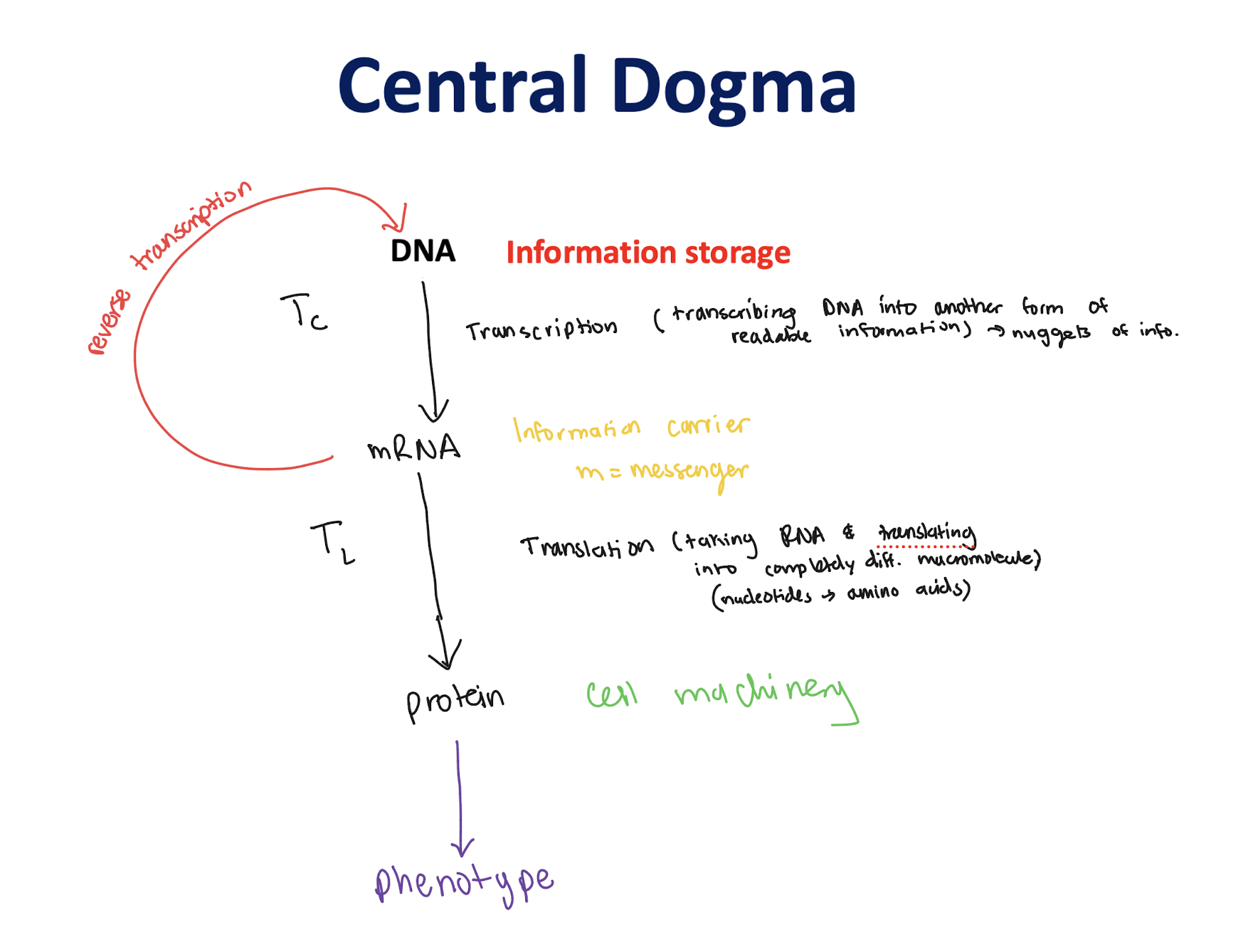
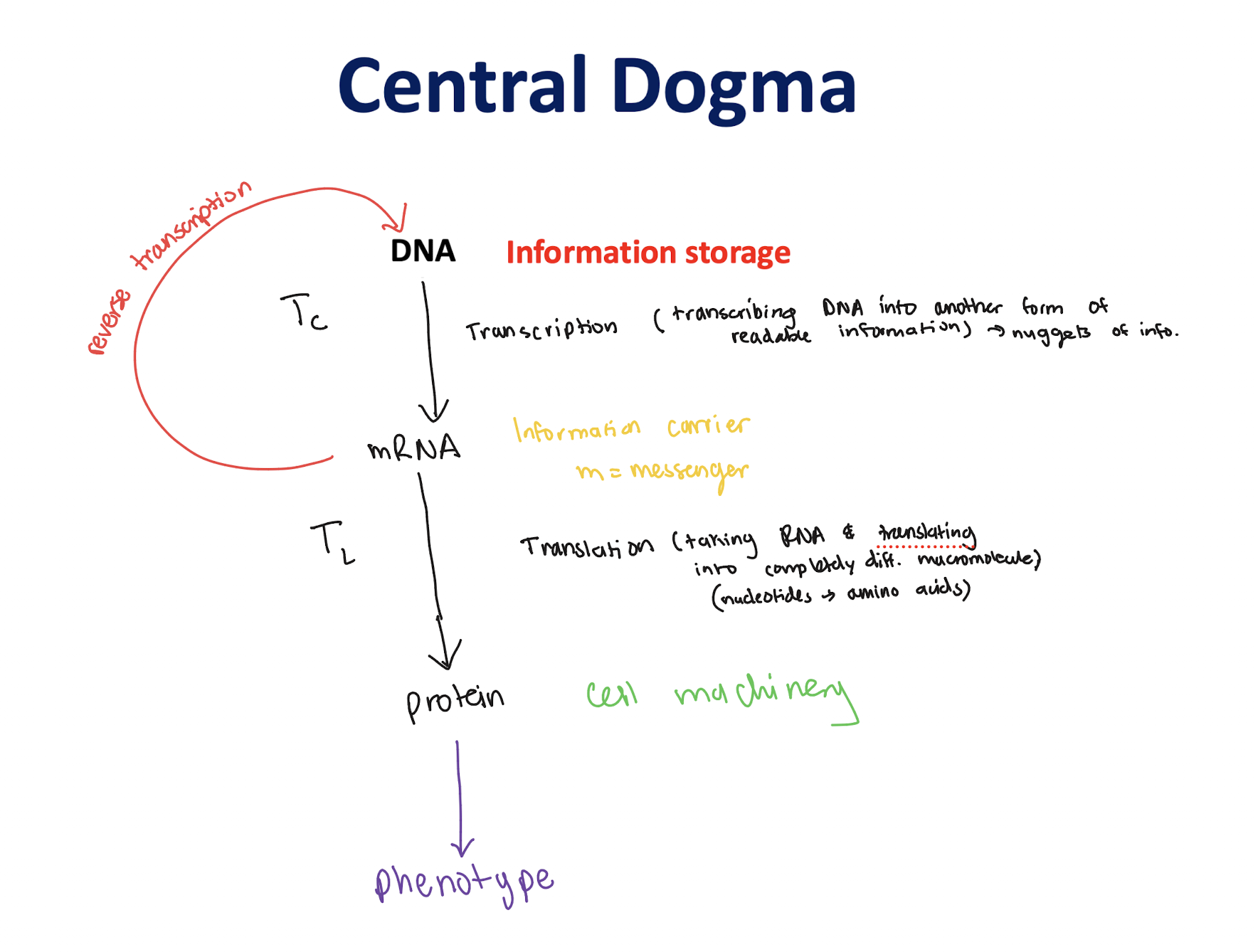
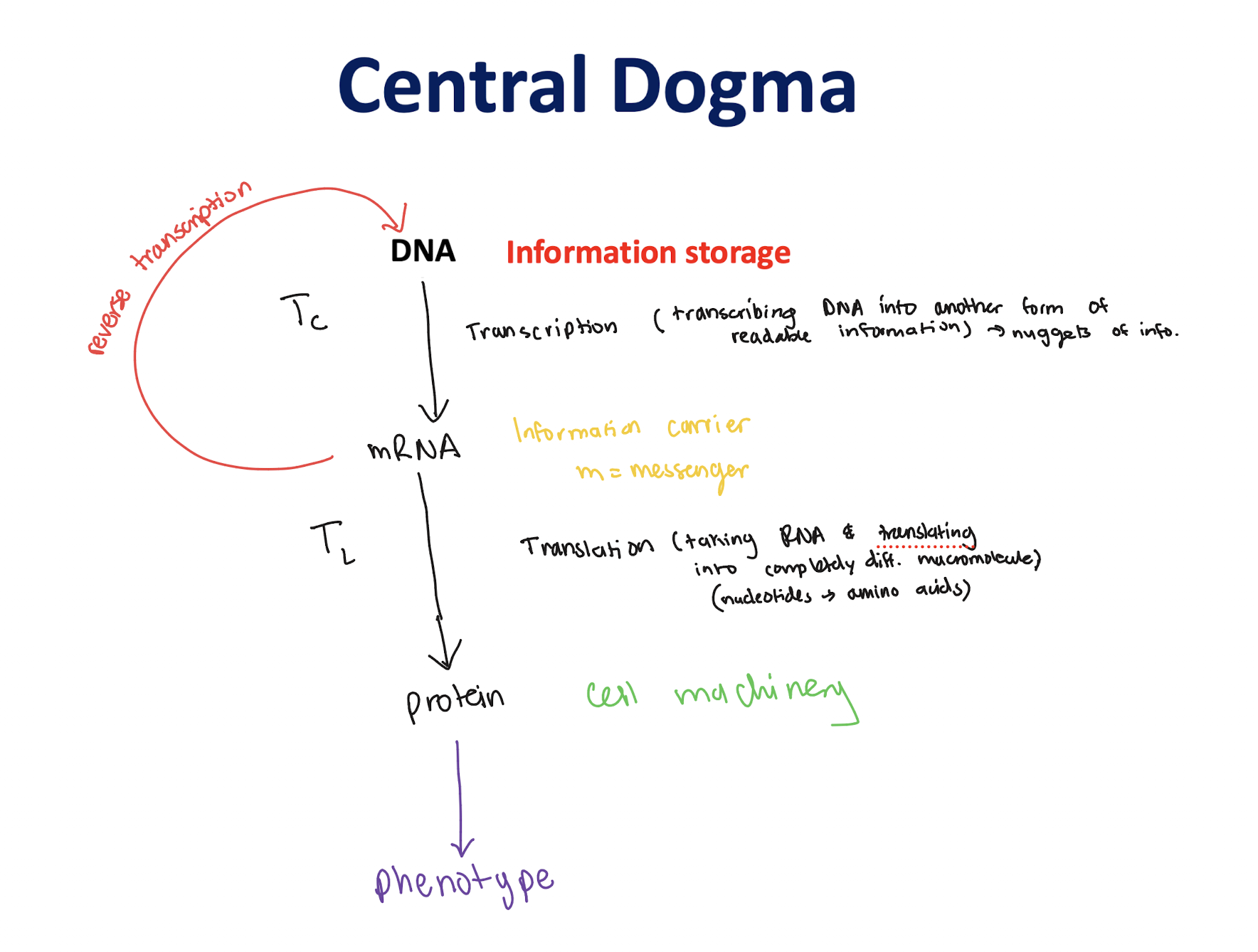
DNA → RNA (mRNA) → Protein → Phenotype.
Which type of RNA carries the genetic message from DNA to ribosomes for protein synthesis?
mRNA
Central Dogma 1) What is the role of DNA in the central dogma?
Long-term storage of genetic information.
Central Dogma 2) What is the role of mRNA in the central dogma?
Carries genetic information from DNA to ribosomes.
Information carrier m = messenger
Central Dogma 3) What is the role of proteins in the central dogma?
Carry out most cellular functions and help determine phenotype.
cell machinery
Central Dogma 4) What is phenotype?
Observable characteristics resulting from gene expression.
What is genotype?
The genetic information encoded in DNA.
What process converts DNA information into RNA?
Transcription
transcribing DNA into another form of readable information (nuggets of info)
What process converts RNA into protein?
Translation
taking RNA & translating into completely different macromolecule
nucleotides → amino acids
Why does the central dogma involve "codes"?
Information is transferred from nucleotide sequences to amino acid sequences using genetic codes.
What molecule serves as the intermediary between DNA and protein?
RNA (specifically mRNA, single stranded)
What is reverse transcription?
The synthesis of DNA from an RNA template.
performed by reverse transcriptase (first discovered in HIV)
Is reverse translation (protein → RNA) known to occur?
no!
Draw the relationship between a gene, mRNA, and protein, and phenotype
Gene (DNA) → mRNA → Protein → Phenotype
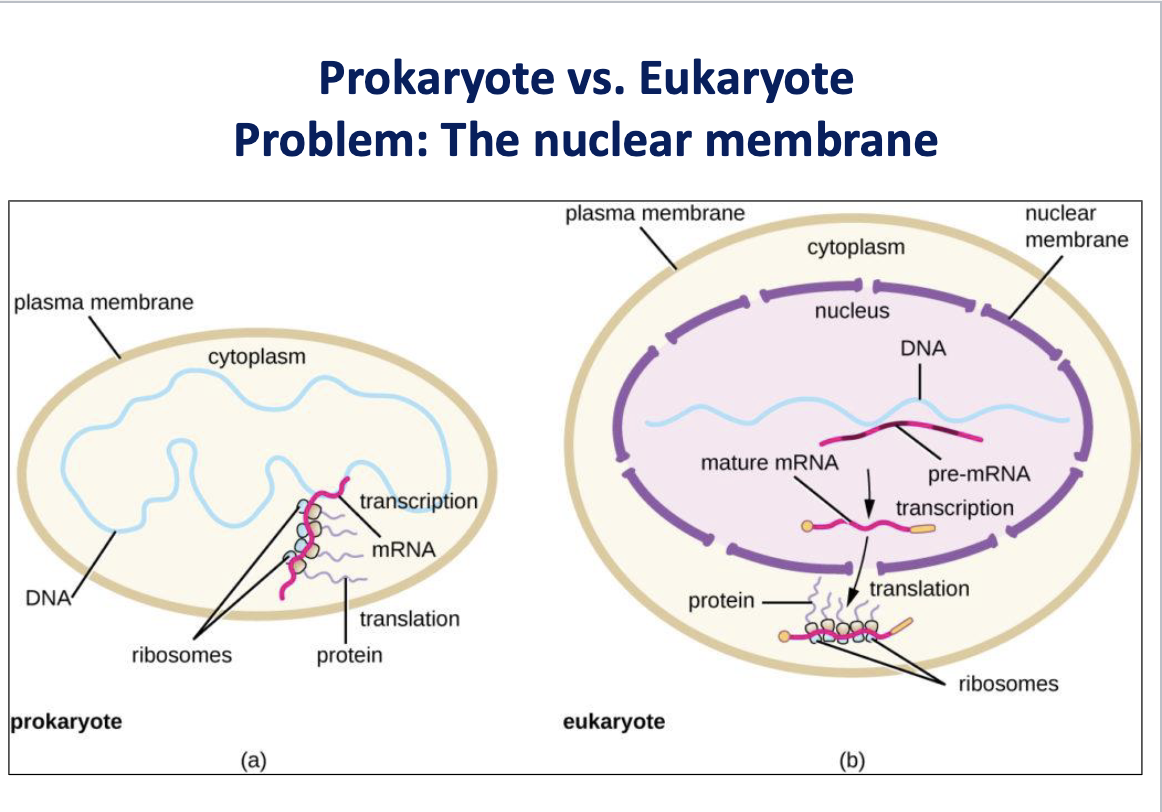
Prokaryote vs Eukaryote: Prokaryote DNA → RNA → Protein
no nucleus
Transcription and translation can happen simultaneously
70s ribosomes + DNA in cytoplasm
Prokaryote vs Eukaryote: Problem in eukaryotes
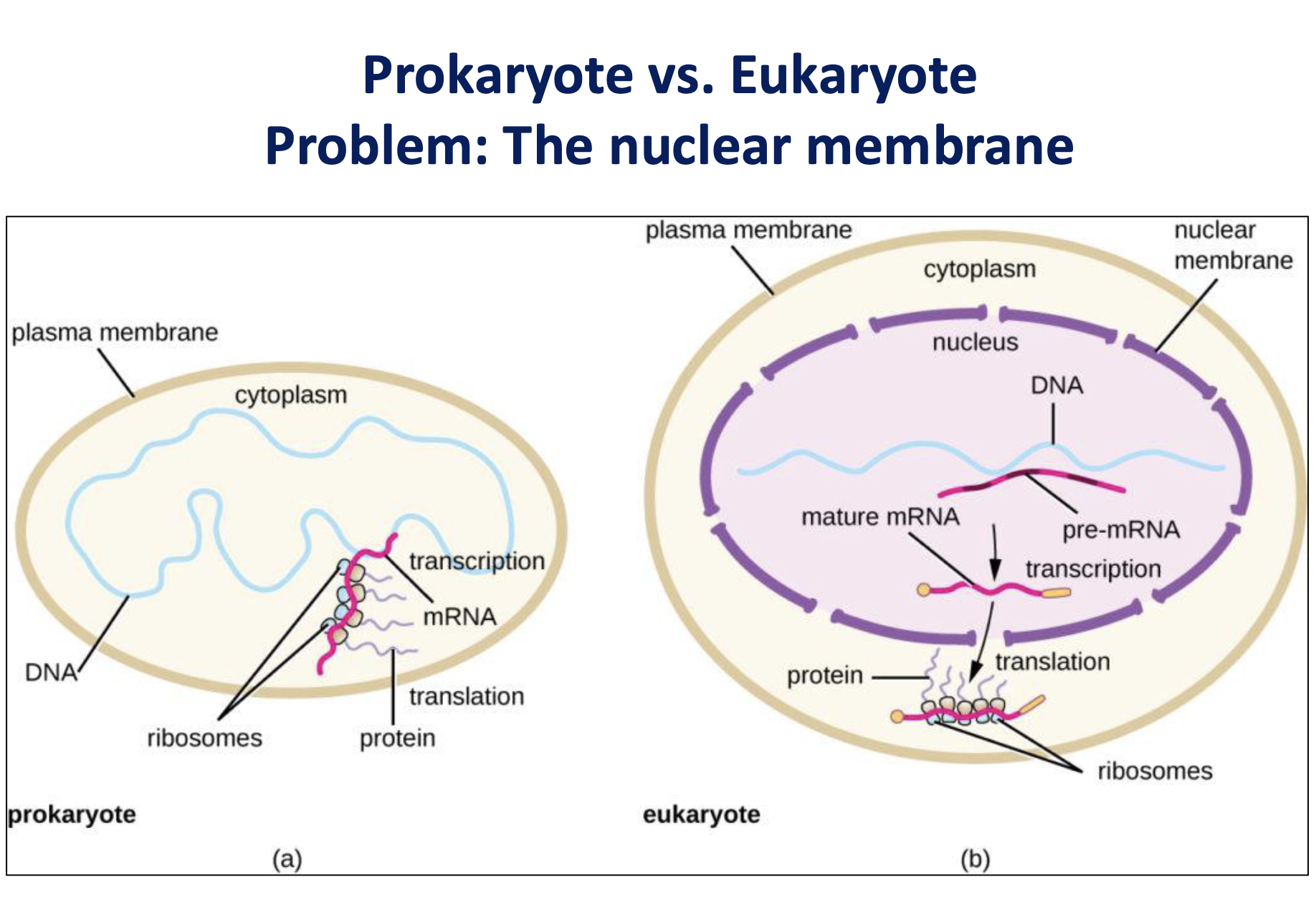
Problem = nuclear membrane
transcription & translation does not occur simultaneously, have to get out of nuclear membrane to access ribosomes
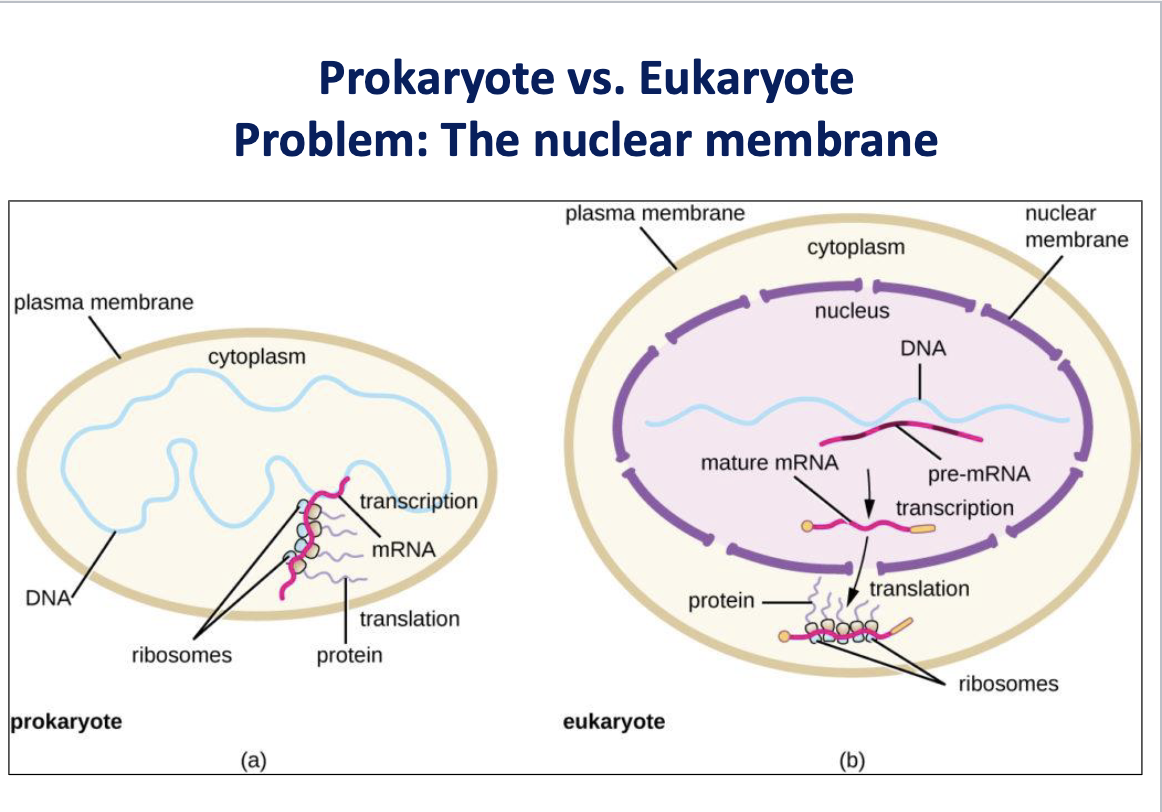
Why can transcription and translation occur simultaneously in bacteria?
They lack a nucleus.
Why can't transcription and translation occur simultaneously in eukaryotes?
DNA is separated from ribosomes by the nuclear membrane.
Where are bacterial ribosomes located?
in the cytoplasm
Where does transcription occur in eukaryotes?
in the nucleus
Where does translation occur in eukaryotes?
in the cytoplasm (e)
What major challenge does the nuclear membrane create?
RNA must be processed and exported before translation.
What is transcription?
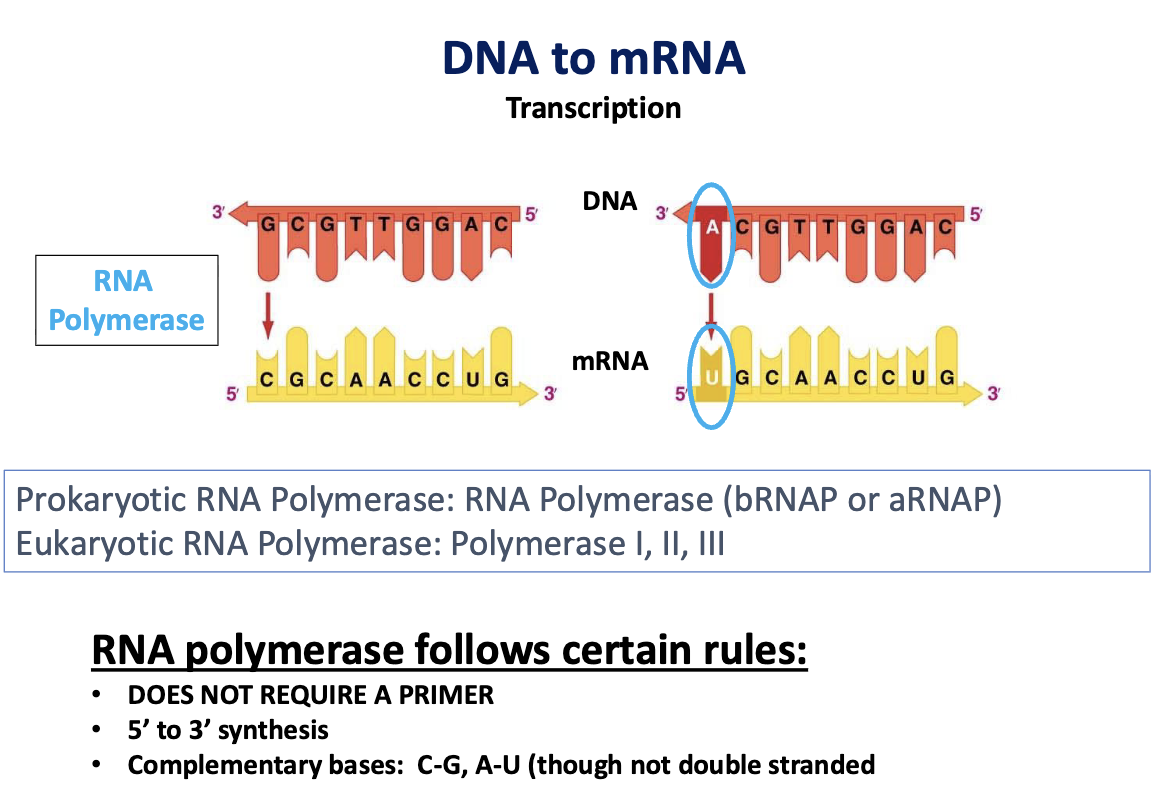
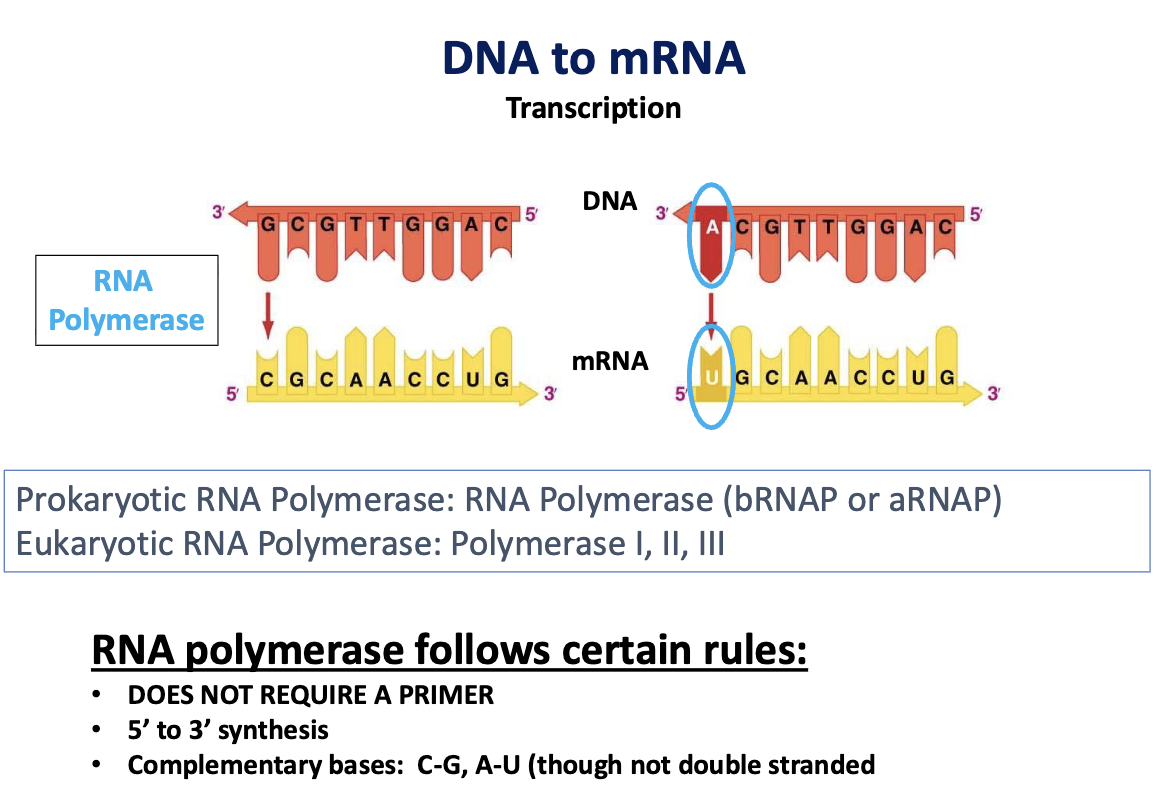
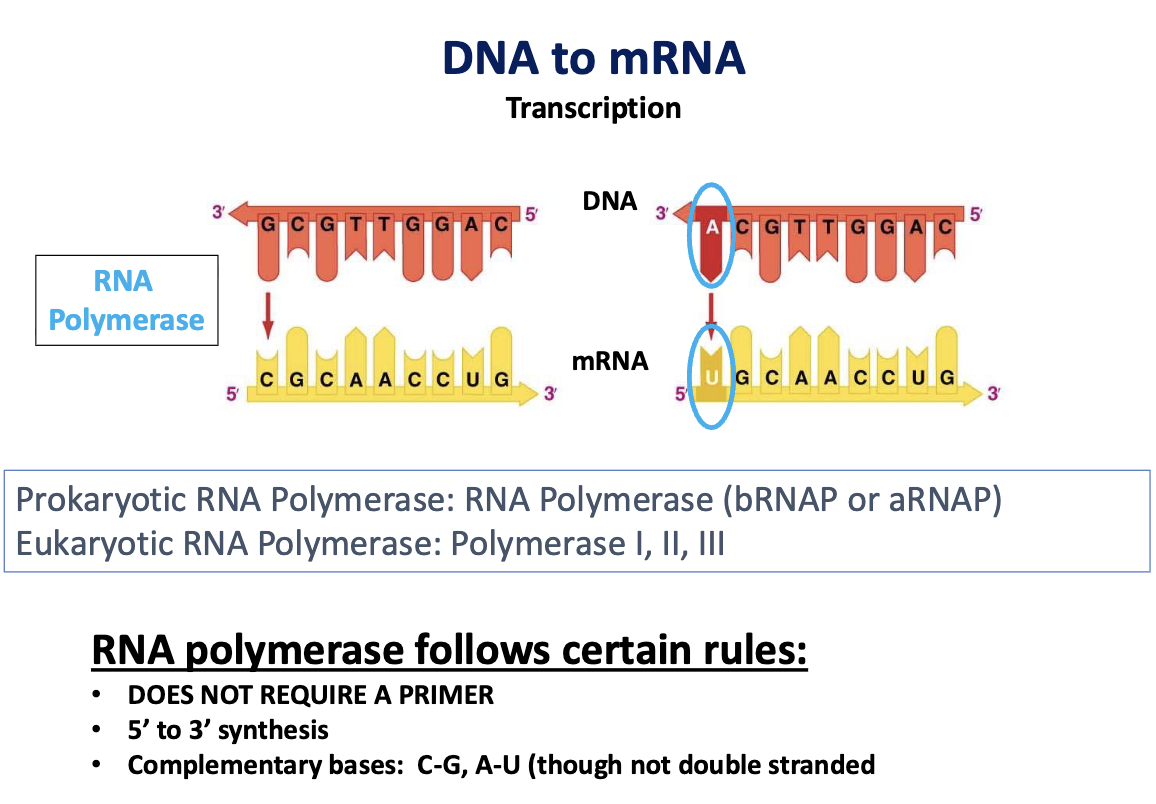
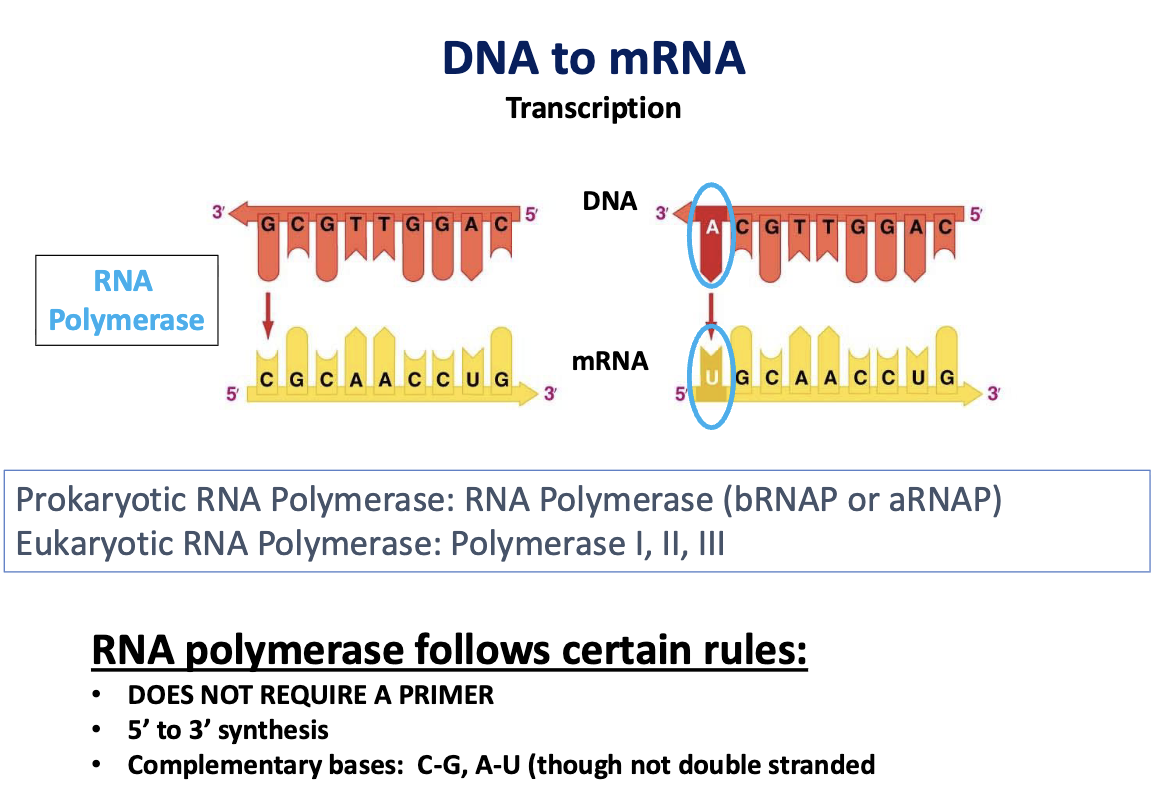
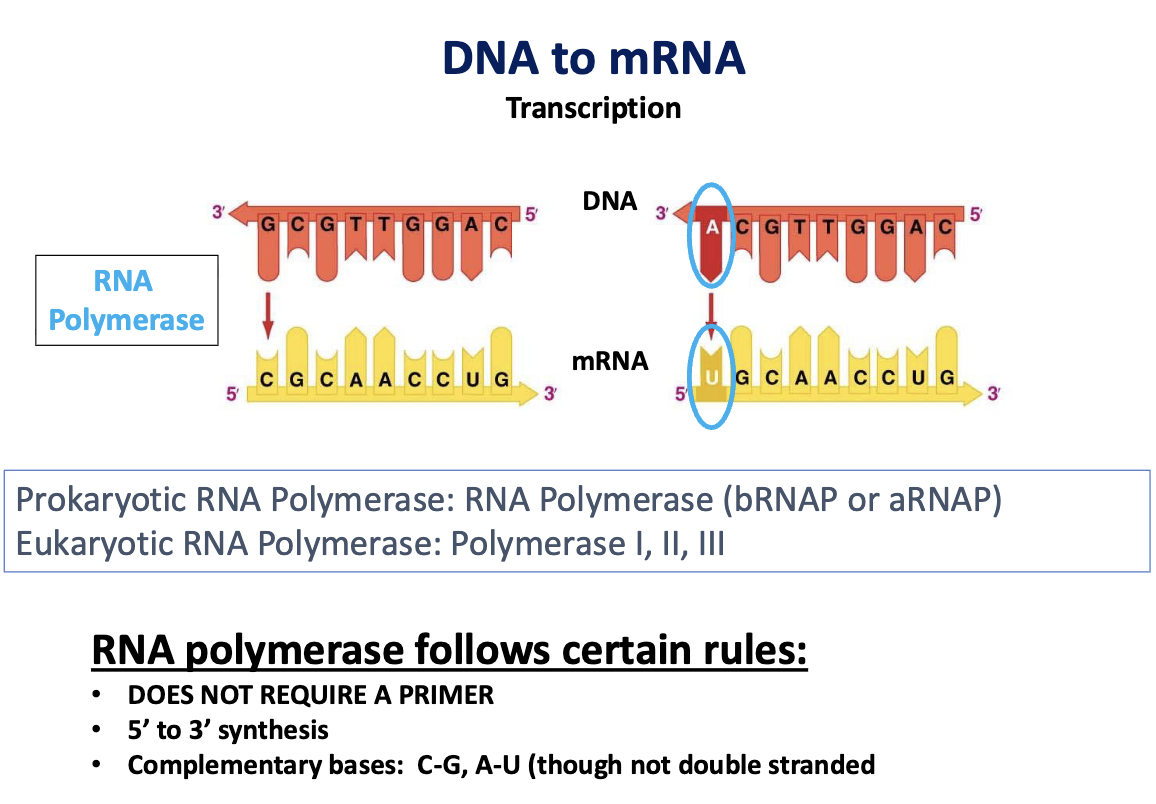
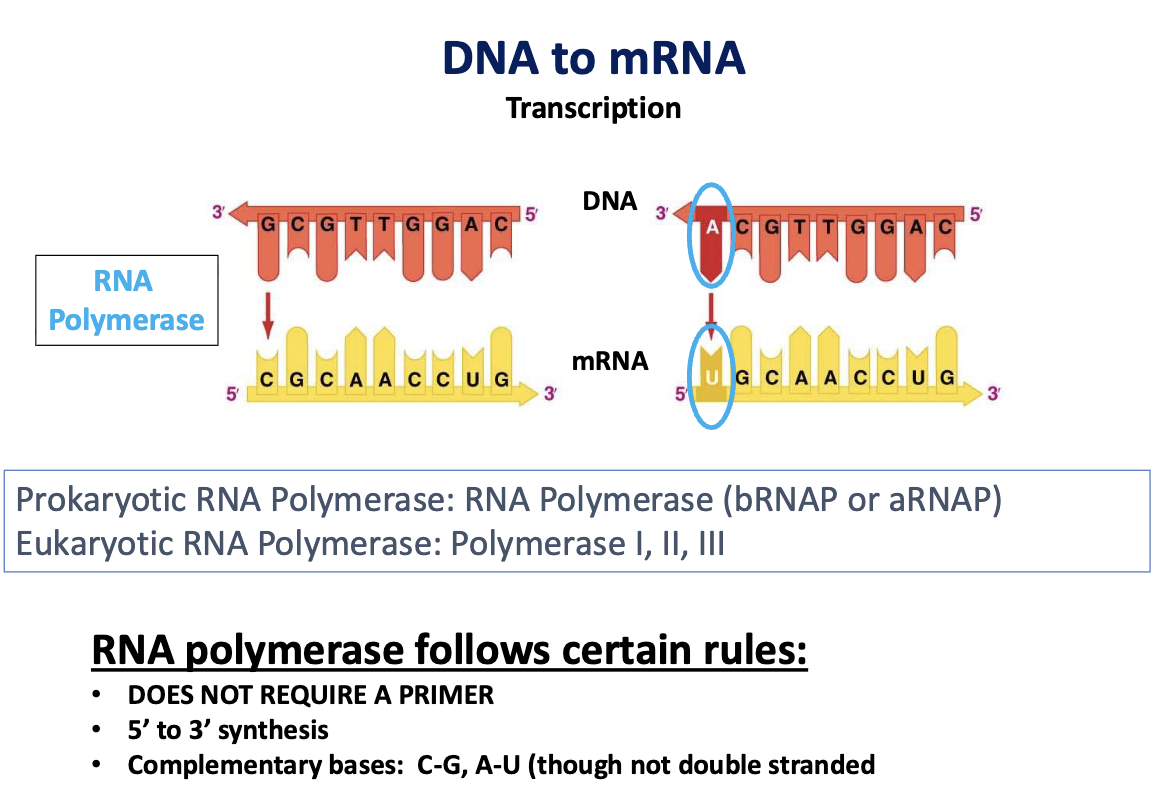
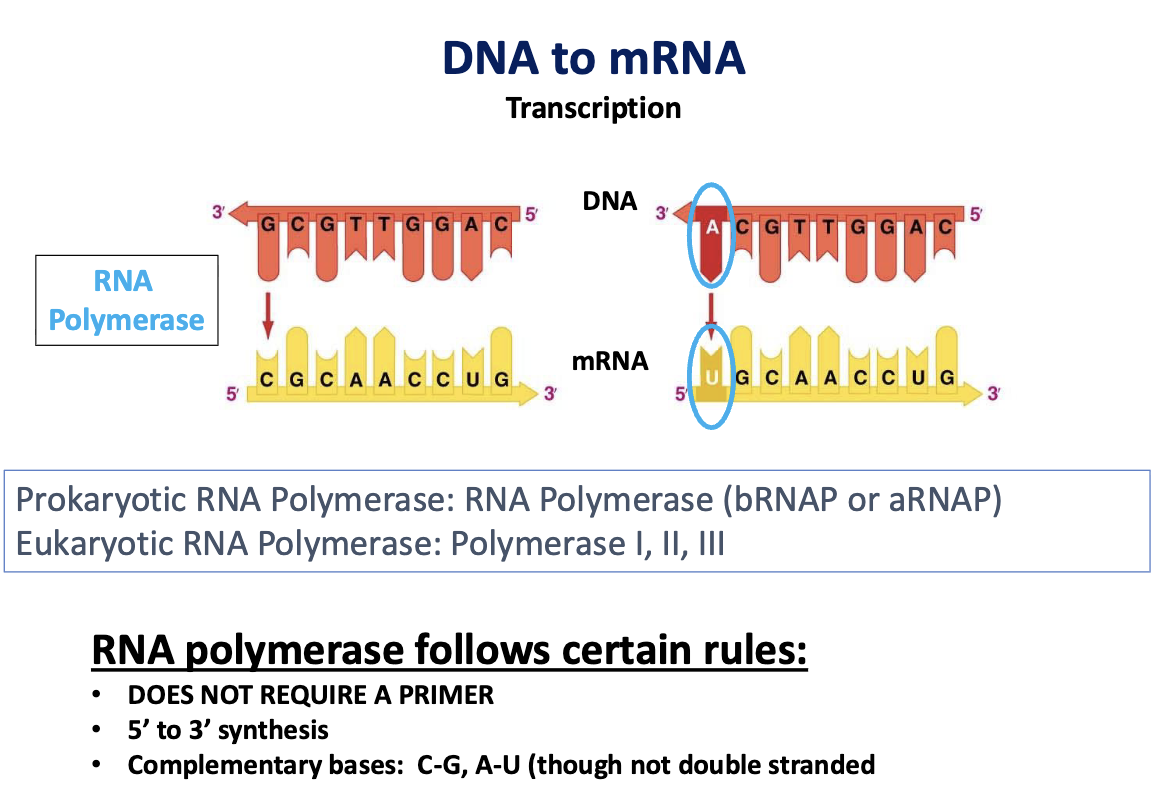
The synthesis of mRNA using a DNA template
mRNA carries message of chromosome → single stranded RNA
What enzyme performs transcription?
RNA polymerase
What is the prokaryotic RNA polymerase often abbreviated as?
bRNAP for bacteria
aRNAP for archaea
Which eukaryotic RNA polymerase primarily synthesizes mRNA?
RNA Polymerase II
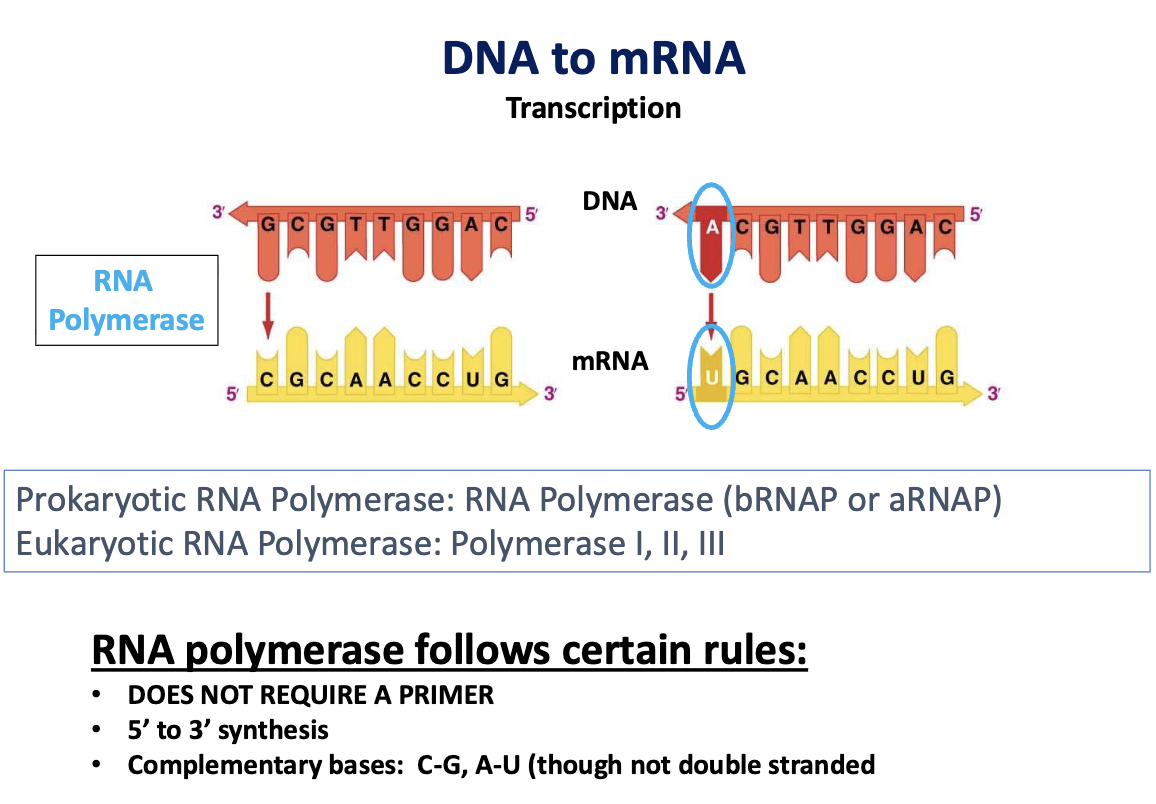
What are the three major eukaryotic RNA polymerases?
RNA Polymerase I, II, and III.
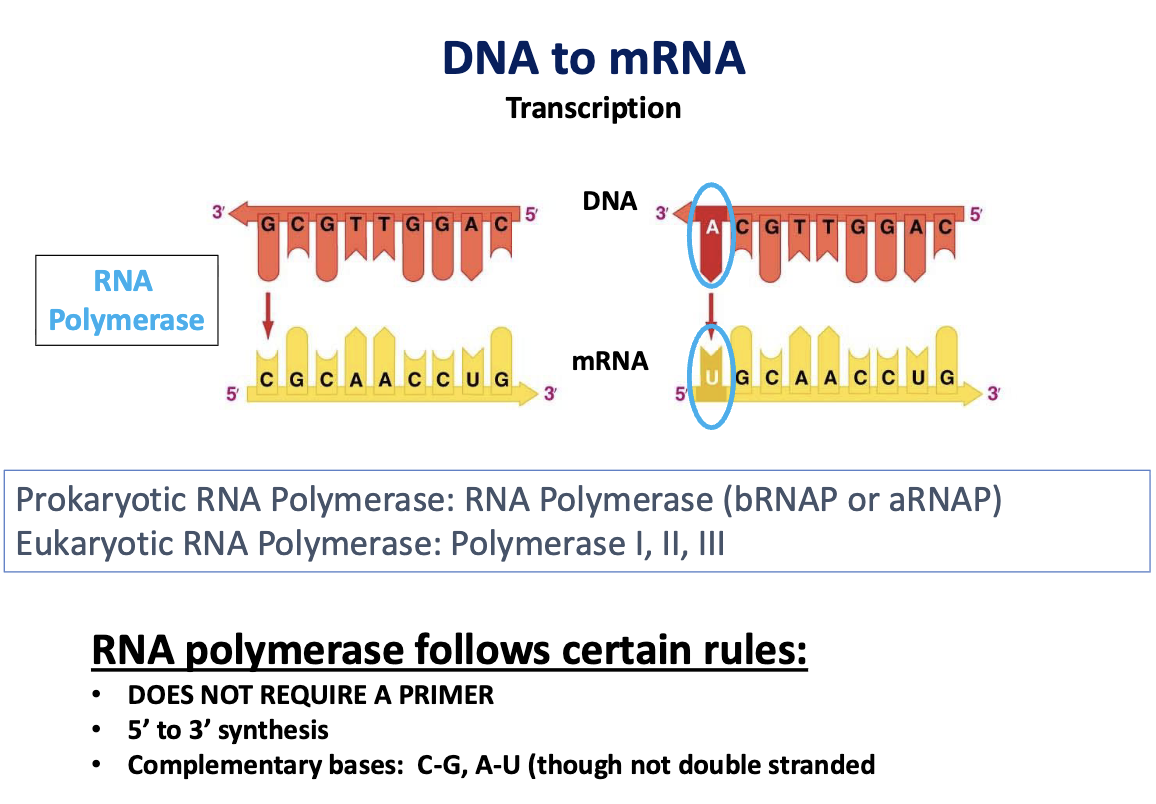
Does RNA polymerase require a primer?
nope
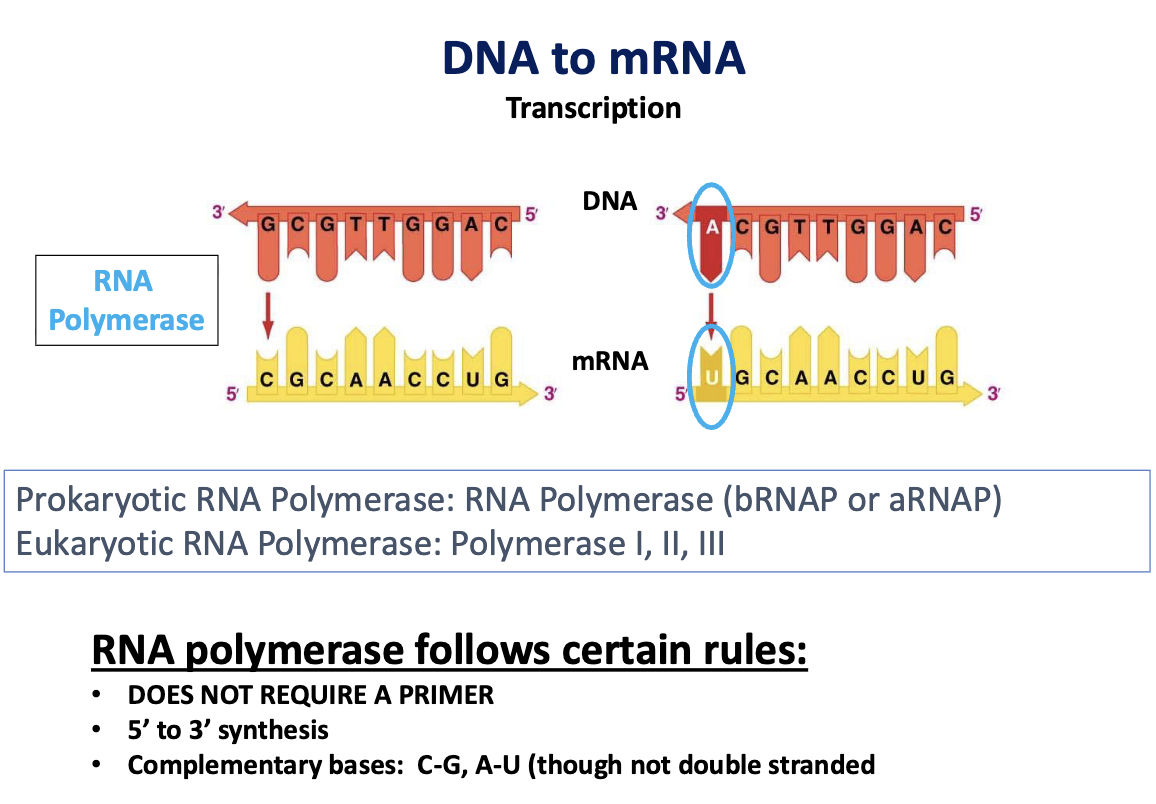
In what direction is RNA synthesized?
5' → 3'.
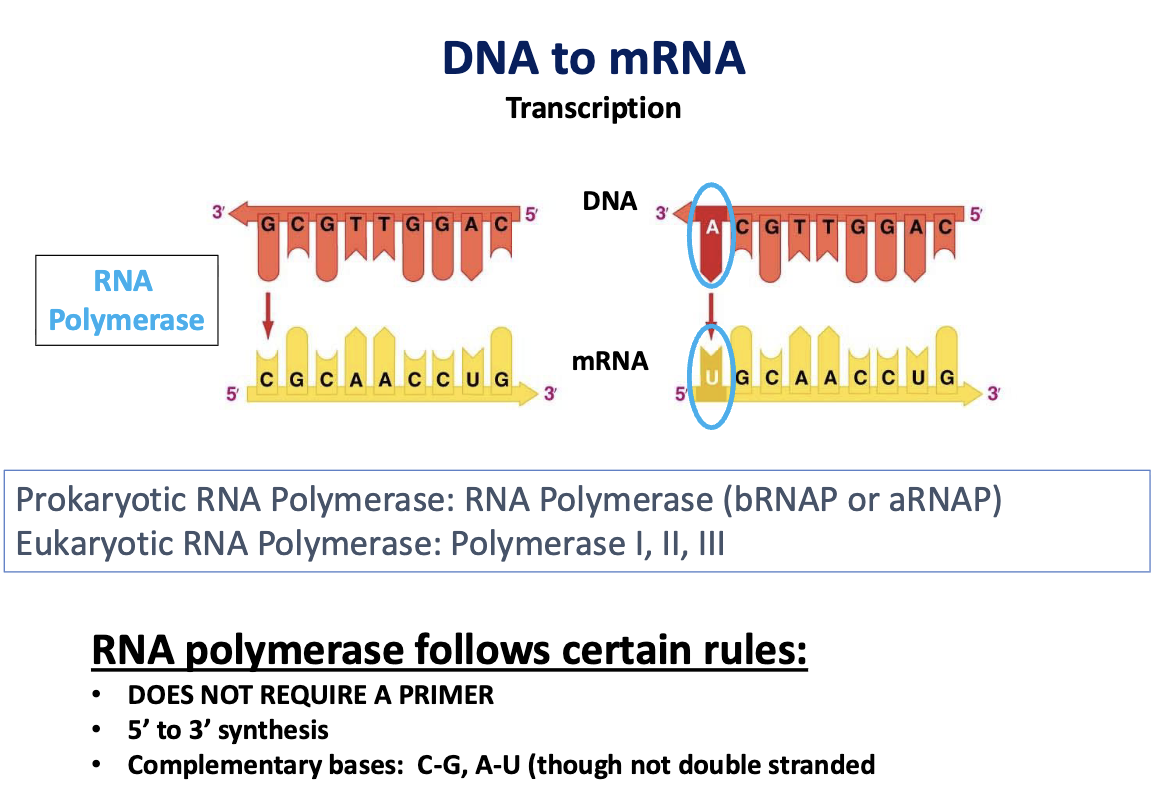
In what direction does RNA polymerase read the DNA template?
3' → 5'
What nucleotides are used in RNA synthesis?
ATP, UTP, GTP, and CTP.
What base pairs with adenine during transcription?
Uracil
What base pairs with cytosine during transcription?
Guanine
Is RNA usually single-stranded or double stranded?
single stranded
What feature distinguishes RNA from DNA?
RNA contains uracil instead of thymine.
Does transcription copy an entire chromosome?
no! only s specific segment/gene is coped/transcribed
In eukaryotic cell, one gene….
…one gene, one RNA, one protein
In prokaryotic cells, one RNA…
…one RNA encoded can lead to multiple proteins
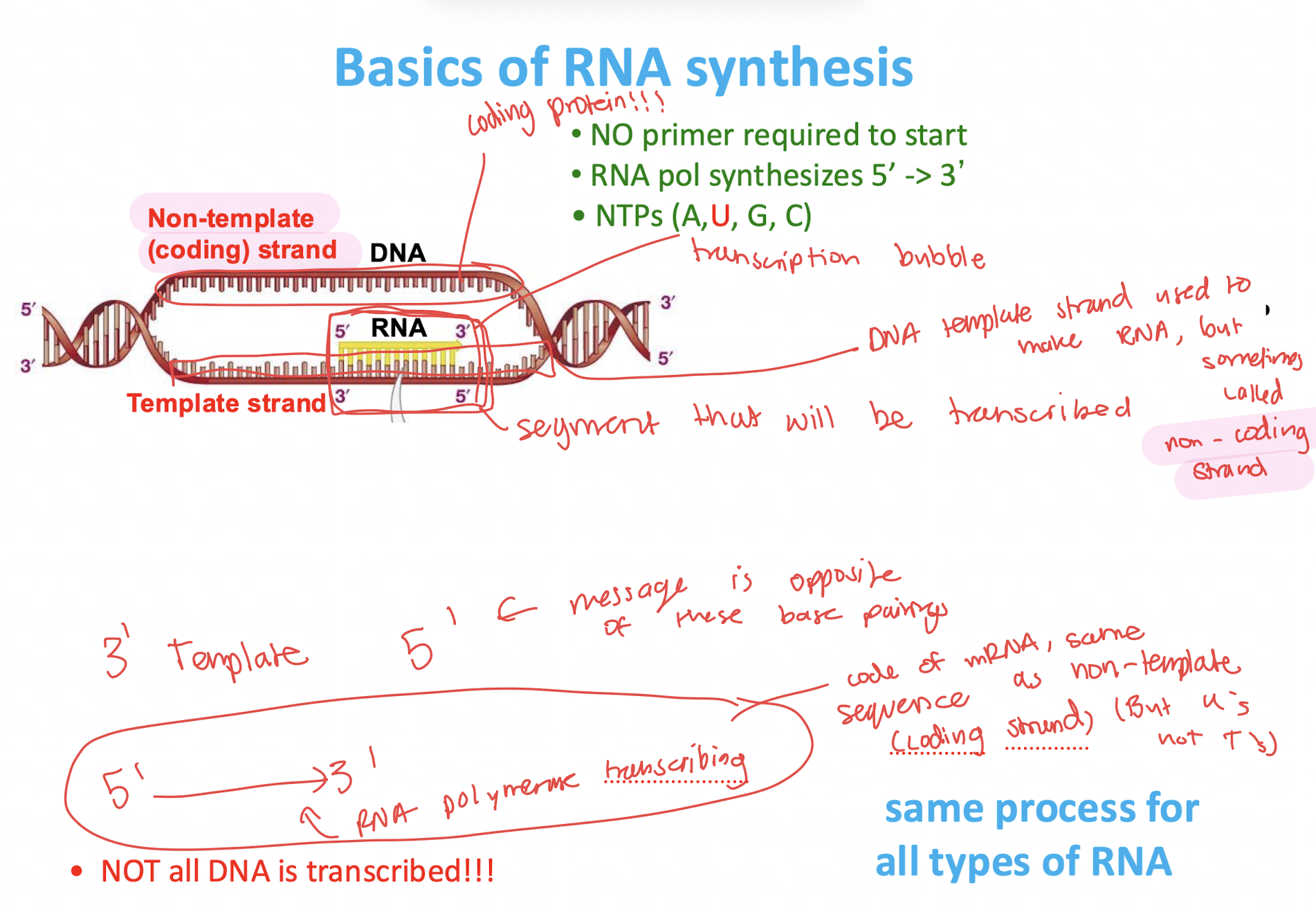
Basics of RNA synthesis: What is a transcription bubble?
locally unwound region of DNA where transcription occurs.
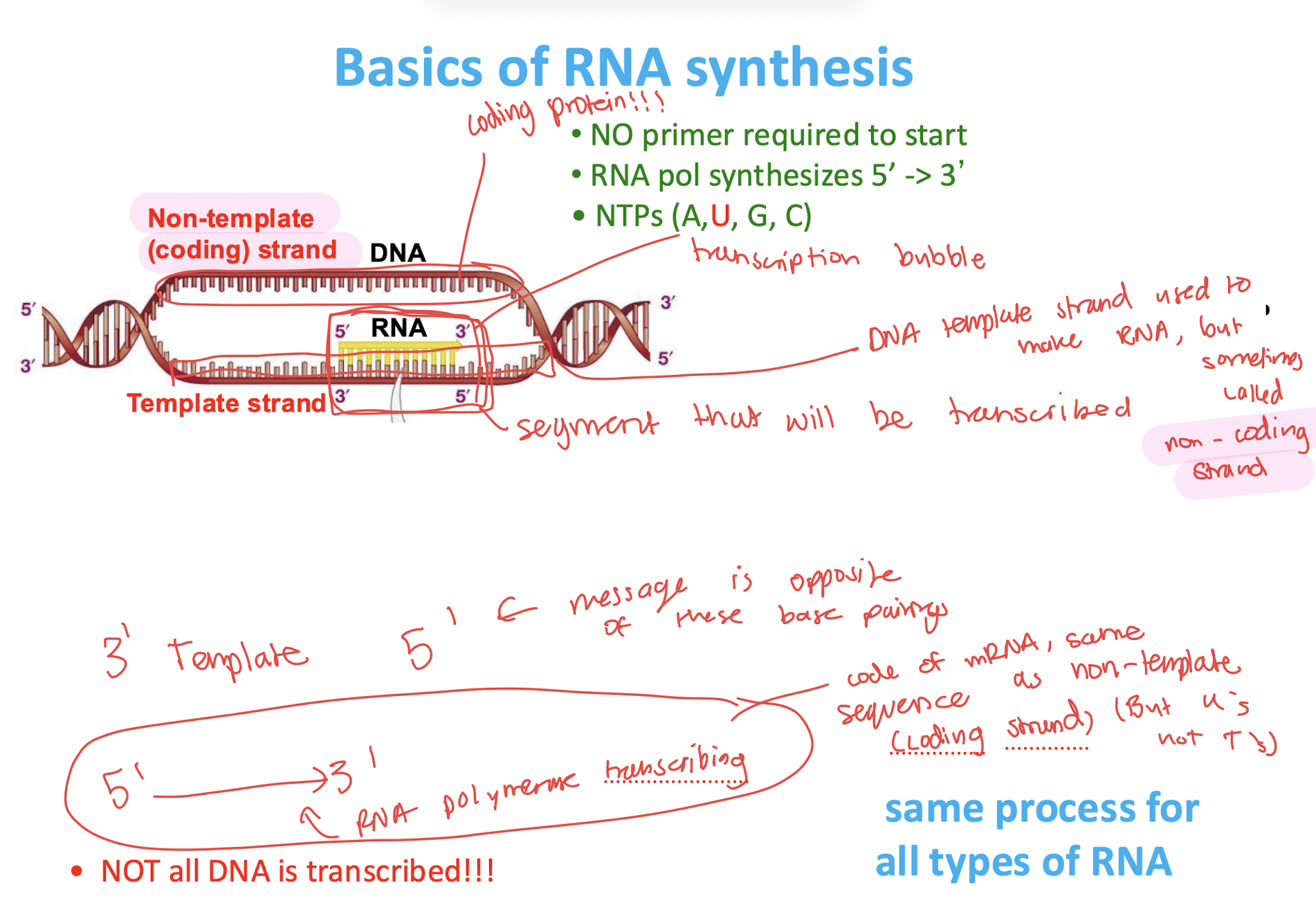
Which DNA strand is used by RNA polymerase as a template?
The template strand
used to make RNA
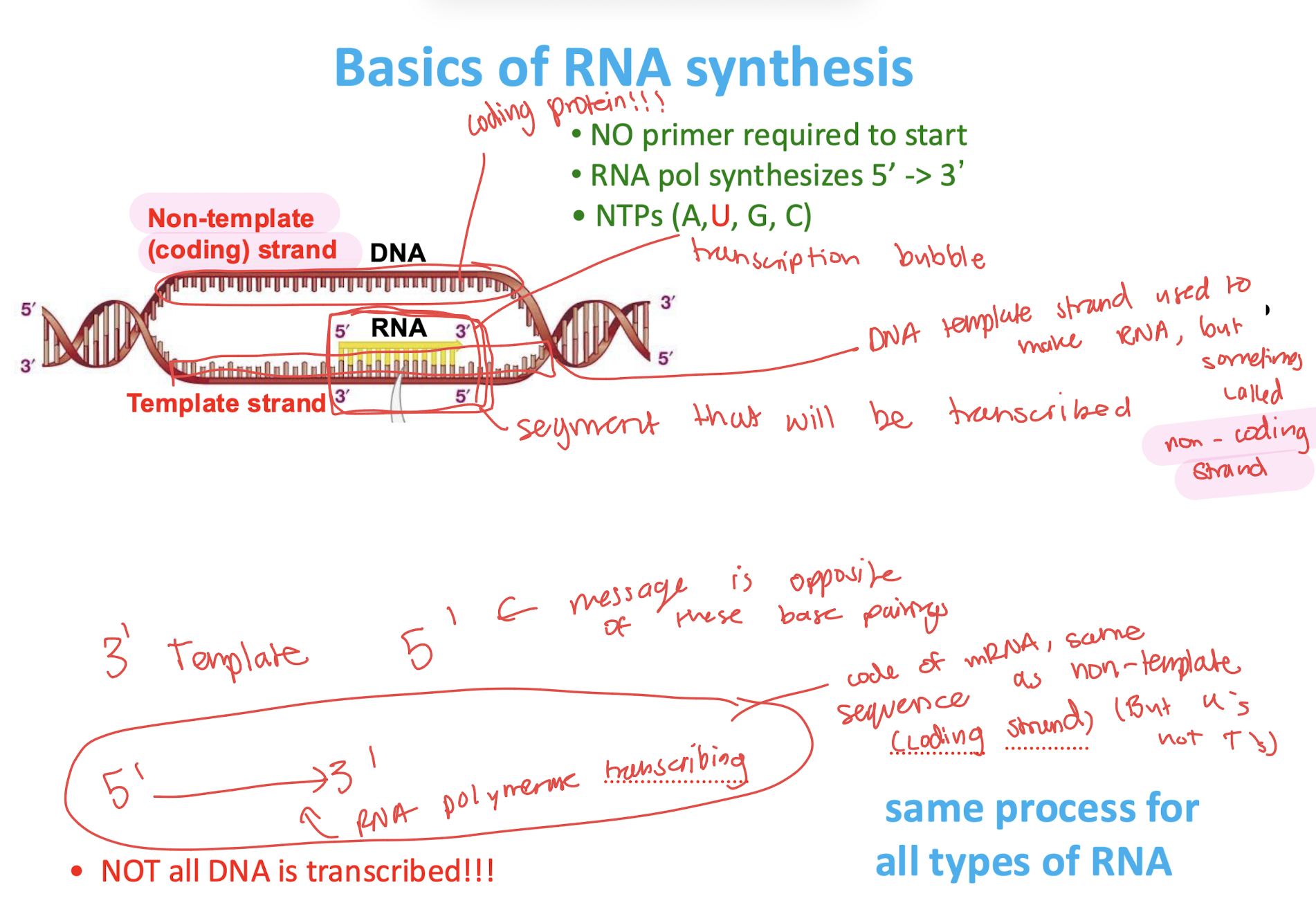
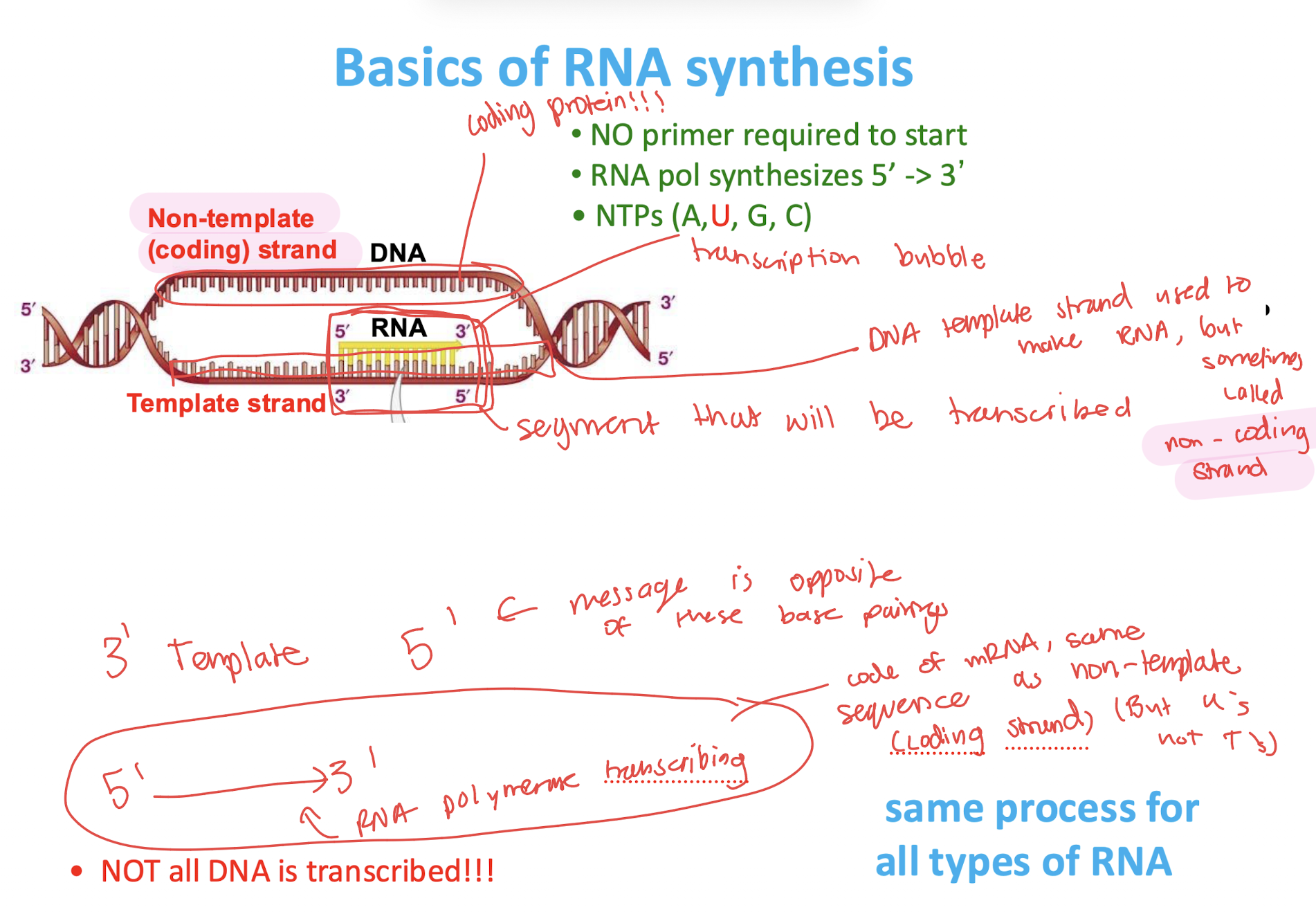
What is another name for the template strand?
Non-coding strand.
What is another name for the non-template strand?
Coding strand.
Why is the non-template strand called the coding strand?
Its sequence matches the mRNA sequence except T is replaced by U.
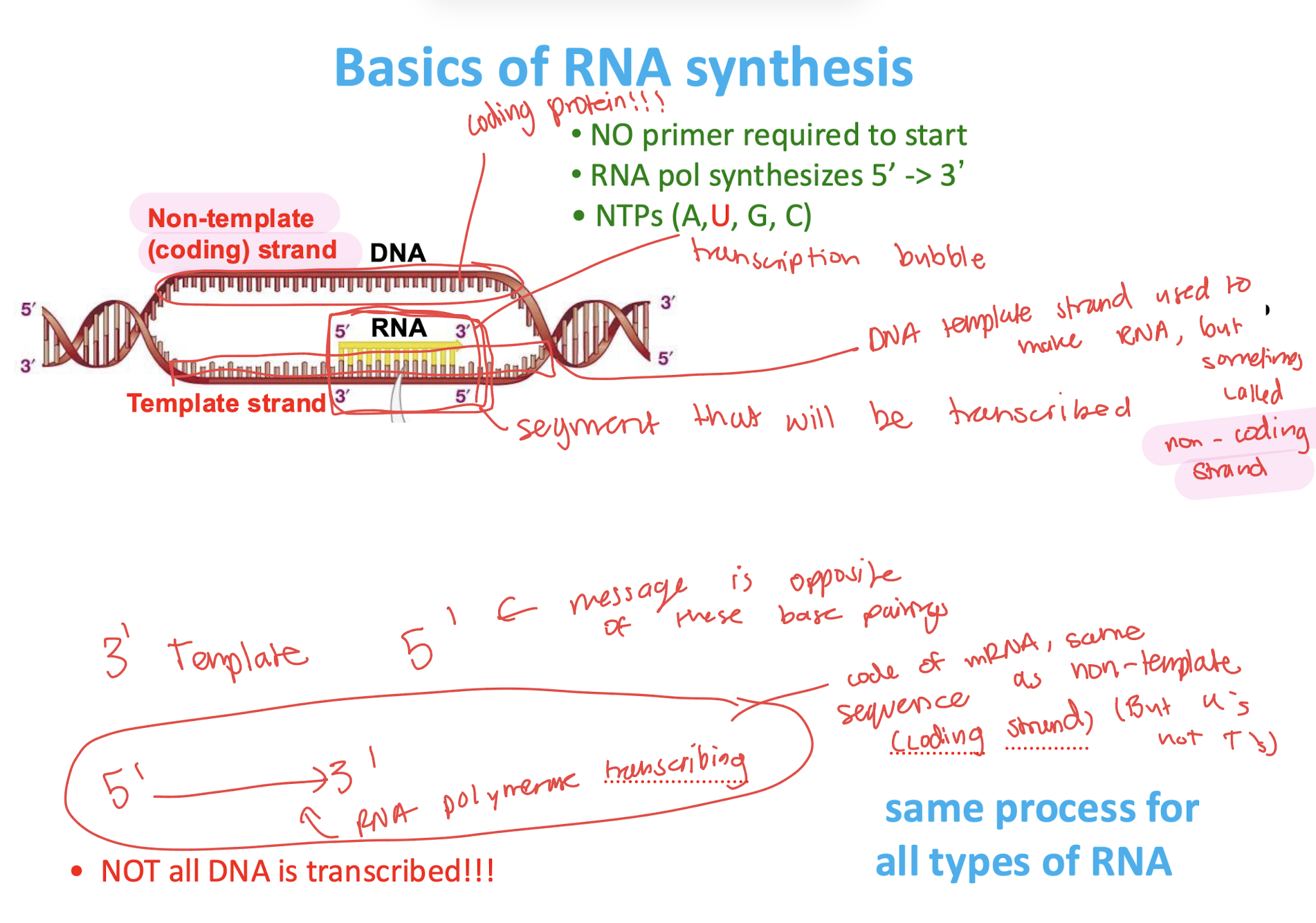
Which strand has the same sequence as the mRNA?
The coding (non-template) strand.
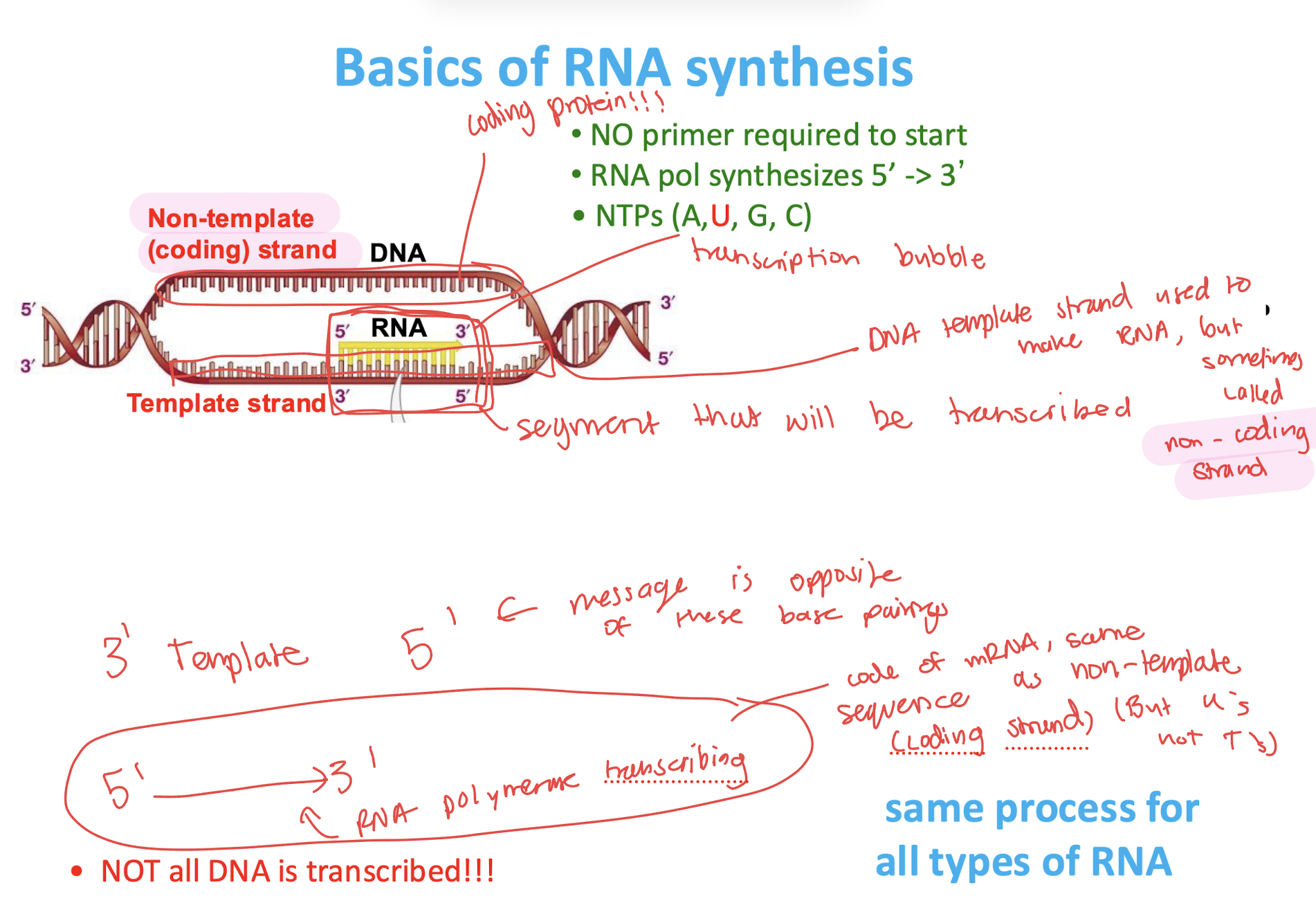
If the coding strand/non template strand is 5'-ATGCC-3', what is the mRNA sequence?
5'-AUGCC-3'
If the template strand/non-coding strand is 3'-TACGG-5', what is the mRNA sequence?
5'-AUGCC-3'
Why must the template strand run 3' → 5'?
Because RNA polymerase synthesizes RNA 5' → 3'.
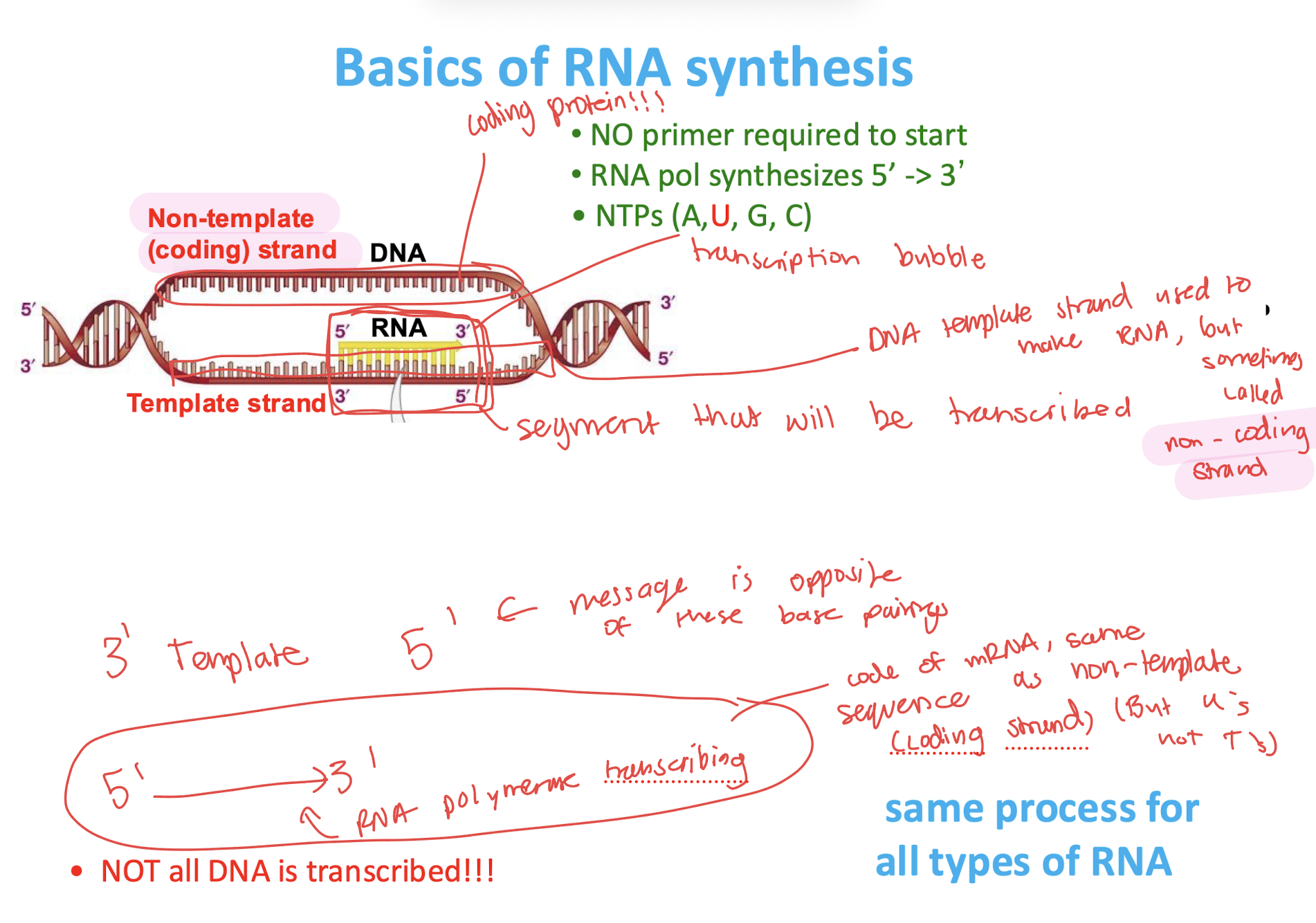
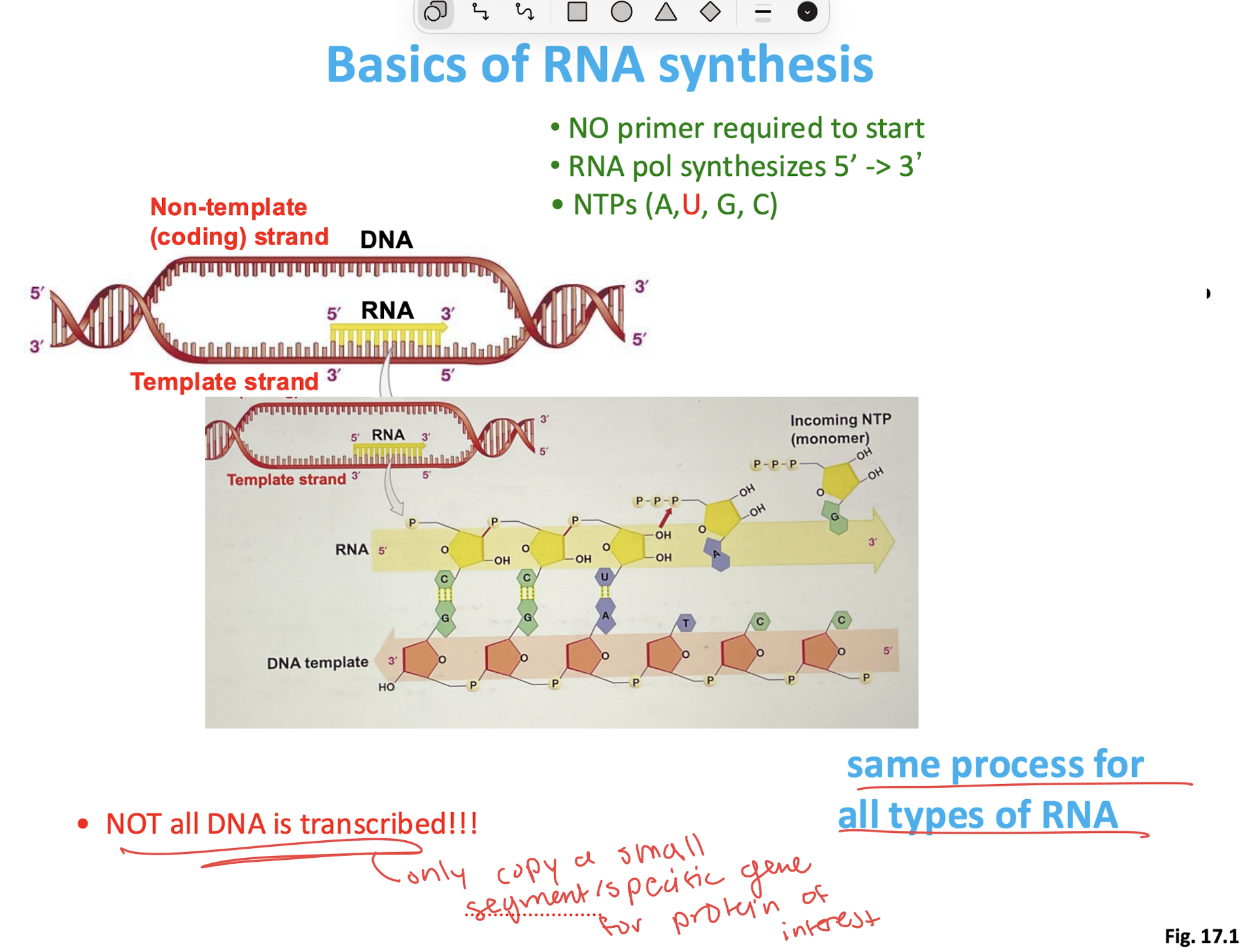
Basics of RNA synthesis summarized
NO primer required to start
RNA pol synthesizes 5’ → 3’
NTPS (A, U, G, C)
→ not all DNA is transcribed!! only small segment/specific gene for protein of interest
Transcription Initiation in Bacteria: What is a promoter?
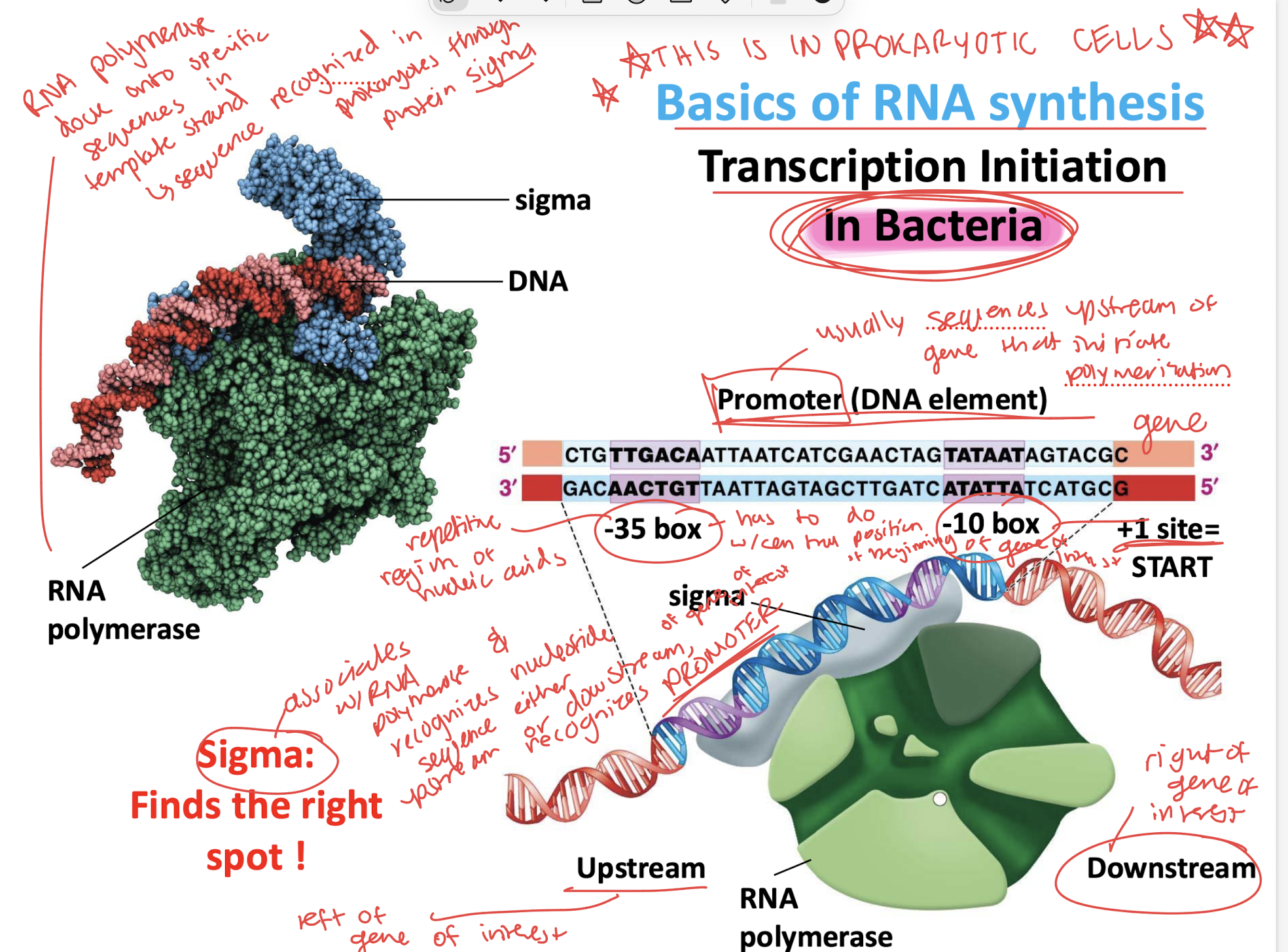
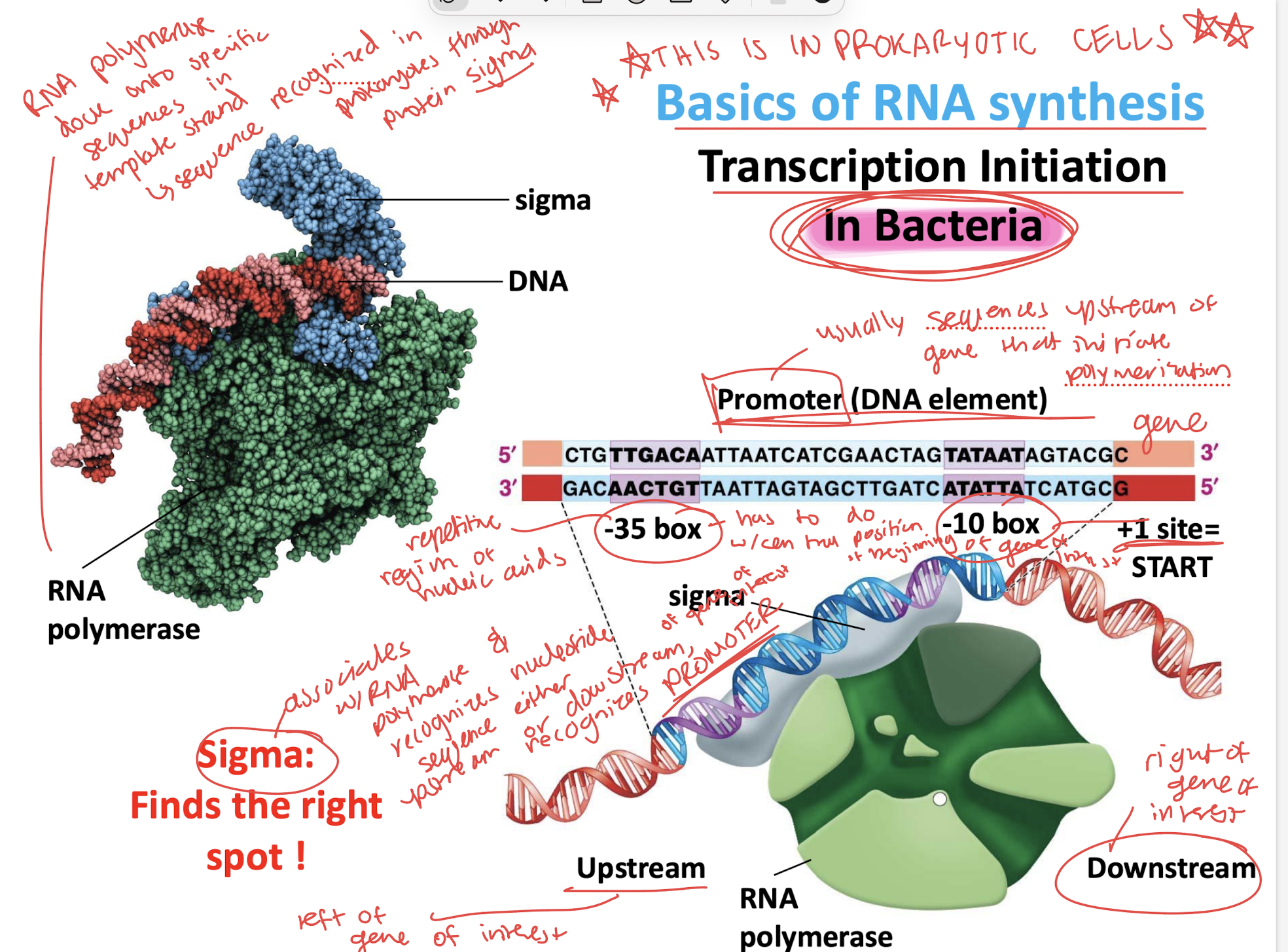
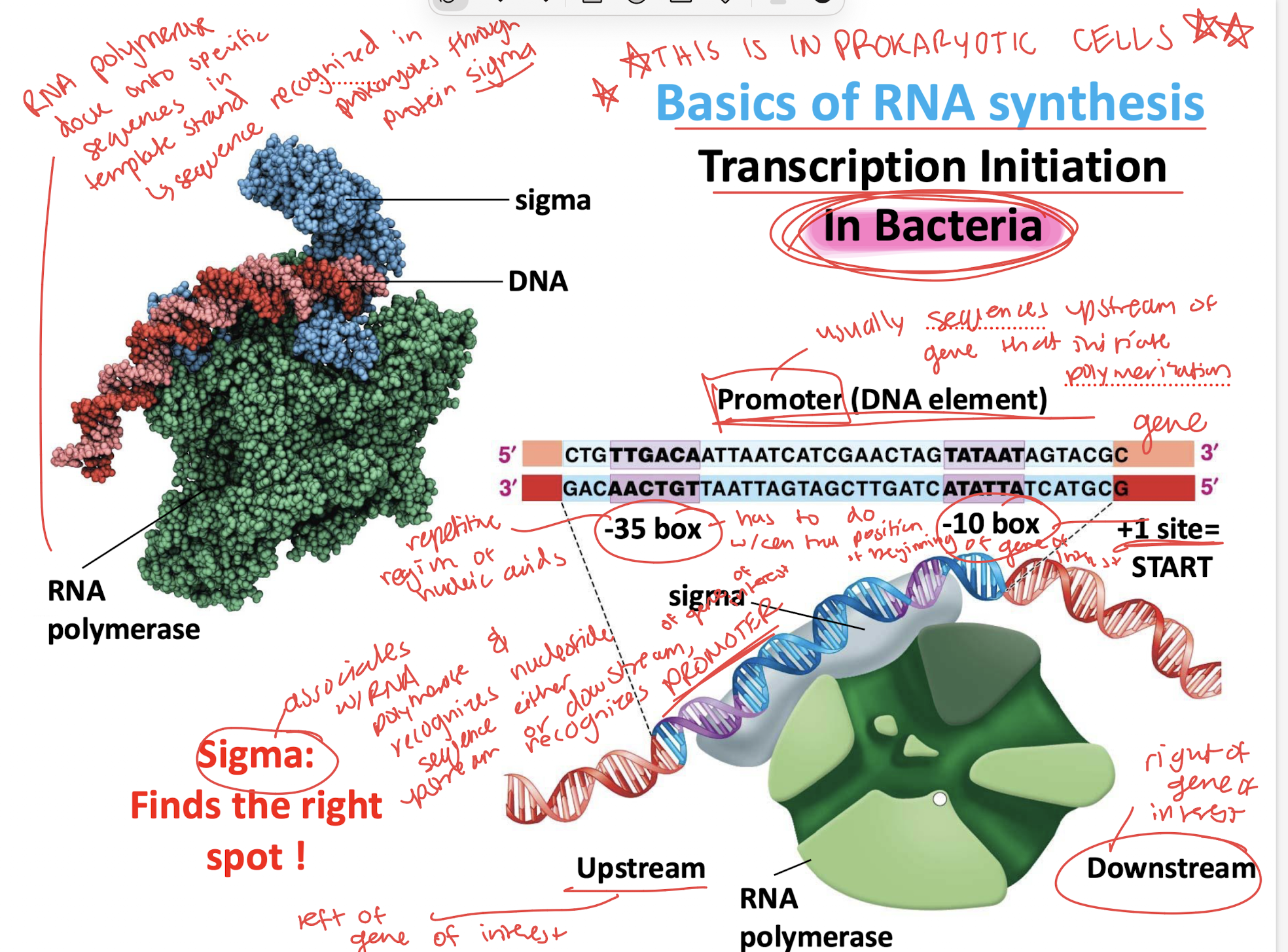
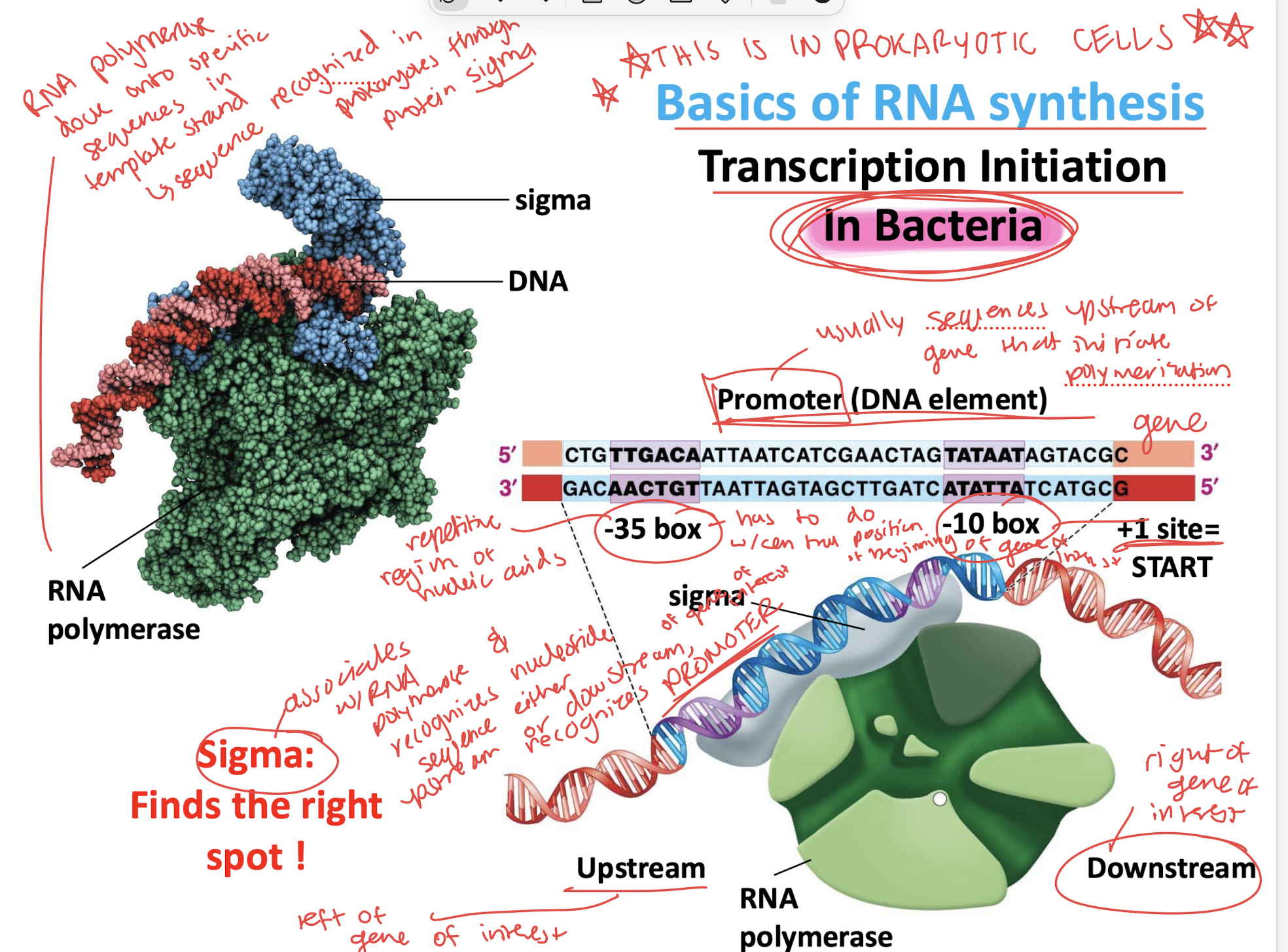
DNA sequence where RNA polymerase begins transcription.
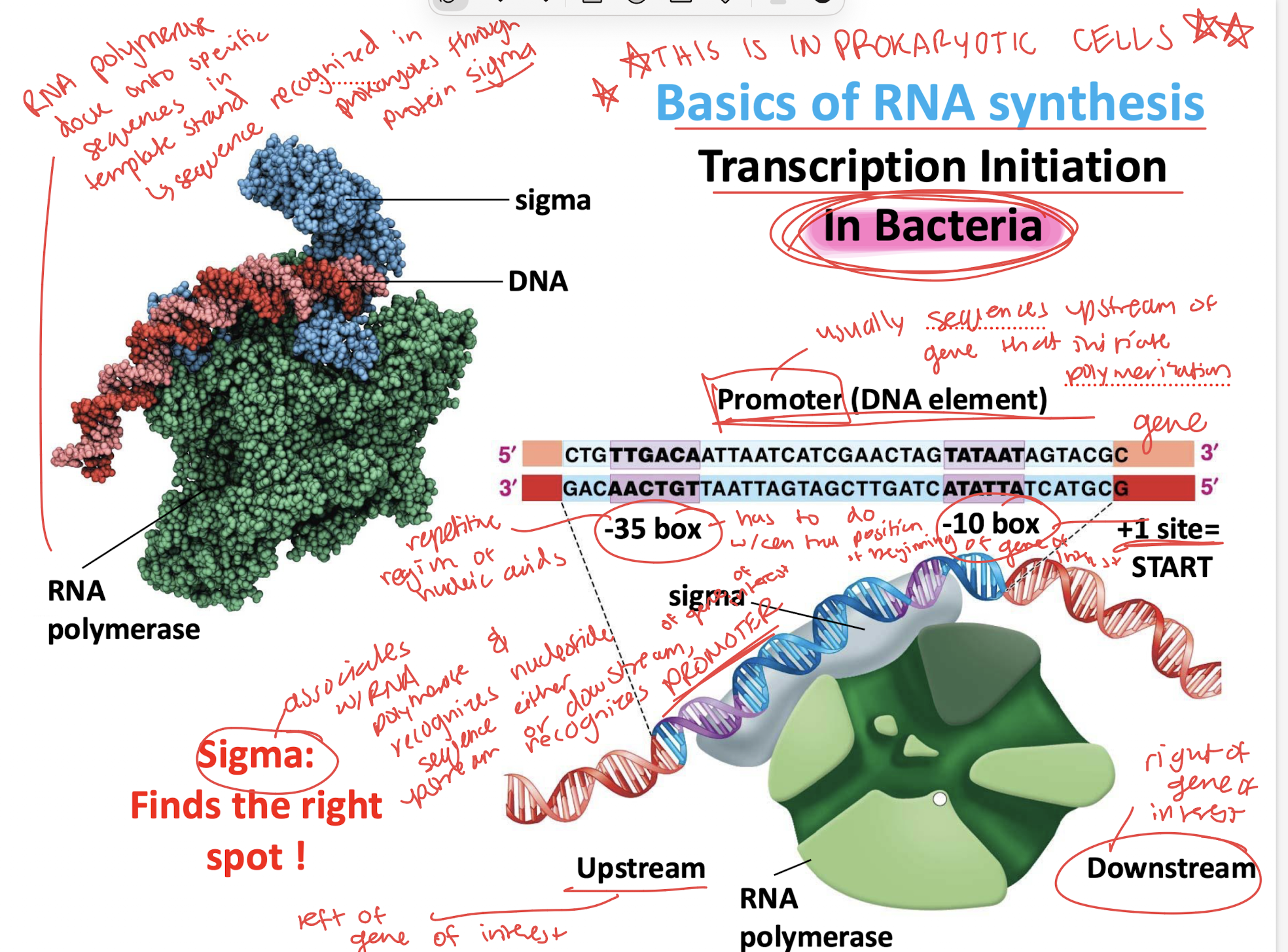
Transcription Initiation in Bacteria: What is the function of a promoter?
usually sequences upstream of gene that initiate polymerization
→ through being recognized by sigma, directs RNA polymerase to the correct gene and start site
Why is correct initiation important?
Starting at the wrong location produces incorrect RNA and proteins.
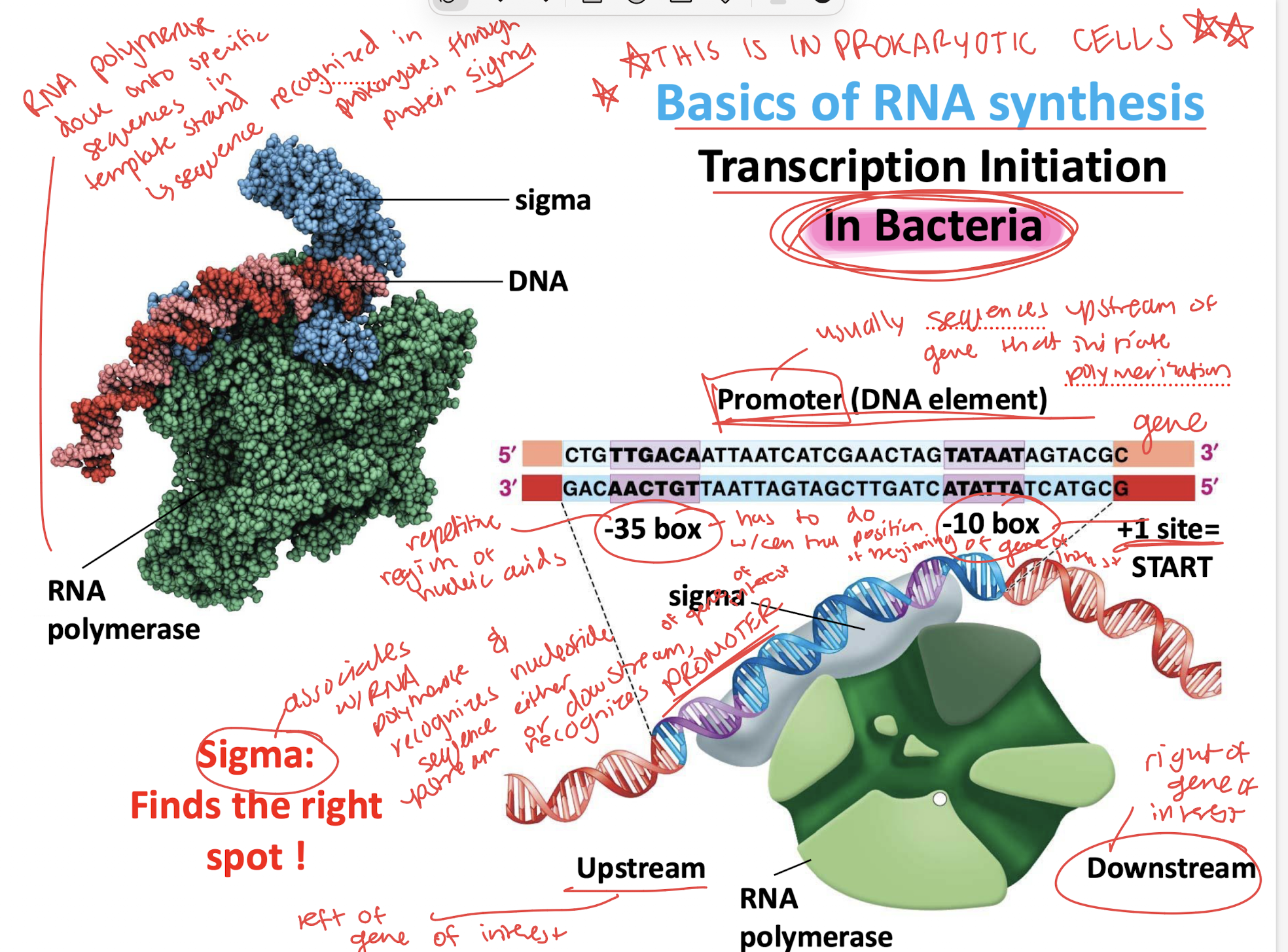
Transcription Initiation in Bacteria: What protein helps bacterial RNA polymerase find promoters?
Sigma factor.
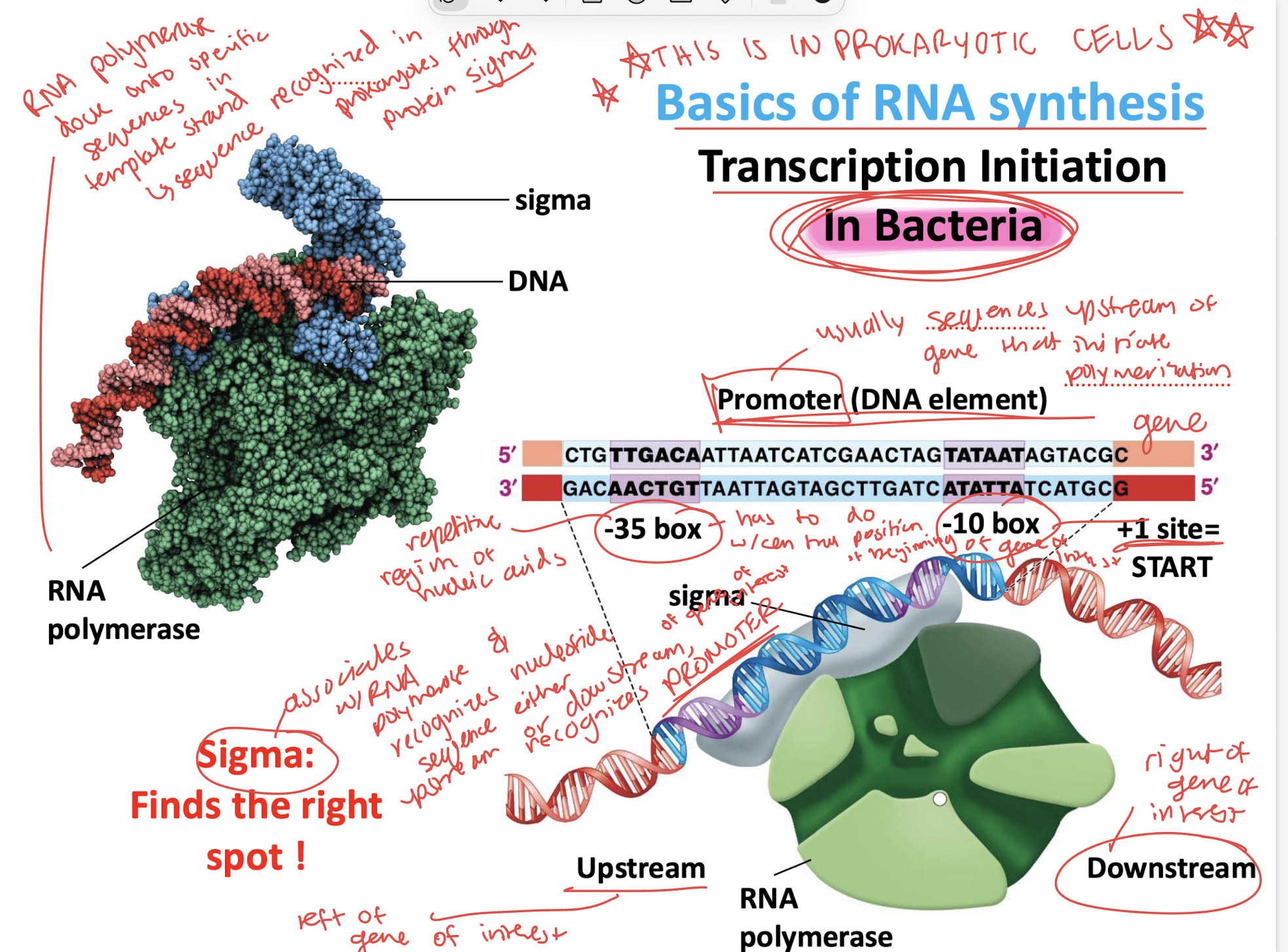
Transcription Initiation in Bacteria: What is the function of sigma factor?
Associates with RNA polymerase & Recognizes promoter sequences and guides RNA polymerase to them
finds the right spot!
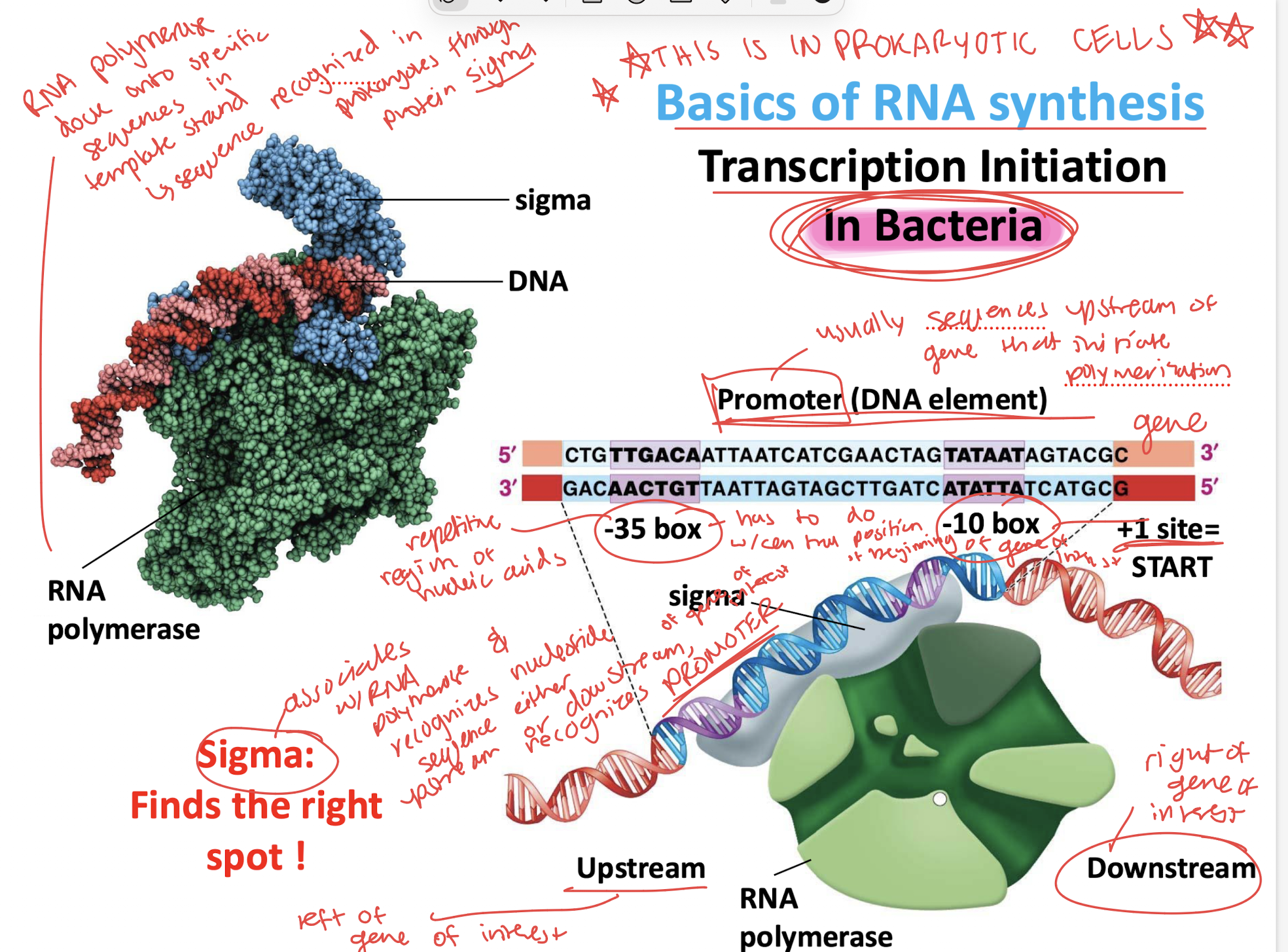
Transcription Initiation in Bacteria: What happens after sigma factor recognizes a promoter?
RNA polymerase binds and begins transcription.
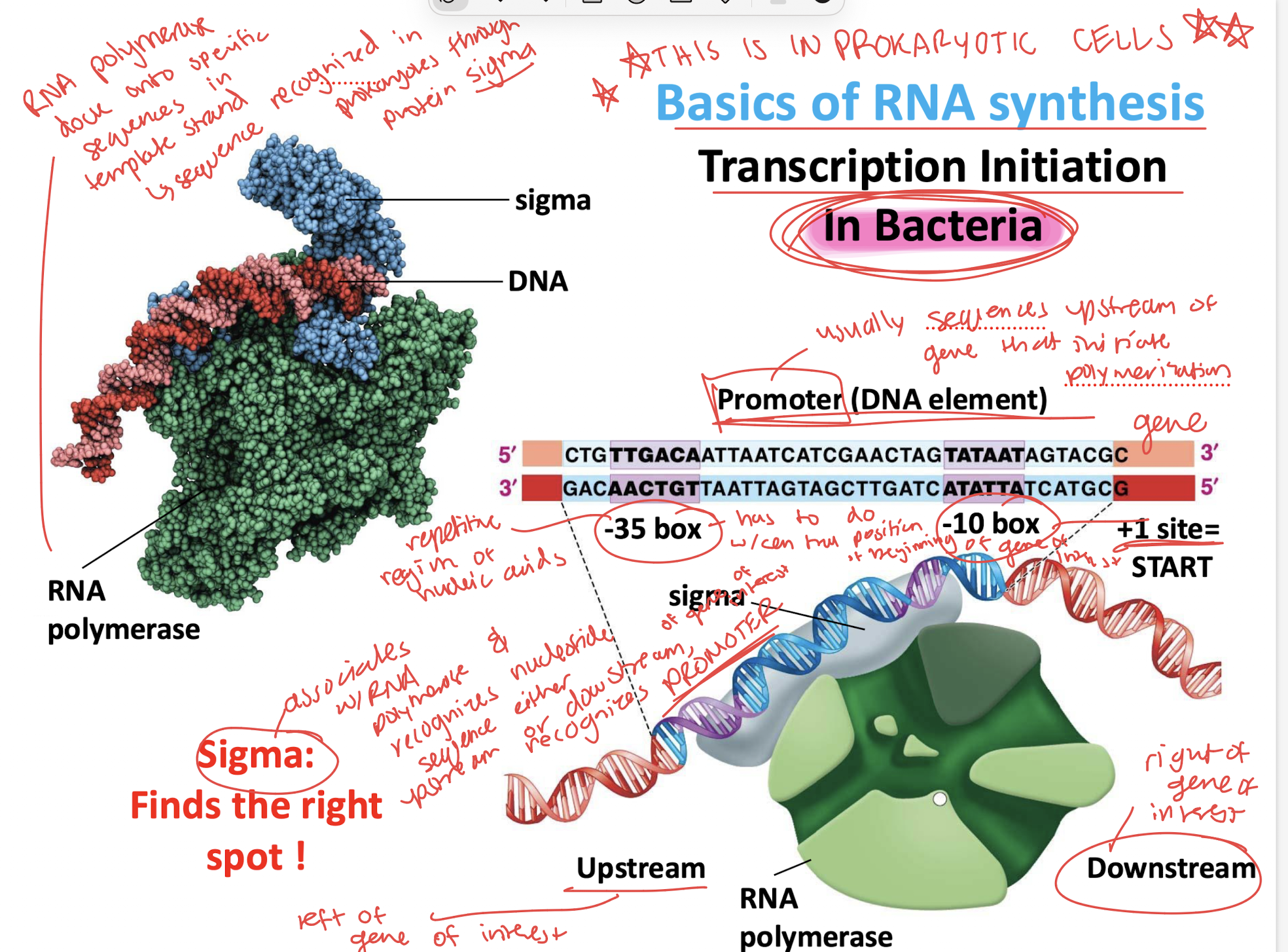
What are the common bacterial promoter elements?
The -10 box and -35 box
have to do w/central position of beginning of gene on interest
precisely positioned upstream from the \(+1\) transcription start site to guide RNA polymerase directly to the beginning of the gene.
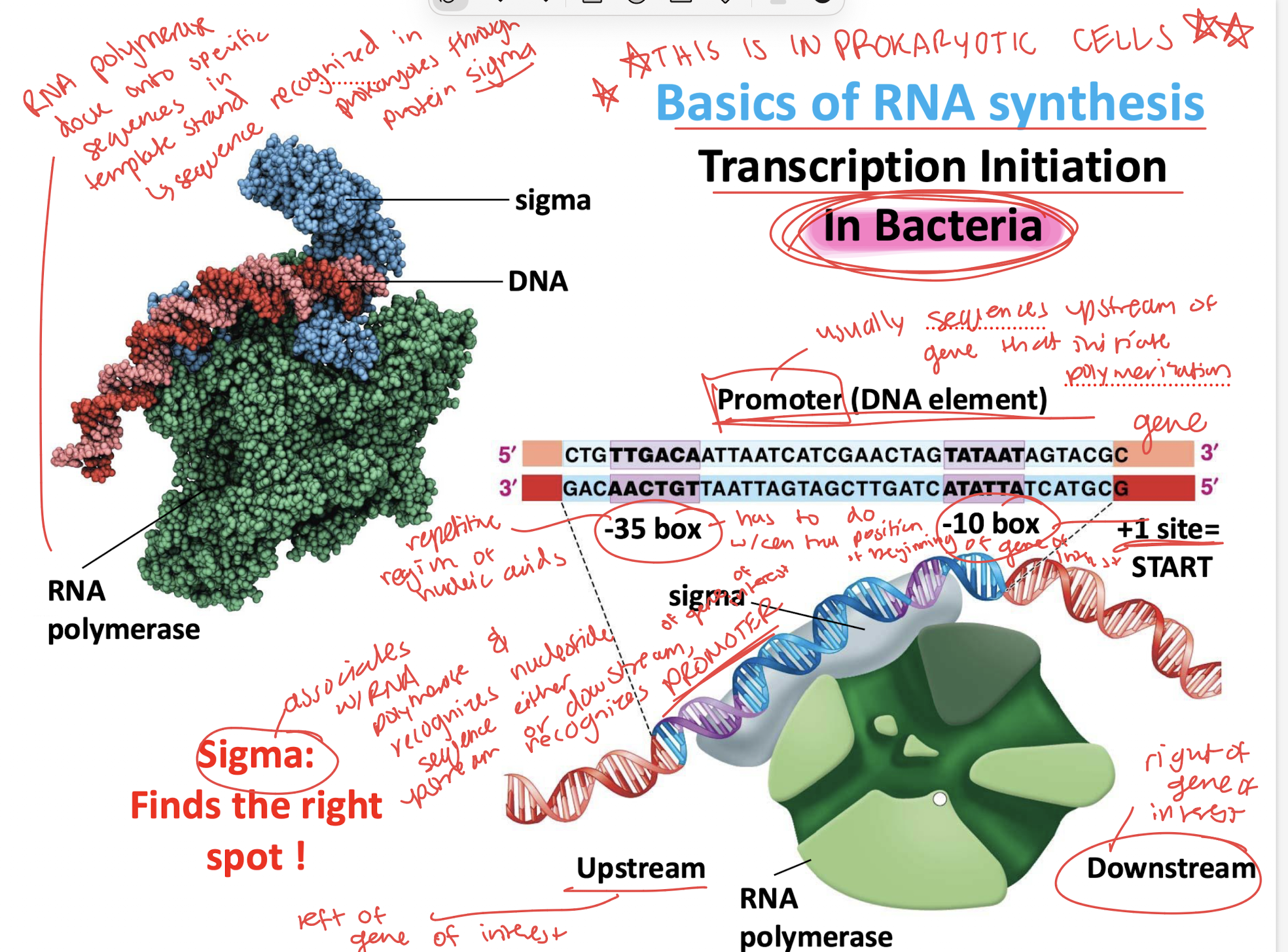
What does the "+1 site" represent?
The transcription start site.
What does "upstream" mean?
left of gene of interest → toward promoter, before start site
What does "downstream" mean?
right of gene of interest → In the direction transcription proceeds; after the start site.
Relative to the gene, where are promoters usually found?
upstream
usually sequences upstream of gene that initiate polymerization
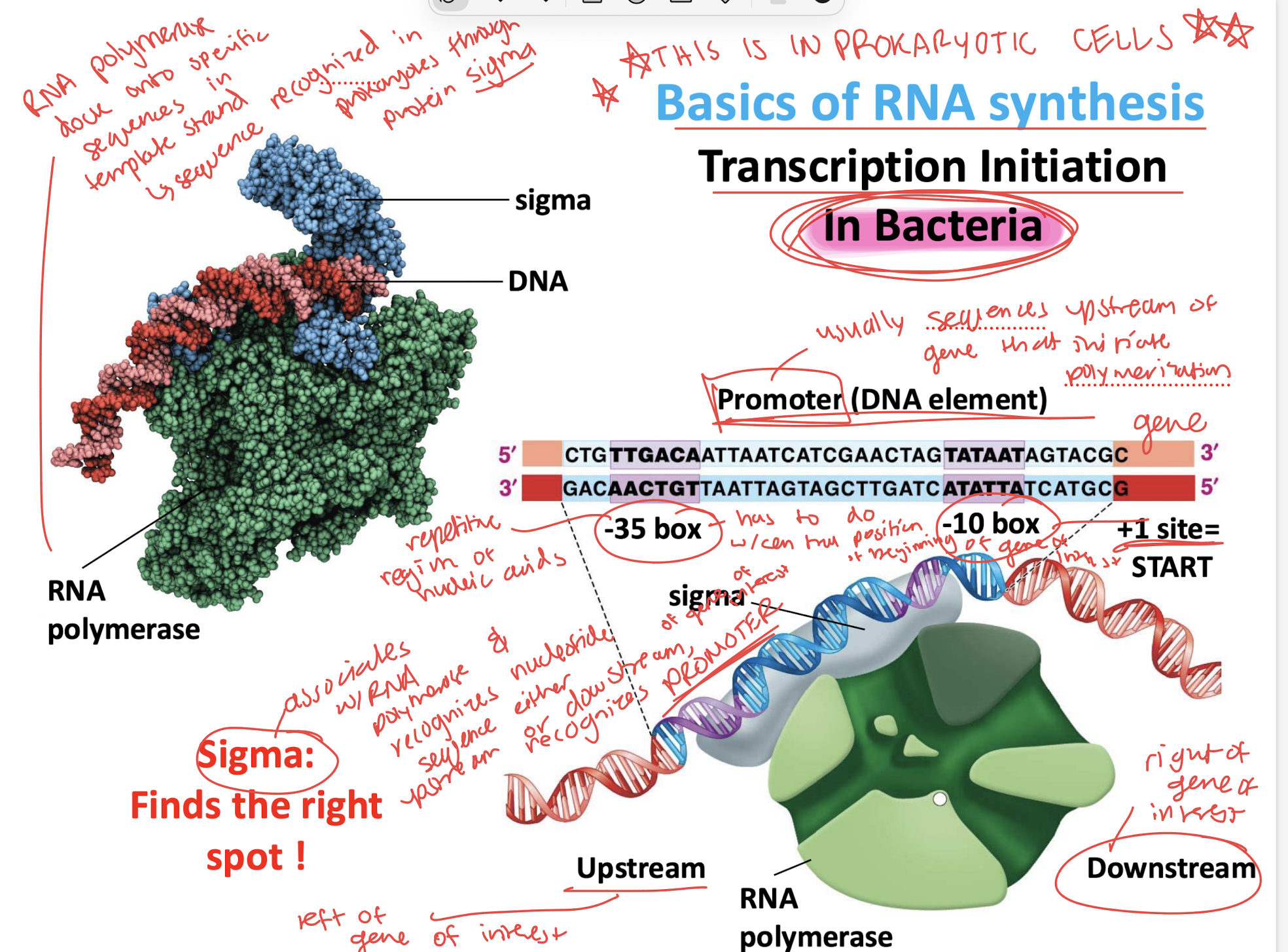
Transcription Initiation in Bacteria: What does sigma factor help place into the RNA polymerase active site?
The DNA template Strand
What occurs during transcription elongation?
RNA polymerase synthesizes RNA while moving along the DNA template.
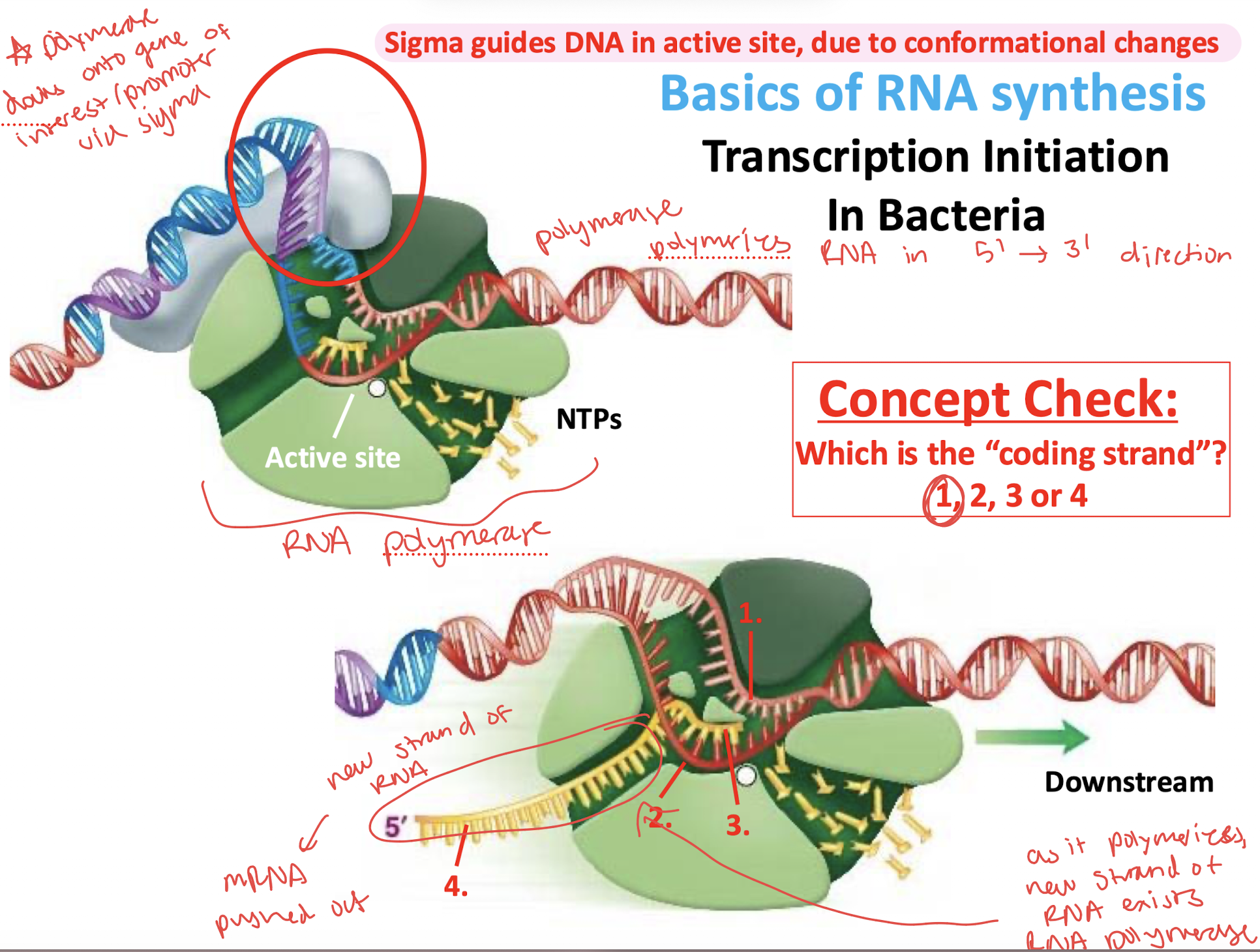
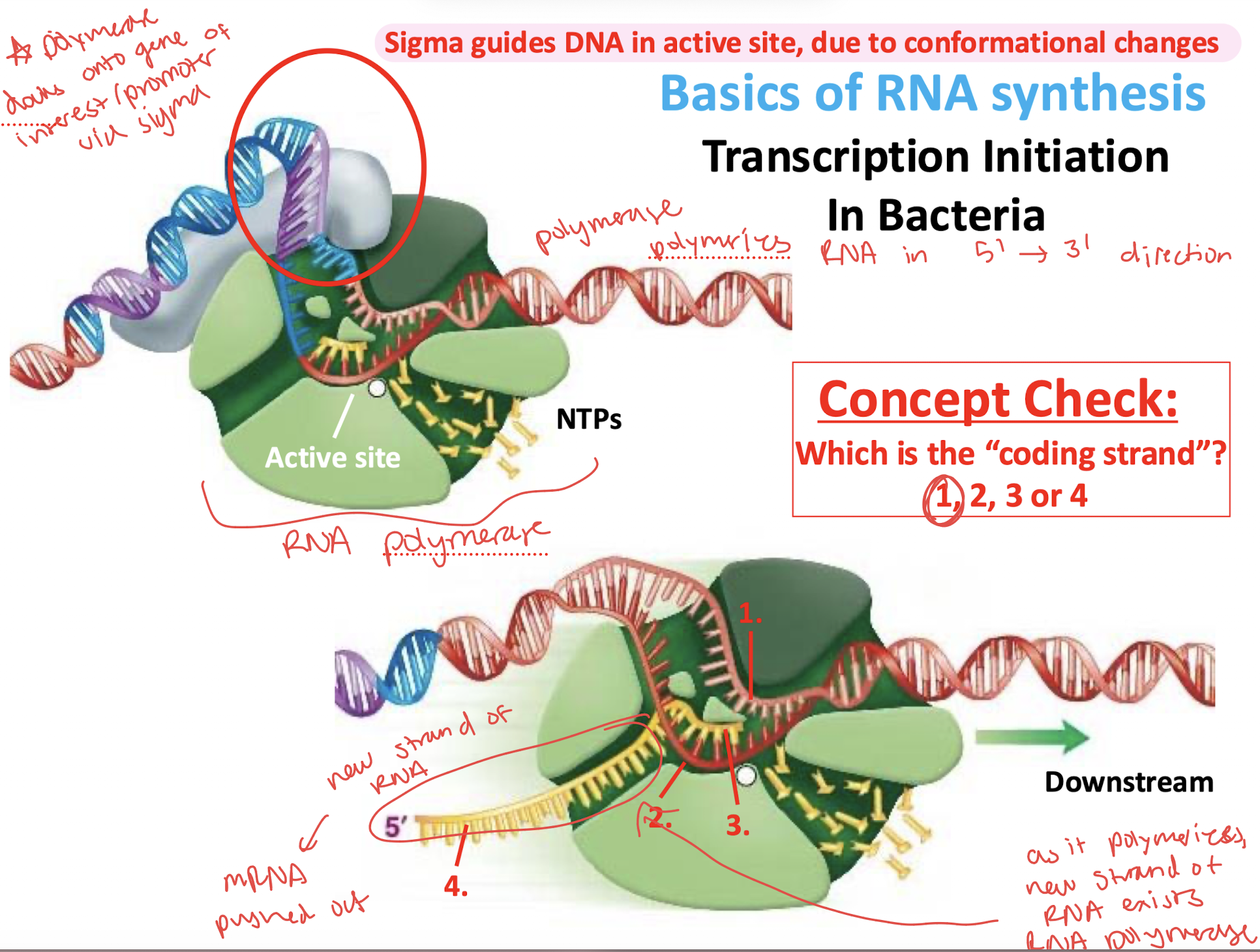
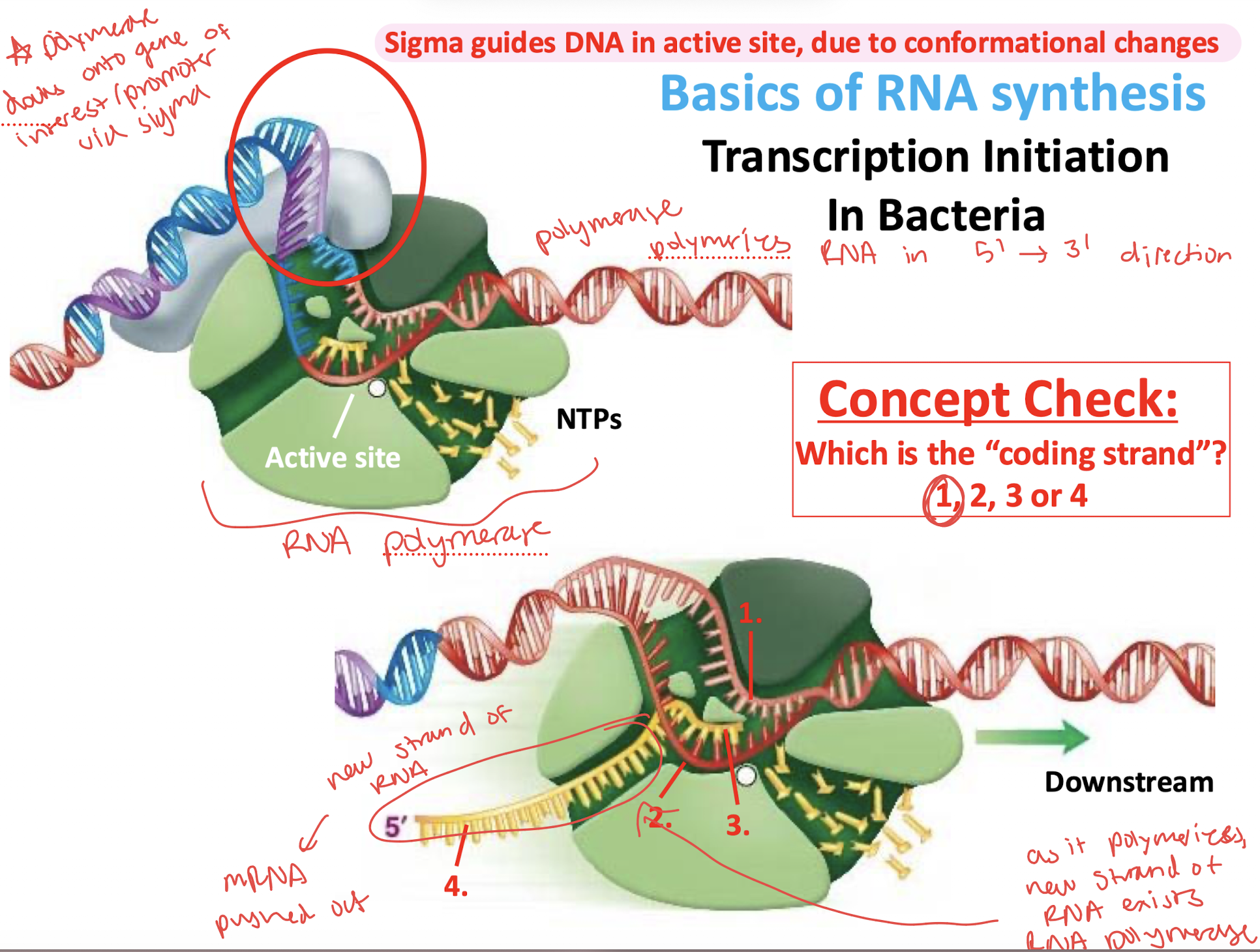
Elongation: RNA polymerase docks onto… (summarized)
docks onto gene of interest/promoter via sigma
sigma guides DNA in active site, due to conformational changes
polymerase polymerizes RNA in 5’ → 3’ direction
as it polymerizes new strand of RNA exits RNA polymerase
Elongation: What happens to DNA behind RNA polymerase?
The strands reanneal.
What exits RNA polymerase during elongation?
The growing RNA transcript.
Can multiple RNA polymerases transcribe the same gene simultaneously?
yes!
Why might a cell use many RNA polymerases on one gene?
To rapidly produce large amounts of RNA.
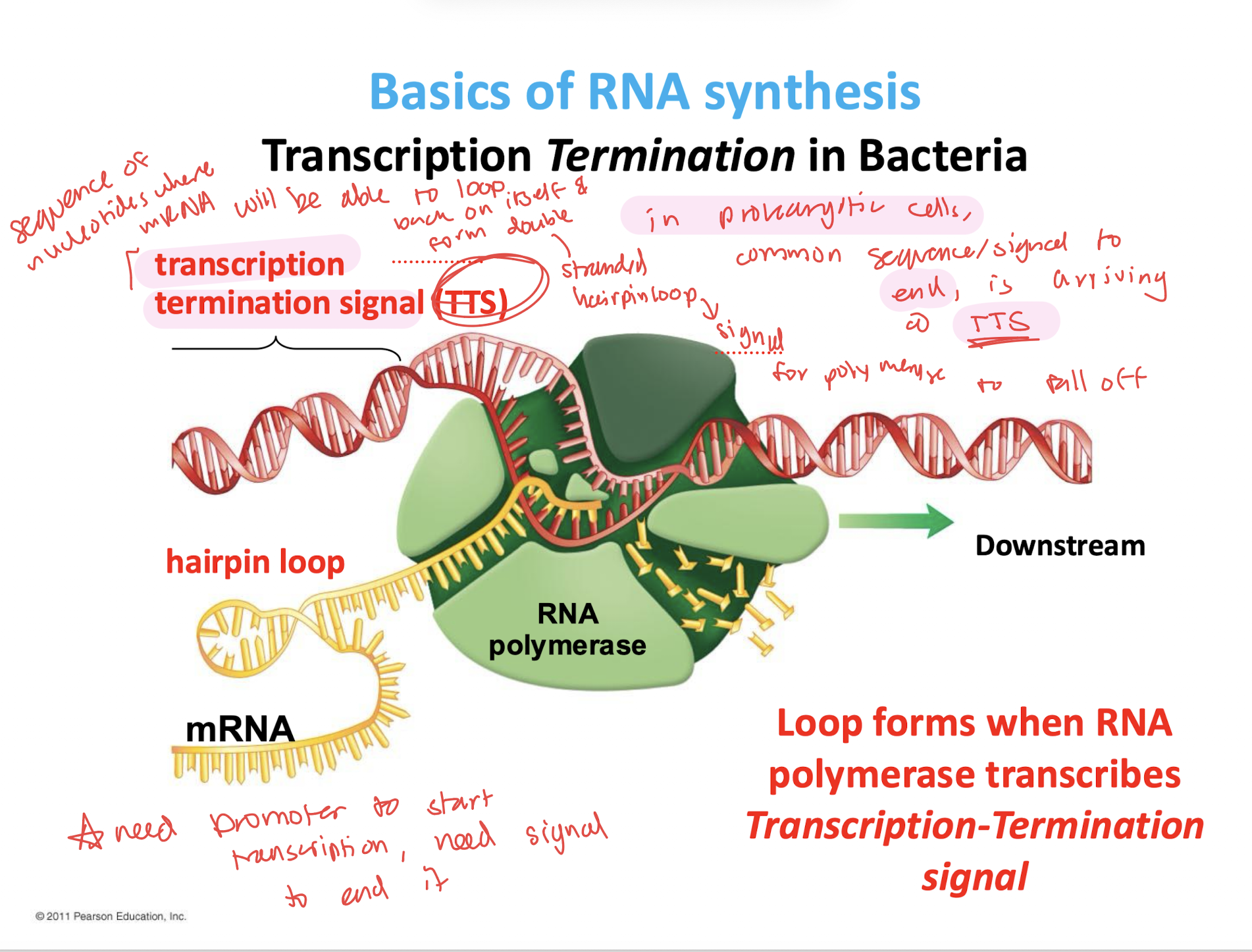
Transcription Termination in Bacteria: What is a transcription termination signal (TTS)?
sequence of nucleotides where mRNA will be able to loop back on itself & form double stranded hairpin loop
→ sequence/signal to end transcription is arriving @ TTS
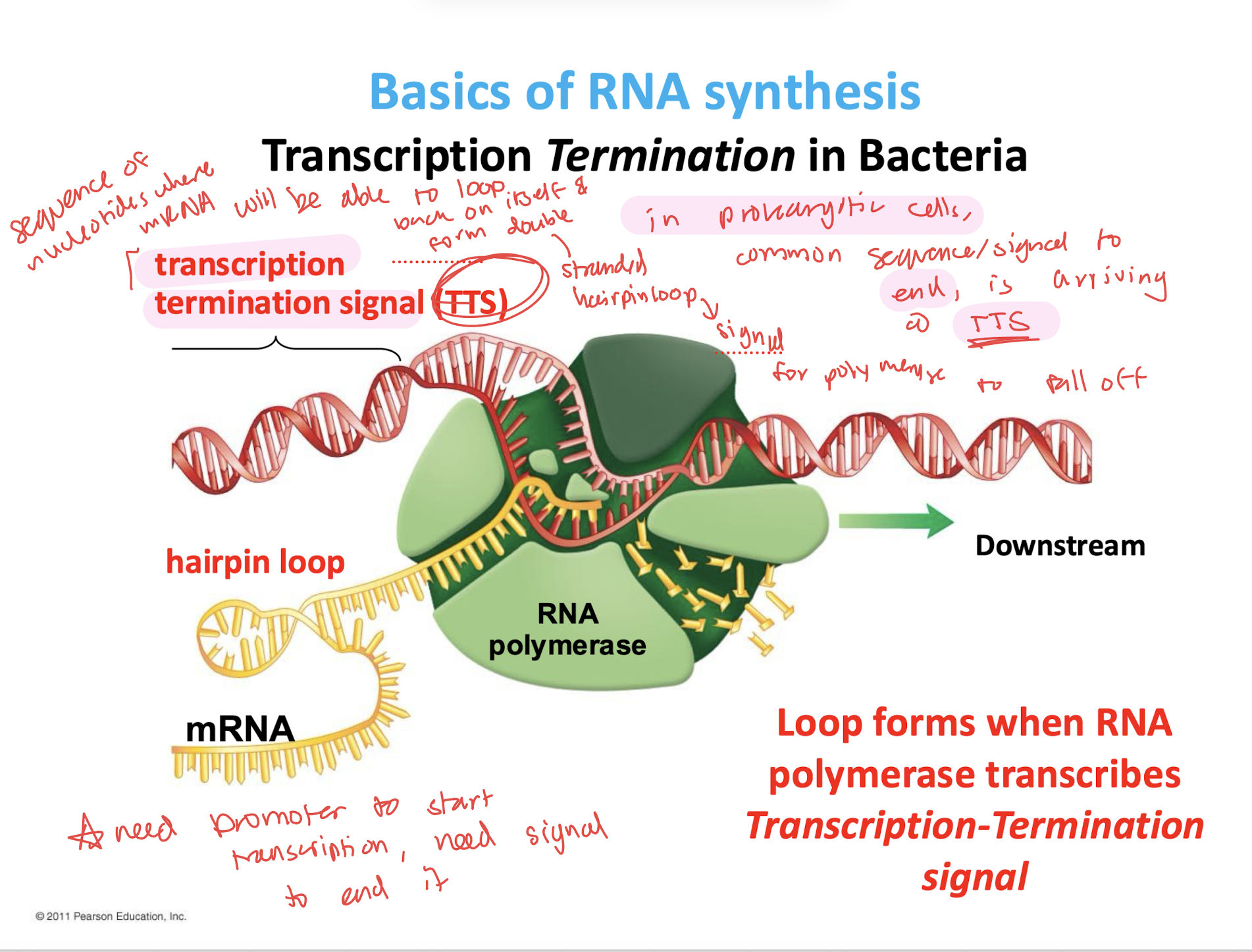
What structure often forms in bacterial termination?
A hairpin loop
Loop forms when RNA polymerase transcribes Transcription-Termination signal
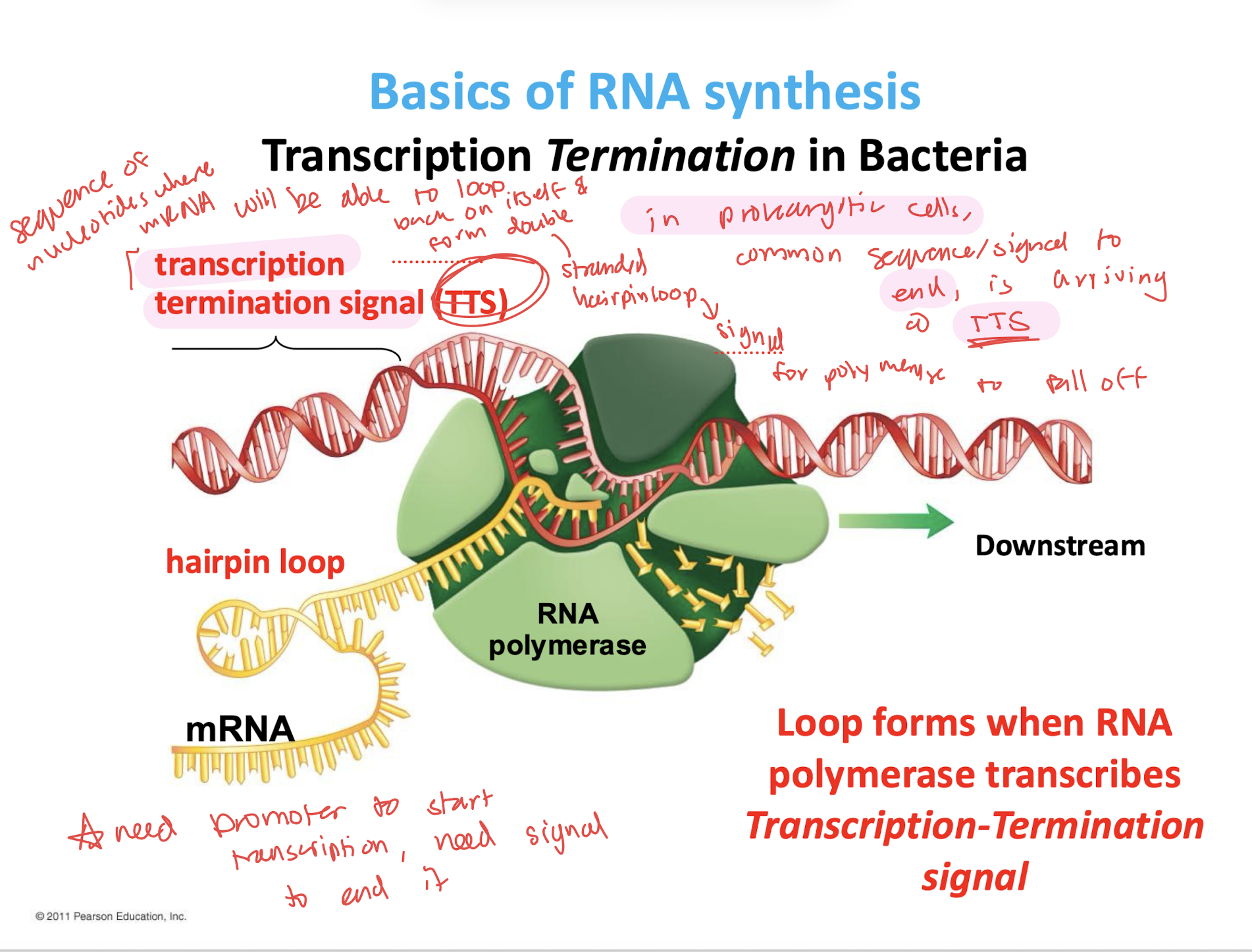
What causes a hairpin loop to form?
Complementary base pairing within the RNA transcript.
What level of RNA structure is a hairpin loop?
Secondary (2°) structure.
How does the hairpin loop terminate transcription?
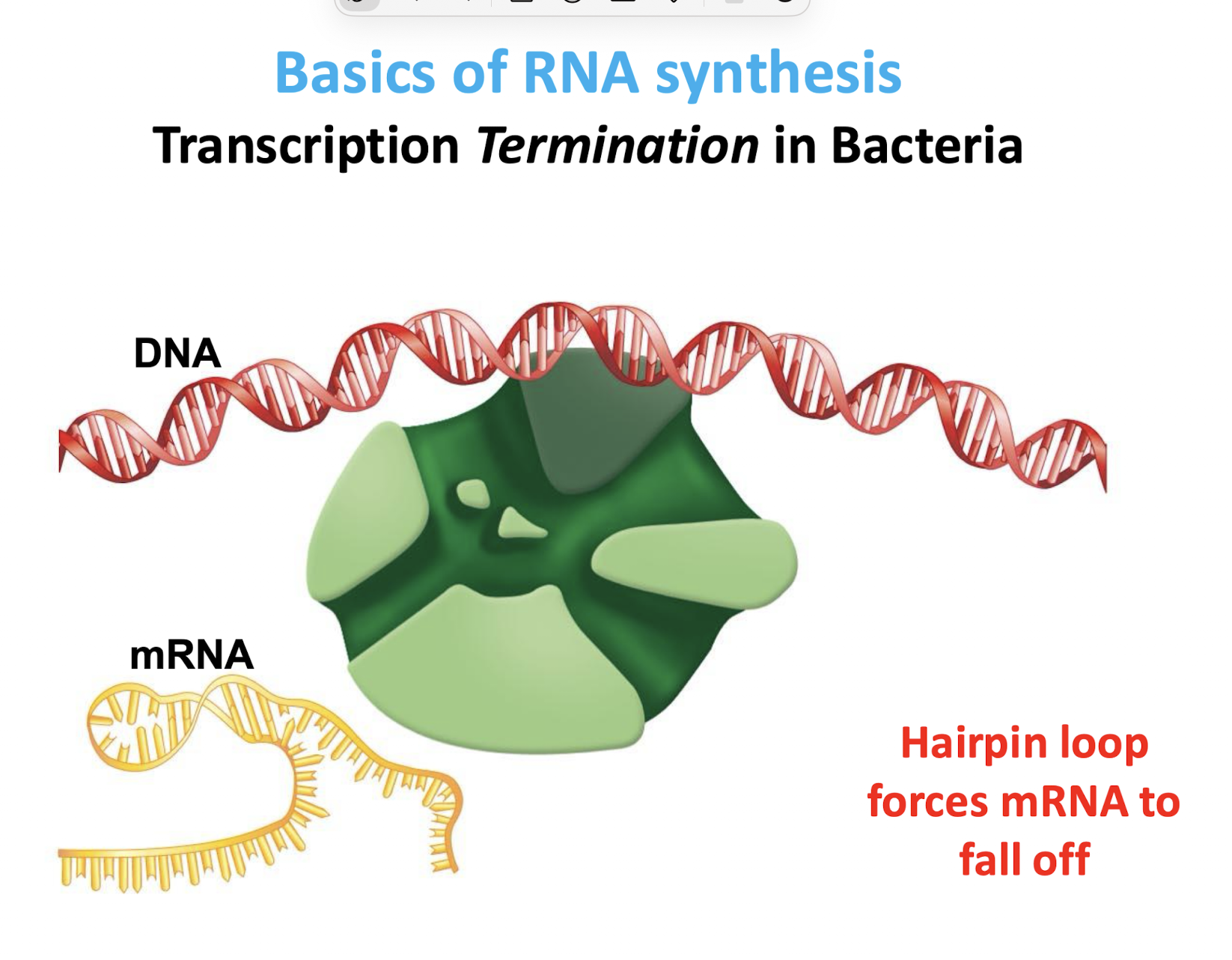
It destabilizes the RNA polymerase complex, causing release of the RNA.
What happens to RNA polymerase after termination?
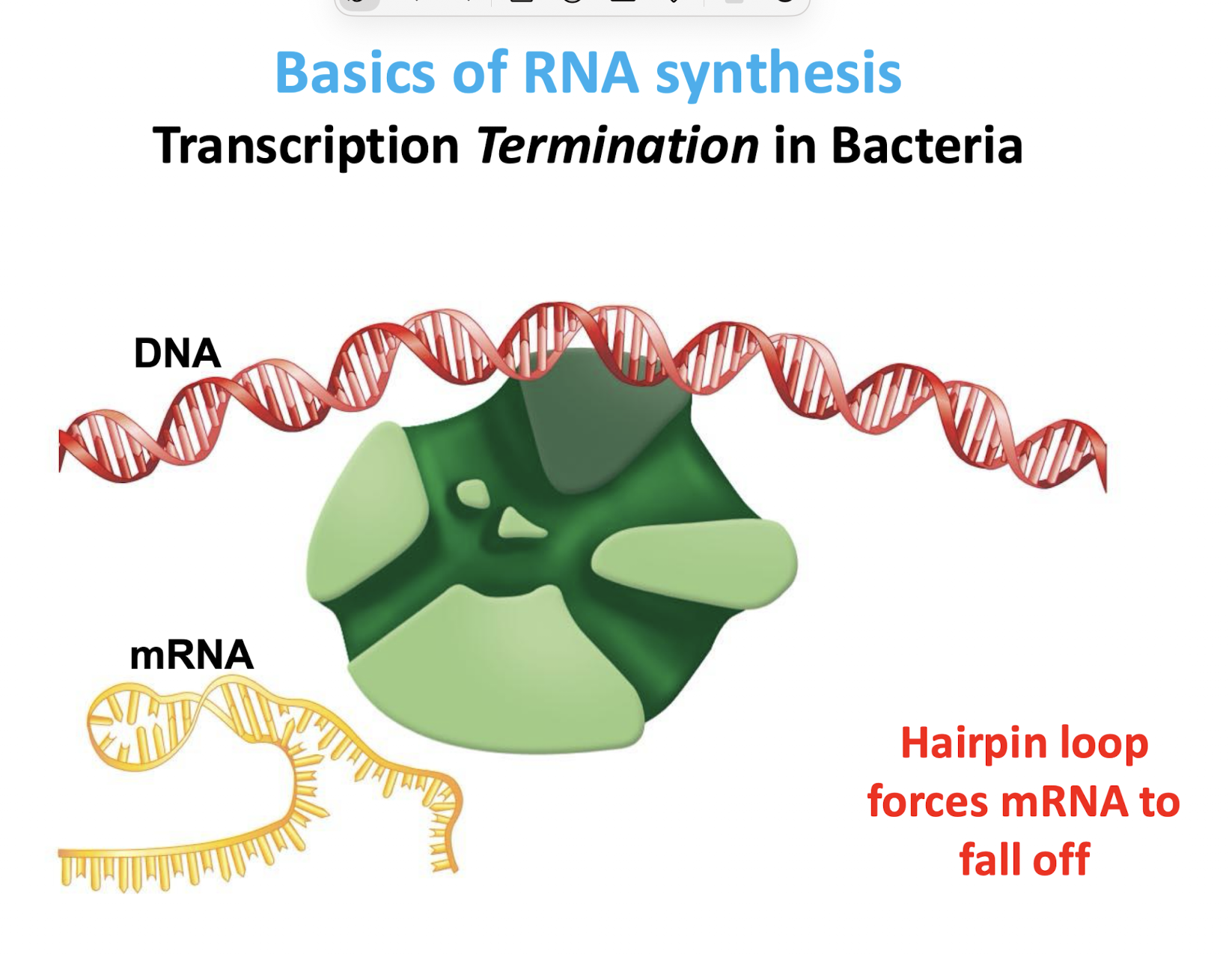
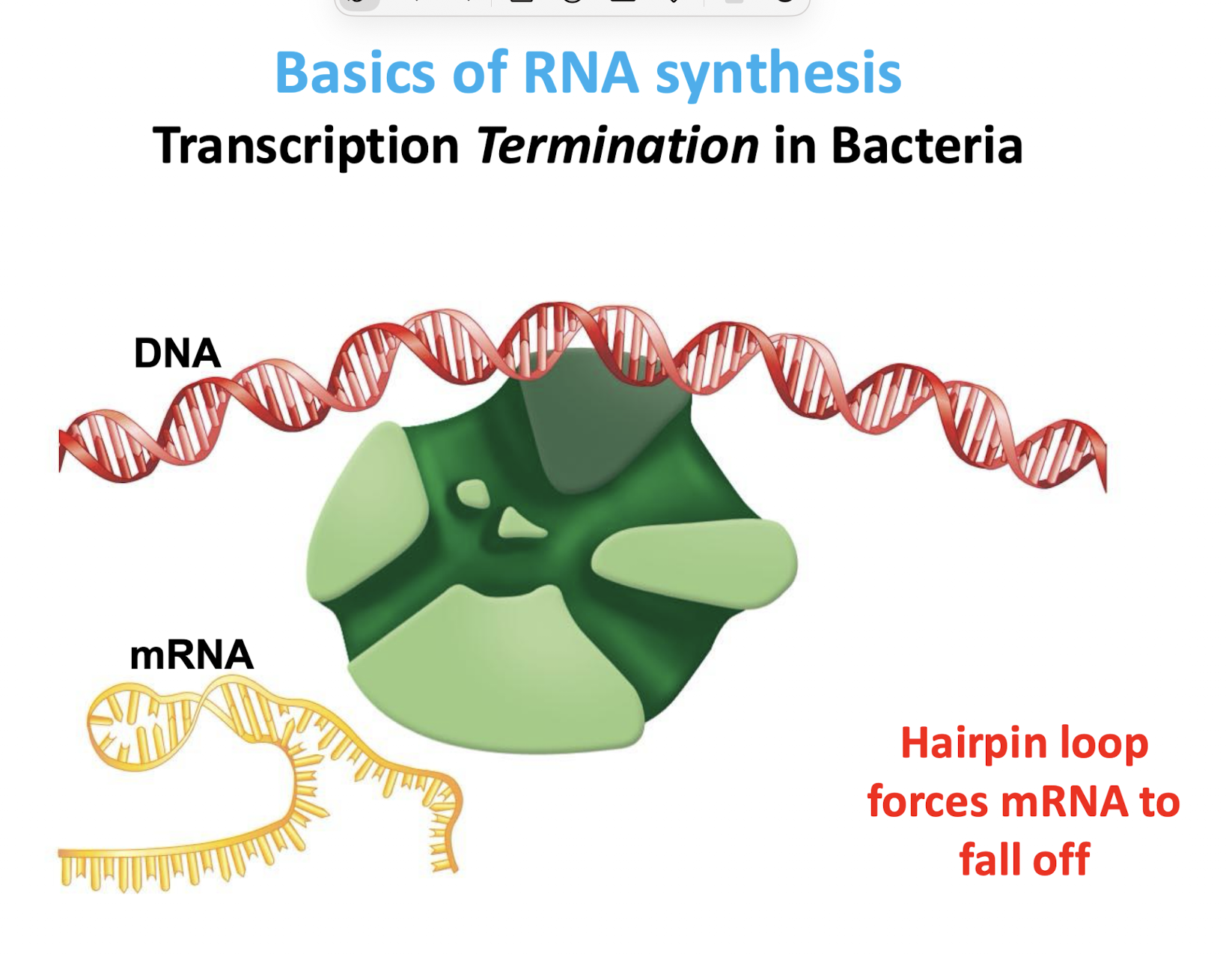
Hairpin loop forces mRNA to fall off
RNA polymerase dissociates from the DNA.
What happens to the RNA transcript after termination?
It is released from the DNA-RNA polymerase complex.
Why can transcription and translation occur simultaneously in prokaryotes?
Because prokaryotes lack a nucleus, ribosomes can bind mRNA while it is still being transcribed
chromosomes in cytoplasm w/ribosomes!
almost immediate, occurs concurrently
as transcript comes off transcription bubble, bacteria can start making protein as RNA nucleotides come off template
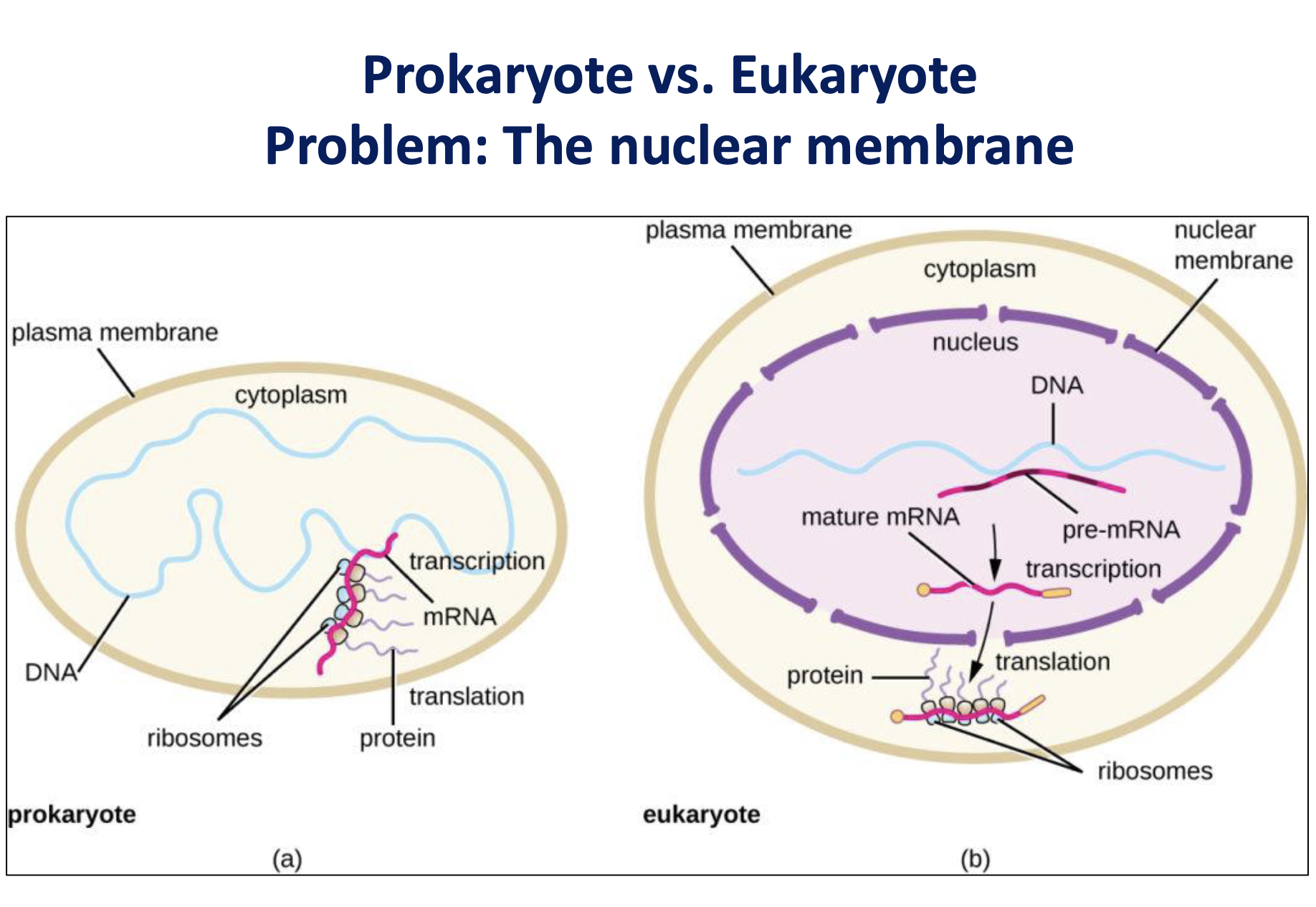
Why can transcription and translation NOT occur simultaneously in eukaryotes?
The nuclear membrane separates transcription (nucleus) from translation (cytoplasm)
need to get mRNA out → nuclear export signals
80s ribosomes outside nuclear membrane
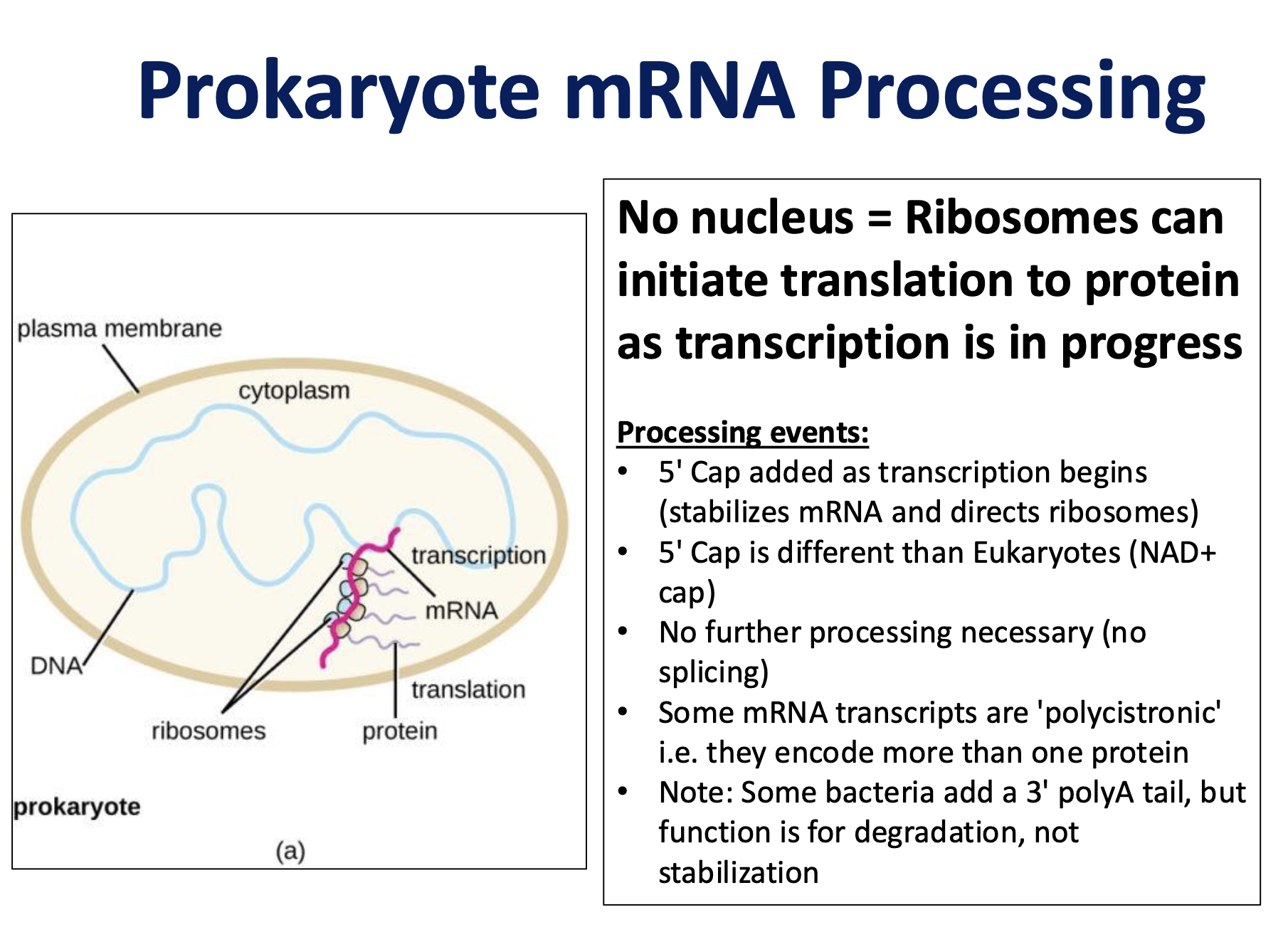
Prokaryote Processing: No nucleus =
ribosomes can initiate translation to protein as transcription is in progress
Prokaryote processing: As transcription begins, why is a 5’ cap added?
stabilizes mRNA & directs ribosomes to start translation
stabilization cap so RNAases do not degrade mRNA
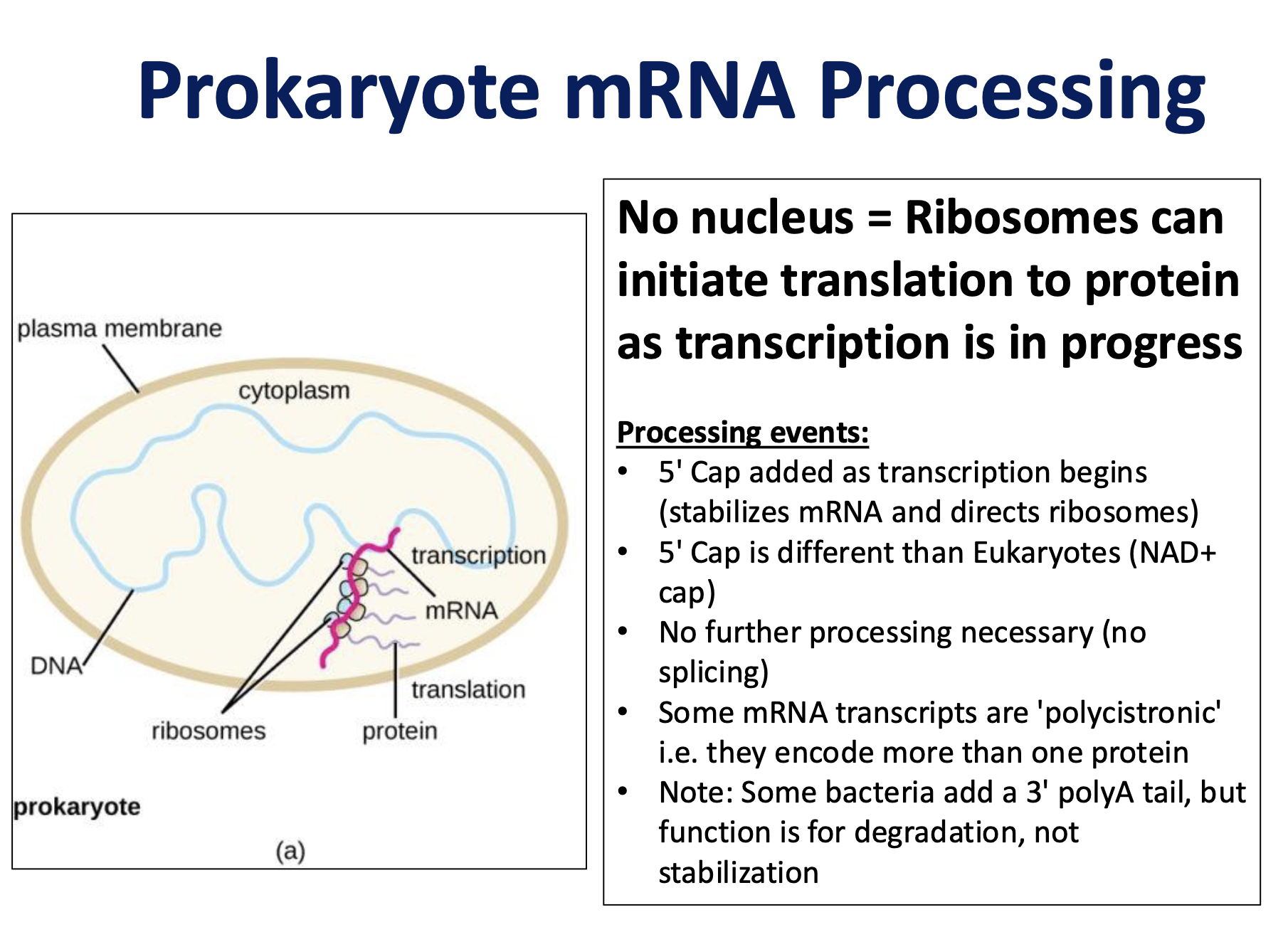
What type of 5' cap is found on prokaryote mRNA?
An NAD⁺ cap
5’ cap added as transcription begins
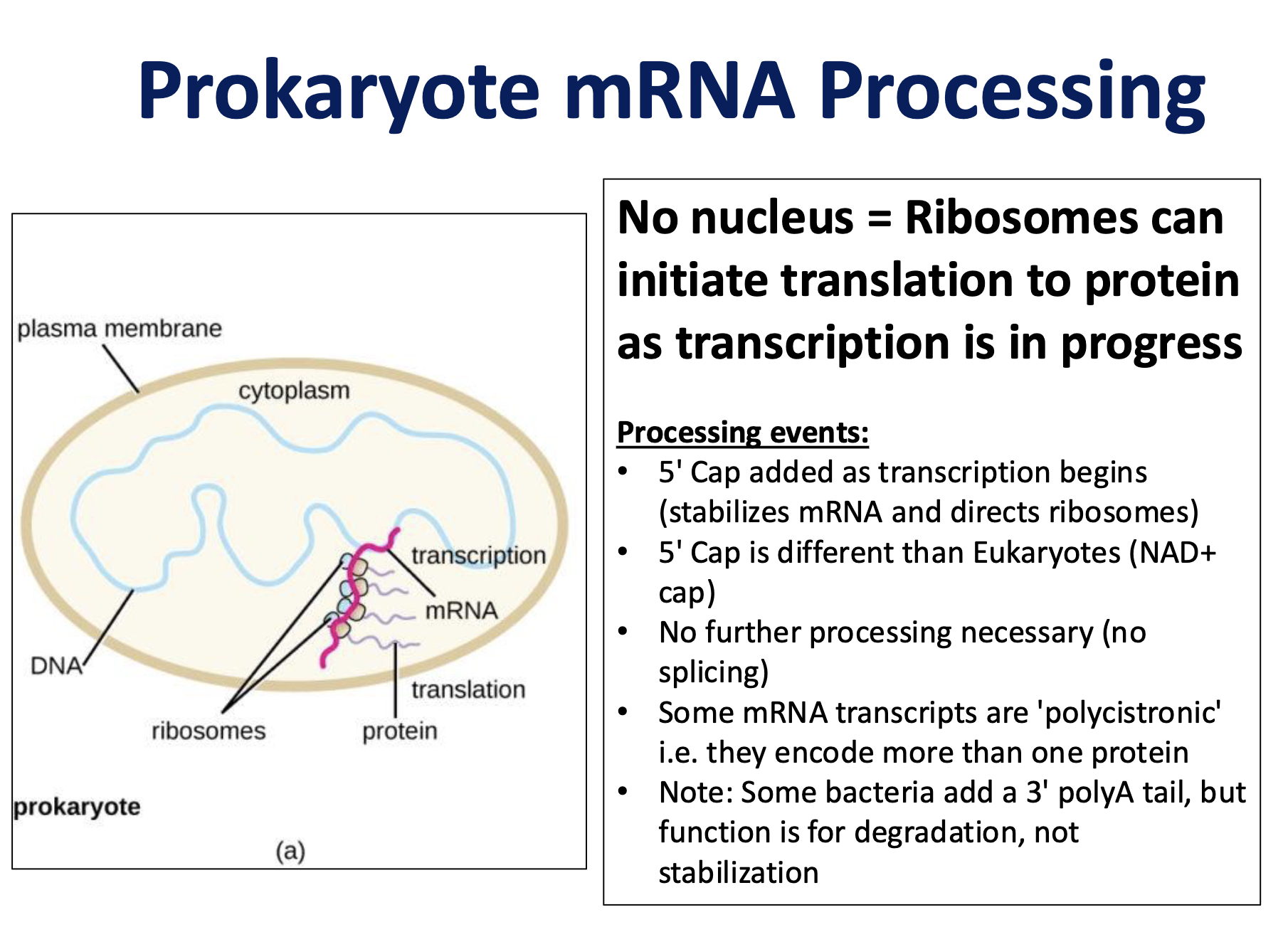
Unlike eukaryotes, prokaryotes = NO FURTHER PROCESSING NECESSARY
(as in no further processing necessary after 5’ cap is added)
NO SPLICING
prokaryotes don’t have….
don’t have organelles!!
ribosomes are not organelles
no rough ER
every protein starts with
methionine → pretty much universal start codon
Some mRNA transcripts are polycistronic =
they encode more than one protein
Do bacterial mRNAs undergo splicing?
no!
Some bacteria add a 3’ polyA tail to mRNA, why?
function is for degradation, not stabilization
What is a polycistronic mRNA?
An mRNA that encodes multiple proteins.
Are bacterial mRNAs often polycistronic or monocistronic?
Polycistronic
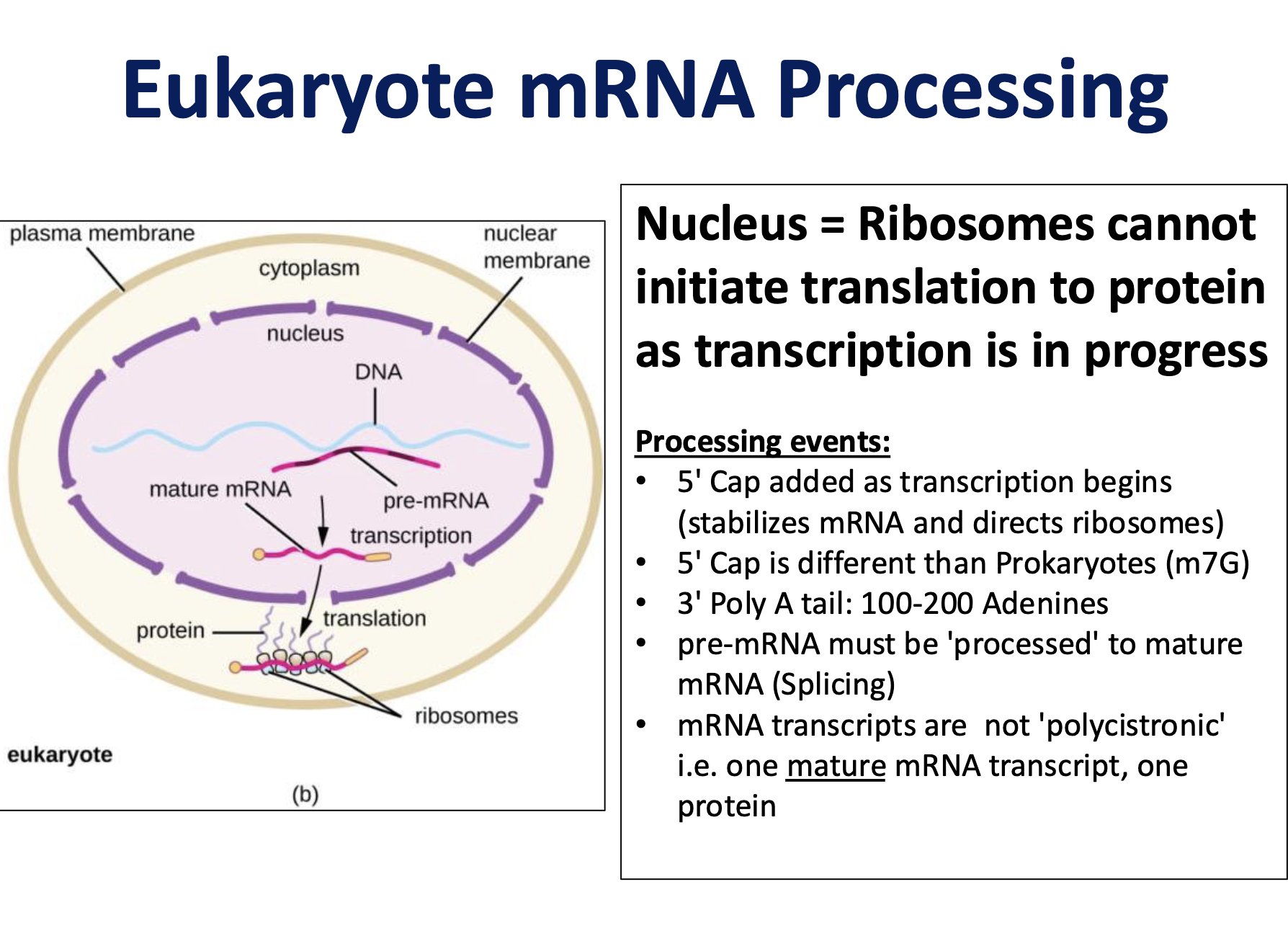
Eukaryote mRNA processing: Nucleus =
ribosomes cannot initiate translation to protein as transcription is in progress
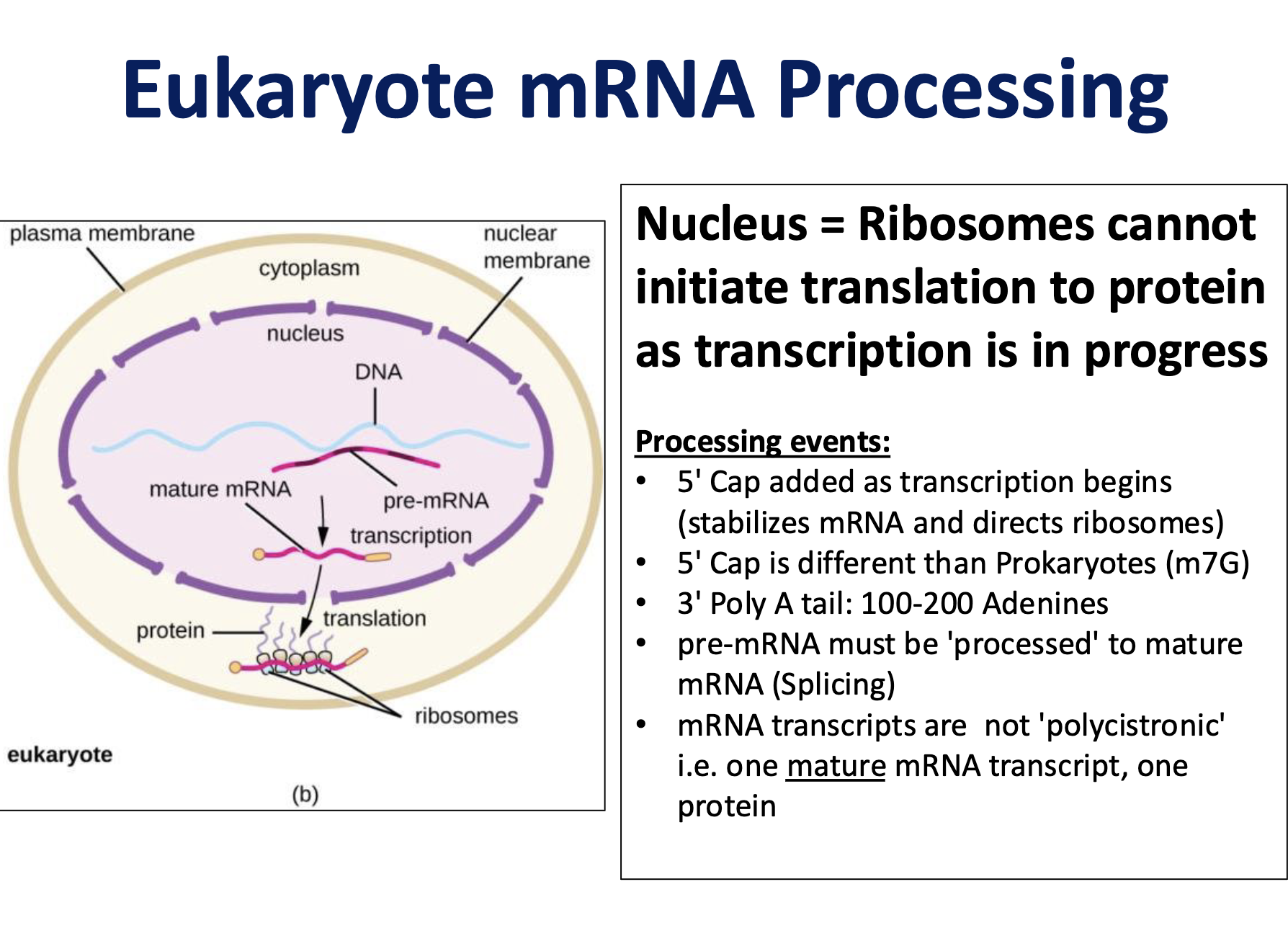
Eukaryote mRNA processing: As transcription begins, why is a 5’ cap added?
as mRNA is synthesized 5' → 3’, 5’ end comes out first
5’ cap added to indicate cell to not degrade
again, for stabilization of mRNA & to direct ribosomes
What type of 5' cap is found on eukaryotic mRNA?
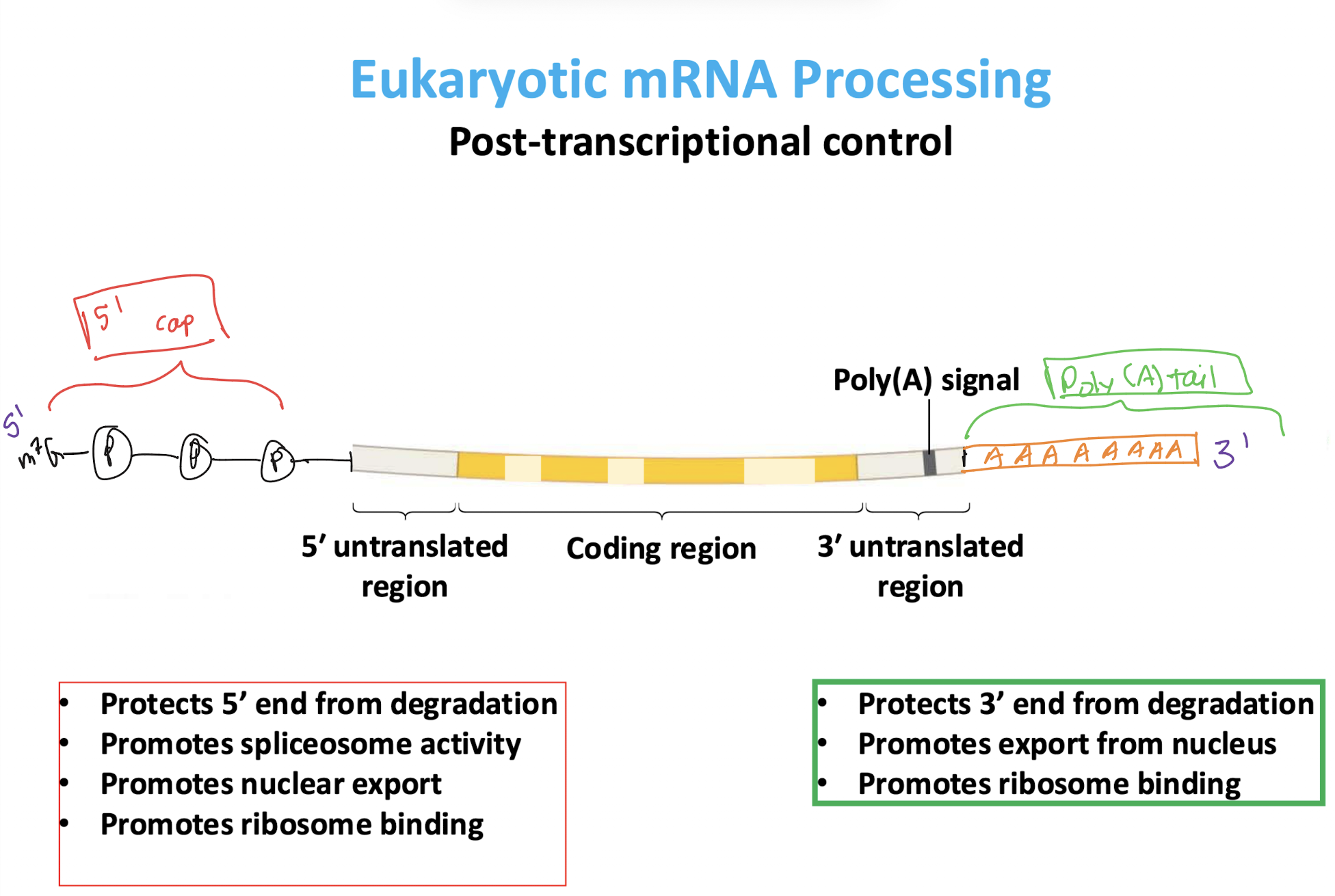
A 7-methylguanosine (m⁷G) cap
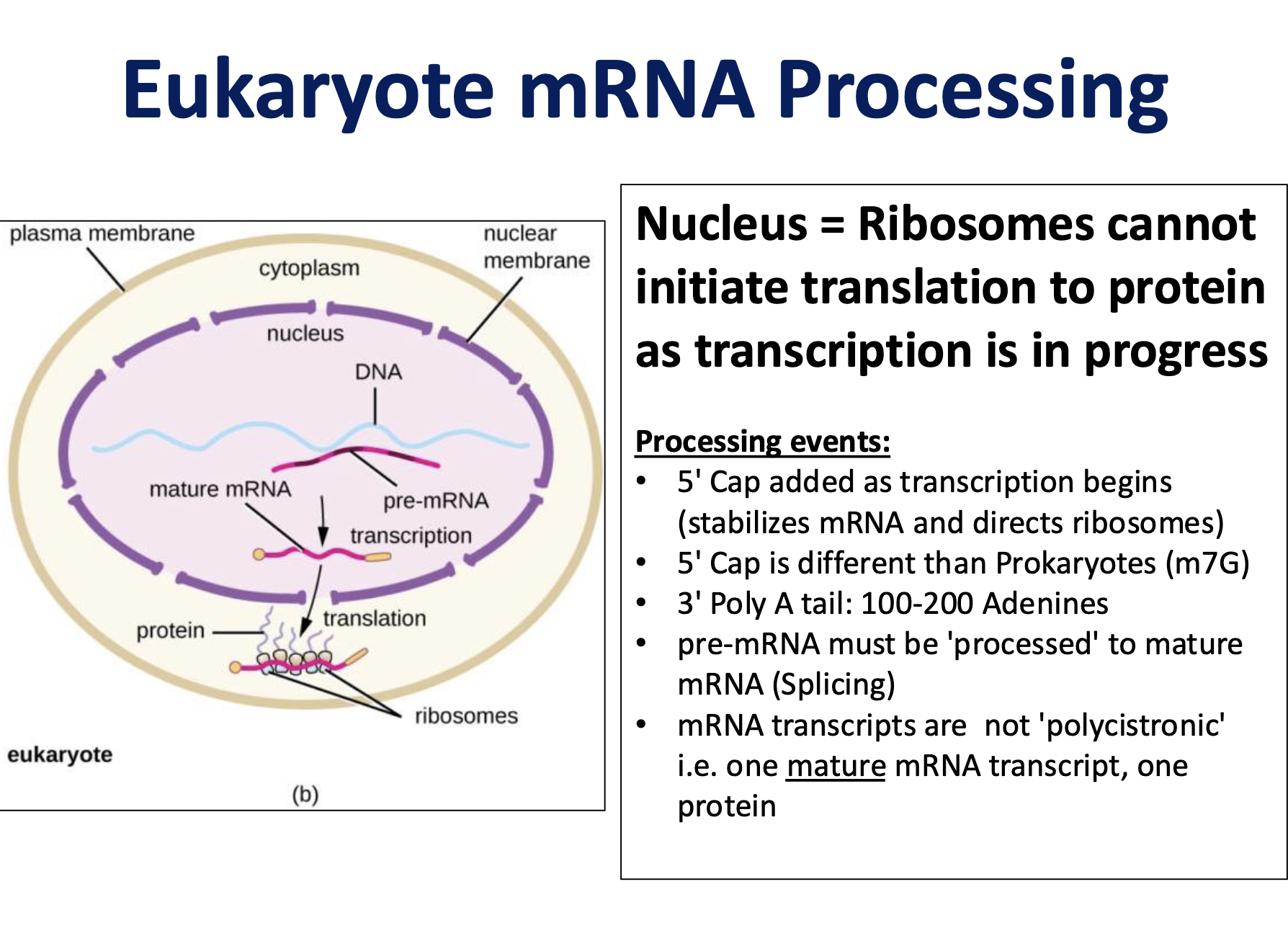
Eukaryote mRNA Processing: Why is a 3’ Poly A tail added?
is 100-200 Adenines
needed to stabilize 3’ end b/c whole mRNA strand needs to be processed BEFORE translation
protect the transcript from degradation, facilitate its export from the nucleus, & promote efficient translation by ribosomes
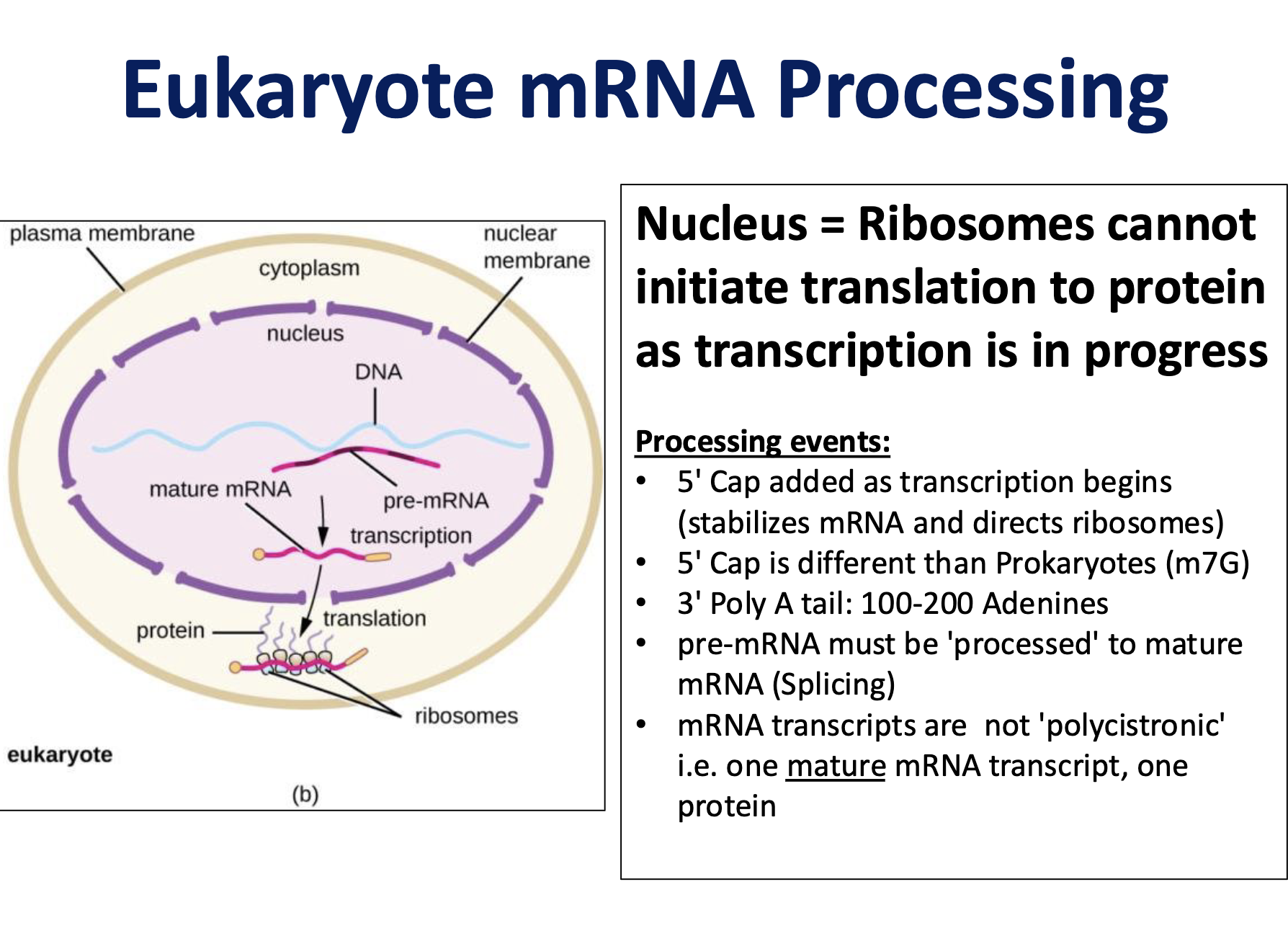
How does a cell differentiate between RNA from viruses or self?
yes viruses are able to 5’ cap RNA
BUT, most will be unmethylated (Not a m7G cap)
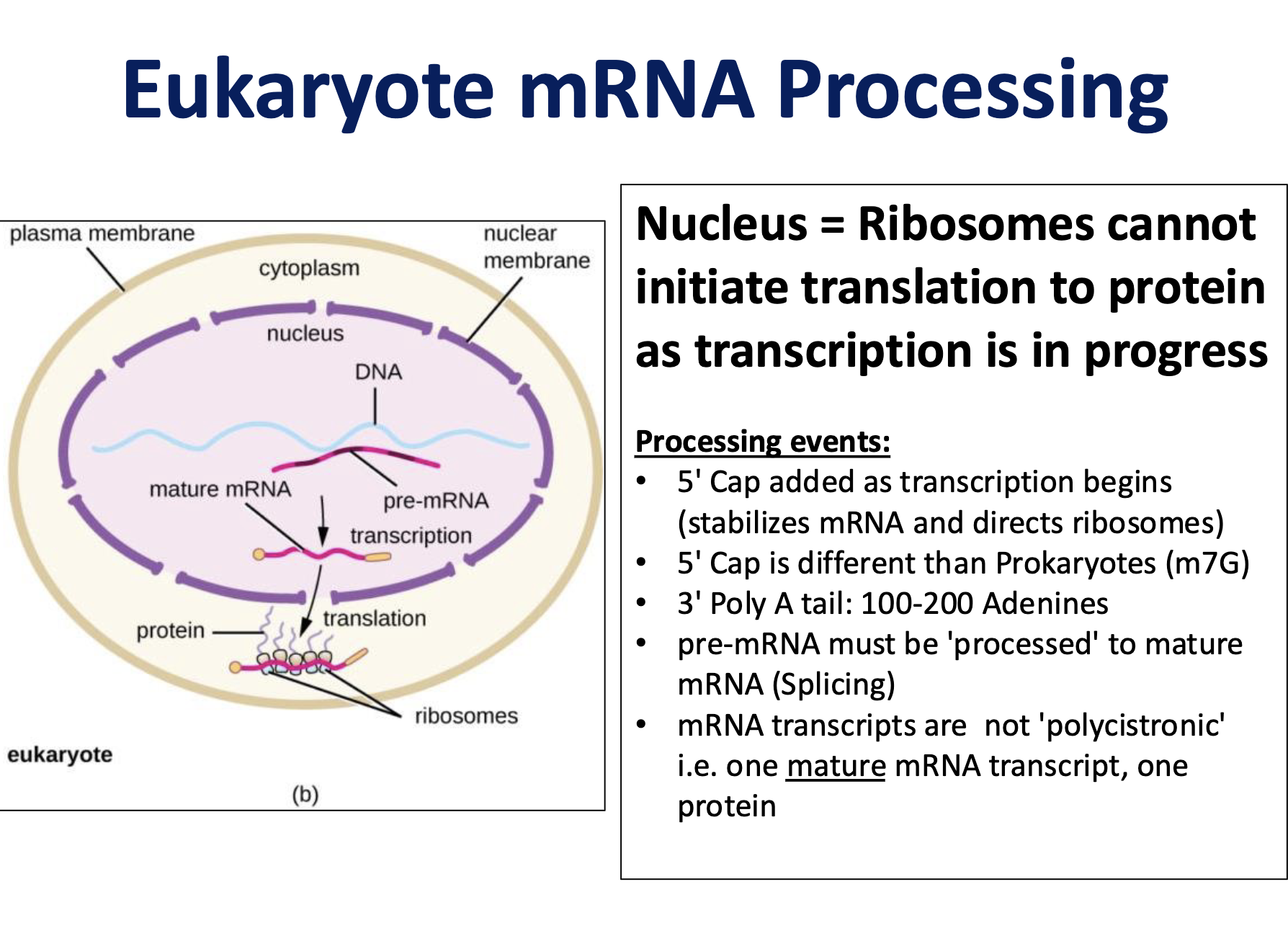
Eukaryote mRNA processing: What must happen to eukaryotic pre-mRNA before it becomes mature mRNA?
RNA processing, including splicing
must be processed/matured to leave nucleus
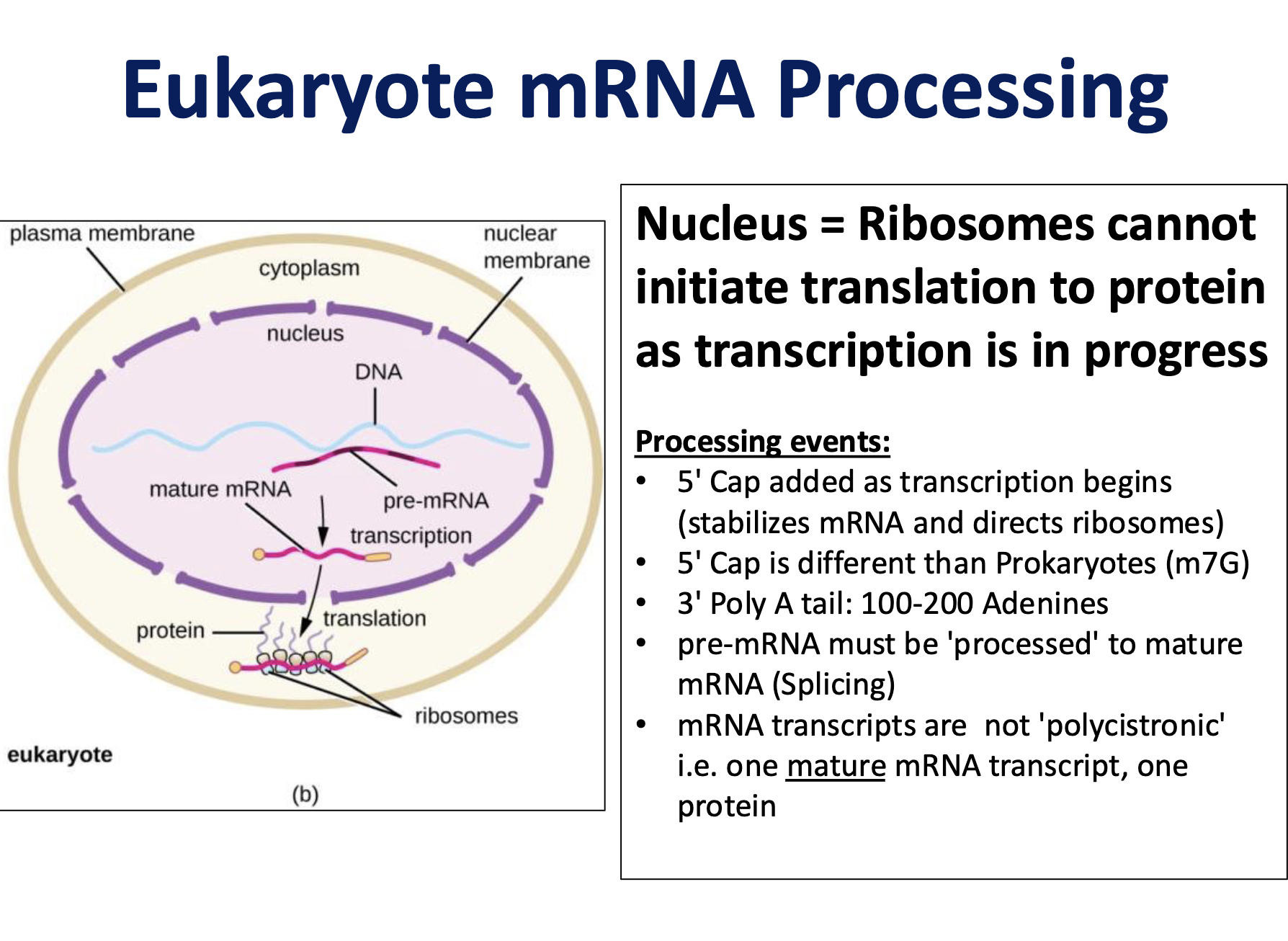
Are eukaryotic mRNAs polycistronic or monocistronic?
Monocistronic
one mature mRNA generally encodes one protein
Keep in mind: pre-mRNA’s can be splcied/processed to
to different mature mRNA’s, meaning different proteins
one mRNA, one protein for MATURE mRNA, not pre-mRNA’s !!
What is added to the 5' end of eukaryotic mRNA?
A 5' cap
m7G
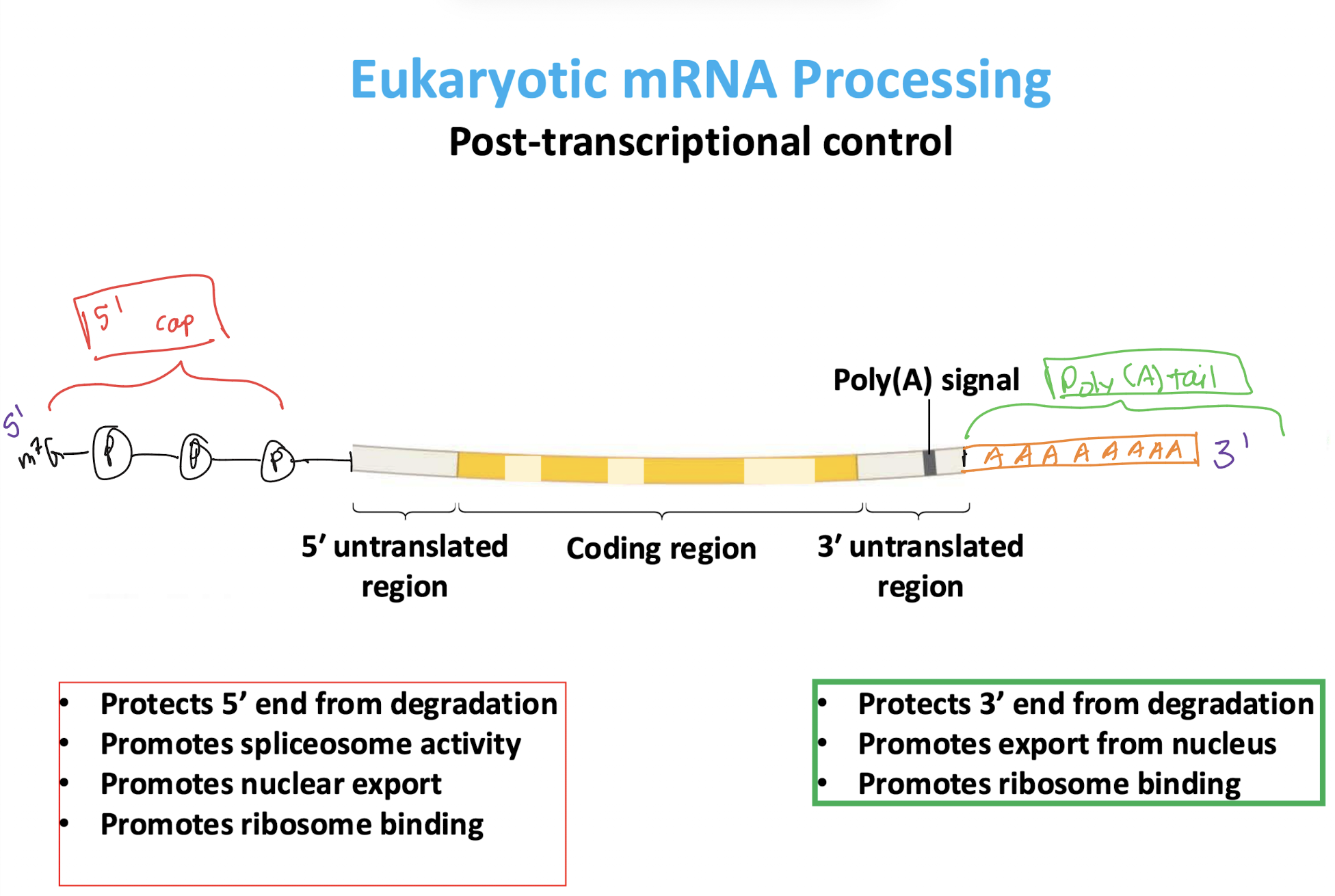
What is added to the 3' end of eukaryotic mRNA?
A poly(A) tail.
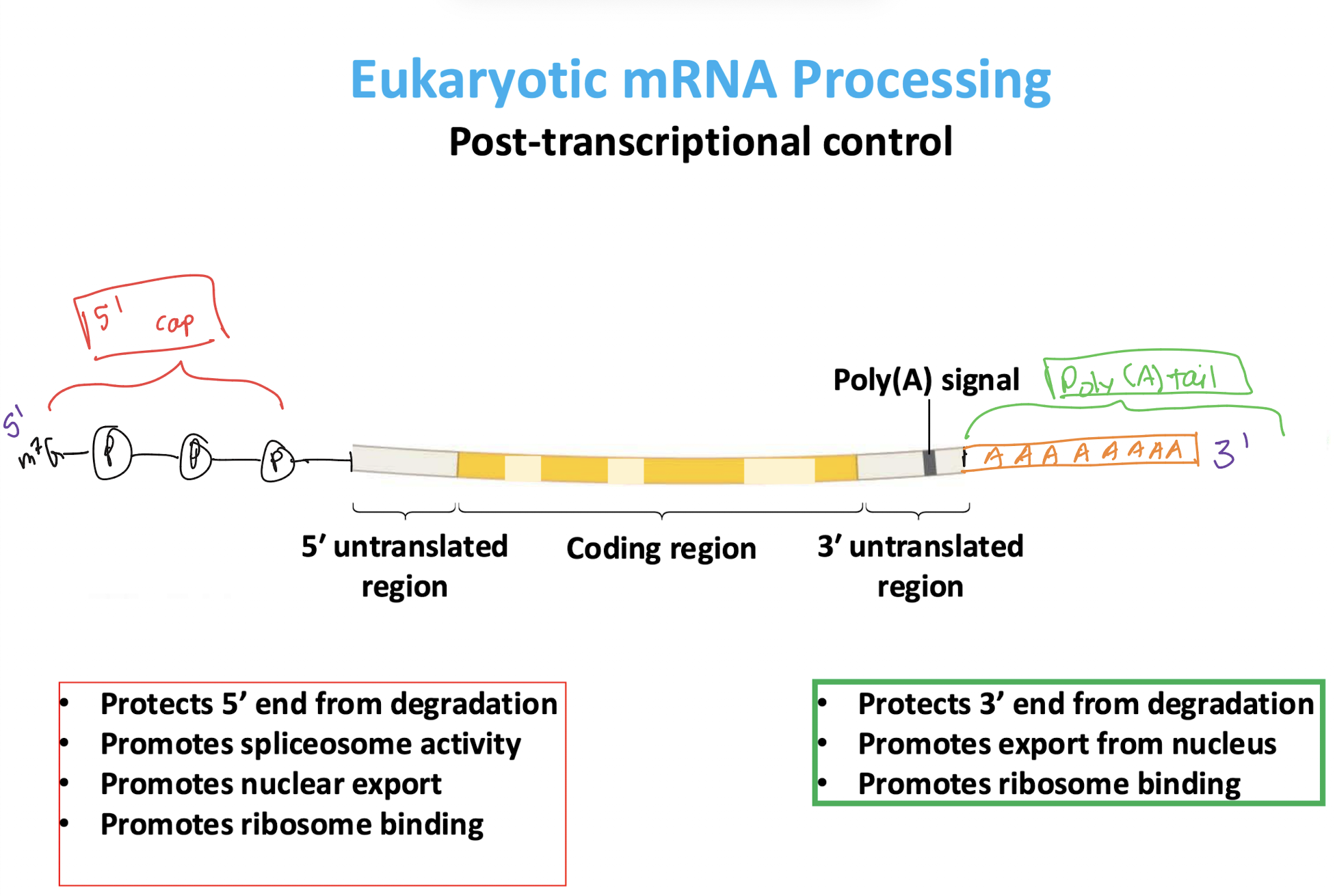
Approximately how many adenines are found in a eukaryotic poly(A) tail?
About 100–200 adenines.
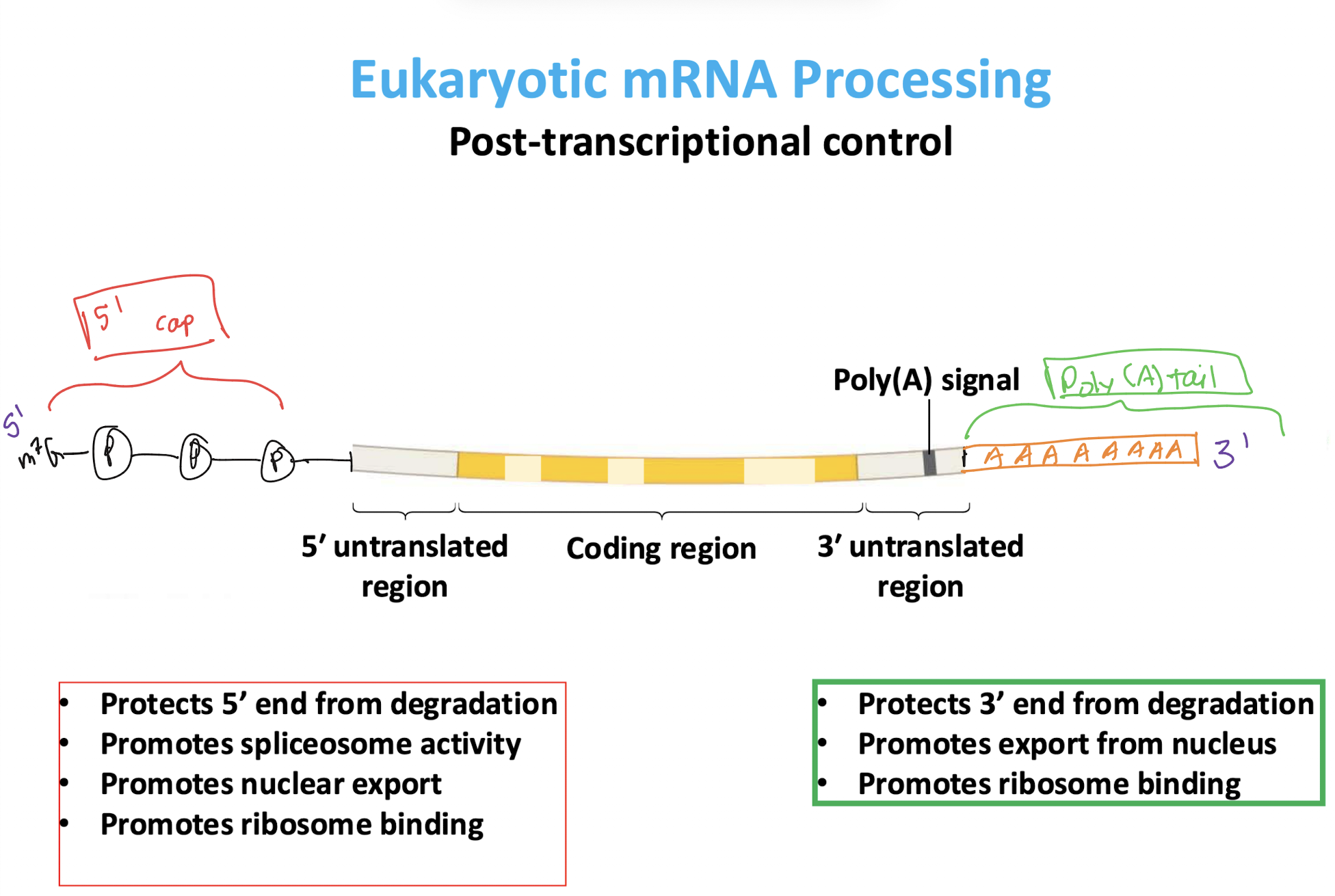
Eukaryote mRNA Processing: What are the functions of the 5' cap? (m7G)
Post-Transcriptional control
Protect 5’ end from degradation
Promote spliceosome activity
promotes nuclear export
promote ribosome binding
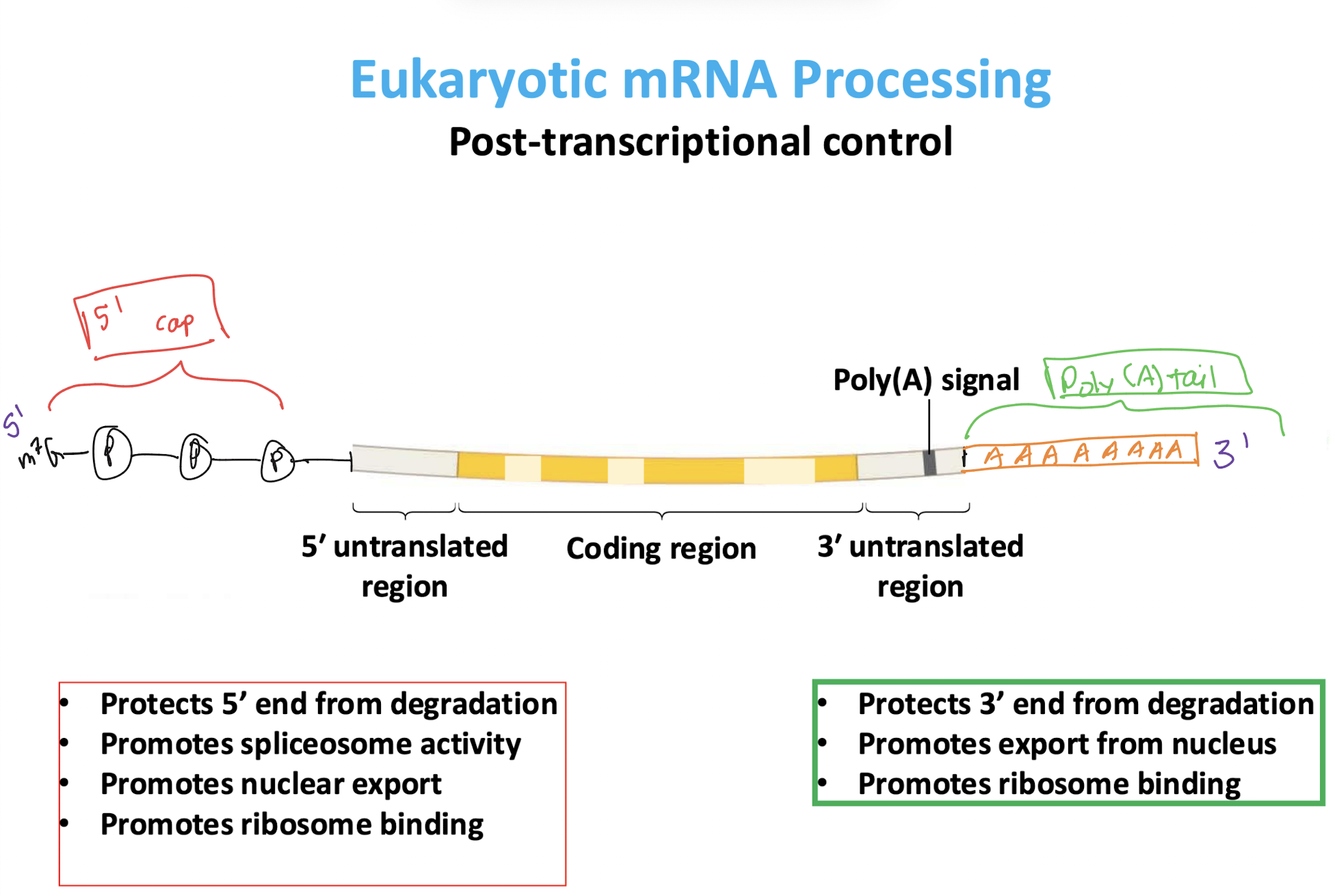
What are the functions of the poly(A) tail?
Post Transcriptional Control
Protects the 3' end from degradation
promotes nuclear export
promotes ribosome binding.