L6 - Glass evidence
 Studied by 0 people
 Call Kai
 Learn
Learn Practice Test
 Spaced Repetition
 Match
Match Flashcards
 Knowt Play
1/36

Earn XP
Description and Tags
Evidential value, discrimination between diff glass types
Name | Mastery | Learn | Test | Matching | Spaced | Call with Kai |
|---|
No study sessions yet.
37 Terms
Where does glass appear at a crime scene?
Window/vehicle glass at point of entry
Float: Fragmentary, backscattered (sharp/angular)
Toughened: Cuboid
Laminated: Fragmentary; impact cracks
Container/ornament or mirror glass broken during the crime
Glass picked out by an intruder and discarded at or removed from the scene
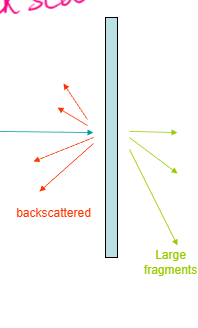
What happens when a window is broken?
large pieces of glass travel in the direction of the blow.
The glass flexes as it breaks and tiny fragments are thrown backwards towards the breaker of the window
The fragments may lodge in the hair, clothing and shoes of the person
Where does glass recovered from mostly a suspects upper parts of the body place them?
In vicinity of breaking glass at the time it was broken
= mainly upper body parts/hair combings
Where does glass from a suspects lower body parts place them?
At the scene of broken glass after it was broken.
lower body parts = walking through scene after
How does proximity affect the evidential value of glass?
The closer to the window the breaker stands, the greater the chance of finding glass on clothing.
How does persistence affect the evidential value of glass?
he shorter the time delay between breaking and recovery of suspect’s clothing the better.
Which types of garments retain glass better?
Coarser garments retain glass better than smooth fabrics.
e.g. knitted pullover has greater retention than a woven polyester shirt
Which size of glass fragments are retained more readily?
Smaller glass fragments are retained more readily than larger glass fragments
What size are the glass fragments recovered from hair and clothing?
generally 0.25 - 1 millimetre
When is glass lost fairly rapidly dependent one?
activity of the wearer
texture of clothing.
Where can glass fragments be trapped in?
Pockets
Crevices on shoe uppers
Embedded in shoe soles
How many pieces of glass fragments are found in general everyday wear?
0 -2 fragments
Finding 10,30 or 100 indicates close proximity to breaking glass
Which types of glass provides a more stronger evidential link?
Imported old glass, patterned, coloured, toughened may be more uncommon and provide a stronger link.
How does location of glass fragments impact the evidential value?
Glass in hair combings is stronger evidence than in soles of footwear
Which aspects of glass are not as important?
The physical or chemical aspects of the actual glass are not as important as the location of the glass on the suspect and the circumstances of the case
What are the outcomes of glass evidence evidentially?
Negative
Corroborative
The value can vary from a very weak link to a strong indication that the person was close to the pane when it was smashed
The shorter the time delay between breaking and recovery from suspect’s clothing, the better
What other types of evidence can be recovered from glass?
Glass fragments themselves
Fingerprints
Footwear marks
Fingerprints
Hairs and fibres
Blood
Glove Prints
What physical aspect of glass should be found?
Physical match of broken fragments
Fracture analysis (flat glass)
Nature of force
Point of contact
Location on pane
Direction of force
Radial and concentric breaks
Wallner or concentric lines
What are macroscopic examinations of glass?
When fragments sufficiently large
Gross features
Colour
Thickness
Flat or curvature?
Evidence of manufacture? (bottles)
How would you discriminate between different glasses?
freshly broken glass
Has fresh breaks (clean and sharp-edge)
recovered from hair combings
or the surfaces of garments,
compared with reference samples of broken glass from the scene
Refractive index (RI) measurements
Compositional Analysis
What is the refractive index (RI)?
a measure of how much light bends, or refracts, when it passes from a vacuum into a specific material
What can the refractive index of glass tell you?
can distinguish between a large number of different glasses.
If the recovered fragments differ in refractive index from a reference glass sample, then they could not have originated from the same piece of glass.
RIs occur more commonly in some types of glass than in others
Can be used to assess the rarity value and therefore the evidential significance of the glass in this particular case
What is the refractive index of glass?
1.5
Glass fragments - clove oil. Heating it changes RI glass edges should disappear
What is the refractive index of water?
1.33
What is the refractive index of air?
1.0
What are the microscopic techniques developed to determine RI of small glass fragments?
Based on RI of liquids change as heated and cooled, while solids less temperature sensitive
Based on examination of fragment in oil (e.g. clove) on heated stage
clove oil. Heating it changes RI glass edges should disappear
Measured the disappearance temperature of glass fragment
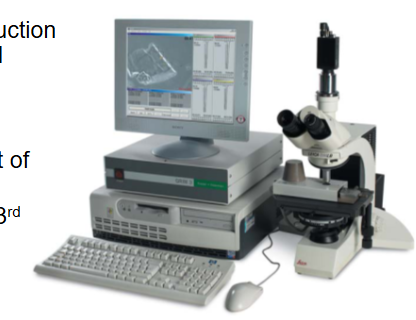
What is foster & freeman GRIM?
Automated approach to measurement of glass RI
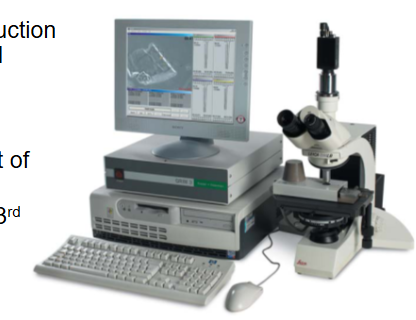
What is GRIM3?
Based on oil immersion/temperature variation method
operates through a standard laboratory microscope
phase contrast optics
Mettler hotstage, for temperature control.
By varying temperature to alter the refractive
index of a calibrated oil, the RI of an immersed
fragment of glass can be determined
Point of null refraction (point at which the refractive indices of glass and immersion oil match) - measure critical points.
Better for excluding matches
What is compositional analysis?
Derived from glass raw materials
can be used to distinguish between glass samples which have the same refractive index but different chemical composition
Measurement of major, minor and trace elements
What does elemental analysis of glass put categories in?
Sheet (or float)
Container
Vehicle window
Vehicle headlamp (borosilicate glass)
Table glass (including lead crystal)
What are the non destructive options for analysis of glass?
SEM/EDX or WDX
LA ICP-MS
What is the issue when using SEM/EDX?
Wont pick up sodium (light elements)
What are the destructive methods for analysis of glass?
AA
ICP-AES
= requires putting glass in solution
What is the gold standard for elemental analysis of glass?
= ICP-MS
Inductively Coupled plasma-mass spectrometry
Combination of ICP technique with a quadrapole mass spectrometer
Separates ions according to mass-to-charge ratio
Laser ablation (LA) ability to analyse direct from solid
What is the most used technique for elemental analysis of glass?
Laser Ablation Inductively Coupled Plasma Mass Spectrometry LA-ICP-MS
Minimal sample handling
Sample in µg range
Non-destructive
Multielement
Significantly lower detection limits compared to EDX/XRF = low trace elements - better to differentiate
What are the X-ray methods for elemental analysis of glass?
Includes XRF, SEM/EDX, SEM/WDX
Provides elemental analysis
Can be used on small fragments
Non destructive
Limitations
Light elements
Variable detection limits
How would you measure density of glass?
Mass volume calculation
Traditional method uses liquid displacement to calculate volume
Large errors on small fragments
Flotation method
Reference glass particle
Immersed in liquid (bromoform and bromobenzene)
Composition of liquid adjusted until glass particle remains suspended
Another glass particle of same density will also be suspended in liquid
If different it will either sink or float
Obsolete methodology