Weather and Climate Systems Exam 1
 Call Kai
 Learn
Learn Practice Test
 Spaced Repetition
 Match
Match Flashcards
 Knowt Play
1/30

There's no tags or description
Looks like no tags are added yet.
Name | Mastery | Learn | Test | Matching | Spaced | Call with Kai | Chat |
|---|
No analytics yet
Send a link to your students to track their progress
31 Terms
Weather and climate are synonymous terms
False
In the process of scientific inquiry, a theory is best defined as:
a hypothesis that has been extensively tested and is generally accepted by the scientific community as best explaining certain observable facts.
The ozone layer is found in the:
stratosphere
A primary difference between the concepts of weather and climate is the:
time period involved
The phenomena seen in the photo above is the result of what?- The Sunset/sunrise
aersols in the atmosphere
On the average, for every 1 km increase in altitude in the troposphere the air temperature:
drops about 6.5 degree Celsius
Which of the following is the MOST important atmospheric component with regard to the earth's climate and the formation of weather systems?
water vapor
which are the two dominant gases that compose most of the air in the atmosphere?
nitrogen and oxygen
Which of the following is NOT a term used to designate one of the "spheres" of the earth's environment?
aquasphere
The absorption of longwave radiation by certain gases in the lower atmosphere is responsible for:
greenhouse effect
The current angle of inclination is:
23.5*
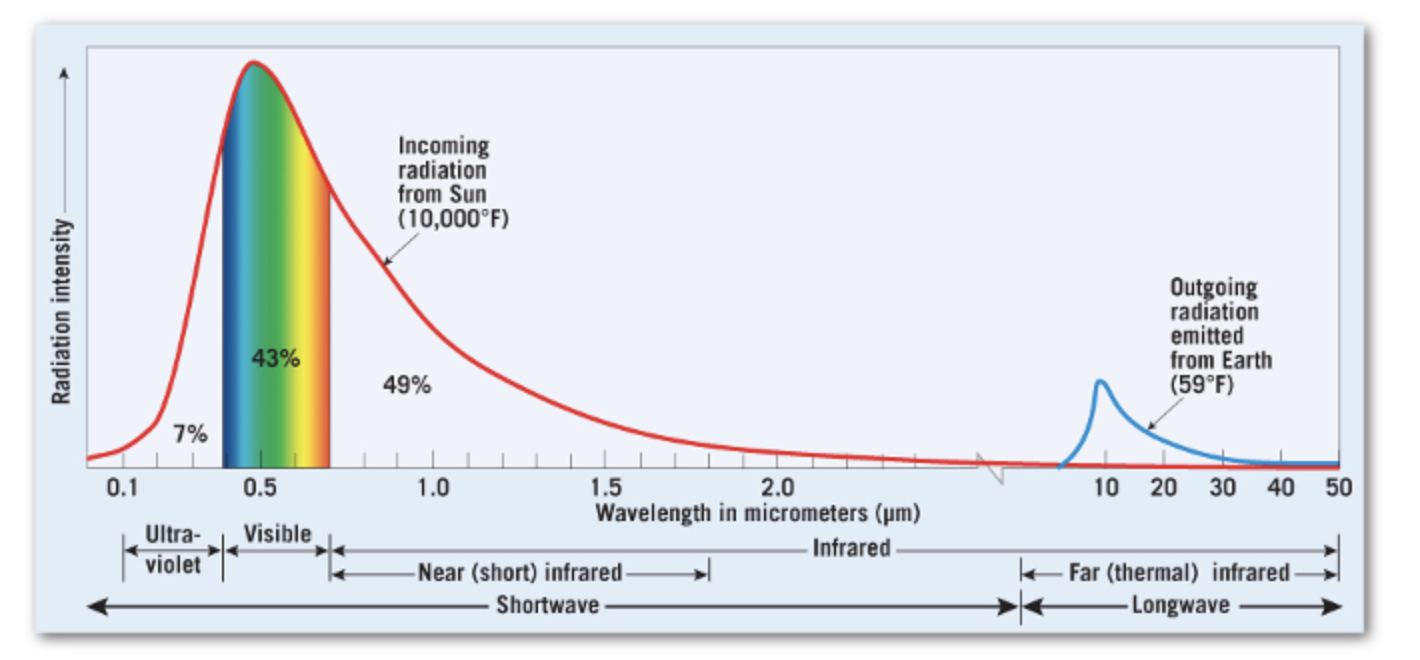
The wavelengths the Earth's emits are longer than those emitted by the Sun.
Objects with higher temperatures:
emit more shortwave radiation than cooler objects do.
Blue sky image- why is the sky blue?
the molecules in the atmosphere scatter blue wavelengths of light.
Today a balance occurs between incoming and outgoing solar radiation. If something happened to change this, and an imbalance occurred between incoming and outgoing energy at the earth's surface:
temperatures either increase or decrease
Suppose the albedo of a planet is measured to be 40 percent. This mean that:
40 percent of the Sun's energy is reflected.
which process involves the movement or circulation of a mass or substance.
Convection
which of the following gases does NOT absorb any significant portion of incoming solar radiation?
nitrogen
Heat:
is a transfer of energy from areas with high temperatures to those with low temperatures.
The earth receives energy from the Sun by:
radiation
The two types of heat recognized by climatologists are:
latent heat and sensible heat.
All of the following explain the difference between land and water temperature patterns EXCEPT:
land has a higher specific heat than water.
A primary reason why land areas warm up more rapidly than water areas is that:
on land, all solar energy is absorbed in a shallow layer.
an equatorial moving ocean current is:
a cold current
Reduction of Arctic sea ice is expected to:
lead to a further increase in air temperatures in the Arctic region.
The amount of heat needed to raise the temperature of 1 gram of a substance by 1˚C is called:
specific heat.

The image above shows annual temperature change from summer to winter by latitude. Based on the image above, which location has the largest annual temperature change?
at high latitudes.
The primary purpose served by surface ocean currents is to:
transfer heat and equalize the imbalance of energy between the poles and the equator.
An isotherm on a map:
connects points of equal temperature.
During the night, clouds:
keep the air warmer by absorbing and re-emitting long wave energy back to the surface.
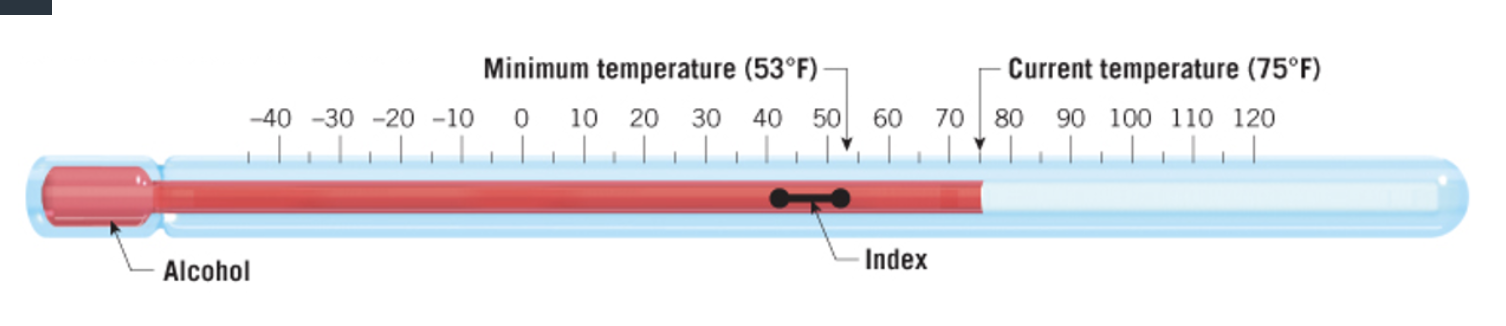
What sort of thermometer is shown in the image above?
Minimum thermometer