Cellular Organization, Membrane Function, and DNA Processes in Human Cells
 Call Kai
 Learn
Learn Practice Test
 Spaced Repetition
 Match
Match Flashcards
 Knowt Play
1/48

There's no tags or description
Looks like no tags are added yet.
Name | Mastery | Learn | Test | Matching | Spaced | Call with Kai | Chat |
|---|
No analytics yet
Send a link to your students to track their progress
49 Terms
What is the primary function of the plasma membrane?
To allow certain molecules to enter the cells while others cannot.
What are the three types of phobicity related to cell membranes?
Hydrophobic, Hydrophilic, Amphipathic.
What is intracellular fluid (ICF) found in?
The cytoplasm of the cell.

What is interstitial fluid (IF) found in?
The spaces between cells.
What is extracellular fluid (ECF) found in?
The surrounding environment outside the cells.
What are integral proteins?
Proteins that span the membrane and include channels, recognition proteins, and receptors.
What is osmosis?
The movement of water across a semipermeable membrane from an area of lower solute concentration to an area of higher solute concentration.
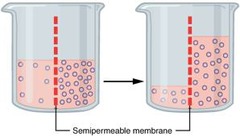
How is osmosis different from simple diffusion?
Osmosis specifically refers to the movement of water, while simple diffusion refers to the movement of solutes.
What type of saline should be used for a dehydrated patient?
Isotonic saline (0.9% NaCl).

What is the Na+/K+ pump?
A protein pump that moves 3 sodium ions out of the cell and 2 potassium ions into the cell.

What is the charge inside the cell after the Na+/K+ pump operates?
The inside of the cell becomes more negative.
What is apoptosis?
Programmed cell death.
What role do free radicals play in apoptosis?
They can cause oxidative stress, leading to cell damage and triggering apoptosis.
What are cilia?
Short, hair-like structures that help in movement and sensing the environment.
What are flagella?
Long, whip-like structures used for locomotion.
What is the nucleus often referred to as?
The computer of the cell.
Why are red blood cells anucleate?
They lose their nucleus during maturation to maximize space for hemoglobin.
What is the structure surrounding the nucleus called?
The nuclear envelope.
What is the difference between nucleoplasm and cytoplasm?
Nucleoplasm is the gel-like substance within the nucleus, while cytoplasm is the substance outside the nucleus.
What is a nucleosome?
A structural unit of a eukaryotic chromosome, consisting of a length of DNA coiled around a core of histone proteins.

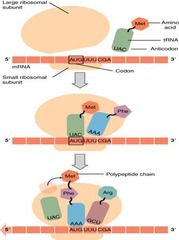
What is the central dogma of molecular biology?
DNA is transcribed to mRNA, which is then translated to protein.

What is a codon?
A sequence of three nucleotides on mRNA that codes for a specific amino acid.
Where does transcription occur in eukaryotic cells?
In the nucleus.

What are the stages of translation?
Initiation, Elongation, Termination.
What are gametes?
Haploid cells that contain one set of chromosomes (n).
What are somatic cells?
Diploid cells that contain two sets of chromosomes (2n).
What is a proto-oncogene?
A normal gene that can become an oncogene due to mutations or increased expression.
What is differentiation?
The process by which a less specialized cell becomes a more specialized cell type.

What is the primary composition of the cell membrane?
The cell membrane is primarily composed of back-to-back phospholipids.

What are phospholipids?
Amphipathic molecules consisting of a negatively charged phosphate group (polar, hydrophilic) and two fatty acids (nonpolar, hydrophobic).

How does cholesterol affect the cell membrane?
Cholesterol contributes to the fluidity of the membrane.

What is the function of channel proteins?
They selectively allow particular materials, such as certain ions, to pass into or out of the cell.
What role do cell recognition proteins play?
They mark a cell's identity so that it can be recognized by other cells.
What is a glycoprotein?
A protein with carbohydrate molecules attached, aiding in cell recognition.
What is the glycocalyx?
A fuzzy-appearing coating around the cell formed from glycoproteins and carbohydrates, involved in cell binding and recognition.
What are peripheral proteins?
Proteins typically found on the inner or outer surface of the lipid bilayer, performing specific functions.
What is selective permeability?
The property of the lipid bilayer that allows only relatively small, nonpolar materials to move through.
What is diffusion?
The movement of particles from an area of higher concentration to an area of lower concentration.
What is facilitated diffusion?
The diffusion process used for substances that cannot cross the lipid bilayer due to their size, charge, or polarity.
What is active transport?
The process requiring energy from ATP to transport substances across the membrane, usually against their concentration gradients.
What is endocytosis?
The process of a cell ingesting material by enveloping it in a portion of its cell membrane.
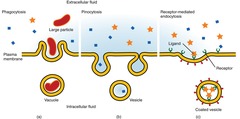
What are the types of endocytosis?
Phagocytosis, pinocytosis, and receptor-mediated endocytosis.
What is exocytosis?
The process of a cell exporting material using vesicular transport.
What are organelles?
Specialized structures within a cell that perform distinct functions.
What is the function of ribosomes?
They are responsible for protein synthesis.
What is the nucleus?
The organelle that contains the cell's DNA and is responsible for replication and transcription.
What is mitosis?
The process of cell division that results in two daughter cells with identical genetic material.

What is the role of the rough endoplasmic reticulum?
It is involved in the synthesis and processing of proteins.
What is the function of mitochondria?
They produce energy for the cell through cellular respiration.