Comprehensive Guide to Tendon Reflexes, Blood Vessels, and Lymphatic System
 Call Kai
 Learn
Learn Practice Test
 Spaced Repetition
 Match
Match Flashcards
 Knowt Play
1/49

There's no tags or description
Looks like no tags are added yet.
Name | Mastery | Learn | Test | Matching | Spaced | Call with Kai | Chat |
|---|
No analytics yet
Send a link to your students to track their progress
50 Terms
What is the biceps brachii tendon reflex responsible for?
Flexion of the elbow joint by tapping the biceps tendon.
Which spinal nerves are involved in the triceps tendon reflex?
C6 to C8.
What action does the brachioradialis tendon reflex test?
Supination of the radioulnar joints by tapping the insertion of the brachioradialis tendon.
What spinal nerves correspond to the upper abdominal superficial reflex?
T6 to T7.
What is the patellar tendon reflex commonly known as?
Knee jerk reflex.
What spinal nerves are involved in the patellar tendon reflex?
L2 to L4.
What is the function of the Achilles tendon reflex?
Plantar flexion of the ankle joint on tapping the Achilles tendon.
Which spinal nerves are associated with the Achilles tendon reflex?
S1 and S2.
What is the role of drugs in modifying autonomic nervous system activities?
They can lower blood pressure by blocking sympathetic nerve endings and causing vasodilation.
What are the three types of blood vessels?
Arteries, veins, and capillaries.
What is the primary function of arteries?
To transport blood away from the heart.
What are the smallest arteries called?
Arterioles.
What is an anastomosis in the context of arteries?
A communicating branch that connects individual arteries.
What distinguishes an anatomic end artery?
Its terminal branches do not anastomose with branches of adjacent arteries.
What happens if an anatomic end artery is occluded?
It results in the death of the target tissues.
What are functional end arteries?
Vessels whose terminal branches anastomose but do not provide sufficient blood if one artery is blocked.
What is the primary function of veins?
To transport blood toward the heart.
What are venules?
The smallest veins.
What is a portal system in the context of veins?
A system of vessels interposed between two capillary beds.
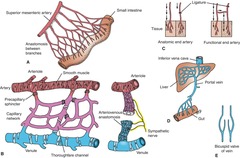
What are capillaries?
Microscopic vessels connecting arterioles to venules.
What are sinusoids?
Wider, irregularly shaped blood vessels found in certain organs.
What is the significance of collateral circulation?
It provides alternative blood channels that can maintain blood flow if a large artery is damaged.
What can occur if coronary arteries are blocked?
Insufficient blood supply to the cardiac muscle, leading to necrosis.
What is lymph?
A clear, colorless tissue fluid collected from tissues, consisting mainly of white blood cells.
What are the two major components of the lymphatic system?
Lymphatic organs and lymphatic vessels.
What are the primary lymphatic organs?
Lymph nodes, tonsils, thymus, and spleen.
What is the function of lymphatic organs?
They produce lymphocytes, act as barriers to pathogens, and filter the blood.
What is the role of lymphatic vessels?
They assist in the removal of tissue fluid and return it to the blood.
Where are lymphatic vessels not found?
Cartilage, bone, the CNS, the eyeball, the internal ear, and the epidermis of the skin.
What are lymph capillaries?
Small vessels that drain lymph from tissues and are larger and more irregular than blood capillaries.
What are lacteals?
Blind-ending projections of lymph capillaries in the villi of the small intestine that absorb chyle.
What drives the flow of lymph?
Extravessel forces such as muscle contractions and negative pressure during inspiration.
What is lymphedema?
An abnormal accumulation of fluid due to obstruction of lymph flow.
Where does lymph eventually drain into the venous system?
At the junction of the internal jugular and subclavian veins.
What is the thoracic duct?
The major lymphatic duct that drains lymph from most of the body into the left side of the venous system.
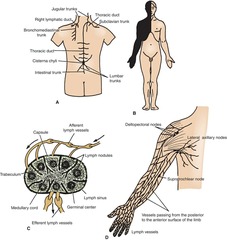
What are afferent and efferent vessels?
Afferent vessels carry lymph to a lymph node; efferent vessels transport it away from a node.
What is the cisterna chyli?
A dilated sac that forms the origin of the thoracic duct, often described as a plexus of vessels.
What is the significance of lymphatic drainage in clinical practice?
It helps identify the primary site of disease based on lymph node swelling.
What is a mucous membrane?
A tissue layer that lines the luminal surface of an organ and may secrete mucus.
What is a serous membrane?
A membrane that lines body cavities and covers organs, consisting of mesothelium and connective tissue.
What are the two layers of a serous membrane called?
The parietal layer (lining the cavity) and the visceral layer (covering the organs).
What is the function of serous fluid?
It lubricates the surfaces of the membranes, allowing them to slide on each other.
What happens to lymph before it returns to the bloodstream?
It passes through at least one lymph node.
What is the appearance of collecting lymphatic vessels?
They often present a beaded or knotted appearance due to numerous valves.
What is the primary role of lymph nodes?
To filter lymph and respond to pathogens.
How does the lymphatic system relate to the cardiovascular system?
It assists in fluid balance and immune responses, complementing the cardiovascular system.
What can cause lymph node swelling?
Metastases or primary tumors.
What is the relationship between lymphatic drainage and cancer detection?
Understanding lymphatic drainage helps locate the primary site of cancer when lymph nodes are swollen.
What is the anatomical significance of the lymphatic system?
It is vital for immune function and fluid balance in the body.
What is the difference between mucous and serous membranes?
Mucous membranes line passages and may secrete mucus, while serous membranes line cavities and cover organs.