Micro Unit 3
 Call Kai
 Learn
Learn Practice Test
 Spaced Repetition
 Match
Match Flashcards
 Knowt Play
1/60

There's no tags or description
Looks like no tags are added yet.
Name | Mastery | Learn | Test | Matching | Spaced | Call with Kai | Chat |
|---|
No analytics yet
Send a link to your students to track their progress
61 Terms
Inhibitor for Columbia Colistin Nalidixic Acid agar (CNA)
colistin, naladixic acid
inhibitor for Eosin Methylene Blue agar (EMB)
eosin and methylene blue
inhibitor for phenylethyl alcohol agar (PEA)
phenylethyl alcohol
inhibitor for MAC (MacConkey agar)
bile salts and crystal violet
organisms expected to grow on SBA
GP and GN
organisms expected to grow on CA
fastidious organisms and hardy ones
organisms expected to grow on Eosin Methylene Blue agar (EMB)
GN rods
organisms expected to grow on columbia colistin nalidixic acid agar (CNA)
GP
organisms expected to grow on PEA (phenylethyl alcohol agar)
GP
organisms expected to grow on MAC
GN rods
what type of media is CA
enriched
what type of media is TSA (SBA)
general purpose
what type of media is MAC
differential, selective
GN broth
enrichment
what type of media is CNA
selective
what temp stores Thioglycollate broth (THIO)
37 C (incubator)
what temp stores SBA
2-8 C (fridge)
what temp stores trypticase (TSB)
25- 30 C (room temp)
what temp stores CA
2-8 C (fridge)
what temp stores MAC
2-8 C (fridge)
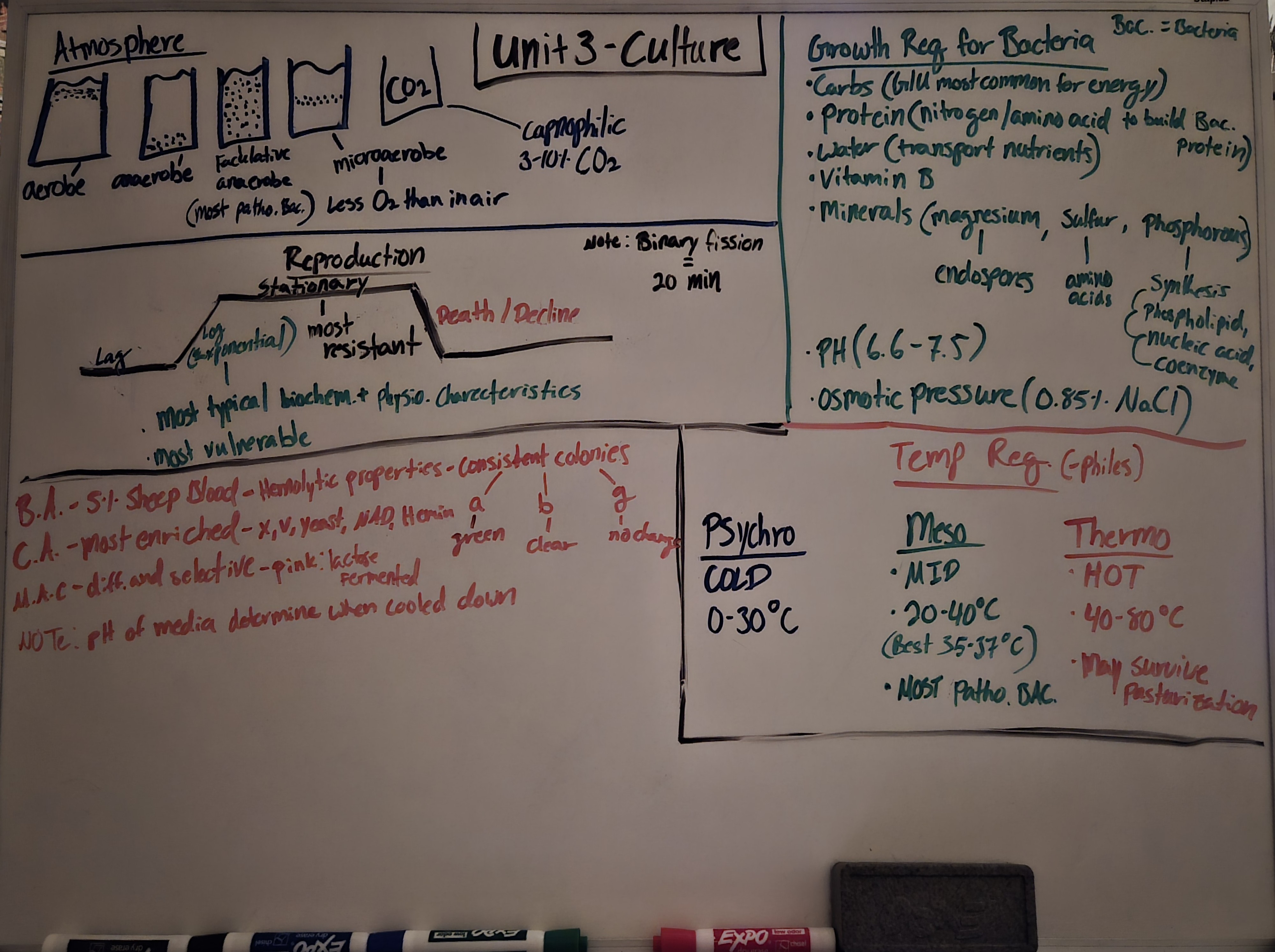
During which phase of the bacterial growth curve are bacteria actively dividing at their fastest rate?
A. Lag phase
B. Log/exponential phase
C. Stationary phase
D. Death/decline phase
B
What primarily happens during the lag phase of the bacterial growth curve?
A. Bacteria are rapidly dividing
B. Bacteria are adapting to the new environment and synthesizing enzymes/proteins
C. The number of dying cells exceeds the number of new cells
D. Nutrients are completely exhausted
B
During which phase of the bacterial growth curve does the number of new cells approximately equal the number of dying cells?
A. Lag phase
B. Log phase
C. Stationary phase
D. Death phase
C
During which phase does the number of dying bacterial cells exceed the number of newly formed cells?
A. Lag phase
B. Log phase
C. Stationary phase
D. Death/decline phase
D
Most medically important bacteria grow best at approximately:
A. 4°C
B. 20°C
C. 35–37°C
D. 55–60°C
C
Which type of culture medium is designed to support the growth of many nonfastidious organisms without specifically favoring or inhibiting particular groups?
A. Selective medium
B. Differential medium
C. Supportive medium
D. Enrichment medium
C
Which type of medium contains extra nutrients to support the growth of fastidious organisms?
A. Enriched medium
B. Selective medium
C. Transport medium
D. Differential medium
A
Which type of medium contains substances that inhibit some organisms while allowing others to grow?
A. Differential
B. Selective
C. Supportive
D. Transport
B
Which type of medium helps distinguish organisms based on a visible biochemical reaction, such as a color change or hemolysis pattern?
A. Differential
B. Enrichment
C. Transport
D. Supportive
A
Which type of medium is usually liquid and is designed to increase the number of a particular organism while suppressing competing organisms?
A. Enriched medium
B. Enrichment medium
C. Differential medium
D. Supportive medium
B
Which type of medium is designed to preserve organisms during transport without allowing significant multiplication?
A. Transport medium
B. Differential medium
C. Enriched medium
D. Supportive medium
a
Which of the following is an example of an enriched medium?
A. Blood agar
B. Thioglycollate broth
C. Transport medium
D. Tryptic soy agar
A (chocolate agar is the MOST enriched)
Which medium is especially useful for growing fastidious organisms because the red blood cells have been lysed, releasing nutrients such as hemin and NAD?
A. MacConkey agar
B. Chocolate agar
C. Tryptic soy agar
D. Phenylethyl alcohol agar
B
Which medium is selective for Gram-negative organisms and differential for lactose fermentation?
A. Blood agar
B. MacConkey agar
C. Chocolate agar
D. Tryptic soy agar
b
What is the pH indicator in MacConkey agar?
A. Phenol red
B. Neutral red
C. Methylene blue
D. Bromothymol blue
b
Which substances in MacConkey agar inhibit most Gram-positive bacteria?
A. Sodium chloride and agar
B. Bile salts and crystal violet
C. Neutral red and lactose
D. Hemin and NAD
b
Which medium is selective for many Gram-positive organisms because it contains colistin and nalidixic acid that inhibit many Gram-negative bacteria?
A. Columbia CNA agar
B. MacConkey agar
C. EMB agar
D. Chocolate agar
A
Which medium is also selective for Gram-positive organisms because phenylethyl alcohol inhibits many Gram-negative bacteria?
A. EMB agar
B. PEA
C. MacConkey agar
D. Chocolate agar
B
Which medium is selective for Gram-negative bacteria and differential for lactose fermentation, with strong lactose fermenters such as E. coli sometimes producing a metallic green sheen?
EMB
Which medium is commonly used as a nutrient-rich broth that can support the growth of many organisms, including some fastidious bacteria?
A. Brain Heart Infusion broth
B. MacConkey agar
C. EMB agar
D. PEA agar
A (BHI)
Which medium contains a reducing agent that lowers oxygen levels and creates an oxygen gradient, making it useful for recovering anaerobes?
A. Thioglycollate broth
B. Blood agar
C. Tryptic soy agar
D. MacConkey agar
A
Which diagnostic method detects microbial DNA or RNA directly?
A. Culture
B. Molecular testing
C. Serology
D. Microscopy
B
Which diagnostic method involves growing the organism on or in laboratory media?
A. Microscopy
B. Culture
C. Serology
D. Molecular testing
b
Which diagnostic method detects a patient’s antibodies against a microorganism?
A. Microscopy
B. Culture
C. Serology
D. Molecular testing
c
Which diagnostic method commonly uses antibodies to detect a microbial antigen directly in a patient specimen?
A. Immunochemical testing
B. Culture
C. Microscopy
D. Serology
A
Which diagnostic method allows you to directly see microorganisms or cellular elements in a specimen?
A. Molecular testing
B. Microscopy
C. Serology
D. Culture
b
Which diagnostic method is generally best when you need a viable organism for identification and antimicrobial susceptibility testing?
A. Culture
B. Serology
C. Microscopy
D. Molecular testing
A
Which hemolysis pattern on blood agar shows complete destruction of red blood cells, producing a clear zone around the colony?
A. Alpha hemolysis
B. Beta hemolysis
C. Gamma hemolysis
D. Delta hemolysis
B
Which hemolysis pattern produces a greenish discoloration around colonies because of partial red blood cell breakdown?
A. Alpha hemolysis
B. Beta hemolysis
C. Gamma hemolysis
D. No hemolysis pattern exists
A
Which hemolysis pattern means no hemolysis has occurred?
A. Alpha
B. Beta
C. Gamma
D. Delta
C
On MacConkey agar, a lactose-fermenting organism usually appears:
A. Colorless
B. Pink/red
C. Green
D. Black
B
On MacConkey agar, a non-lactose fermenter usually appears:
A. Pink/red
B. Colorless or pale
C. Metallic green
D. Black
B
On EMB agar, a strong lactose fermenter such as E. coli may produce:
A. Colorless colonies
B. Metallic green sheen
C. Clear zones of hemolysis
D. Yellow colonies
B
Which medium would be the best choice for selecting Gram-positive organisms while inhibiting many Gram-negative organisms?
A. MacConkey agar
B. Columbia CNA agar
C. EMB agar
D. Chocolate agar
B
Which medium is nonselective, enriched, and especially useful for growing fastidious organisms such as Haemophilus and Neisseria?
A. Chocolate agar
B. MacConkey agar
C. EMB agar
D. PEA agar
a
Which of the following is the best example of an enrichment medium?
A. Selenite broth
B. Blood agar
C. Tryptic soy agar
D. Chocolate agar
A
Which of the following is a transport medium?
A. Stuart medium
B. Blood agar
C. MacConkey agar
D. Tryptic soy agar
A
Which statement best distinguishes enriched media from enrichment media?
A. Enriched media contain extra nutrients; enrichment media selectively increase a target organism, usually in broth
B. Enriched media are selective; enrichment media are differential
C. Enriched media are only for fungi; enrichment media are only for bacteria
D. There is no difference between them
A
Which factor is most important for maintaining proper osmotic pressure in culture media?
A. Salt concentration
B. Incubation temperature
C. Oxygen concentration
D. Agar depth
A
Most bacteria that cause human disease grow best at a pH that is:
A. Strongly acidic
B. Near neutral
C. Strongly alkaline
D. Exactly pH 2
B
review