Business Management (2)
 Call Kai
 Learn
Learn Practice Test
 Spaced Repetition
 Match
Match Flashcards
 Knowt Play
1/217

There's no tags or description
Looks like no tags are added yet.
Name | Mastery | Learn | Test | Matching | Spaced | Call with Kai | Chat |
|---|
No analytics yet
Send a link to your students to track their progress
218 Terms
Management
The process of co-ordinating a business resources to achieve its goals
Contemporary Management
Working with people
Features of effective management
Planning: Setting goals and objectives
Organising: Structuring the organisation
Leading: Motivating employees
Controlling: Evaluating peformance
Skills Of Management
Interpersonal
Communication
Strategic Thinking
Vision
Problem Solving
Decision Making
Flexibility
Adaptibility to change
Reconciling the conflicting interests of stakeholders
Interpersonal
Refers to the management’s ability to deal wuth people and build positive relationships
Clear communication, understanding their needs
Communication
The exchange of information between people, sending of messages
Strategic Thinking
Allows a manager to see the business as a whole, and take the broad long term view
Thinking a business future goals and direction
12 months or less- Short Term
12 months +- Long term
Vision
Vision provides a clear sense of direction by outlining the business’s long‑term purpose and desired future position. Managers use vision to inspire employees, align their efforts, guide decision-making,
Problem Solving
A broad set of activities involved in searching for, identifying and then implementing a course of action to correct an unworkable situation
6 steps:
- Identify problem
- Gather information
- Develop alternative solutions
- Analyse the alternatives
- Implement alternative
- Evaluate situation
Decision Making Skills
The process of identifying the options available and choosing a course of action to solve a problem
Effective descison making leads to great future in the business
Flexibility and adapatability to change
Succesful managers must anticipate and adjust to changing circumstances
Being responsive to change, while being proactive that incorporates action
Reconciling the conflicting interest of stakeholders
The ability of managers to balance and resolve competing stakeholder needs (Employee, Customer, Management), through decsion making
Employee and Shareholders:
Employees require safe working and wage, but may reduce business profits and dividents to shareholders
Management and Customers
Managers could attempt to maintain profit by raising prices but will upset customers
2 Strategies Managers use to reconcile the conflicting interest of stake holder (employees and shareholders)
Training and Development of Employees
Flexibility in the workplace
Training and development of employee
Managers can invest in the training and development of employees by funding courses, workshops, or on-the-job learning programs.
Employees perspective: This helps reconcile conflict because employees feel valued and supported
Shareholders' perspective: A better-skilled workforce leads to higher productivity and efficiency, which ultimately increases profitability and returns.
Flexibility in the workplace
Managers can introduce flexible working arrangements such as remote work, flexible hours, or part-time options.
EMPLOYEE: Employees can manage work life balance, being able to spend time for further commitments such as family
SHAREHOLDER: Flexibility can reduce absenteeism and staff turnover, lowering recruitment and training costs for the business something shareholders benefit from as it protects profitability.
Strategies for (8)
Triple Bottom Line: The triple bottom line measures a business’s performance across economic, social and environmental outcomes. It is important because society increasingly expects businesses to operate sustainably, protect communities and minimise environmental harm.
Align with stakeholders decisions
Business Goals
Describes what a busines expects to acclompish over a set period
Common Buisness Goals
Profit
Market Share
Growth
Share Price
Social
Environmental
Profit
The financial return a business earns after expenses
Increase revenue, reduce costs and improve effiency to maximise profits
Market Share
Refers to the business proportion of total sales in its industry
For example, in Australia’s supermarket industry:
Coles might have about 30% market share
Woolworths might have about 35% market share
👉 This means Woolworths sells a larger portion of all groceries compared to Coles.
Increasing market share strenthens brand recogniton
Growth
Refers to expanding the size and scale of a business
Internal Growth: Higher employment, High revenue, new products
External Growth: Merging or acquiring with another business
Share Price
Increasing the share price, builds trust with investors, as they are more likely to invest shares in your business
Reflects investor confidence, financial health
Achieved through consistent profits and good management
A share price (or stock price) is the current market value of a single unit of a company's equity,
Social Goals
Focus on improving the community and society
3 main goals
Community service: Businesses support society through actions like donations, programs, or sponsorships to achieve social goals
Proivsion of Employment: Look towards people who need employment
Social Justice: Everyone has the right to be treated fairly
Environmental Goals
Aim to reduce negative impacts on the planet
Reducing waste, lowering emissions and using sustainable materials
Appeals to environmentally conscious customers
Sustainable development
Using resources in a way that meets our needs today without damaging the ability of future generations to meet theirs.
Woolworths reducing plastic bags and using recyclable packaging
👉 This helps the environment (less waste), while still running a profitable business and serving customers.
Achieving a mix of goals
Business tries to balance different goals at the same time, rather than focusing on just one
Must balance
Short term vs long term goals
Stakeholder expectations ( Employee and Customer)
Financial vs environmental goals
Effective management means balancing and combining economic, social, and environmental goals to ensure long-term success.
EG: Woolworths makes profit, reduces plastic use, and supports communities at the same time
Staff Involvement
Involves the employees in the desicion making process and giving them the neccessary skills and rewards
Types of staff involvement
Innovation
Motivation
Mentoring
Training
Innovation
Encouraging new ideas for products
Improves competitiveness and supports growth
Rewards given to employees with innovative profitable ideas
Innovation “ Intraprenaur”
Individual who takes the entrepreunar role WITHIN a business
Motivation
Refers to drive that makes someone want to work hard and achieve goals.
Leads to higher productivity, better customer service and higher profits
Tips for motivating staff
- Recognition
- Clear expectations
- Safe work environment
Mentoring
Refers to the pass down of knowledge of experienced employees to newer employees
Builds skills from experienced workers
Higher level of confidence
Reduces staff turnover
Training
Refers to the prcess of teaching staff how to peform their job more efficiently and effectively by boosting knowledge and skills
Aim of developing multiskilled employees
Management Approaches
Classical Approach
Behavioural Approach
Contingency Approach
Classical Approach ( Everything below is classical until next heading)
A management theory that emphasies effiency and structure, through clear organisation and control
2 types of classical approach
Classical Scientific Approach + 4 principles
Classical Bureacratical Approach
Classical Scientific Approach
Focus on how the work is done and effiency
Developed by Fredrick W Taylor
4 Principles of Scientifc management
Scientifically examine each part of a task to determine most efficient method
Select suitable workers and train them
Co-operate with workers to guarantee they use the methods
Divide work and responsibility
Eg
In a fast food kitchen, one worker only cooks burgers, another only fries chips, and another only packs the food. Each person does one job repeatedly to work faster and more efficiently.
Time and Motion Studies
They are used to study how people work and then make the job more efficient.
Classical Bureacratic Approach
Way of organising a business or organisation using clear rules, hierarchy, and formal procedures.
Developed by Max Weber and Henri Fayol
Bureacracy: The set of rules and regulations
Features
Strict Hierachial organisational structure
Rules and Procedures
Managament as Planning
Planning: The preperation of a predetermined course of action for a business
Levels of Planning
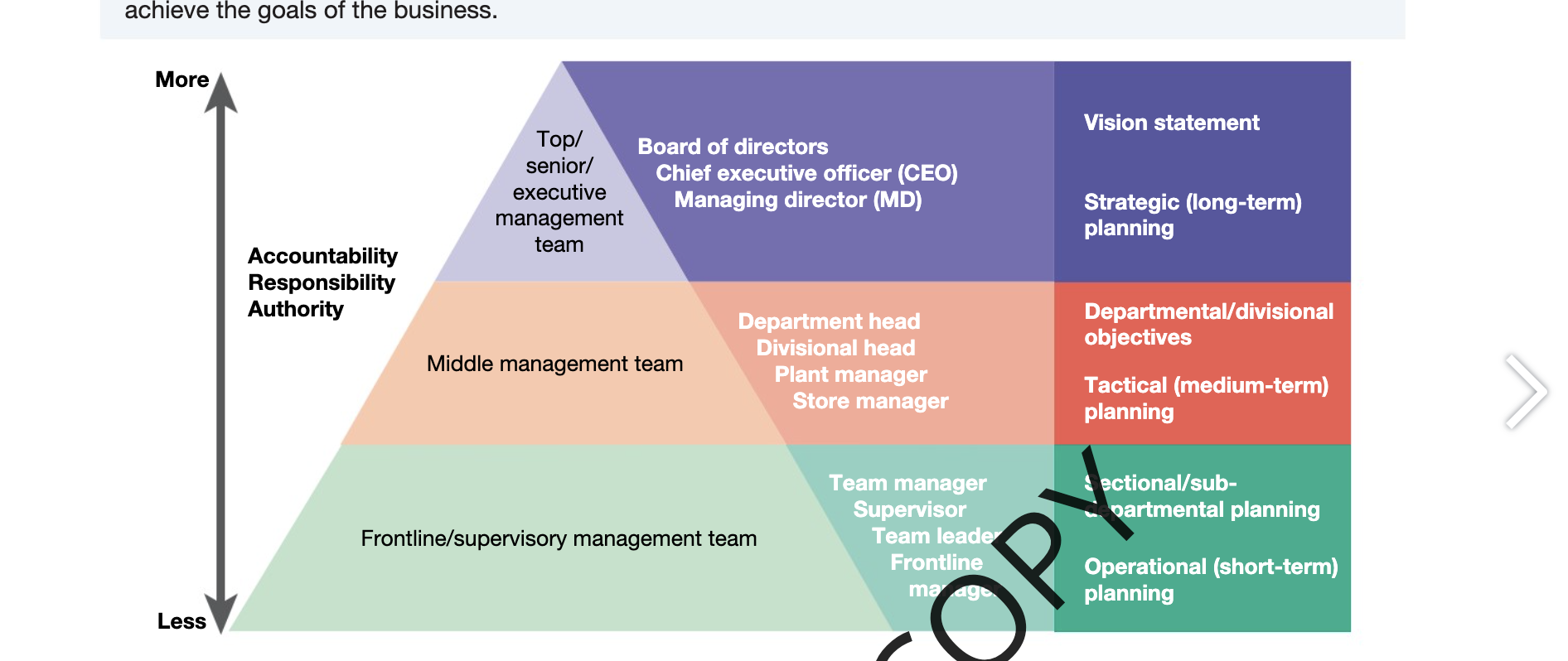
Strategic Planning (Long term)
Planning for 3-5 years
Focus on where the business wants to be in the future
Done by top managers
Tactical Planning ( Medium Term)
Flexible/ adaptable planning for 1-2 years
Allows the business to respond quickly to change
Turning big strategic goals into clear practical actions
EG Business strategic goal is to increase market share by 20 percent in 3 years
Tactical Plan: Hire more staff, new ads campaign
Operational Planning ( Short Term)
How the business will operate in short term
Operates daily, weekly, monthly
Shifts and daily tasks
Management as Organising
Organising: Allocating resources, assigining tasks and establishing a structure in a business
The organisation process
Determining the work activities
Figure out what tasks need be to done to achieve the goal
Break big goals into smaller, managable steps
Classifying and grouping activities
Group similar tasks together
Improves effiency by enabling the most appropriate allocation of resources
Assiging work and delegating authority
Deciding who does each task
Give them responsibility to do it
Managament as Controlling
The process management goes through when it attempts to evaluate peformance and take action
Control Process
Establish standards
Set targets
Measure peformance
Check results and compare
Take action
Fix any problems if peformance does not match standard
Hierachical Organisational Structure
Rigid communication as employees have limited freedom to communicate across levels, needing to go through specific managers
Longer chain of command
Narrow span of control
Flatter organisational structure
Easier communication
Shorter chain of command ( Lower amount of management levels)
Wider span of control
Management Hierachy
A management hierarchy is the structure that shows the different levels of authority and responsibility in a business, from the highest managers to the lowest-level employees.
Demonstrated in a pyramid
Specialisation of Labour
The degree to which tasks are divided into seperate jobs
Chain of Command
An organisational structure, shows how each memeber of a company reports to one another
Autocratic Leadership Style
Make all decisions, dictates work methods, frequently checks employees giving cruel feedback
Can be effective in a time of crisis, when immediate compliance with rules is needed
Behavioural Approach
An approach that stresses that employees should be the main focus of the way in which the business is organised
Major Contributer
Elton Mayo
- Famous for the Hawthorne Studies, which showed workers peform better when they feel values and recognised
Advantages and Disadvantaes of Behavioural Approach
Advantages
Increased empowerment of employees, can take ownership of their own work
Increased motivation
Improved relationships
Disadvantages
Lack of control
Senior employees can disrupt the process
Difficult to predict employee behaviour
Managament as Leading
Leading is the management function that involves directing and influencing employees to achieve the organisation's goals.
Leadership qualities
Delegates tasks
Confidence
Shares recognition
Builds a clear vision
Sets an example, earning respect
Managament as Motivating
To encourage employees to work willingly and effectively towards business goals
Elton Mayo Hawthorne Studies showed that human factors improved employee productivity
Recognition, Self Worth, Positive reinforcement
Managament as communicating
Managers focus on sharing information clearly and effectively
Effective communication is key towards business success
Teams
Teamwork is when people interact regularly and co-ordinate their work towards a common goal
It is important that managers foster a sense of cohesion
Teams- Flatter Organisatioal structure
Fewer levels of managament, resulting in shorter chain of commands and a wider sense of control
Fewer bosses
Faster descion making
Participative Democratic Leadership style
When managers consult with employees to aks their suggestions and ideas, after considering it through decision making.
Advantages and Disadvantages of a Democratic
Advantages
Employee- relations are strengthed and positive
Employees have a greater opportunity to gain skill
High level of trust
Disadvantages
Time consuming
Internal conflct, as more involvement leads to disagreement
Not all employees want to contribute
We skipped a fair few topics due to Zoo Excursion
MANAGEMENT PROCESS
Managamenent Process: Marketing (again skipped ahead so wont be in order)
Marketing
Marketing is the set of activities a company uses to identify customer needs and satisfy them profitably.
Identification of the Target Market
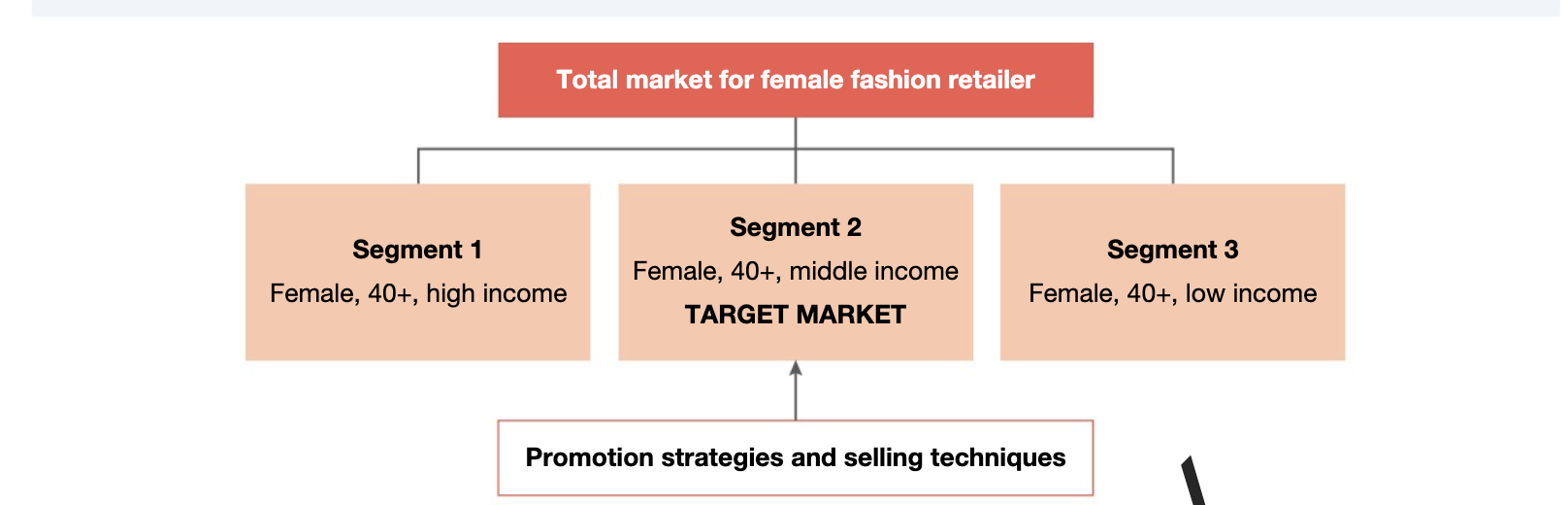
Target Market: A specific group of people a businesses aim to sell its products to
Benefits of a target market
No wasted money on people who wont buy
Learn consumer buying behaviour
Collect better data
2 types of target markets
Primary Target Market: Main focus, most money and marketing goes here
Secondary Target Market: A smaller and less important market segment
3 approaches to choosing a target market
Mass Marketing
Market segmentation
Niche Marketing Approach
Mass Marketing Approach
Seller mass produces, mass distributes and mass promotes one prouduct to all buyers
Seeks a large range of customers
Dettol, as it is used in every household
Market segmentation approach
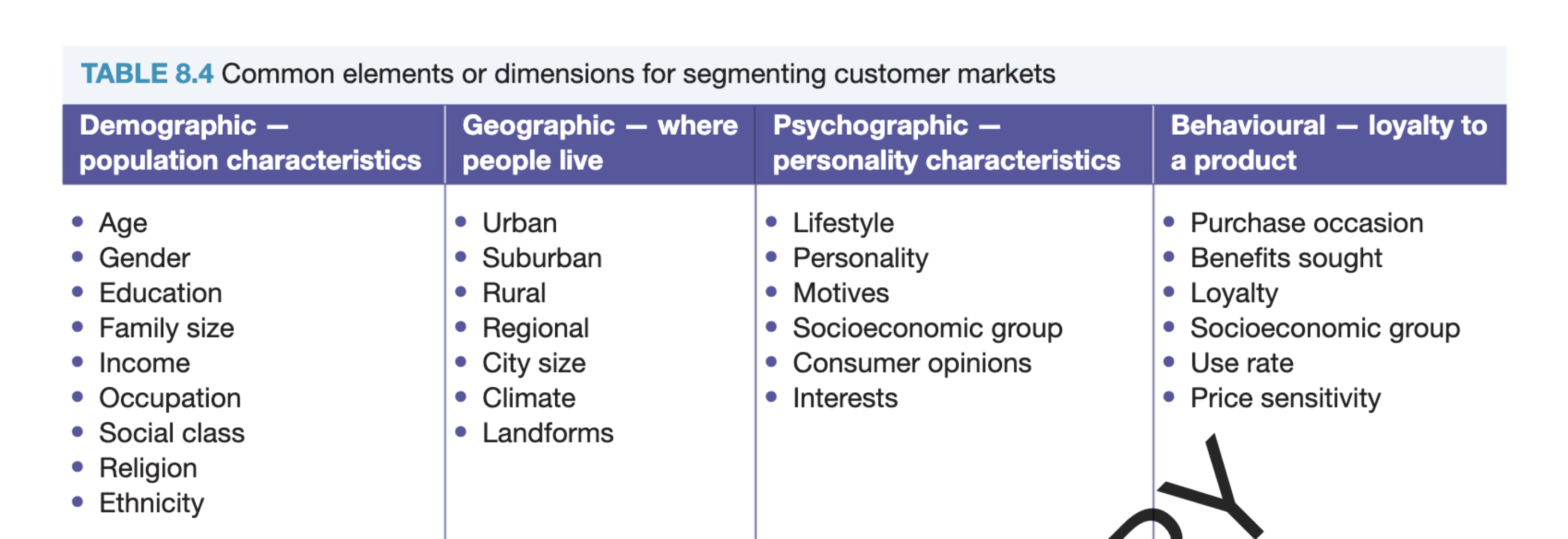
When the total market is divided into groups of people who share similar characteristics based on 4 elements
- Demographic
- Geographic
- Psychographic
- Behavioural
A table of the 4 elements (read and understand)
Aim of market segmentation
To increase sales by better understanding and responding to the desires of the target customers
Purpose of markey segmentation
The purpose of market segmentation is to divide a broad target market into smaller, manageable groups of consumers with shared characteristics, needs, or behaviors. This allows businesses to tailor marketing strategies, optimize resource allocation, enhance customer satisfaction.
What happens after market has been segmented?
The business selects one of the segments to become the target market
Rural Supply PTY LTD: Male, 25-60 yrs old, middle to high income , example
Niche Market
A narowly defined group of customers with specific needs
Gluten-free bakery products – for people with coeliac disease or gluten intolerance
Vegan skincare products – for consumers who avoid animal products
Luxury pet accessories (like designer dog collars) – for pet owners who want premium items
Marketing Mix
The combination of the 4 elements of marketing, the 4ps , Product, Place, Price, Promotion
Also can include
- People
- Physical evidence
- Process
7p’s
Product
The actual good or service
Product Design
Product Branding
Product design
Refers to the process of planning and creating a product
Focuses on the appereance, suitability and how it meets the needs of consumers
Example: Clear signage through a zoo, improves acceibility
Product Branding
Process of creating a name, logo, desgin and identity so people remember and recognise
Making a product stand out due to its brand logo
Price
The monetary value assigned to the product or service, that a customer must pay inorder to access
It acts as a powerful indicaton, shaping customer perception on the quality of the product
Directly generates revenue
Methods to calculate price
Cost based: Adding a mark up from total cost
Market based: Interactions between levels of supply and demand
Competitor based: Against competitors
Promotion
This method used by a business to inform, persuade and remind a market about its products
Main forms of promotions
Personal selling
Relationship Marketing
Sales promotion
Publicity
Public relations
Advertisements
Technology
Personal selling
A salesperson directly communicates with a potential customer to persuade them to buy a product or service.
Relationship Marketing
Focus on building long term customer loyalty and ongoing engagement
Sales promotion
Activities or materials used to gain attention
Coupons, free samples
Publicity
The attention the business gets through media and articles
Public relations
What a business does to create and maintain a good image
press conferences
Advertising
Advertising is when a business pays to promote a product or service to a large audience using different media
Technology
SMA- Social Media Advertising
Place ( Distribution)
Refers to how and where a product is made available to customers so they can easily buy
Distribution channel
Ways of getting product to customers
3 forms of distribution channels
Direct channel (Producer → Customer)
No middleman involved
The business sells directly to the customer
Example: buying from a farmer’s market or a brand’s website (like Apple Online Store)
2. One-level channel (Producer → Retailer → Customer)
One middleman (the retailer)
The retailer buys from the producer and sells to the customer
Example: Nike selling shoes to Foot Locker, then Foot Locker sells to you
3. Two-level channel (Producer → Wholesaler → Retailer → Customer)
Two middlemen involved
Wholesaler buys in bulk, sells to retailers, then retailers sell to customers
Example: food products like Coca-Cola going through wholesalers before reaching supermarkets
People
Everyone in the business affects customer experience
Staff attitute, skills, behaviour
Processes
The systems and steps a business uses
Smooth process= better customer satisfaction
Physical Evidence
What customers can see
Influences their perception on the business
Management Approach: Contingency Approach
Contingency Approach: Managers change their strategies and leadership style to suit different circumstances
Contingency Approach ( Brief Idea)
A business can either use a behavioural or classical approach depending on the scenario
Example of Contingency Approach: McDonalds
Classical Approach: During a busy lunch rush
- Strict rules
- Clear division of tasks
- Effiency and speed
Behavioural Approach: Staff are stressed
Encouraging teamwork
Motivating Staff
This shows the “contingency approach” as the manager changes their management style depending on the situation