Ecology Final Exam
 Call Kai
 Learn
Learn Practice Test
 Spaced Repetition
 Match
Match Flashcards
 Knowt Play
1/28

Earn XP
Description and Tags
Chapters 18-22
Name | Mastery | Learn | Test | Matching | Spaced | Call with Kai |
|---|
No analytics yet
Send a link to your students to track their progress
29 Terms
Based on the equilibrium theory of island biogeography, which type of island would have the smallest number of species present?
Small islands far from the mainland
Suppose that multiple sites in a large geographic region have been found to have very similar species compositions of herbivorous insects, even though each site has a large number of species. These herbivorous insects are therefore said to have low _______ diversity.
beta
Which statement about global biogeographic patterns is true?
Most groups of organisms show more diversity at the tropics than at higher latitudes.
Suppose a land mass begins to separate and drift apart, separating populations of mice on either side. These mice then evolve into new species on the two sides of the land mass. This is an example of evolution by
vicariance
Net primary production is:
gross primary production minus autotroph respiration.
Suppose that heterotrophs ingested 7,500 kilograms of plant biomass over a month's period. Respiration of these heterotrophs was the equivalent of 5,200 kilograms, and they egested 1,400 kilograms. What was the net secondary production?
900Kg
What does Net Ecosystem Exchange (NEE) measure?
Both photosynthesis and respiration of autotrophs, plus respiration of heterotrophs
In the Calvin cycle, the ‘carbon reaction’ of photosynthesis, which synthesizes carbohydrates, is catalyzed by the enzyme _______, which catalyzes both carboxylase and oxygenase reactions.
Rubisco
Plant species from resource-_______ environments often have low growth responses to fertilization because these plants typically have _______ intrinsic growth rates.
poor; low
Based solely on this map, would you expect the species of Australia to be more similar to the Philippines or New Zealand?
New Zealand
Which of the following is not an example of weathering (i.e., the release of elements form rock minerals)?
All of the above are examples of weathering.
_______ is a natural anaerobic process that removes nitrogen (in the form of nitrate, NO3-) from the environment, converting it to _______.
Denitrification; dinitrogen gas
Which of the following is not part of the decomposition process
fixation
The original source of all nutrients is _________. Because these sources are slow to make nutrients available to organisms, there is a high degree of _________ in most ecosystems.
minerals in rocks and gases in the atmosphere; internal recycling
Which of the following does not impact decomposition rates?
None of these (i.e. all impact decomposition rates)
-complexity of organic molecules
-redfield ratio
-presence of secondary compounds
Treatment wetlands, such as the Orlando Wetlands Park, are utilized because of their ability to remove excess ________ from wastewater.
Nitrogen and phosphorus
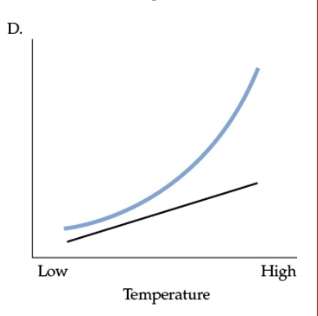
Which figure best illustrates the relationship between temperature and primary productivity and temperature and rates of decomposition?
Figure D
Excess nitrogen can become a pollutant in aquatic systems, contributing to eutrophication and harmful algae blooms. Denitrification is a natural process that occurs at very high rates in ______ and converts nitrate to harmless _____.
wetlands; N2
Soils composed of high amounts of ______ typically hold the least amount of water and nutrients.
sand
Which of the following is not included within the definition of “biodiversity?”
None of the above (i.e., all are included in the definition)
-Genes
-Species
-Communities
The primary goal of the field of Conservation Biology is to:
Protect biodiversity
The figure shows the current level of threat faced by each biome from a variety of sources. The arrows show the direction whether the threat is decreasing, continuing, increasing, or rapidly increasing. In which biome has climate change had a high or very high effect in the past 50-100 years?
Polar
Genetic rescue of endangered species would be most useful in a species that
has a low population and low genetic diversity.
The use of species‒area relationships to predict extinction rates assumes that most extinction is due to
habitat loss.
Extinction rates in 20th century are
above background rates.
The acidification of oceans due to carbon dioxide diffusion into the water has had serious deleterious consequences for corals and other species. For some species, however, the acidification has had little, if any, effect. Thus, the best term to describe the overall effect of ocean acidification on marine life is habitat
degradation.
The activity of an earthworm species increases the fertility of soils in an agricultural field. This is an example of
an ecosystem service.
A keystone species present in the state of Florida that is responsible for providing refuge for other organisms during fire
Gopher Tortoise
In general, most of the biodiversity loss that is occurring is resulting in more generalist species persisting, while more specialist species are being lost.
True