Lecture 10: Arrhythmias & Antiarrhythmic Therapy
 Call Kai
 Learn
Learn Practice Test
 Spaced Repetition
 Match
Match Flashcards
 Knowt Play
1/50

There's no tags or description
Looks like no tags are added yet.
Name | Mastery | Learn | Test | Matching | Spaced | Call with Kai | Chat |
|---|
No analytics yet
Send a link to your students to track their progress
51 Terms
What are the effects of arrhythmias?
syncope
weakness
CHF decompensation
reduced blood flow → reduced CO, reduced cerebral and coronary blood flow
reduced renal perfusion
Describe the cardiac electrical system.
SA node: pacemaker in the RA → initiates electrical impulse
Atrial conduction pathways: impulse spreads through atrial muscle causing contraction
AV node: located at junction between atria and ventricles → delays impulse to allow ventricles to fill
Bundle of his: conducts impulse from AV node to ventricles
R&L bundle branches: carry impulses down the interventricular septum
Purkinje fibers: throughout ventricular walls → trigger ventricular contraction
What are the 4 classes of antiarrhythmic drugs according to Vaughan-Williams classification?
• Class I – Sodium (Na+) channel blockers
• Class II – Beta (β) blockers
• Class III –Potassium (K+) channel blockers
• Class IV – Calcium (Ca+2) channel blockers
What are the three classes of Na channel blockers (class I antiarrhythmics)?
Class 1A: Quinidine, Procainamide
• Blocks fast Na channels → Slows conduction moderately
• Works on normal and depolarized cells; used for atrial & ventricular arrhythmias
Class IB: Lidocaine, Mexiletine
• Block fast Na⁺ channels, especially in depolarized / ischemic cells
• Minimal effect on normal tissue, safer for ventricles, no effect on atrial tissue
Class IC: Flecainide, Encainide
• Strong Na⁺ block → marked conduction slowing, high efficacy but high risk if heart is diseased
• Used for supraventricular arrhythmias &life-threatening ventricular arrhythmias
What drug treats supraventricular and ventricular arrhythmias and is used to treat atrial fibrillation in horses?
quinidine
What are the possible side effects of quinidine?
• Proarrhythmic effect, Torsades de pointes
• Horses - Colic, hypersensitivity, urticaria, sweating
• Enhanced AV conduction – rapid heart rate
• GI signs
• Hypotension
What are the possible side effects of procainamide?
• Proarrhythmic
• GI signs
• Haircoat color change, Lupus-like changes
When is lidocaine used to treat arrhythmias?
used for serious ventricular arrhythmias
IV bolus followed by infusion (CRI) is best
correct hypokalemia for optimal efficiency
When should a lidocaine dose be reduced?
with severe liver disease or CHF
What are the side effects of lidocaine?
GI upset
seizures
cats and horses sensitive: neuro signs
What are the commonly used class II antiarrhythmics (beta-blockers)?
Propranolol
atenolol
metoprolol
carvedilol
esmolol
What are the clinical uses for beta-blockers?
• Ventricular arrhythmias
• Supraventricular arrhythmias
• Congestive heart failure
• Systemic hypertension
• Hyperthyroidism
• Intoxication (ie. Chocolate, aminophylline)
What are the side effects of beta blockers?
• Negative chronotropism: Bradycardia, AV block
• Negative inotropism: CHF, weakness
• Hypotension
• Bronchospasm
• Neurologic
What are the commonly used class III antiarrhythmics and what do they do?
K Channel Blockers → Prolong action potential
Both can be used for ventricular and supraventricular arrhythmias
• Amiodarone (*also crosses over to all other 3 classes of antiarrhythmics)
• Sotalol (*also beta blocker)
What drug is commonly used in boxer cardiomyopathy?
sotalol
Amiodarone has a higher side effect profile than sotalol. What are the side effects?
• Hepatotoxicity
• GI upset, thyroid abnormalities
What are the commonly used class IV antiarrhythmics (Ca channel blockers)?
• Diltiazem
• Verapamil
• Amlodipine
What are the clinical uses of class IV antiarrhythmics (Ca channel blockers)?
• Supraventricular tachycardia
• Atrial fibrillation
• Systemic hypertension
• Hypertrophic cardiomyopathy
• Coronary vasodilation
What are the possible side effects of class IV antiarrhythmics (Ca channel blockers)?
• Negative chronotropism → Sinus bradycardia, AV block
• Negative inotropism → May precipitate CHF
• Excessive vasodilation → Hypotension
What is the mechanism of digoxin?
Positive inotrope (improves cardiac contractility)
• Blocks Na+ K+ ATPase pump
Negative chronotrope (vagomimetic effect)
• Slows heart rate
• Slows AV conduction
• Antiarrhythmic effect
What are the indications for digoxin?
• A fib or SVTs (slows ventricular response rate)
• DCM with reduced systolic function (improves contractility)
• Low output CHF when other inotropes not tolerated or efficacious
What cardiac drug has a very narrow therapeutic index and can quickly become toxic, causing anorexia, lethargy, depression, V/D, and cardiac arrhythmias, so it should be monitored closely?
digoxin

What is the treatment for this rhythm?
no treatment - normal sinus rhythm

What is this rhythm and what is the treatment?
sinus arrhythmia → incidental finding, no treatment
What is a sinus arrhythmia?
Cyclic slowing and speeding of the sinus rate, most commonly associated with respiration
Normal finding in dogs (rare to see in cats)
Often accompanied by change in P wave configuration (wandering pacemaker) with taller, spiked P waves on inspiration and flatter on expiration
May be associated with wandering pacemaker → Variable P wave height or appearance
What is the treatment for sinus tachycardia and sinus bradycardia?
sinus tachycardia: treat underlying cause - shock, hypotension, fever, CHF, pain, hyperthyroidism, anxiety
sinus bradycardia: treatment only needed based upon hemodynamic status - atropine, glycopyrrolate, epinephrine, pacing

What is this rhythm and how do you treat it?
atrial premature contractions = Early abnormal (ectopic) beats that arise from the atria
no treatment, but may warrant investigation as to cause
What causes atrial premature contractions?
• Structural heart diseases which cause enlargement and stretch of atria
• Congenital accessory conduction pathway
• Extra-cardiac illness: elyte abnormalities, anemia, thyroid dz, trauma

What is this rhythm and what is the treatment?
SVT
treatment if symptomatic: cardioversion, cardiac ablation, medical therapy
What rhythm caused by conditions that cause atrial enlargement, metabolic disease, autonomic tone variations, or congenital conduction system abnormalities can result in dyspnea, exercise intolerance, weakness, and syncope?
SVT
What drugs can be used for SVTs?
IV treatment for rapid response
• Diltiazem (Ca channel blocker) - IV for acute use, PO for chronic use
• Esmolol (beta blocker)
Oral treatment
• Calcium Channel blockers - Diltiazem
• Beta blockers
• K Channel blockers, Sotalol, Amiodarone
• Digoxin
What are the possible side effects of dilitazem?
• Negative chronotropism - Bradycardia, AV block
• Negative inotropism - May precipitate CHF
• Hypotension
• CV collapse
What are vagal maneuvers?
Parasympathetic innervation → at sinus node, atrial tissue & AV node
Carotid sinus compression:
Compress carotid sinus against vertebral body
Sinus tachycardia – transient slowing of HR
Sustained SVT – Abrupt termination of the abnormal rhythm
Ocular pressure
Ice water – Dive reflex (not used in dogs or cats)
Precordial thump – Not advised
What causes atrial fibrillation?
atrial dilation secondary to heart disease

What is this rhythm and what is the treatment?
atrial fibrillation
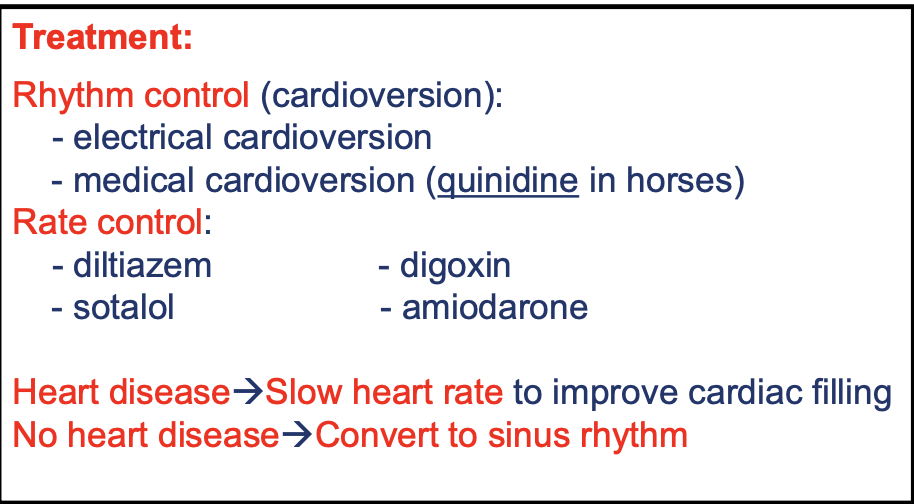
How is atrial fibrillation treated if there is heart disease involved?
goal is to slow HR
achieved by slowing AV conduction → digoxin, Ca channel blocker (diltiazem), beta-blocker if no CHF, less frequently amiodarone
How is atrial fibrillation treated if there is no heart disease involved?
goal is converions to sinus rhythm
drugs that sometimes work: quinidine, diltiazem, sotalol, amiodarone
Cardioversion - ECG synchronized

What is this rhythm and what is the treatment?
VPCs
Treatment:
None for isolated VPCs, may want to investigate cause
Couplets or triplets with fast coupling rate or “R on T” phenomenon typically treated
Holter monitor recommended to determine frequency and malignancy of the arrhythmia

What is this treatment and what is the treatment?
ventricular tachycardia
treated with urgent anti-arrhythmic drugs (ex. lidocaine)
key to identify underlying cause of rhythm

Does this rhythm need treatment?
Probably not – Slow rate (25 mm/sec strip, HR 130 , not scary)
What is accelerated idioventricular rhythm caused by?
Caused by enhanced automaticity of ventricular pacemaker cells vs reentry mechanisms like in V-tach:
• During reperfusion after injury
• Certain drugs/toxins
• Increased vagal tone
• Normal variant
• Electrolyte disturbances
• Structural heart disease

What is this rhythm and how is it treated?
v-fib
medical emergency
only prompt defibrillation and CPR can restore a viable rhythm and save life
What are the indications for defibrillation?
• Ventricular fibrillation
• Ventricular flutter
• Torsades de pointes
• Pulseless ventricular tachycardia
What is sick sinus sindrome?
• Signalment: middle-aged to older Mini Schnauzers, Westies, American Cocker Spaniels
• Cause: idiopathic fibrosis of the sinus node
• Periods of sinus arrest are often followed by a paroxysm of supraventricular tachycardia
• Can cause syncopy or sudden death
How is sick sinus syndrome treated?
Treatment: Atropine response test to determine medical management (positive chronotrope) vs. pacemaker
Medical management (if atropine responsive)
Propantheline, Isopropamide
Theophylline
Terbutaline (higher risk of side effects)
Cardiac pacing
What can cause atrial standstill?
can result from severe hyperkalemia (IV fluids - NaCl, calcium gluconate, sodium bicarb, dextrose and insulin)
can also result from an atrial muscular dystrophy, hypothermia, terminal event
What is atrial standstill?
Atrial activity is absent
There are no P waves anywhere on the ECG strip
If result of severe hyperkalemia → peaked T wave and bradycardia
What are the types of AV blocks?
Abnormal conduction from atria to ventricles
1st degree: slowed conduction
2nd degree: sometimes doesn’t conduct
Type 1: gradual prolongation before block (Wenckebach)
Type 2: consistent PR interval before block, High-grade – multiple consecutive non-conducted P waves
3rd degree: never conducts (complete heart block)
How are the different types of AV blocks treated?
1st degree: No treatment if asymptomatic
2nd degree:
Type 1: Atropine if symptomatic
Type 2: Usually needs pacemaker (+/- atropine short term if effective)
3rd degree: Pacemaker
What are the therapeutic options for bradycardias?
Medical therapy:
Sympathomimetics: Theophylline, Terbutaline, Isoproterenol (Hypotension, ventricular tachycardia, ventricular fibrillation)
Vagolytics (Parasympathetic antagonists): Atropine, Glycopyrrolate, Probanthine, isopropamide (Orally acting)
Temporary transvenous pacing lead
Permanent pacemaker implantation
What is the most commonly used type of cardiac pacing?
permanent cardiac pacing - transvenous