anelli biology 6
 Call Kai
 Learn
Learn Practice Test
 Spaced Repetition
 Match
Match Flashcards
 Knowt Play
1/4

There's no tags or description
Looks like no tags are added yet.
Name | Mastery | Learn | Test | Matching | Spaced | Call with Kai | Chat |
|---|
No analytics yet
Send a link to your students to track their progress
5 Terms
focal adhesion video
focal adhesions are made up of:
∎ Integrins, which bind to the ECM
∎ Adapter proteins like talin which link integrins to the cytoskeleton
∎ Actin filaments inside the cell, providing mechanical support and signalin
5 junction types summary
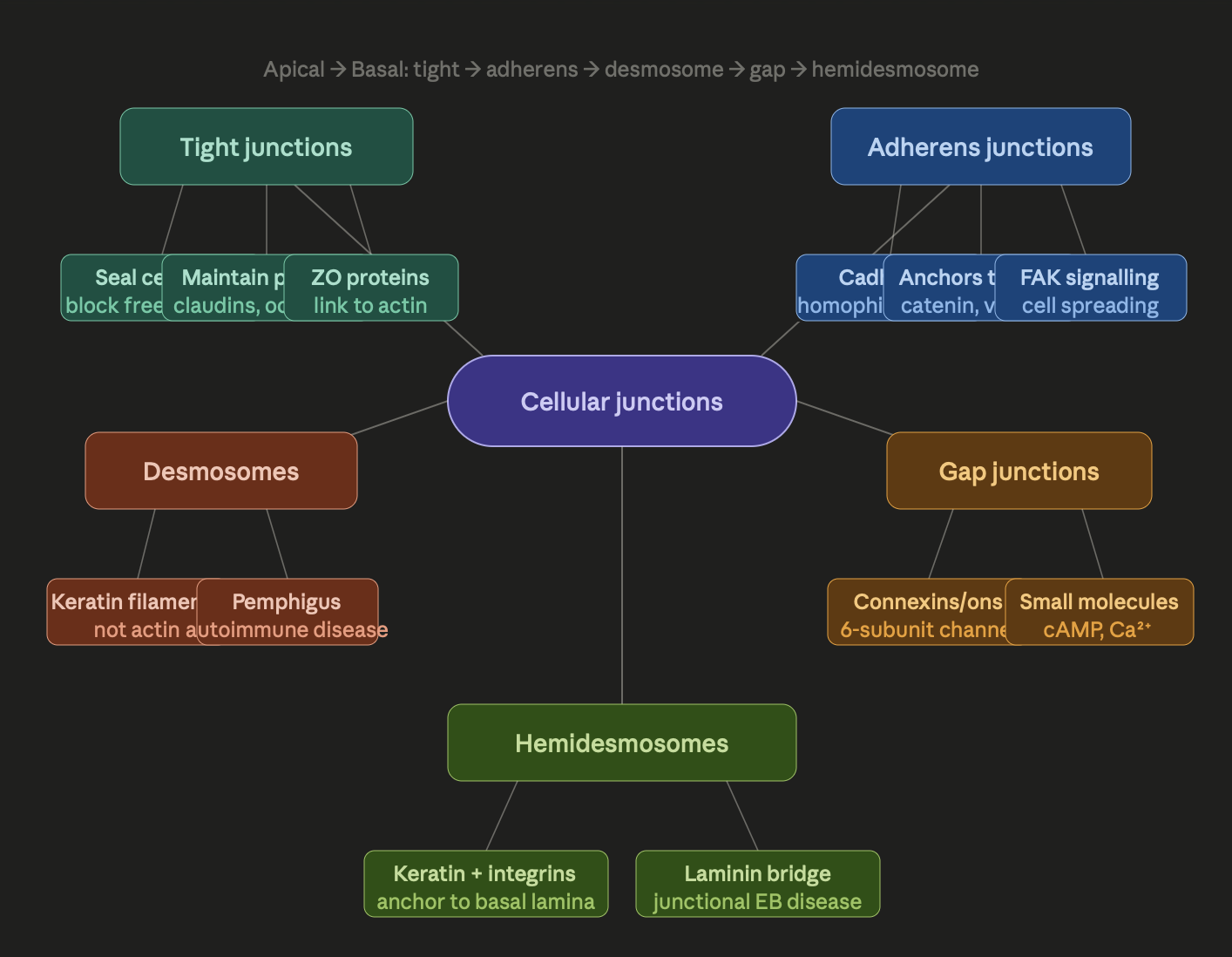
Here's a summary of all five junction types:
Tight junctions sit at the very top (apical) of epithelial cells. Their job is to seal the space between neighbouring cells so molecules can't sneak through — anything that needs to cross must go through the cell itself. Claudins and occludins form the belt-like seal, and ZO proteins anchor it to the actin cytoskeleton. This also locks membrane proteins in place, maintaining cell polarity.
Adherens junctions sit just below tight junctions. Cadherin proteins on adjacent cells bind each other (homophilic interaction), and on the inside, anchor proteins like catenin and vinculin link them to actin filaments. Each cadherin has low individual affinity, but strength comes from clustering many dimers together.
Desmosomes work similarly to adherens junctions, but instead of actin they recruit keratin intermediate filaments. This gives tissues like skin their mechanical toughness. In pemphigus, antibodies attack desmosome cadherins, making the epithelium dangerously fragile.
Gap junctions are fundamentally different — they don't provide adhesion but create direct channels between adjacent cytosols. Built from hexameric connexon units, they allow small molecules (cAMP, Ca²⁺) to pass directly from cell to cell, enabling coordinated signalling in nerves and muscle. The channels can be gated open or closed by phosphorylation or pH changes.
Hemidesmosomes anchor epithelial cells to the basal lamina (the ECM below). They use keratin filaments and integrin dimers, with laminin acting as a molecular bridge between the integrin and the ECM. Mutations in laminin cause junctional epidermolysis bullosa, a severe condition where skin blisters easily.
junction types mind map
first 7 pages quiz
file:///Users/edagulsen/Downloads/cellular_junctions_quiz.html
d
d