oxidative phosphorylation
 Call Kai
 Learn
Learn Practice Test
 Spaced Repetition
 Match
Match Flashcards
 Knowt Play
1/66

There's no tags or description
Looks like no tags are added yet.
Name | Mastery | Learn | Test | Matching | Spaced | Call with Kai | Chat |
|---|
No analytics yet
Send a link to your students to track their progress
67 Terms
what is substrate level phosphorylation
Phosphorylation of ADP or some other nucleoside 5′-diphosphate coupled to dehydrogenation of an organic substrate (reactive compound)
indepedent of the ETC/respiratory chain
most straightforward way to make ATP
where does substrate phosphorylation happen in glycolysis process (e.g. what step)?
1,3-bisphosphoglycerate → 3-phosphoglycerate
phosphoenolpyruvate → pyruvate
phosphate is donated to ADP
where does substrate phosphorylation happen in citric acid cycle (e.g. what step)?
succinyl CoA → succinate
hydrolysis of phosphodiester bond between coenzyme A and succinyl group is very exothermic so can drive phosphorylation of ADP/GDP
what is oxidative phosphorylation?
final stage of aerobic cellular respiration where cells make energy in the form of ATP
consists of ETC and chemiosmosis
reduced coenzymes get oxidised (linked to ATP production)
what are the two reduced coenzymes involved in oxidative phosphorylation?
NADH and FADH2
FADH2 is always bound to its enzyme
what are the main structural elements of the mitochondria?
inner mitochondrial membrane (IMM)
outer membrane
intermembrane space (IMS)
matrix
describe the structure of the IMM
highly folded (cristae)
high surface area for enzymes
less permeable
very selective transporters (bind specific substances)
describe the structure of the outer membrane
highly permeable - lots of large channels that let most substances through
describe the composition of the IMS
solution is very similar to cytosol solution (due to permeable outer membrane)
high H+ concentration (low pH)
describe the composition of the matrix
low H+ concentration (high pH)
very different to IMS solution due to very selective IMS
why is the pH difference between the IMS and matrix important?
forms a proton gradient
proton gradient is needed for the ETC and ATP synthetase to function
what reactions (in the matrix) are the three main sources of reduced coenzymes for oxidative phosphorylation?
fatty acid oxidation (matrix)
amino acid oxidation (matrix)
citric acid cycle (matrix)
reduced coenzymes from these reactions can directly take part in oxidative phosphorylation
what reaction (in the cytosol) is the main source of reduced coenzymes for oxidative phosphorylation?
glycolysis
there is no transporter for NADH in the IMM so this NADH molecule cannot directly take place in oxidative phosphorylation
what are shuttles?
biochemical systems that move electrons from NADH made in the cytosol across the inner mitochondrial membrane
use carrier molecules to transfer electrons across the IMM so they can participate in oxidative phosphorylation
how do shuttles work?
use NADH to reduce a compound that can be transported into the matrix
that compound is then used to produce NADH in the matrix by reducing NAD
what is an example of a shuttle?
malate-aspartate shuttle
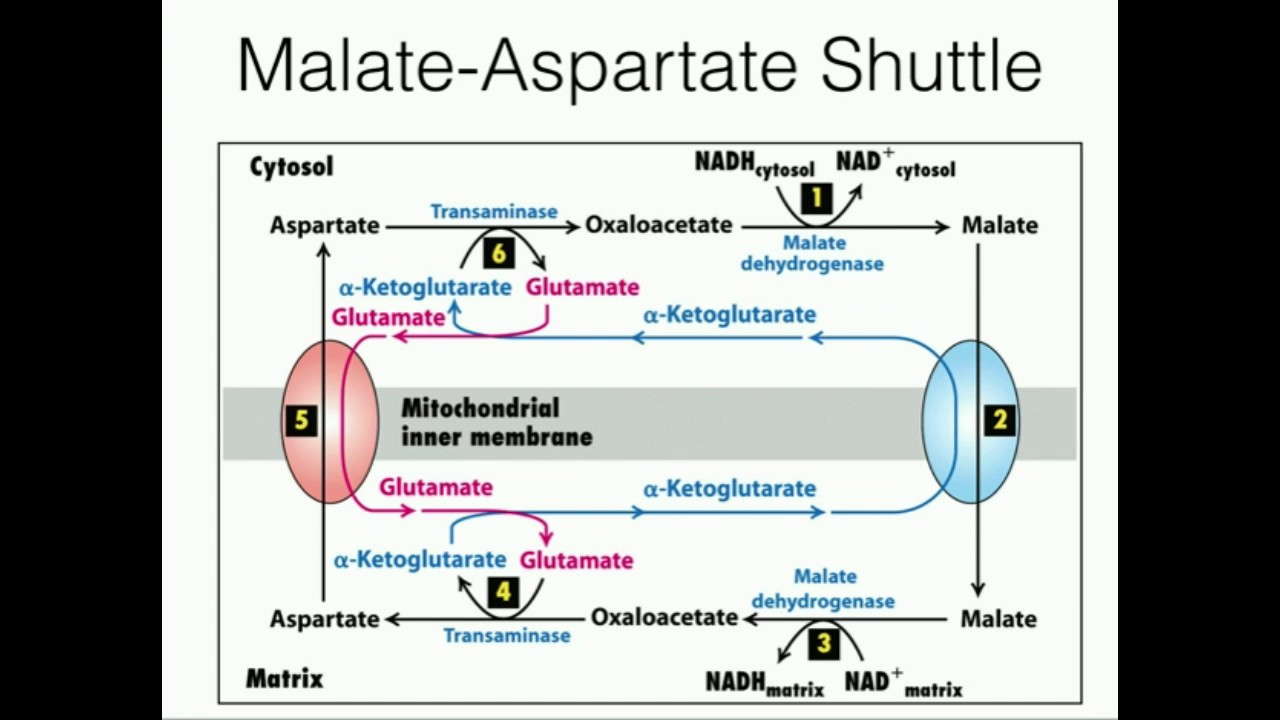
outline the pathway of the malate aspartate shuttle
oxaloacetate in the cytosol is reduced by malate dehydrogenase (using NADH) to make malate
malate is transported in to the matrix
another malate dehydrogenase uses malate to reduce NAD to NADH in the matrix (malate → oxaloacetate)
oxaloacetate transported back out into the cytosol
malate aspartate shuttle diagram
what is the electron transport composed of?
3 protein complexes (all enzymes) embedded in IMM
Complex I, III and IV
what does complex I do?
catalyse transfer of electrons from NADH to coenzyme Q
NADH --> NAD (oxidised)
Coenzyme Q --> Coenzyme QH2 (reduced)
what does complex III do?
Catalyses transfer of e- from Coenzyme QH2 to cytochrome C
Coenzyme QH2 --> Coenzyme Q (oxidised)
Cytochrome C --> reduced cytochrome C (reduced)
what does complex IV do?
Catalyses transfer of e- from cytochrome C to oxygen
Reduced cytochrome C ---> cytochrome C (oxidised)
Oxygen ---> water (reduced)
are the ETC reactions (catalysed by the complexes) endothermic or exothermic?
exothermic
what is the energy from the exothermic ETC redox reactions used for?
used to pump protons from the matrix into the IMM
energy is required to do this because the protons are being transported against their concentration gradient
what is a half-reaction?
individual oxidation or reduction part of a redox reaction
two complementary half reactions occur simultaneously and represent the specific transfer of electrons between substances
what do the oxidation and reduction half equations show respectively?
oxidation = loss of electrons / loss of hydrogen
reduction = gain of electrons / gain of hydrogen
what is a redox couple?
a pair of chemical species consisting of the oxidised and reduced forms of the same substance
(An electron donor and its corresponding oxidized form; for example, NADH and NAD+)
what is reduction potential (E0)?
measure of a chemical species' tendency to acquire electrons and be reduced (aka likelihood of a compound to be reduced)
what does a positive reduction potential mean?
reduced form of compound is preferred
'the oxidised compound has a higher potential to get reduced'
'reduction of oxidised compound is relatively spontaneous process'
what are the thermodynamics (ΔG, ΔH) of a half-reaction with a positive E0?
positive ΔG
negative ΔH (exothermic process)
reduction of oxidised compound is relatively spontaneous
what does a negative reduction potential mean?
prefers oxidised form of compound
vice versa of positive reduction potential
what does the magnitude of the difference in reduction potential (ΔE0) mean?
small difference in reduction potential = not much energy produced by reaction
large difference in reduction potential = lots of energy produced (very exothermic)
how are half equations and reduction potentials linked to oxidative phosphorylation?
reduction of oxygen to water (complex IV)
O2 + NADH → H2O + NAD
oxygen and water are a redox couple, NADH and NAD are a redox couple
what is the ΔE0 for the reaction for the reduction of oxygen?
large difference in reduction potentials
very exothermic, produces lots of energy
if NAD/FAD involved there is a transfer of TWO electrons
what is the equation for ΔG° (standard gibbs free energy) using E0?
n = number of electrons transferred
F = Faraday's constant (will be given but is 96.5 kJ mol-1 V-1)
E = difference in reduction potential
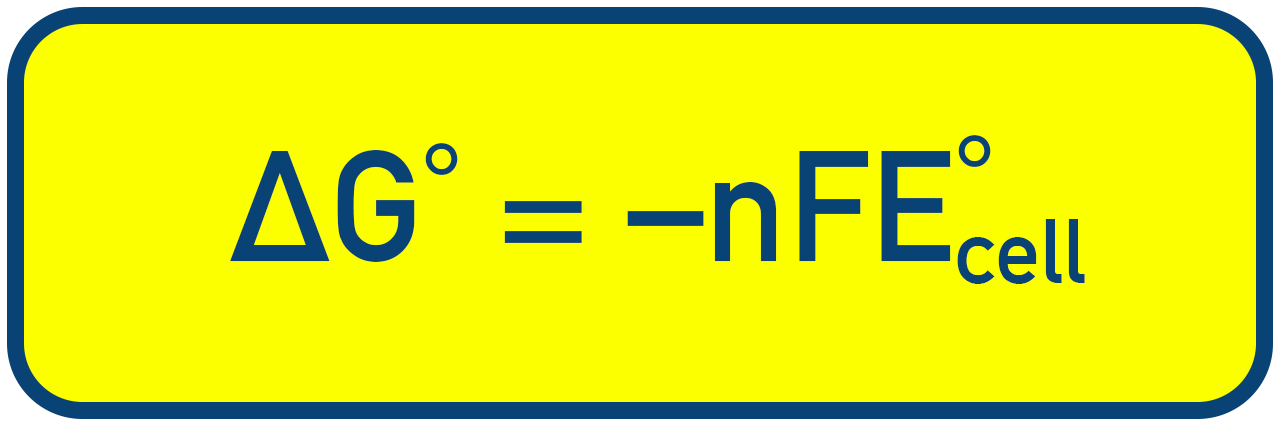
what is ΔG° for the reduction of oxygen?
-220kJ mol-1 (lots of energy)
what are the key electron carriers (coenzymes) in the ETC?
ubiquinone
flavin mononucleotide (FMN)
Iron-Sulfur (FeS) Protein
Cytochrome
describe ubiquinone
accepts H atoms and electrons
can also be referred to as a hydrogen carrier
describe FMN
accepts H atoms and electrons
Can also be referred to as a hydrogen carrier
Similar structure to FAD -- can be reduced to FMNH2 (found in complex 1)
describe FeS protein
Can only accept SINGLE electron
Contain iron ion complex with cysteine residues and sulfur atoms
describe cytochrome
Can only accept SINGLE electron
Protein with a haem group
how many oxygen atoms does ONE NADH reduce?
½ O2
how many hydrogen ions are pumped out of the matrix per NADH?
10 H+
what is ATP synthase?
enzyme
c-subunits embedded in IMM, gamma stalk extending into matrix
what does ATP synthase do?
produce ATP
use energy flow of protons across a membrane to chemically bond ADP and inorganic phosphate
what are the main structural components of ATP synthase?
c-subunits
a-subunits
beta subunits
gamma stalk
ATP synthase diagram
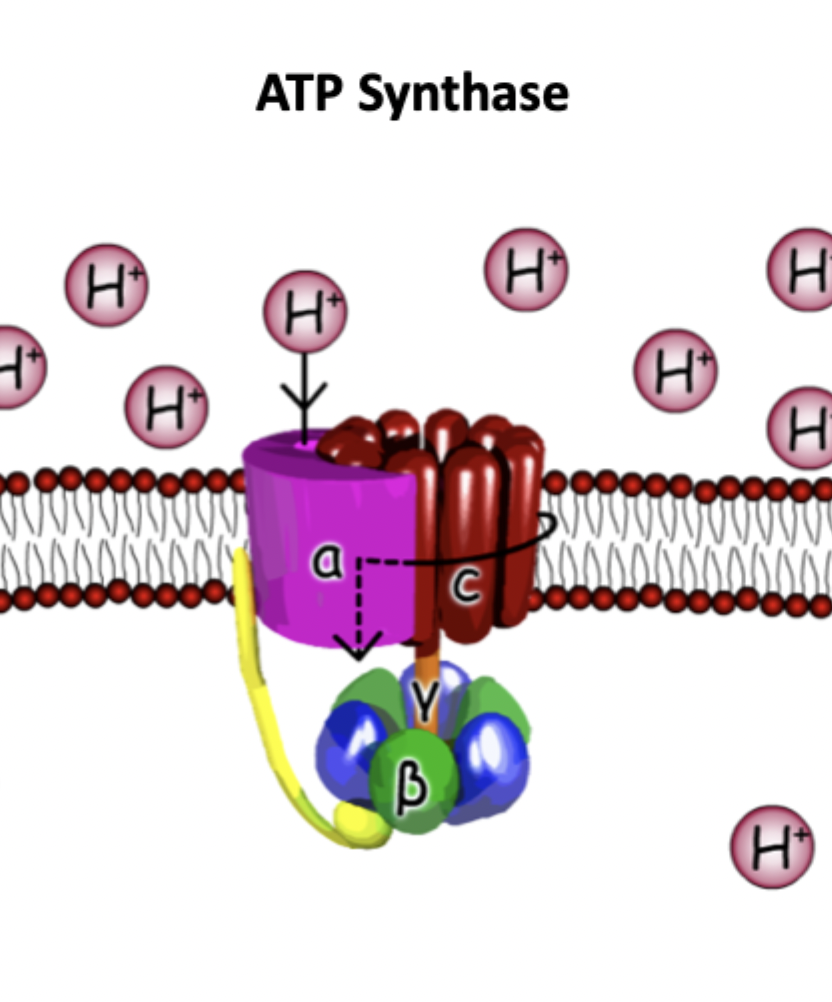
how does the rotary motor of ATP synthase work?
High concentration of protons are built up in the IMS (by pumping), creating a strong electrochemical gradient
Protons are forced to flow back to matrix through ATP synthase
This causes the c-subunit of ATP synthase to turn
As the c-subunits turn they interact with the alpha and beta subunits below (interacting through the gamma stalk)
As gamma stalk turns it causes the beta subunits to change shape
Bind ADP and phosphate --> convert it to ATP --> release ATP
describe the structure of c-subunits
Aspartate residue around the middle of each c-subunit
Aspartate residues have a COOH group on the end of their R group/side chain
These residues are protonated and have no charge - therefore easily embeds in IMM (with fatty acid chains of phospholipid bilayer/hydrophobic environment)
describe alpha subunits
Contains proton channels (hydrophilic) that extend partway into the membrane
One half proton channel faces an environment with a HIGH concentration of protons (IMS)
Other half proton channel faces an environment with a LOW concentration of protons (matrix)
how do C and A subunits work together?
when c-subunits are facing/in contact with proton channels of A-subunits they are easily able to release/accept a proton
when proton channel is facing IMS (high [H+]) aspartate residues on c-subunit are more likely to accept a proton
COO → COOH
when proton channel is facing matrix (low [H+]) aspartate residues on c-subunit are more likely to release a proton into the matrix
COOH → COO
what are the three different posisble conformations of beta subunits ?
loose
tight
open
each conformation holds ADP, Pi and ATP in different ways
each beta subunit cycles through the different conformations as the gamma stalk turns
what can the loose conformation do?
can hold ADP and Pi
allows them to be separate
what can the tight conformation do?
converts substrates to ATP
(cannot release ATP)
what can the open conformation do?
release ATP
bind ADP and Pi
describe a cycle of ATP synthase
Aspartate residue on c-subunit has COOH group
C-subunit is facing proton channels of A subunit
H atom is released because matrix has low concentration of protons
COOH group on aspartate becomes COO- group
C-subunit (aka the aspartate residue with a COO- group) it is more likely to want to stay in contact with the A subunit and the proton channels (because they are both slightly hydrophilic/charged)
Concentration of protons in IMS is high so proton is likely to be accepted by c-subunit
COO- group becomes COOH group
C-subunit is no longer charged
C-subunit turns in order to be in contact with fatty acid chains/hydrophobic environment
Proton gradient drives the rotation of the c-subunits which causes the gamma stalk to turn
As gamma stalk turns it interacts with beta subunits
Beta subunits switch between different conformations forming ATP
how many electrons are required to reduce one oxygen atom?
2 e-
(both NADH and reduced flavoproteins provide two electrons e.g. one NADH reduces one oxygen atom)
how many protons does one NADH molecule pump out of the matrix?
10 H+
how many protons does one FADH2 molecule pump out of the matrix?
6 H+
what is the number of protons needed for a full rotation of ATP synthase determined by?
the number of c-subunits
if there are more c-subunits, more protons required for a full rotation (one proton per subunit for a full rotation)
how many ATPs does a full rotation of ATP synthase produce?
3 ATPs
how many protons are required to import ADP/Pi and export 3 ATP
3 H+
what is a P:O ratio?
the number of ATP molecules produced per oxygen atom reduced in cellular respiration
how is the P:O ratio calculated? (using NADH and FADH2 values)
number of protons pumped (for NADH/FADH2) ➗ number of protons required per ATP
number of protons required per ATP = H+ re-entering for a full rotation + H+ for transport of ADP, P, ATP
how much ATP can be made for every NADH oxidised? (if there are 8 c-subunits)?

what is driving the formation of ATP?
the transfer of electrons from NADH to oxygen along the ETC drives the proton gradient which drives the formation of ATP
example of coupling (in oxidative phosphorylation)?
NADH is needed to make ATP
ATP synthesis is needed for the ETC to function