Critical Care RW Exam 3
 Call Kai
 Learn
Learn Practice Test
 Spaced Repetition
 Match
Match Flashcards
 Knowt Play
1/135

There's no tags or description
Looks like no tags are added yet.
Name | Mastery | Learn | Test | Matching | Spaced | Call with Kai | Chat |
|---|
No analytics yet
Send a link to your students to track their progress
136 Terms
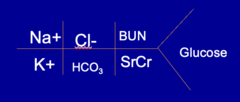
How is a fishbone diagram read?
Top: Na -> Cl -> Bun
Bottom: K -> HCO3 -> SrCr
Far right: Glucose
How is IBW calculated?
Males 50 kg + (2.3 kg/in x [ht in inches - 60])
Females 45.5 kg + (2.3 kg/in x [ht in inches - 60])
How is CrCl calculated?
Males [(140 - age) x IBW] / (72 x serum creatinine)
Females [(140 - age) x IBW] / (72 x serum creatinine) x 0.85
Should pain or agitation be treated first?
Pain should always be treated first with analgesia
If agitation is still occuring can then treat that with sedatives
Practice of analgosedation (analgesia-first sedation)
Which opioids are the cornerstone of treatment for pain for patients in the ICU?
Fentanyl, Morphine, and Hydromorphone
Which opioid is used most commonly, and is preferred, in the ICU setting?
Fentanyl
If a patient has renal failure, what medications should be used for pain management?
Fentanyl preferred
Avoid morphine due to metabolites (C/I in renal failure)
If a patient is hemodynamically unstable, what medications should be used for pain management?
Fentanyl preferred
(very well tolerated, minimal effect on BP)
If a patient claims a morphine allergy, how should their pain be managed?
Clarify allergy - morphine can cause allergy like symptoms even without a true allergy
If true morphine allergy - may use Hydromorphone
What PK properties are desired for pain management medications in the ICU?
Rapid onset and offset preferred
Titratable
What therapies should be used as adjuncts to opioid therapy?
Bowel regimen scheduled (stimulant laxatives needed)
Naloxone prn
Antiemetics prn
What agents can be used as part of multimodal pain management therapy?
NSAIDs
APAP
Gabapentin/Pregabalin
Ketamine
When are NSAIDs used for pain management?
Mild pain
How are NSAIDs administered for pain management?
IV or PO
Ketorolac for max of 5 days
When is APAP used for pain management?
Mild pain, and antipyretic
How is APAP administered for pain management?
IV, PO, or rectal (PR)
When are Gabapentin/Pregabalin used for pain management?
Neuropathic pain
How is ketamine used for pain management?
Low doses (1-2 mcg/kg/hr) post-surgical
For opioid sparing
Do sedatives have analgesic properties?
Sedatives have NO analgesic properties
(Except dexmedetomidine - but effect is still minimal)
Need to address analgesia before using sedatives
What are strategies to improve outcomes for patients on sedatives?
Daily interruption of sedation
RASS -2 to +1 is general goal
Balance minimal sedation and patient comfort
Continually assess need for sedation
Utilize non-pharmacologic therapy
What is the Richmond Agitation Sedation Scale (RASS)?
Sedation assessment
General goal is -2 to +1, ideally pt. would be at 0
Positive numbers = less sedated (combative/agitated)
Negative numbers = more sedated (unarousable)
0 = alert and calm, spontaneously pays attention to caregiver
What are agents used for sedation in the ICU?
Benzodiazepines (Lorazepam)
Propofol
Dexmedetomidine
Which sedatives maintain light sedation, to minimize delirium?
Propofol or Dexmedetomidine
(non-benzodiazepines)
What are risks of using sedation?
Harm from oversedation
Delirium
Prolonged sedation without break worsens outcomes
Harm to self (pulling lines, tachycardia, etc) - if under-sedated
Adverse drug reaction
What are the benefits of using benzodiazepines (Lorazepam) for sedation?
Inexpensive, long history of use
May be useful if risk of alcohol withdrawal or seizures
What are the risks of using benzodiazepines (Lorazepam) for sedation?
Accumulation/prolonged sedation & liver dysfunction may limit use
May cause prolonged dependence on mechanical ventilation, increased risk of delirium, and increased ICU stay
What are the PK's of Lorazepam?
Onset: 15-20 mins if IV, 20-30 mins if PO
Dur: about 6-8 hours if IV/IM
How should benzodiazepines (Lorazepam) be administered for sedation?
Intermittent dosing preferred (over continuous infusion)
When are benzodiazepines (Lorazepam) used for sedation?
Often last line
Unless pt has alcohol withdrawal or specific indication for benzo's (ex. seizures)
What are the PK's of Propofol?
Rapid onset and short duration—ease of use
Onset: 9-51 secs
Duration: 3-10 mins
In what situations is propofol beneficial?
Beneficial for head injury or elevated intracranial pressures
(decreases intracranial pressure, and rapid offset for exams)
What is a concern with Propofol formulation?
Formulated in a lipid emulsion
May increase triglycerides or induce pancreatitis
Account for lipid in total nutrition for patient (1.1kCal/mL)
Not for use in egg- or soy- intolerant patients
What are ADRs of Propofol?
Hypotension
Hypertriglyceridemia
Infection
Propofol-related Infusion Syndrome (PRIS)
What is Propofol-related Infusion Syndrome (PRIS)?
Rare ADR of Propofol, with high mortality
Causes dysrhythmia, heart failure, metabolic acidosis, renal failure
When is Propofol used for sedation?
Often 2nd line (after Dexmedetomidine)
Beneficial for head injury or elevated intracranial pressures
What are advantages of using Dexmedetomidine for sedation?
May be useful in delirium or for extubation
(least risk of delirium, and no resp. depression)
Lighter level of sedation (dec. risk of delirium)
What are disadvantages of using Dexmedetomidine for sedation?
HYPOTENSION or hypertension (esp. if using bolus dose)
May require adjunct benzodiazepines (not being adequately sedated)
Most expensive
What are the PK's of Dexmedetomidine?
Onset: 5-10 min
Duration: 1-2 hours
When is Dexmedetomidine used for sedation?
First-line agent (due to lowest risk of delirium)
Useful in pt.'s w/ delirium or for extubation
Approved for short-term (≤24 hours) use, but used longer in practice
What must be done before starting therapeutic paralysis
MUST adequately treat with sedatives and analgesics first
Sensory neurons NOT affected
Pt. can still hear, smell, feel (pain), etc.; but cannot EXPRESS self
When is therapeutics paralysis used?
Acute respiratory distress syndrome (ARDS)
REFRACTORY agitation/ combativeness
"fighting the vent"
Increased intracranial pressure
Therapeutic hypothermia
What are agents used for therapeutic paralysis?
Non-depolarizing agents: Cisatracurium, Pancuronium, Atracurium
How long should therapeutic paralysis be used for?
Use for shortest duration possible
(due to risk of complications)
What are possible complications of therapeutic paralysis?
Corneal ulcers
Prolonged weakness/atrophy
Pneumonia
Deep vein thrombosis (DVT)
What are non-modifiable risk factors for VTE?
Factor V Leiden or hematological disorders
Age >40 years
Familial history of thrombosis
Oncological disorders
Male sex
What are modifiable risk factors for VTE?
Immobility
Medications
Obesity
Transfusion related
Surgery or trauma
Is pharmacological or non-pharmacologic therapy preffered for VTE prophylaxis?
Pharmacologic has superior efficacy
Only use non-pharm when it is C/I
What are contraindications to VTE prophylaxis?
Thrombocytopenia (
What are pharmacologic options for VTE prophylaxis?
Unfractionated heparin
Enoxaparin
Fondaparinux
What are advantages of UFH for VTE prophylaxis?
May be used in renal failure
What are disadvantages of UFH for VTE prophylaxis?
Multiple daily doses
Risk of HIT
How is UFH dosed for VTE prevention?
5000 units SubQ 2-3x/day
What are advantages of Enoxaparin for VTE prophylaxis?
Single daily dose
Less risk of HIT than UFH (still some risk)
What are disadvantages of Enoxaparin for VTE prophylaxis?
Adjust/monitor in renal dysfunction
How is Enoxaparin dosed for VTE prevention?
40mg SubQ daily
If CrCl 30-15 : 30mg Sub-Q daily
At what CrCl is Enoxaparin dose decreased?
CrCl
At what CrCl is Enoxaparin contraindicated?
CrCl < 15 mL/min
What are advantages of Fondaparinux for VTE prophylaxis?
Single daily dose
No HIT (but STILL thrombocytopenia risk)
What are disadvantages of Fondaparinux for VTE prophylaxis?
Significant adjustment for renal dysfunction
How is Fondaparinux dosed for VTE prevention?
2.5mg SubQ daily
At what CrCl is Fondaparinux contraindicated?
C/I
What are options for non-pharm VTE prophylaxis?
Sequential Compression Devices (SCDs)
What are signs/symptoms of Stress-Related Mucosal Disease (SRMD)/ Stress ulcers?
Vomiting blood (hematemesis)
Blood in stool (occult blood or frank melena)
Decrease in hemoglobin ≥2 grams or require transfusion
Decrease in SBP >20mmHg
HR increase >20 bpm
What are risk factors for stress ulcers (indications for prophylaxis)?
Most ICU patients, rarely acute care
Coagulopathy
Shock
Chronic liver disease
Neurocritical care
What agents are used for stress ulcer prophylaxis?
PPI (preferred) or H2RA
Also utilize enteral nutrition
What are risks of H2RA use?
CrCl (use caution and lowest dosse)
Confusion
Thrombocytopenia
What are risks of PPI use?
Risk of Clostridium difficile infection may be enhanced
When should stress ulcer prophylaxis be stopped?
Stop as soon as risk decreases
What is CAM-ICU?
Tool to identify patients with delirium,
Assess every shift, or at least daily
What are risk factors for ICU delirium?
Greater age
Dementia, prior coma
Emergency surgery/trauma
Higher Acute Physiology and Chronic Health Evaluation (APACHE) score
Benzodiazepines
Blood transfusion
How should ICU delirium be prevented?
Limit risks
Nonpharmacologic: reorientation, sleep hygiene, early mobilization, light sedation
How should ICU delirium be managed?
No medicine proven to treat
Medications may help manage symptoms
(Atypical antipsychotics, Haloperidol, Dexmedetomidine when agitation is preventing extubation; Minimize duration, Maximize safety)
What are the 4 types of shock?
Cardiogenic
Hypovolemic
Septic and Anaphylactic (Distributive shock)
What are common causes of cardiogenic shock?
Massive MI
Severe CHF
What is the major hemodynamic problem in cardiogenic shock?
Low contractility
What is the effect of cardiogenic shock on hemodynamic variables (preload, contractility, afterload)?
Preload: High
Contractility: Low
Afterload: Normal/High
Heart contractility problem (not able to pump enough)
Leads to "backup" of fluid, increasing perload (not moving fluid through fast enough)
What are common causes of hypovolemic shock?
Blood loss
Dehydration
What is the major hemodynamic problem in hypovolemic shock?
Low preload
What is the effect of hypovolemic shock on hemodynamic variables (preload, contractility, afterload)?
Preload: Low
Contractility: Low/Normal
Afterload: High
Not enough volume due to loss - causes low preload
Not enough volume - causes low contractility
Arteries constrict to make up for lack of volume - causes high afterload
What are common causes of septic (distributive) shock?
Blood infection
What is the major hemodynamic problem in septic (distributive) shock?
Low afterload
What is the effect of septic (distributive) shock on hemodynamic variables (preload, contractility, afterload)?
Preload: Low/Normal
Contractility: High
Afterload: Low
Heart works harder to compensate for low afterload - causes high contractility
What are common causes of anaphylactic (distributive) shock?
Type I allergic rxn.
What is the major hemodynamic problem in anaphylactic (distributive) shock?
Low afterload
What is the effect of anaphylactic (distributive) shock on hemodynamic variables (preload, contractility, afterload)?
Preload: Normal
Contractility: High
Afterload: Low
Heart works harder to compensate for low afterload - causes high contractility
How is high preload treated?
Diuretics and NTG
Inotropes
How is low preload (Hypovolemic shock) treated?
FLUIDS
How is low contractility (cardiogenic shock) treated?
Inotropes
How is high afterload treated?
Anti-hypertensive
How is low afterload (septic/anaphylactic shock) treated?
Fluids
Pressors
What is sepsis defined as?
Response to infection
Life-threatening organ dysfunction caused by dysregulated host response
What is septic shock defined as?
Sepsis with hypotension unresponsive to fluids
What is Systemic Inflammatory Response Syndrome (SIRS)?
2 of following 4:
-Temp
-HR >90 BPM
-Resp >20 per min
-WBC >12,000/mm3 or
What are monitoring parameters for sepsis?
Mean Arterial Pressure (MAP)
Urine output
What is the goal MAP?
≥ 65
What is the goal urine output?
>0.5 mL/kg/hour
How is urine output calculated?
Output = amount of output / weight / time for output
What are the steps for management of sepsis?
1.Prompt recognition of the septic patient and early implementation of therapies
2.Fluid therapy, using crystalloids initially
3.Early administration of broad-spectrum antibiotics
4.Vasopressor therapy to maintain MAP of 65 mmHg
5.Hydrocortisone if still hemodynamically unstable
6.Glycemic control to goal of 140-180 mg/dL
7.Adjunctive therapy (nutrition, DVT ppx, SRMD ppx, and sedation for mechanically ventilated patients)
What are the first treatments used in sepsis?
Fluid therapy, using crystalloids initially (within 1 hr)
Early administration of broad-spectrum antibiotics (within 1 hr)
In sepsis, if fluid therapy does not adequately maintain MAP≥65 what therapy should be added?
Vasopressor therapy