Summarized Org Chem 1
 Call Kai
 Learn
Learn Practice Test
 Spaced Repetition
 Match
Match Flashcards
 Knowt Play
1/25

There's no tags or description
Looks like no tags are added yet.
Name | Mastery | Learn | Test | Matching | Spaced | Call with Kai | Chat |
|---|
No analytics yet
Send a link to your students to track their progress
26 Terms

Organic Chemistry: The study of carbon-containing compounds.
Vitalism: The outdated belief that organic compounds could only be produced by living organisms using a "vital force".
Disproof: Friedrich Wöhler disproved it in 1828 by heating the inorganic salt ammonium cyanate (NH4+NCO−) to form organic urea (H2N-CO-NH2).
What is organic chemistry, and how was Vitalism disproved?

Atoms in organic compounds form a fixed number of covalent bonds depending on their element type:
Carbon: Tetravalent (4 bonds)
Oxygen: Divalent (2 bonds)
Hydrogen & Halogens: Monovalent (1 bond)
Carbon can form single (C-C), double (C=C), or triple (C≡C) bonds with other
What is the central premise of valency in Structural Theory?
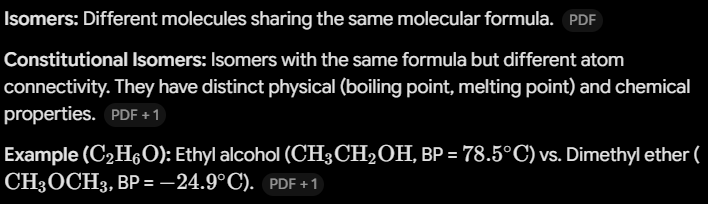
Isomers: Different molecules sharing the same molecular formula.
Constitutional Isomers: Isomers with the same formula but different atom connectivity. They have distinct physical (boiling point, melting point) and chemical properties.
Example (C2H6O): Ethyl alcohol (CH3CH2OH, BP = 78.5∘C) vs. Dimethyl ether (CH3OCH3, BP = −24.9∘C).
What are isomers and constitutional isomers? Give an example.

Proposed by van 't Hoff and Le Bel (1874), the four single bonds point toward the corners of a regular tetrahedron.
Bond Angle: 109∘28′ (or approximately 109.5∘).
What is the 3D geometry around a carbon atom with four single bonds?
Octet Rule: Atoms form ionic or covalent bonds to achieve a stable noble gas valence electron configuration (8 valence electrons for most 2nd-row elements; 2 for elements near helium).
Electronegativity: The tendency of an atom to attract electrons. It increases left to right and bottom to top on the Periodic Table (Fluorine is the most electronegative atom at 4.0).
What is the Octet Rule and how does Electronegativity affect bonding?
Ionic Bonds: Formed between atoms with widely different electronegativities through complete electron transfer, producing attraction between oppositely charged ions (e.g., Li+F−).
Covalent Bonds: Formed between atoms of similar electronegativity by sharing pairs of valence electrons to fulfill octets (e.g., H2, Cl2, CH4).
What is the difference between Ionic and Covalent Bonds?
The number of valence electrons equals the group number:
Hydrogen (Group 1A): 1
Carbon (Group 4A): 4
Nitrogen (Group 5A): 5
Oxygen (Group 6A): 6
Halogens (Group 7A): 7
What are the basic valence electron counts for common organic atoms?

Incomplete Octet (2nd-row elements): Elements like boron can have fewer than 8 electrons (e.g., BF3 has only 6 electrons around B).
Expanded Octet (3rd-row and higher): Elements with accessible d-orbitals can hold more than 8 electrons (e.g., PCl5 with 10 electrons, SF6 with 12 electrons).
What are the major exceptions to the Octet Rule?

Formal Charge=(Valence e− of neutral atom)−(Assigned e− in molecule)
Assigned $e^-$: All non-bonding lone pair electrons + half of all bonding electrons (1 per bond line).
Example: Oxygen with 1 single bond and 3 lone pairs has a formal charge of $6 - (6 + 1) = -1$.
How do you calculate Formal Charge?
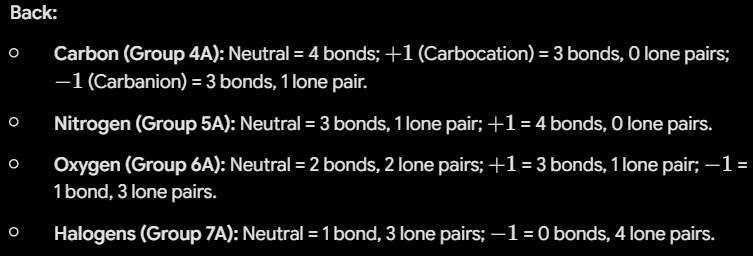
Carbon (Group 4A): Neutral = 4 bonds; $+1$ (Carbocation) = 3 bonds, 0 lone pairs; $-1$ (Carbanion) = 3 bonds, 1 lone pair.
Nitrogen (Group 5A): Neutral = 3 bonds, 1 lone pair; $+1$ = 4 bonds, 0 lone pairs.
Oxygen (Group 6A): Neutral = 2 bonds, 2 lone pairs; $+1$ = 3 bonds, 1 lone pair; $-1$ = 1 bond, 3 lone pairs.
Halogens (Group 7A): Neutral = 1 bond, 3 lone pairs; $-1$ = 0 bonds, 4 lone pairs.
Quick reference for common neutral and charged forms of C, N, O, and Halogens.
Resonance Hybrid: The actual overall structure of a molecule, which is a weighted average of all valid Lewis contributing structures.
Curved Arrows: Used as electron bookkeeping tools to show the movement of electron pairs (multiple bonds and lone pairs) between resonance forms.
Note: Double-headed arrows (↔) separate resonance structures; equilibrium arrows are incorrect because structures do not convert back and forth.
What is a Resonance Hybrid and what do curved arrows represent?

Resonance forms exist only on paper; the real molecule is a single hybrid.
Only electrons move (lone pairs and π-bonds); nuclei positions must never change.
Every form must be a valid Lewis structure (2nd-row elements like C, N, O, F can never exceed 8 valence electrons).
What are the mandatory rules for drawing resonance structures?
Higher stability/contribution comes from forms with:
More covalent bonds.
Complete octets for all atoms.
Minimal charge separation (neutral forms are favored).
Negative charges placed on more electronegative atoms (e.g., O > C).
How do you evaluate the relative stability/importance of resonance forms?
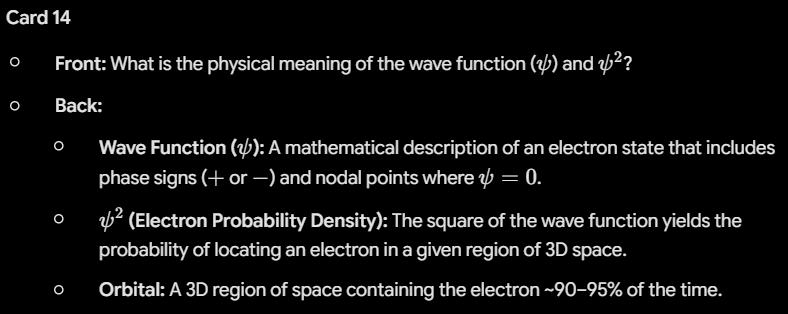
Wave Function (ψ): A mathematical description of an electron state that includes phase signs ($+$ or $-$) and nodal points where ψ=0.
ψ2 (Electron Probability Density): The square of the wave function yields the probability of locating an electron in a given region of 3D space.
Orbital: A 3D region of space containing the electron ~90–95% of the time.
What is the physical meaning of the wave function (ψ) and ψ2?
Back:

1s: Spherical, no nodes, lowest energy.
2s: Spherical, contains 1 spherical nodal surface (ψ=0), higher energy than 1s.
2p: Dumbbell-shaped with two lobes of opposite phase signs separated by a nodal plane; 3 degenerate orbitals ($p_x, p_y, p_z$) orthogonal to each other. Higher energy than 2s.
Compare the shape, energy, and nodes of 1s, 2s, and 2p Atomic Orbitals.
Aufbau Principle: Orbitals fill in order of increasing energy (lowest energy first).
Pauli Exclusion Principle: An orbital can hold a maximum of 2 electrons, which must have opposite (paired) spins.
Hund’s Rule: Degenerate orbitals each receive one electron before any orbital receives a second electron.
State the 3 key principles governing electron configurations.
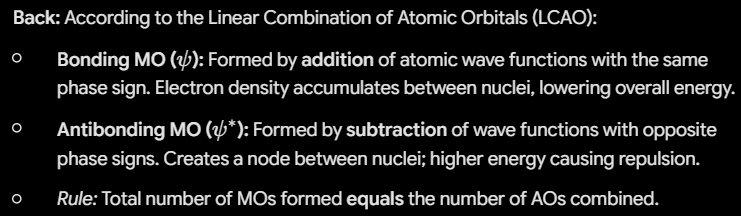
According to the Linear Combination of Atomic Orbitals (LCAO):
Bonding MO (ψ): Formed by addition of atomic wave functions with the same phase sign. Electron density accumulates between nuclei, lowering overall energy.
Antibonding MO (ψ∗): Formed by subtraction of wave functions with opposite phase signs. Creates a node between nuclei; higher energy causing repulsion.
Rule: Total number of MOs formed equals the number of AOs combined.
How do Bonding and Antibonding Molecular Orbitals (MOs) form?
Back:
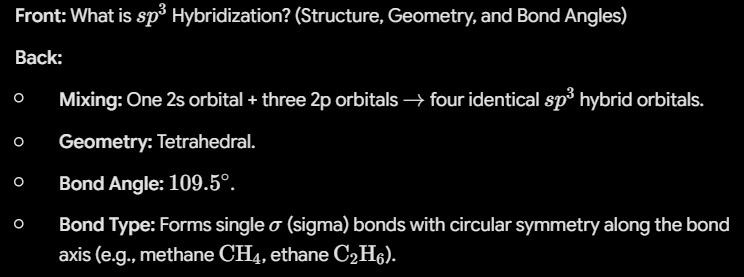
Mixing: One 2s orbital + three 2p orbitals → four identical $sp^3$ hybrid orbitals.
Geometry: Tetrahedral.
Bond Angle: 109.5∘.
Bond Type: Forms single σ (sigma) bonds with circular symmetry along the bond axis (e.g., methane CH4, ethane C2H6).
Front: What is $sp^3$ Hybridization? (Structure, Geometry, and Bond Angles)

Mixing: One 2s orbital + two 2p orbitals → three identical $sp^2$ hybrid orbitals (1 unhybridized p orbital remains).
Geometry: Trigonal planar.
Bond Angle: ≈120∘.
Bonding: $sp^2$ orbitals form 3×σ bonds; the unhybridized p orbital forms a π (pi) bond by sideways overlap above and below the bond plane (e.g., ethene C2H4).
What is $sp^2$ Hybridization? (Structure, Geometry, and Bond Angles)

Mixing: One 2s orbital + one 2p orbital → two identical $sp$ hybrid orbitals (2 unhybridized p orbitals remain).
Geometry: Linear.
Bond Angle: 180∘.
Bonding: $sp$ orbitals form 2×σ bonds; the two orthogonal unhybridized p orbitals form 2×π bonds (e.g., ethyne C2H2).
What is $sp$ Hybridization? (Structure, Geometry, and Bond Angles)

Single Bonds (σ): Free rotation requires minimal energy (13–26 kJ/mol) because σ overlap is symmetrical along the bond axis.
Double Bonds (σ+π): High rotational barrier (≈264 kJ/mol) because rotating 90∘ breaks the sideways overlap of the π bond. This restriction gives rise to cis-trans stereoisomers.
Why is there restricted rotation around double bonds versus single bonds?
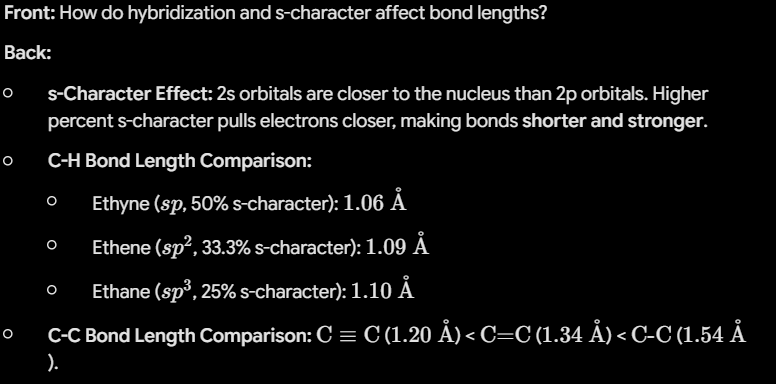
s-Character Effect: 2s orbitals are closer to the nucleus than 2p orbitals. Higher percent s-character pulls electrons closer, making bonds shorter and stronger.
C-H Bond Length Comparison:
Ethyne ($sp$, 50% s-character): 1.06 A˚
Ethene ($sp^2$, 33.3% s-character): 1.09 A˚
Ethane ($sp^3$, 25% s-character): 1.10 A˚
C-C Bond Length Comparison: C≡C (1.20 A˚) < C=C (1.34 A˚) < C-C (1.54 A˚
How do hybridization and s-character affect bond lengths?
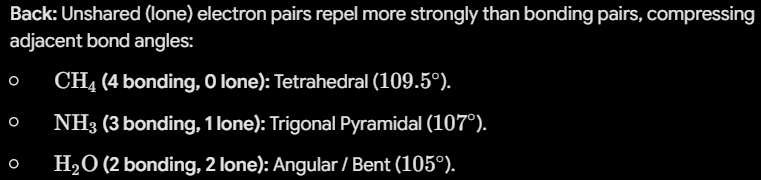
Unshared (lone) electron pairs repel more strongly than bonding pairs, compressing adjacent bond angles:
CH4 (4 bonding, 0 lone): Tetrahedral (109.5∘).
NH3 (3 bonding, 1 lone): Trigonal Pyramidal (107∘).
H2O (2 bonding, 2 lone): Angular / Bent (105∘).
How does VSEPR Theory predict the geometry of CH4, NH3, and H2O?

2 electron sets: Linear (180∘, e.g., BeH2, CO2).
3 electron sets: Trigonal Planar (120∘, e.g., BF3, CH3+).
4 electron sets: Tetrahedral (109.5∘, e.g., CH4, NH4+).
What are the main VSEPR geometries for 2, 3, and 4 electron groups with no lone pairs?
Carbon atoms are represented by line ends and line intersections (vertices).
Hydrogen atoms attached to carbons are omitted; their presence is implicit based on carbon’s tetravalency.
Heteroatoms (O, N, Cl, S, etc.) and hydrogens directly attached to heteroatoms must be explicitly written.
How do you read and interpret Bond-Line Structural Formulas?
Solid Line: Represents a bond lying flat in the plane of the paper.
Solid Wedge: Represents a bond pointing forward, out of the plane toward the viewer.
Dashed Wedge: Represents a bond pointing backward, out of the plane away from the viewer.
What do solid wedges, dashed wedges, and solid lines signify in 3D formulas?